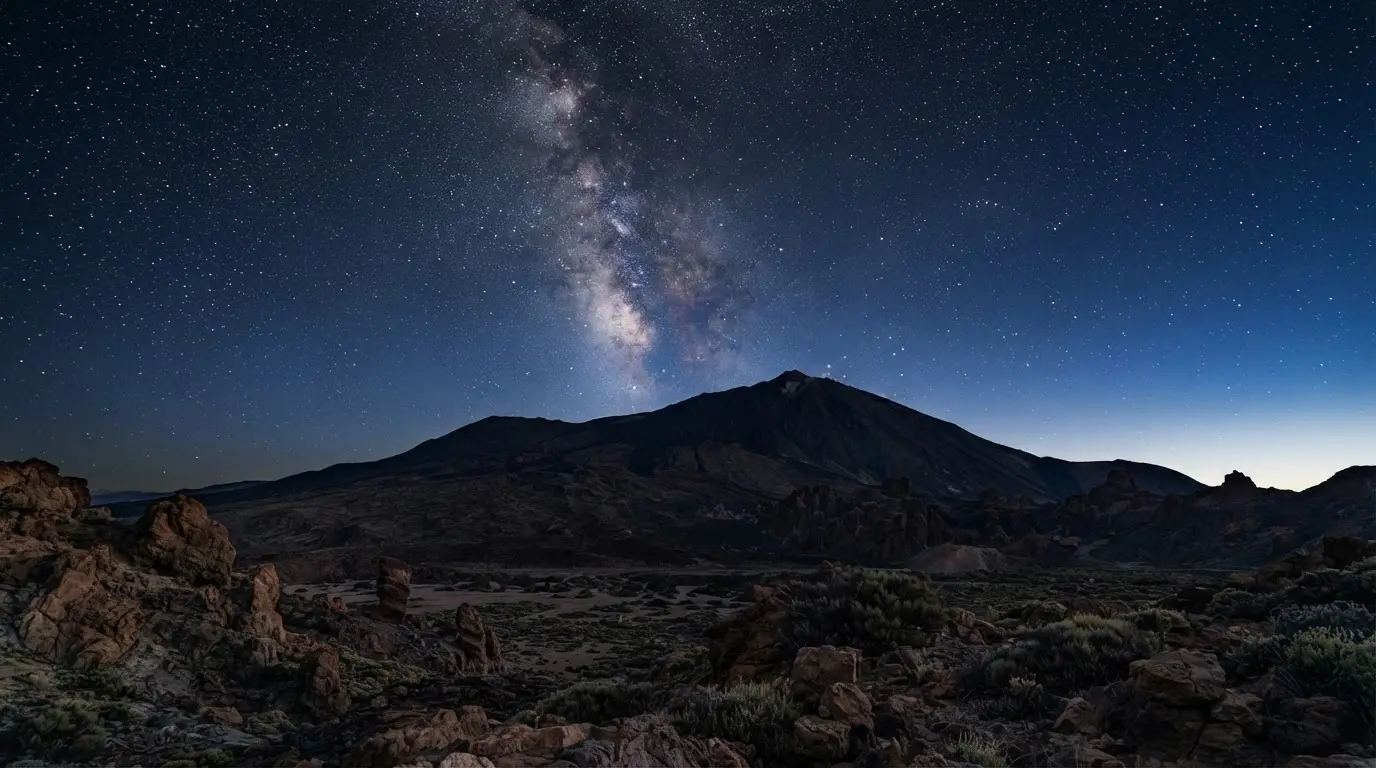

Guayota's prison: the myth of the stolen sun
Guayota was the principal malignant deity of Guanche mythology and the sworn adversary of the supreme god Achamán. According to the Guanches, Tenerife's pre-Hispanic inhabitants, he lived inside the Teide volcano, one of the mythological gateways to the underworld, and took the form of a black dog. He travelled with demon-dogs called tibicenas — the same name still used across the island for the legendary black hounds said to haunt the mountain at night[6].
The central myth explains why. Guayota kidnapped Magec, the Guanche god of the sun and light, and shut him inside Teide, plunging the world into permanent darkness[4]. Magec's name is thought to mean 'possesses radiance, mother of brightness' — a title whose blurred gender (the Guanches never fixed whether Magec was god or goddess) hints at how much of this Guanche pantheon survives only in fragments[8]. Humans prayed to Achamán, who freed Magec and locked Guayota inside the volcano in his place[4]. That single reversal is the reason Guanches, and every guide who repeats the story today, call Teide Guayota's prison rather than his palace.
None of this reads as quaint folklore once you are standing on the caldera floor, looking up at the same summit the Guanches named Echeyde. Guayota's mythical prison and the modern Tenerife Stargazing destination sit on the same mountain, protected today by rules the Guanches never needed because nobody had yet invented streetlights.
Achamán, the sky father, and the Guanche pantheon
Achamán was the Guanches' supreme, omnipotent creator god, father of the land, the water, the fire and the air, and the origin of every living thing that came after. His name means literally 'the skies,' a direct reference to the celestial vault above the island[9].
He was not a distant abstraction. Achamán was said to live in the heights and to descend, occasionally, to the summits of the island's mountains to watch over what he had made[10]. That same behavior, arguably, draws travelers to Teide's summit today, for a different kind of watching.
Every other Canary Island had its own version of the same supreme god, though it is not known whether Guanche communities considered them the same deity under different names or genuinely separate gods:
- Acoran (Gran Canaria)
- Abora (La Palma)
- Orahan (La Gomera)
- Eraorahan (El Hierro)
That the concept of a sky father recurs across seven islands with limited pre-conquest contact between them says something about how central the sky itself was to aboriginal Canarian mythology, independent of which name a given island used[11].
Chaxiraxi, the sun mother, and the goddess who became a saint
Chaxiraxi, the Sun Mother, was one of the principal goddesses of the Guanche pantheon, associated with the star Canopus[12]. Where Achamán ruled the sky in the abstract, Chaxiraxi anchored it to a specific, brilliant point of light — the second-brightest star visible from Earth, and one bright enough to cut through Tenerife's coastal haze long before anyone built an observatory.
Her cult did not disappear at the conquest; it moved. Around 1392 to 1401, an image of the Virgin Mary was said to have appeared at Güímar, on Tenerife's eastern coast, carrying an infant identified with Chaxiraxi's own child. Over the following generations, Christian missionaries folded her worship into that of the Virgin of Candelaria[13], who remains the patron saint of the Canary Islands today. It is one of the clearer documented cases of religious syncretism anywhere in the pre-Hispanic Atlantic — a sun goddess absorbed, almost intact, into a Catholic cult that still draws pilgrims every February.
It is one of the clearer documented cases of religious syncretism anywhere in the pre-Hispanic Atlantic — a sun goddess absorbed, almost intact, into a Catholic cult that still draws pilgrims every February.
What survives of Chaxiraxi is thinner than what survives of Achamán or Guayota. No surviving Guanche account explains why Canopus specifically, rather than the sun itself, carried her name, but the pattern is consistent with the rest of the pantheon: a sky measured, mapped and named star by star, long before anyone called it astronomy.
The popular Guajara legend — a jealous mountain princess sometimes blamed for Teide's eruptions — has no primary-source confirmation; it circulates mainly in travel blogs, with no corroboration from Tenerife's tourism authorities or its Museum of Nature and Man. Much of what survives of this pantheon online today comes from encyclopedic sources rather than primary Guanche testimony.
Reading the sky before Teide had an observatory
The Guanches were not only mythologizing the sky; they were measuring it. Surviving cave and rock structures on Tenerife carry markings interpreted as solstice and equinox indicators, and the stars did double duty as navigation and timekeeping tools alongside their role as the cast of these origin stories[14]. That pairing of myth and method in the same tradition is exactly what modern archaeoastronomy looks for when it studies a pre-literate culture's relationship to the night sky.
Teide itself was never just a backdrop. The Guanches called it Echeyde, the gate to hell, and used it as a place of worship in its own right, not only as Guayota's prison[5]. In 1954, the mountain and its surrounding caldera became Teide National Park; in 2007, UNESCO inscribed it as a World Heritage Site under criteria (vii) and (viii), citing both its volcanic landscape and its significance to the geology of oceanic islands[15]. The sacred mountain and the scientifically significant one turned out to be the same rock.
The protection that followed is what makes this island's cosmology more than a museum piece. Since 1988, the Canarian 'Ley del Cielo' (Act 31/1988), a pioneering light-pollution law, has restricted lighting over La Palma and the part of Tenerife with a direct line of sight to it, to protect the islands' observatories[18]. The Instituto de Astrofísica de Canarias (IAC) operates the Teide Observatory here and the Roque de los Muchachos Observatory on La Palma; together they form the European Northern Observatory, hosting telescopes from more than sixty institutions across nineteen countries[16]. See what that infrastructure looks like on the ground in the Teide Observatory guide, and check road and access logistics in getting to Teide.
Featured · Destination
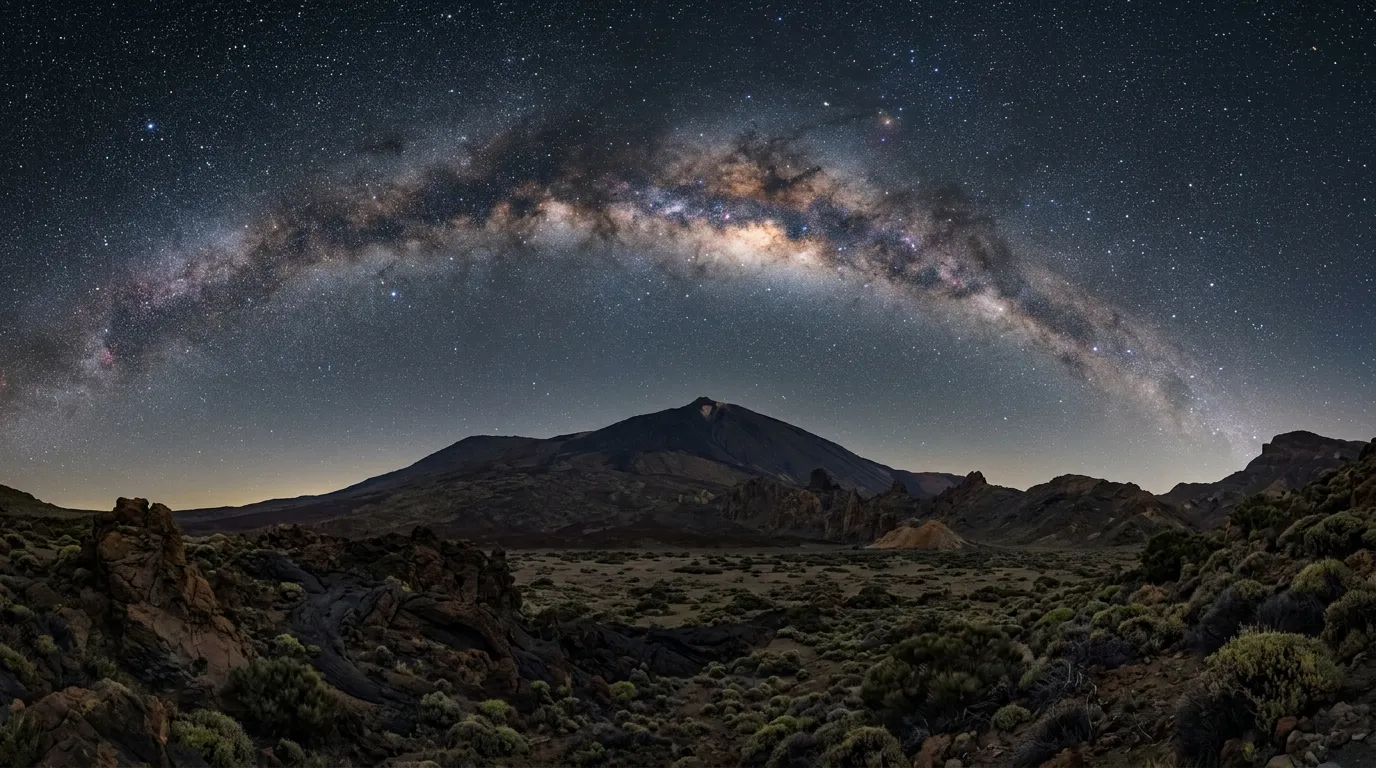
Tenerife Stargazing
Tenerife stargazing guide: Teide National Park's UNESCO Bortle-2 skies, 83 constellations visible. Observatory visits from €21, Parador hotel, and best tours.
The Starlight Foundation, created by the IAC in 2009, certifies places worldwide under a two-tier system: a Starlight Tourist Destination for places whose sky quality and infrastructure suit astro-tourism, and a Starlight Reserve for places that keep natural night-sky darkness fully intact[17]. Teide National Park holds Starlight Tourist Destination status in its own right, and it is also the núcleo, the core zone, of the separate Cumbres de Tenerife Starlight Reserve, which extends into an adjoining Corona Forestal buffer zone[19]. The practical result is the same one the Guanches would recognize either way: a mountain kept dark on purpose, for reasons that have shifted from theology to astrophysics without the sky itself changing much at all.
Visiting Echeyde today: the myth's home is now a protected sky
None of this mythology requires a telescope to appreciate, but it helps to know it before standing on the caldera floor after dark. The volcano the Guanches called Echeyde now sits inside one of the best-protected night skies in Europe, and the practicalities of seeing it are entirely modern: a rental car, warm layers, and a plan for where to point your eyes once astronomical twilight ends.
A few ways to connect the story to the visit:
- Book a guided stargazing tour that includes a telescope session on the caldera floor; most guides point out Achamán's summits and explain the Guayota myth as part of the route.
- Base yourself inside the park itself using the best lodges for Tenerife stargazing, so the walk from dinner to dark sky takes minutes rather than an hour's drive.
- Look south from any of the caldera's viewpoints in December for the Geminid meteor shower, which peaks at more than 100 meteors an hour[3], the closest thing the modern sky offers to the drama the Guanches wrote into their own origin story.
Featured · Article
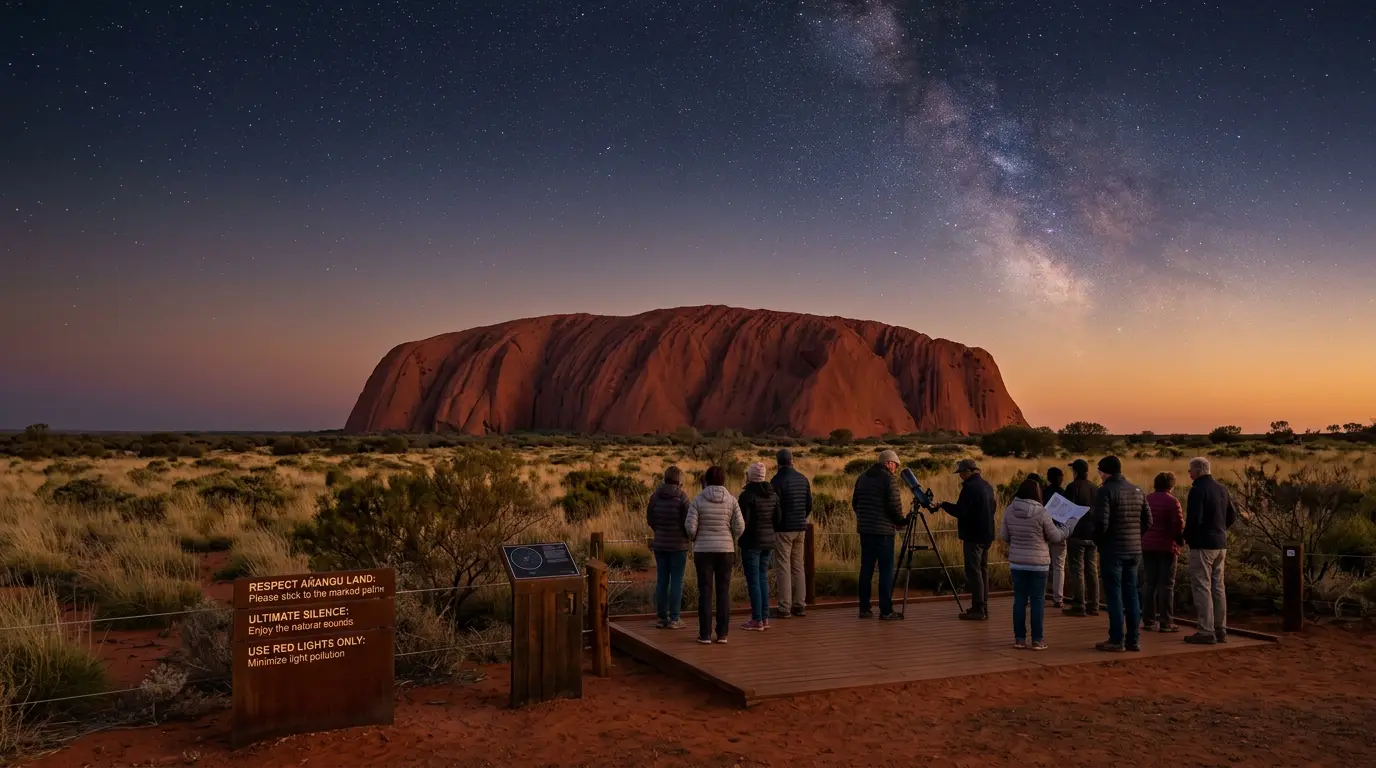
Uluru Cultural Significance and Visitor Etiquette
Uluru is Anangu land under joint management. Here's why the 2019 climb closure is settled policy, what you can't photograph, and real visitor etiquette.
The myth and the measured sky describe the same mountain from two different centuries. Guayota's prison and the Starlight Tourist Destination certification are, in the end, the same argument made twice: Teide's darkness is worth protecting, whether the reason given is a kidnapped sun god or a light-pollution law.