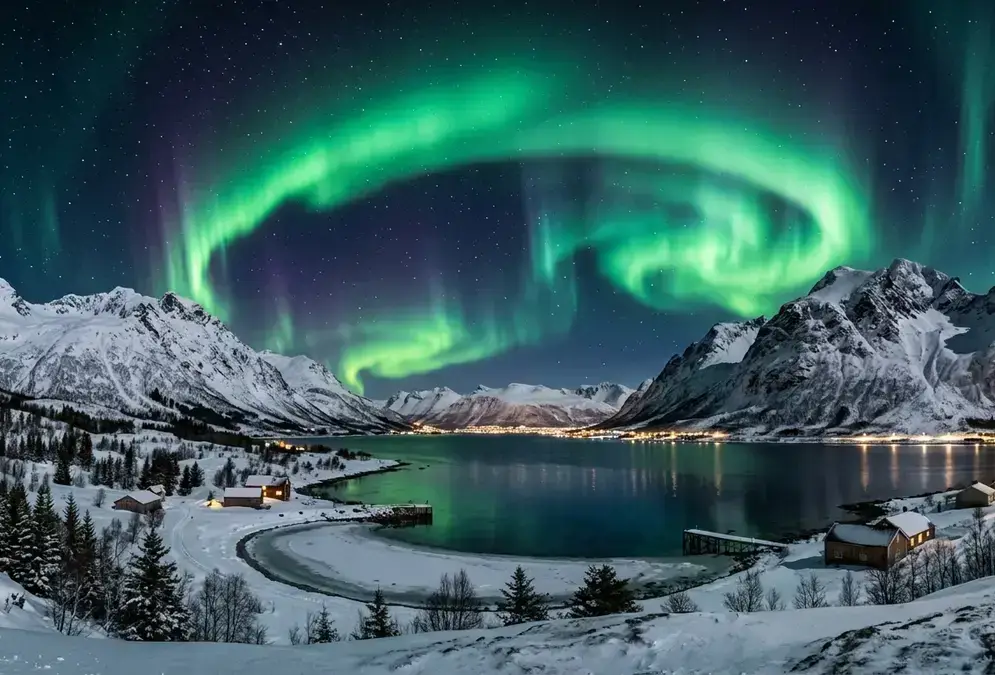

Aurora season: when it starts and when it ends
Aurora season in Tromsø runs from September until early April[1]. Outside that window, the midnight sun makes viewing impossible: between May 15 and July 29, the sun stays above the horizon around the clock, washing out any display regardless of geomagnetic conditions.
The polar night runs from November 26 to January 15, when the sun stays below the horizon for the entire day[6]. Total darkness gives you a 24-hour viewing window in theory. In practice, Tromsø's coastal fjord climate means cloud cover in December and January can be relentless. The sky is dark; whether it is clear is a different question.
Featured · Destination
Northern Lights in Tromsø
At 69.6°N inside the auroral oval, Tromsø sees aurora at Kp 2. Peak season November–February. Best viewing spots, tour advice, and aurora forecast strategy.
October is the most forgiving entry point to the season. The equinox effect boosts geomagnetic activity around the September and March equinoxes, temperatures hover near 0°C rather than -20°C, and nights run long enough for a serious viewing window from around 8 PM. January and February deliver maximum darkness but come with real cold: expect -10°C to -20°C on a typical night, colder in a hard snap. The destination page for Tromsø northern lights has a month-by-month breakdown of what to expect through the season.
How the Kp index works and why Tromsø is different
The Kp index measures geomagnetic disturbance on a scale from 0 to 9. Most locations in the continental US and central Europe need a Kp of 5 or higher before aurora reaches visible latitudes. Tromsø sits inside the auroral oval, the ring-shaped band where solar wind particles interact with Earth's magnetic field most consistently[2], so a much lower Kp is typically enough for a good display. On very clear, dark nights, even weak geomagnetic activity can be visible to the naked eye.
Because Tromsø sits inside this ring rather than below it, aurora appears directly overhead rather than as a thin band on the northern horizon. For practical planning, this means that even a modest disturbance produces results.
Kp 5
For real-time forecasting, download at least two apps: Aurora Now and SpaceWeatherLive give the most reliable short-term readings[3]. No app predicts aurora reliably beyond 24 hours, because geomagnetic activity depends on solar wind speed and density that are only measurable a few hours out. Check forecasts in the evening, not days before you arrive. The article Kp index explained for aurora chasers walks through how to read the numbers and what different Kp levels look like in the field.
How many nights to book and what the odds actually mean
Aurora sightings compound with time spent in Tromsø, because cloud cover on any single night is the biggest variable working against you. A clear run of weather can produce a sighting on night one; a solid cloud bank can shut out an entire week regardless of geomagnetic activity. One widely used local guide puts it bluntly: budget five to seven nights if seeing the aurora is the actual point of the trip, not a bonus alongside other plans[5].
For the full numbers behind that kind of recommendation, the article how many days in Tromsø for aurora breaks down cumulative probability by number of nights and by month, using historical clear-night data. The short version: three nights is the practical minimum for a first visit, five nights or more if you want strong odds or need a photograph rather than just a sighting.
| Nights booked | What to expect | Best for |
|---|---|---|
| 1-2 nights | Essentially a coin flip against cloud cover | Tight itineraries, willing to gamble |
| 3-4 nights | Meaningfully better odds if skies cooperate on any one night | Most first-time visitors |
| 5-7 nights | Local guides' recommended minimum for a dedicated aurora trip | Astrophotographers and serious chasers |
For accommodation that removes the city light problem from the start, the Aera Panorama glass lodge sits outside Tromsø in genuinely dark conditions, with panoramic windows facing north. For what a longer, split-stay trip actually looks like booked out night by night, see an 8-night Tromsø aurora itinerary.
Watching from the city versus driving out
You can see northern lights from Tromsø city center when a strong display breaks (Kp 4 or above). The waterfront along Storgata is a common spot, and the cable car up to Storsteinen gives an elevated vantage with less street-level light pollution. The problem is faint displays: on a Kp 2-3 night, which covers most of what you will experience, the city's ambient glow washes out the greens and leaves little visible.
Recommended tours
Tours are selected for quality, not commission. I earn a small fee if you book — at no extra cost to you.

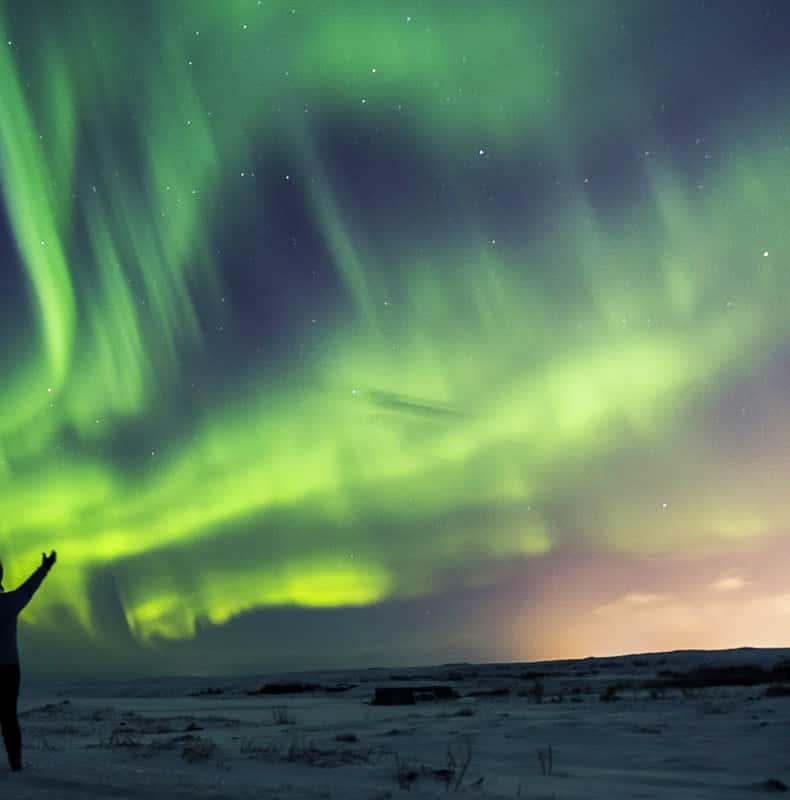

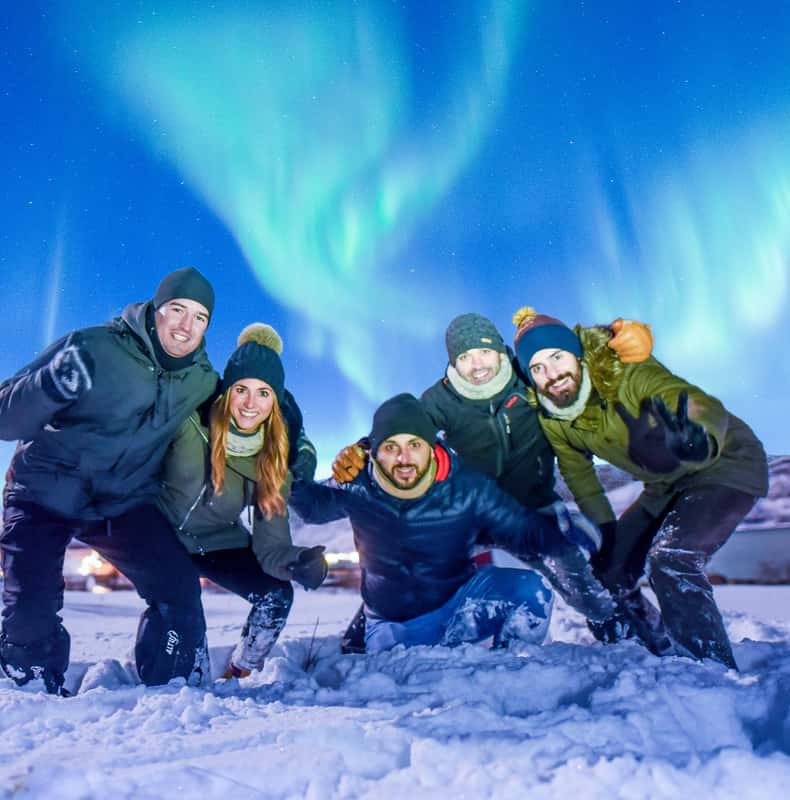
Driving out of Tromsø changes the picture significantly. Telegrafbukta, a beach park about 15 minutes from the centre, is a popular near-in option once city glow becomes the limiting factor. For darker skies, the island of Kvaløya and the Ersfjordbotn area, roughly 30 minutes out, put real distance between you and Tromsø's light dome[4]. If you are renting a car, check the cloud-cover map before leaving: driving half an hour in one direction only to hit a cloud bank is a common frustration. Guides handle this routing in real time, which is the main practical argument for booking a tour on at least one night.
The advantage of going independently is flexibility. You leave when the forecast improves, stay as long as you want, and move locations without coordinating a group.
What to wear and what a real display looks like
The cold is the variable most first-time visitors underestimate. Merino wool or synthetic thermal base layers, a mid-layer fleece, an insulated down jacket, and a windproof outer shell are non-negotiable for a January night in Tromsø[4]. Feet lose heat fastest when you are standing still for an hour: boots rated to at least -30°C matter more than most people expect. A balaclava, neck gaiter, and insulated mittens complete the kit. Mittens outperform gloves by a meaningful margin when you are not moving.
January and February are Tromsø's coldest, darkest months: well below freezing on a typical night, with a hard Arctic cold snap possible at any point in midwinter. Wind drops the felt temperature further. Tromsø city centre has rental shops that carry full expedition kit: if you are flying in from a warm climate, renting locally is often more practical than packing for Arctic conditions. Ask when you book your accommodation.
A typical aurora display lasts 15-30 minutes[3]. Major geomagnetic storms can run all night; weak events are over in under a minute. Going out with a plan to stay until midnight, not just dash out for 20 minutes, gives you a much better chance. The lights move, fade, brighten, and sometimes vanish and return within the same hour. For the full kit breakdown, the guide to dressing for an Arctic winter in Tromsø covers base layers, boot ratings, and hand warmers in detail.
Guided tours: what they cost and whether you need one
A guided aurora tour is not required. Tromsø has reliable car rental infrastructure, well-maintained winter roads, and the auroral oval sits directly overhead from any dark-sky spot outside the city. If you are comfortable driving on snow and ice and can navigate with a forecast app, heading out independently is cheaper and more flexible.
The practical case for a guide is cloud-cover routing. Operators running 6-hour tours track both aurora forecasts and cloud maps in real time, driving to find clear sky sometimes 80-100km outside town. They also carry camera equipment and offer astrophotography coaching for visitors who want to come home with images rather than just memories. For first-time visitors who want to maximise their one or two clear nights, that expertise is often worth the price.
Guided tour pricing varies by format. Standard six-hour tours typically run NOK 950-2,000 per person, depending on operator and format; small-group tours with a rebooking guarantee, like the guaranteed sighting aurora tour, sit in a similar range but add the rebooking policy on top — see the tour page for current pricing. If no aurora borealis appears on your first night, most operators offer a free return the following night, though some apply a discount on the second booking instead, so confirm the exact terms before you pay. Worth understanding what that means: no operator controls solar activity or cloud cover, so no tour can truly guarantee lights. What the policy delivers is a second attempt, useful only if you have a spare night in Tromsø to actually use it.
Read next · Tour
Northern Lights Tour with Guaranteed Sightings in Tromsø
Small-group aurora chase in Tromsø with a free rebook if no lights appear. Unlimited mileage, expert guides, and thermal suits included. Nov–Mar, from 950 NOK.