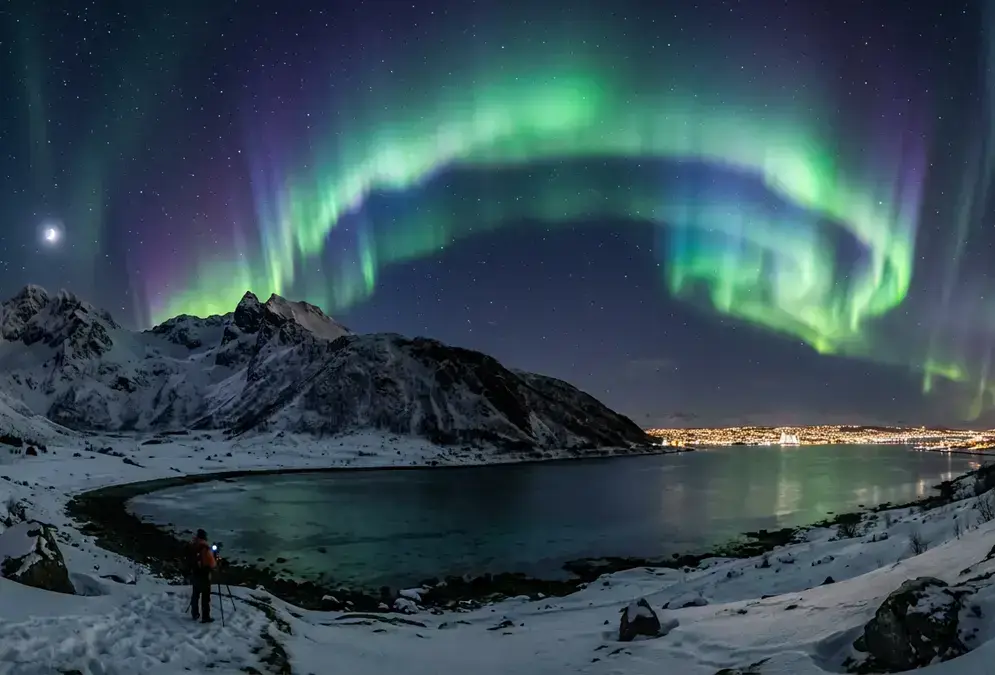

When city centre aurora actually works
The northern lights are visible from central Tromsø on active nights, and on strong nights you do not need to leave the city. What you see depends almost entirely on one number.
Tromsø sits well inside the auroral oval[1], the band where charged particles funnel down Earth's field lines most reliably, commonly placed at around 67°N magnetic latitude. That position is why aurora appears here on nights when it would be invisible from Edinburgh or Iceland's south coast. Even a modest Kp index of 1 or 2 triggers visible aurora in darker areas nearby. That same geography is why 20th-century researchers built Tromsø's aurora observatories here rather than further south.
The city centre sits under a sky several steps up the Bortle scale toward suburban light pollution, driven by the harbour, the bridge, and the built-up streets of Tromsøya island. At Kp 3 to 4, that sky glow is weak enough that a clear green curtain stands out overhead. Distinct shapes, movement, and colour are all visible to the naked eye.
At Kp 5 and above, the threshold question stops mattering. A G1 geomagnetic storm produces aurora bright enough to cut through city lighting. Some of the most widely shared aurora photographs from Tromsø northern lights were shot from the harbourfront on strong-storm nights, with the bridge and water as backdrop.
Featured · Destination
Northern Lights in Tromsø
At 69.6°N inside the auroral oval, Tromsø sees aurora at Kp 2. Peak season November–February. Best viewing spots, tour advice, and aurora forecast strategy.
The problem starts below Kp 3. On the many clear nights when geomagnetic activity registers Kp 1 or 2, a routine condition during the viewing season, the city's background glow drowns the display entirely. The aurora is overhead, but the lit sky hides it. A 20-minute drive east changes that.
Spontaneous city viewing works reliably at Kp 3 and above. Below that threshold, leaving is not optional. It is the difference between a sighting and a blank sky.
Best spots within walking distance of the city
If the forecast shows Kp 3 or above and you are staying in the city, three specific spots give a meaningful advantage over the generic harbourfront without needing a car.
Telegrafbukta Beach sits at the southern tip of Tromsøya island, around 35 minutes on foot from the city centre or a short ride on Bus 33 (return on Bus 34)[2]. The beach faces south and east over open water, away from the heaviest harbour and hotel lighting. The horizon is wide enough to catch aurora low in the sky, and the lack of tall buildings means you can read the display from multiple angles.
The Arctic Cathedral (Ishavskatedralen) sits on the eastern side of the Tromsø Bridge, around 25 minutes on foot from the waterfront. The hillside location lifts you slightly above the harbour glow, and the cathedral's angular white facade against a green sky has become one of the most-photographed aurora compositions in northern Norway. The bridge approach and reflected water give a second framing option if the aurora is relatively quiet.
Fjellheisen cable car takes four minutes to reach the Storsteinen summit at 421 metres[4], putting you above the bulk of the city's light pollution. The viewing platform gives a 360-degree panorama, and the elevation genuinely reduces the horizon-level sky glow that obscures lower-altitude aurora from street level. The cable car runs until midnight (00:00) in winter; check the current schedule and pay the small admission fee before heading up.
None of these three spots fully escapes the city's brighter Bortle scale sky, but each reduces direct exposure to ground-level light sources. At Kp 3 and above, the difference from standing outside your hotel is noticeable.
What changes when you leave the city
Thirty minutes southeast of Tromsø, the Kp threshold for a visible display drops substantially. An aurora that stays hidden behind the city's glow is clearly visible even during modest activity from the dark fjord valleys around Ramfjord or the lake district near Tromsdalen.
That matters because Kp 1 and 2 activity is the norm for perhaps half of all clear nights during the dark season. From the city, those nights produce nothing visible. From a dark-sky site 25 to 35 kilometres east or southeast, they regularly produce a green band on the northern horizon, sometimes with curtain rays above it.
Dark adaptation is the variable most visitors underestimate. Your eyes take 20 to 30 minutes to fully adjust to darkness. In the city, that adaptation never completes: every passing car and lit window resets your pupils. Outside the city, after 20 minutes in genuine darkness, the same sky looks fundamentally different. A faint aurora that registered as a vague whitish glow on your phone camera in the city resolves, to the naked eye, as a structured pale green arc.
The colour difference in the aurora itself is the other gain. Strong displays in dark-sky conditions show purples and reds in the upper corona that city sky glow suppresses entirely. These are oxygen emissions at altitudes above 200 km: they wash out against the city's bright sky but become visible several steps down the Bortle scale, beyond the reach of harbour and street lighting. Astrophotographers who work through the Kp index explained guide specifically leave the city for any display below G2.
Outside the brighter city sky, well down the Bortle scale, fainter stars fill the gaps between aurora curtains in a way that changes the subjective experience as much as the aurora brightness. What you give up is convenience, warmth, spontaneity, and transport cost.
The practical upshot is that a trip with two or three nights based at a dark-sky site, and the rest flexible to go where the forecast points, gives substantially better coverage than the same number of nights fixed in the city. Flexibility beats commitment when cloud patterns are the dominant variable.
City vs outside: the key trade-offs
The gap between city and dark-sky aurora comes down to sky darkness and the Kp threshold that triggers a visible display. Accessibility and cost tip the scales back toward the city.
Sky darkness is the structural difference. The Bortle scale runs from 1 (pristine dark) to 9 (inner city). Tromsø city centre sits several steps up the Bortle scale toward suburban brightness, while the fjord valleys 30 km southeast are dark enough to reveal the galactic core without aurora, several steps darker on the same scale. In practical terms, that gap means you need Kp 3 in the city where you need only Kp 1 outside. The best aurora spots in Tromsø guide details the specific dark-sky locations within 30 minutes of the city.
Accessibility tips the other way. The city needs no planning, no car hire, and no tour booking. If you arrive late from a flight and the forecast unexpectedly shows Kp 4 at 22:00, you can walk to Telegrafbukta in 20 minutes. That option disappears if you are committed to a site 35 kilometres away.
On very strong nights at Kp 5 and above, the question collapses. A G1 storm fills the sky regardless of where you stand in the city. The trade-offs below Kp 5 are what the comparison below captures.
| Factor | City centre | Outside (30 min) |
|---|---|---|
| Bortle scale | Brighter, suburban-level | Darker, several steps down |
| Minimum Kp visible | Kp 3 | Kp 1 |
| Getting there | Walk or bus | Car hire or tour |
| Milky Way visible | No | Yes |
| Aurora colour depth | Greens only | Greens, purples, reds |
| Best for | Kp 5+ storms, spontaneous trips | All Kp levels, astrophotography |
Reading the forecast: when to stay and when to drive
Cloud cover is the first variable to check, not the Kp index. A forecast showing Kp 5 is irrelevant if the sky above Tromsø is closed. Check Yr.no for a cloud forecast at three-hour resolution on the day itself, not a week ahead.
If the city is overcast, check whether the fjord valleys to the east and southeast have different conditions. Cloud patterns in this region are patchy: a 40-kilometre drive often moves you from closed to open sky. This is why local tour guides drive rather than stand in one spot. Mobility matters more than the right hotel window.
If the sky is clear, the Kp reading drives the decision:
Recommended tours
Tours are selected for quality, not commission. I earn a small fee if you book — at no extra cost to you.



- Kp 1 or 2: Head 25 to 35 kilometres southeast. The display is too faint for the city, and driving out is the only route to a sighting.
- Kp 3 to 4: The city works, especially from Telegrafbukta or the Fjellheisen summit. Leaving still improves the experience, but it is no longer the difference between seeing and not seeing.
- Kp 5 and above: The city is fine. A G1 or stronger storm fills the sky regardless of background light. Watching from the harbour approach or Telegrafbukta is a reasonable call.
Kp 1 minimum
Moon phase adds a third variable. A full moon reduces sky sensitivity the same way light pollution does, suppressing fainter displays. On Kp 2 nights near a full moon, you may need to drive further than a routine 30-kilometre run for a meaningful sighting.
The aurora season runs from late September through early April, when nights are dark enough for the lights to be visible against a fully dark sky[3]. Within that window, aurora is geomagnetically active on many clear nights during peak season. Cloud cover blocks the majority. The Kp reading and the cloud forecast together determine whether to stay or go.
Check forecasts at 24-hour intervals, not a week ahead. Longer-range forecasts confirm that conditions are broadly favorable, but specific Kp peaks and cloud windows only become visible in the 24 to 48 hours before. Planning around a weekly forecast is planning around noise.
Getting out of the city: practical options
Getting outside Tromsø takes more coordination than walking to the harbourfront. Working out the logistics before a promising forecast arrives is the highest-value planning step.
Self-drive is the most flexible approach. Winter car hire at Tromsø Airport starts from roughly 600 NOK per day, with winter tyres standard and legally required on Norwegian winter roads. Driving a short distance out of the city opens up genuinely dark sky within 25 minutes. The variable most people miss is knowing where to stop: unlit laybys near lake shores and open fields away from farmhouse windows work better than open roadsides.
Guided tours address the hardest part of dark-sky aurora nights: knowing which fjord valley the cloud is clearing over, right now, and getting there before conditions change. Transport and local knowledge both come included. Whether you need one depends on your experience and schedule flexibility; do you need a tour for Tromsø northern lights lays out the practical cases.
Glass lodges work differently. From a heated room with a clear ceiling, you monitor the sky without setting an alarm and step outside when conditions shift. On a marginal Kp 3 night with patchy cloud, that passive watching covers more ground than repeated trips outside a standard hotel room.
The logistics matter most on nights that fall in the marginal zone: Kp 2 or 3, sky partly cloudy, moon at 50% or above. Those nights are the most common category worth acting on. Plan the transport before you need it.
Read next · Lodge
Æra Panorama Glass Lodge
Glass-ceiling cabins 30 min northeast of Tromsø: Æra lets you watch the northern lights from bed. On-site sauna, restaurant, and rental car with direct booking.