Why the High Desert Became a Stage for Sky-Watchers

The dry, high-elevation air over the Morongo Basin is genuinely exceptional for stargazing, and that fact predates every spaceship story attached to this stretch of high desert. Low humidity and minimal cloud cover give the night sky an unusual clarity, and for decades there was next to no artificial light for miles in any direction out here. That emptiness has a human history behind it, not only a geological one.
In the years after World War II, a federal program known as the Small Tract Act let ordinary Americans claim small parcels of open desert, provided they built a modest cabin within a few years to "prove up" the claim. The scattered one-room cabins that resulted, now called jackrabbit homesteads, still dot the hills around Joshua Tree and Landers. They explain something about who ended up living under this particular sky: not ranchers, not miners, but a loose scatter of individualists after cheap land and total privacy. One of them was George Van Tassel, and the desert he moved into is the same one now protected as Joshua Tree National Park.

Giant Rock and the Man Who Set Up a Café Beneath It

Van Tassel spent the run-up to that move inside the aerospace industry that boomed around Los Angeles during and after the war, working as an aircraft mechanic and flight inspector for Douglas Aircraft, Hughes Aircraft, and Lockheed. In 1947, at the peak of that industry's growth, he left it entirely and moved his family out to the desert near Giant Rock[1].
Giant Rock itself is an enormous free-standing boulder that had already drawn a scattering of prospectors and eccentrics before Van Tassel arrived. He leased land beneath it from the federal government, built an airstrip, and ran a small café and gas stop for travelers passing through what was, at the time, genuinely the middle of nowhere. It's an unremarkable start for what the rock would become: a stage for one of the stranger chapters in American desert history.

17 years

Van Tassel spent roughly 17 years in the aerospace industry, at Douglas Aircraft, Hughes Aircraft, and Lockheed, before trading it for a desert café beneath Giant Rock in 1947.

The Claim, and What He Built From It

What happened next depends entirely on whose account you trust, because the only account that exists is Van Tassel's own. He said that in 1953, the occupant of a spacecraft from Venus woke him in the middle of the night and gave him a technique for rejuvenating the human body[2]. That's the whole of the documented claim. No named visitor, no witnesses, nothing that exists outside Van Tassel's own retelling, embellished over the following decades by writers who added details he never seems to have put in writing himself, including a name for the visitor and a physical blueprint changing hands. Treat those flourishes as folklore layered onto folklore, not history.
What is documented is what Van Tassel did with the story. He began hosting weekly channelling sessions in the desert, and within a few years he had broken ground on a machine he said the visitor's instructions described: a structure he called the Integratron. He worked on it, by his own account, for the rest of his life.
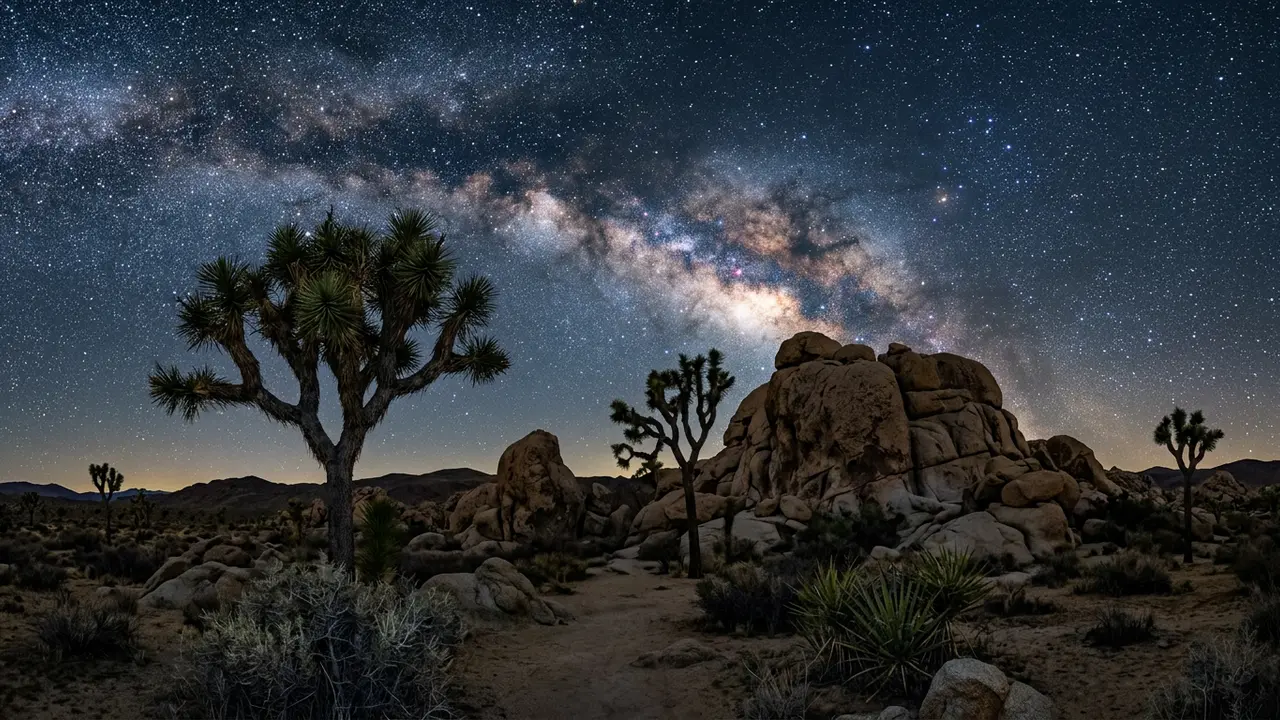
Star-filled night sky over Joshua Tree's boulder formations and namesake trees, an International Dark Sky Park two hours from Los Angeles

Featured · Destination

Joshua Tree National Park

Joshua Tree earned International Dark Sky Park status in 2017, just two hours from LA. Here's where to see the Milky Way, dodge crowds, and stay the night.

The building itself needs no hedging, because it's real and strange regardless of why it was built. It's a 38-foot-tall, 55-foot-diameter white cupola[3], built entirely from non-ferromagnetic materials, no nails, no metal fasteners, the same basic logic as a modern radome. Van Tassel said the design drew on Georges Lakhovsky's Multiple Wave Oscillator, pairing a high-voltage Tesla coil with a split-ring resonator, and he sited the whole structure over what he claimed, without independent verification, was a powerful geomagnetic anomaly. By his own account, the finished machine would rejuvenate the human body, defeat gravity, and let a person travel through time. None of that happened. What he actually built is a wooden acoustic chamber with genuinely unusual resonant properties, and that alone is reason enough to go inside.
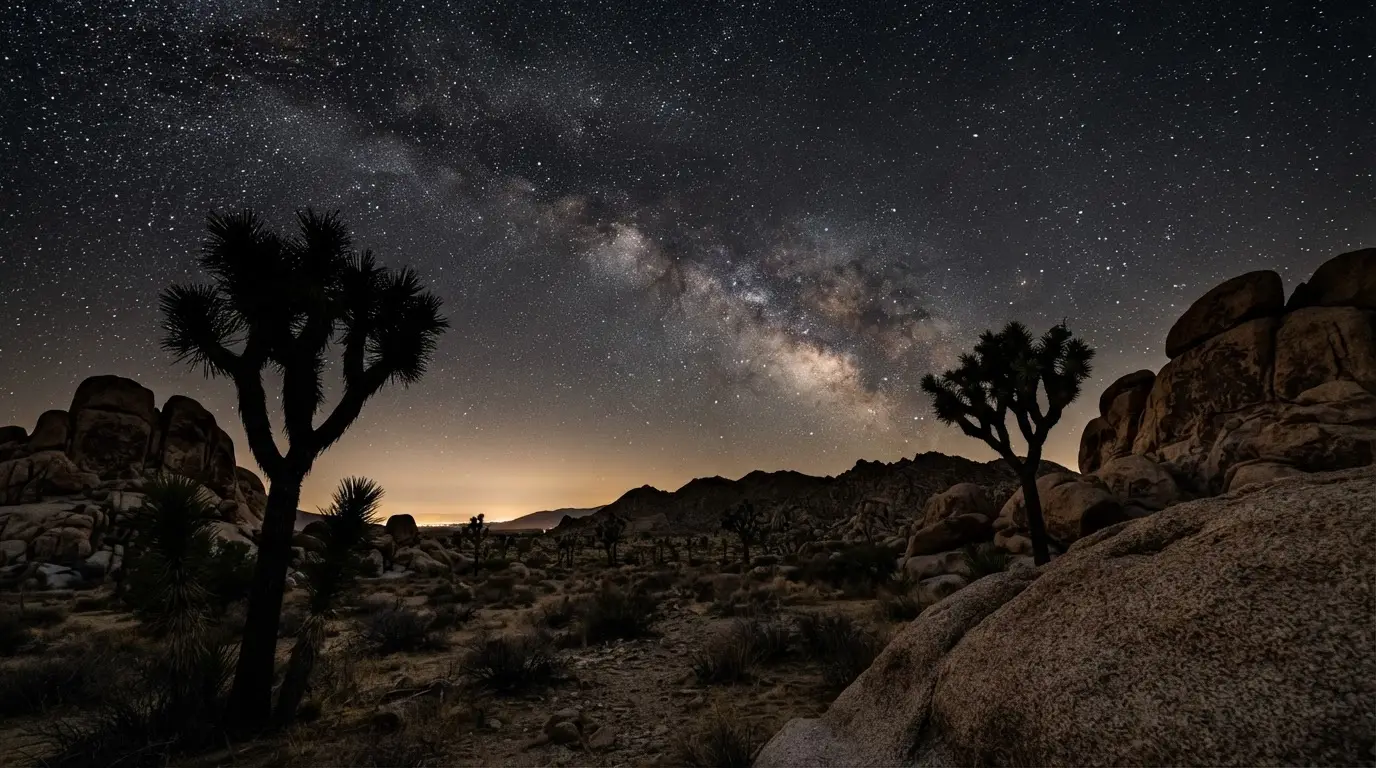
Silhouetted Joshua trees and granite boulders under the Milky Way in the Mojave high desert near Joshua Tree, with a faint glow of city lights on the horizon

The Interplanetary Spacecraft Conventions

Van Tassel's channelling sessions grew into something bigger: an annual event called the Interplanetary Spacecraft Convention, held beside Giant Rock from 1953 to 1971, drawing as many as 10,000 attendees at its 1959 peak[4]. It became a real gathering point for what historians now call the contactee movement, a loose network of people who claimed personal contact with extraterrestrial "Space Brothers" and who found, in Van Tassel's convention, a rare place to compare notes without being laughed out of the room.
How long the gathering actually ran is one of the few places where even the historical record disagrees with itself. The 1953-to-1971 range above is the standard account, but other retellings of Giant Rock's history stretch the convention closer to the end of the 1970s, ending only with Van Tassel's own death. Either way, it lasted the better part of two decades, well past the point where flying-saucer culture was supposed to have faded out of American life. Van Tassel himself died of a sudden heart attack in a Santa Ana hotel room in early 1978, hours before he was due to give a television interview, having spent almost every year since 1953 either building the Integratron or defending the story behind it.
Timeline
  1. 1947

    Leaves aerospace for the desert

    Van Tassel moves his family to the desert near Giant Rock, trading an aviation career for a small airstrip and café.

  2. 1953

    The claim, and the first convention

    By his own account, a visitor from a spaceship gives him a rejuvenation technique; he starts hosting the annual Interplanetary Spacecraft Convention.

  3. 1959

    Peak crowd, dome nearly complete

    The convention draws its largest crowd, roughly 10,000 people, around the same time the Integratron's main structure is essentially finished.

  4. 1971

    One account ends the gatherings here

    The standard record of Van Tassel's life puts the convention's run through this year, though other retellings extend it further into the decade.

  5. 1978

    Van Tassel dies

    A sudden heart attack in a Santa Ana hotel room, hours before a scheduled television interview.

  6. Early 2000s

    New owners, new purpose

    Sisters Joanne, Nancy, and Patty Karl buy the Integratron and reopen it for sound-bath sessions.

What You Actually See Up There Now

None of this history changes what you'll actually see if you drive out to Giant Rock or the Integratron after dark, and the honest answer is a genuinely excellent sky with a few ordinary things in it that first-time visitors sometimes mistake for something stranger. Joshua Tree National Park earned its International Dark Sky Park designation in 2017[5], and the park's interior sky reads close to Bortle 2-3 on a clear night, dark enough for the Milky Way's core to cast a faint shadow. It isn't untouched, though: look toward the horizon and you'll see the unmistakable sky glow domes of Los Angeles to the west and the Coachella Valley and Palm Springs to the south, a reminder that even a certified dark-sky park sits inside real regional how artificial light erodes a dark sky.
Most of what gets reported as a UFO out here has a mundane, checkable explanation, and knowing the short list in advance saves a lot of adrenaline.
None of that makes the sky here less worth the drive. It just means the strangest thing you're likely to run into on a Joshua Tree night is the story, not the light.
What you might seeWhat it usually is
A line of steady lights moving in slow formation across the skyA Starlink satellite train, brightest in the hour after sunset or before sunrise
A bright, unmoving light low on the horizonVenus, especially in the western sky after dusk
A sudden flare or drifting orange light near the horizonA military illumination flare from the Marine Corps base at Twentynine Palms
A light that seems to pulse, wobble, or change color while sitting stillAn aircraft's navigation lights, distorted by turbulence or a temperature inversion

Visiting the Mythology Today

The Integratron is still standing, still all wood and no metal, and it's still doing something with sound whatever you make of the rest of the story. Sisters Joanne, Nancy, and Patty Karl bought the building in the early 2000s and now run it as a sound-bath venue, sending small groups into the dome for live sound-bath sessions[6]. Reservations for a public session book out well ahead, and the full mechanics of the experience, what it actually feels like and how to book one, are covered in things to do in Joshua Tree beyond stargazing. Worth knowing before you go: it's in Landers, close to but outside the national park boundary, so it needs its own stop rather than a detour from an evening at the overlooks.
Giant Rock itself is free to visit, a short unpaved drive past the Integratron. The road in is sandy rather than technical, so most passenger cars manage it in dry weather, though higher clearance helps after rain. There's little to see beyond the rock and a plaque, but standing at its base, in a landscape this quiet, it's easy to understand why a man who wanted total privacy chose it, long before anyone was calling it a saucer base.
Wide, respectful photograph of Uluru glowing red at dusk under a star-filled sky on Anangu land, capturing Uluru's cultural significance and the visitor etiquette every stargazer should know

Featured · Article

Uluru Cultural Significance and Visitor Etiquette

Uluru is Anangu land under joint management. Here's why the 2019 climb closure is settled policy, what you can't photograph, and real visitor etiquette.

Fold either stop into a stargazing trip rather than building a whole day around them. Both sit within easy range of the park's best stargazing spots, so a late-afternoon visit to the rock or an early sound bath ahead of the best time for stargazing in Joshua Tree works better than treating the desert's stranger history as a separate trip.