
Joshua Tree Beyond the Stars: What Fills the Daylight Hours
Joshua Tree National Park sits where the Mojave and Colorado deserts meet, and that overlap is why the landscape looks like nowhere else: monzogranite boulders stacked into fists and towers, Joshua trees bristling across the high desert, and enough open horizon that a clear night here regularly draws astrophotographers out from Los Angeles and Palm Springs. For the after-dark half of the trip, my guide to stargazing in Joshua Tree covers where to set up and when to go. That night-sky draw is real, and it's also only half the reason to build a trip around this park.
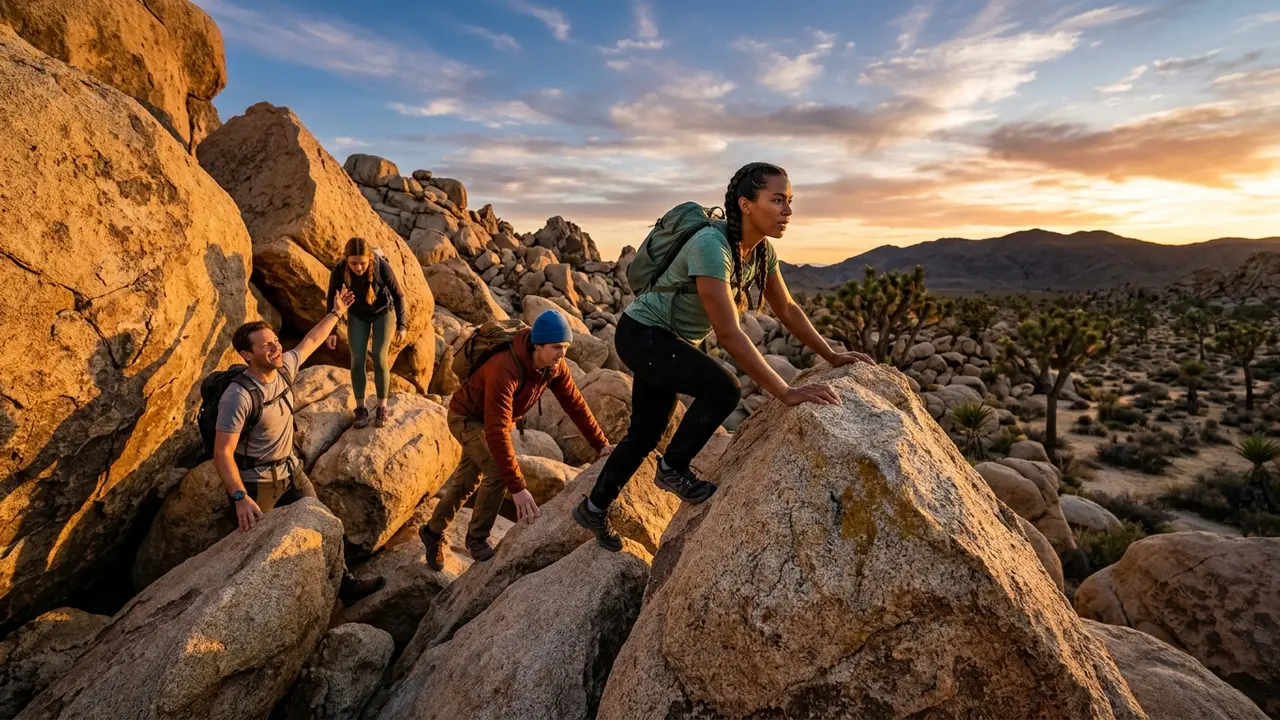
Three daytime pursuits make the strongest case for staying longer than a single overlook evening. Hiking through the boulder fields at Barker Dam and Hidden Valley, or up Ryan Mountain for the best view in the park, puts you inside the landscape instead of admiring it from a pullout. Rock climbing and bouldering turn the same monzogranite into one of the busiest climbing destinations in the American West. And a short drive north through Yucca Valley into Pioneertown trades rock for stranger terrain: a Western movie-set town that's still a working community, an outdoor art museum built from scavenged junk, and a geodesic dome where you lie on the floor and let crystal bowls do the rest.
None of it replaces a night at the overlooks. It just means the trip doesn't have to end when the sun goes down, or start once it does.
Rock Climbing and Bouldering in the Wonderland of Rocks
Joshua Tree National Park is one of the busiest climbing destinations in the American West, and the numbers back that up: more than 8,000 routes and 2,000 boulder problems across monzogranite domes and stacked formations, spanning everything from a first outdoor lead to serious multi-pitch trad[6]. The Wonderland of Rocks, the maze of boulders north of Hidden Valley, holds the park's densest concentration of climbable rock, and it's also the easiest place in the park to get turned around without a map.
8,000+ routes
Most climbing here is trad climbing, placing removable protection into cracks rather than clipping pre-drilled bolts, which suits the park's granite better than it suits a first-timer. Bouldering, unroped climbing low to the ground with crash pads underneath, is the more approachable entry point, and Hidden Valley's boulder field is one of the most popular bouldering areas in the park for exactly that reason.
One rule surprises a lot of visiting climbers: placing, replacing, or even removing a fixed anchor anywhere in the park requires an NPS permit, in every circumstance, whether you're a first-time visitor or a local putting up a new route[7]. It's a conservation measure as much as a safety one, and it applies regardless of experience.
Conditions change with weather, temporary closures for nesting raptors, and rockfall, so check current climbing conditions and any active closures at nps.gov/jotr before you rack up rather than relying on an old topo or trip report.
Pioneertown and Pappy & Harriet's: A Movie Set That's Still a Town
Pioneertown, a short drive north of the park through Yucca Valley, is a genuine Western movie-set town: founded in 1946 by actor Dick Curtis as a live-in, 1880s-themed backdrop for film and TV productions[8]. Unlike a studio backlot, Pioneertown was built to be lived in between takes, and enough of it survived Hollywood moving on that the town still stands today, part film set, part real high-desert community.
Recommended tours
Tours are selected for quality, not commission. I earn a small fee if you book — at no extra cost to you.

The false-front buildings along Mane Street still look the part, and one of them, the town's original and only gas station, now houses Pappy & Harriet's[9], a restaurant and live-music venue known for barbecue, classic American fare, and a Western-saloon interior that isn't set dressing[10]. It's booked serious touring acts alongside the standard roadhouse crowd for decades, and reservations for dinner on a show night are worth making ahead rather than assuming you'll walk in.
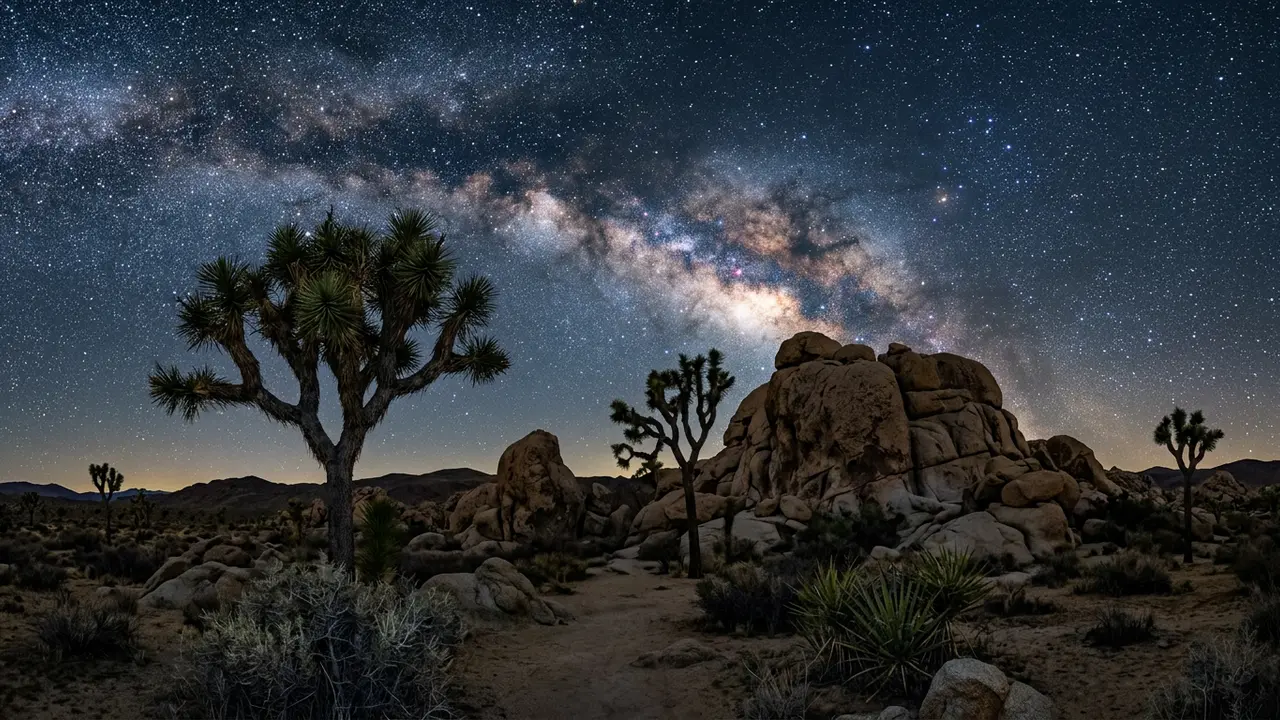
Featured · Destination
Joshua Tree National Park
Joshua Tree earned International Dark Sky Park status in 2017, just two hours from LA. Here's where to see the Milky Way, dodge crowds, and stay the night.
Hours and the show calendar shift by season, and Pappy & Harriet's doesn't publish a fixed weekly schedule on its own site, so check current hours and any ticketed shows directly before building an evening around it.
Noah Purifoy Outdoor Desert Art Museum and the Integratron
Noah Purifoy Outdoor Desert Art Museum, ten acres of large-scale assemblage art built from scavenged televisions, toilets, tires, and whatever else the artist could haul into the desert, sits about a 10-minute drive from Joshua Tree's town center at 63030 Blair Lane[11]. There's no ticket booth and no gate hours to plan around: the museum is free and open to the public every day of the year from sunup to sundown[12]. Wander it slowly. Purifoy built the pieces to survive the desert, not to be roped off from it, and walking among sculptures that have weathered decades outdoors is a different experience than seeing assemblage work behind museum glass.
The Integratron, a white geodesic dome outside Landers built in the 1950s and '60s on a theory of sound, magnetism, and rejuvenation, runs its sound bath sessions as 60-minute experiences: a short introduction to the building's history, 35 to 40 minutes of 22 live quartz crystal singing bowls, and time afterward to lie in the chamber and let it settle[13]. Whatever you make of the origin story, the acoustics inside the dome are real, and worth the drive on their own.
| Site | Cost | Reservation |
|---|---|---|
| Noah Purifoy Outdoor Desert Art Museum | Free | None needed - open daily, sunup to sundown |
| The Integratron sound bath | Paid session | Required - no walk-ins; confirm current schedule |
Reservations are required to enter the building at all, with no walk-in tours offered[14]. Both the sound-bath schedule and museum hours are worth double-checking before you go: the Integratron's operating days have shifted across sources, and the site lists a scheduled blackout period in mid-2026, so confirm current availability directly at integratron.com rather than planning around a fixed weekly schedule.
Building a Day (or Two) Beyond the Stars
None of these pursuits needs the others, but strung together they turn a single stargazing evening into a trip that earns the drive out. A two-day itinerary covers the ground comfortably: one day inside the park for a hike and, if the group is up for it, a climbing or bouldering session in the Wonderland of Rocks; a second day out in the high desert towns for Pioneertown, Pappy & Harriet's, the Noah Purifoy museum, and, with a reservation booked well ahead, an Integratron sound bath.
Sequence it around heat and light rather than convenience. Hike and climb early, before the desert sun gets serious, and save the art-and-music day for whenever the group needs a break from full sun and elevation gain. Stargazing doesn't wait on a hiking or climbing schedule either, so pick whichever evening the forecast looks clearest and build the daytime plan around it.
Featured · Article
What Is Astrotourism? The Complete Beginner's Guide
Astrotourism means travel built around dark skies: meteor showers, auroras, the Milky Way. What it means, where to go, and how to plan your first trip.
Drive times from Palm Springs and the Los Angeles basin vary enough by route and traffic that they're worth checking before locking in an arrival time; my guide to getting to Joshua Tree breaks down the options. Conditions in the park also shift with weather, seasonal closures, and fire restrictions more than most first-time visitors expect, so check current trail, road, and climbing status at nps.gov/jotr before finalizing plans around one specific trail or route.