Is Joshua Tree Open for Stargazing Any Time, and Is It Really Dark-Sky Certified?
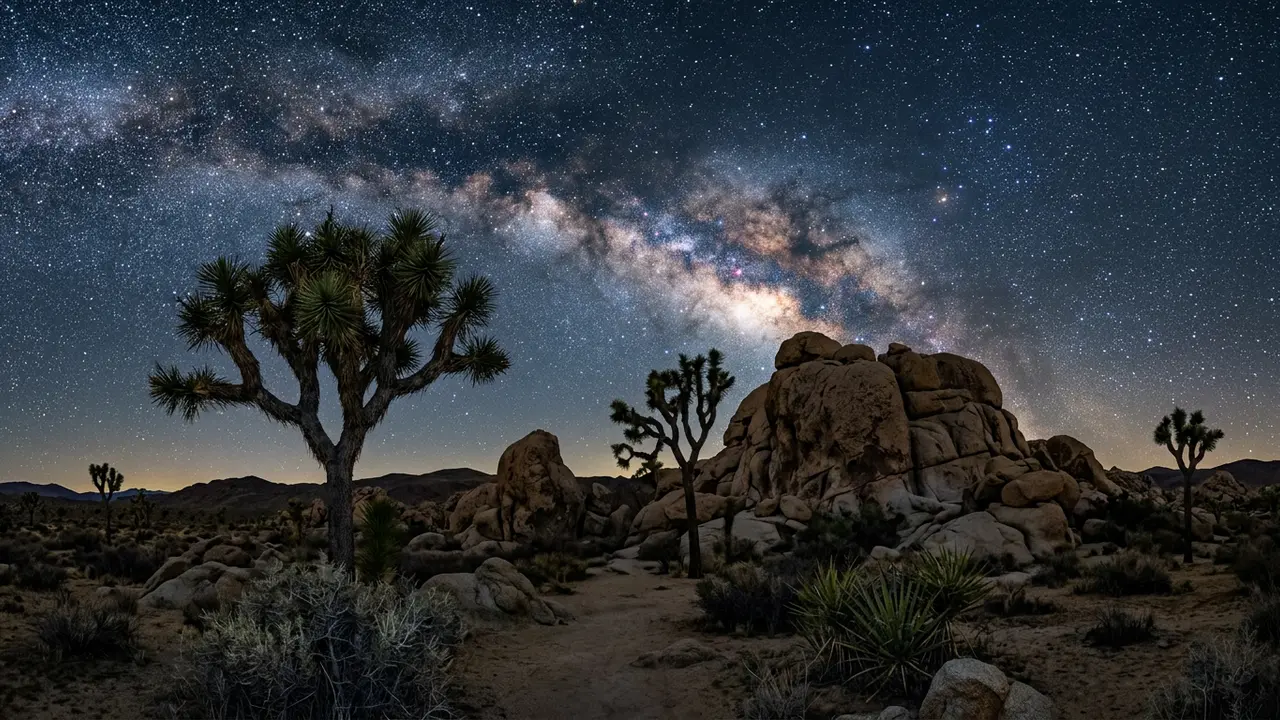
Joshua Tree National Park doesn't have a closing time. The gates run 24 hours a day, 7 days a week, 365 days a year[1], and the unstaffed entrance stations stay open through the night, so nobody waves you through at a fixed hour and nothing locks at dusk. Drive in after dinner, find a pullout, and drive back out whenever the cold or the alarm clock wins.
That around-the-clock access isn't an accident of a desert that just happens to go dark. Joshua Tree carries a formal International Dark Sky Park designation from DarkSky International[2], the kind of certification that follows real, sustained control over a park's own lighting rather than a one-time inspection. It's a statement about how the park manages itself, not a guarantee about any single night's weather or crowd level. See our explainer on Joshua Tree's dark sky certification for exactly what that designation required.

Featured · Destination

Joshua Tree National Park

Joshua Tree earned International Dark Sky Park status in 2017, just two hours from LA. Here's where to see the Milky Way, dodge crowds, and stay the night.

None of this means the whole park delivers the same sky. Light pollution from towns like Twentynine Palms and Yucca Valley still reaches parts of Joshua Tree[3], so a pullout near the West Entrance and a spot forty minutes deeper inside aren't showing you the same amount of darkness. For the fuller case on what makes this desert night sky worth planning a trip around, stargazing in Joshua Tree National Park covers the park's dark-sky credentials and layout in more depth.

Do You Need a Permit, and What Does It Cost to Get Into Joshua Tree?

No, you don't need a permit. There's no reservation system[4] to enter Joshua Tree for a night of stargazing: no timed-entry ticket, no separate night-access form, nothing to book weeks ahead. Show up, pay to get in, and go find your patch of dark desert.

That entry cost still applies after dark, though. A pass must be purchased or shown to enter or exit the park[5] no matter the hour, and what it costs depends entirely on how you arrive, not on what you're planning to do once you're inside:

  • Private vehicle: $30, valid 7 days, covers everyone in the car[6]
  • Motorcycle: $25, valid 7 days, up to 2 motorcycles and 4 riders[7]
  • On foot or bicycle: $15 per person, valid 7 days[8]
  • Annual park pass: $55, valid 12 months from the month of purchase[9]
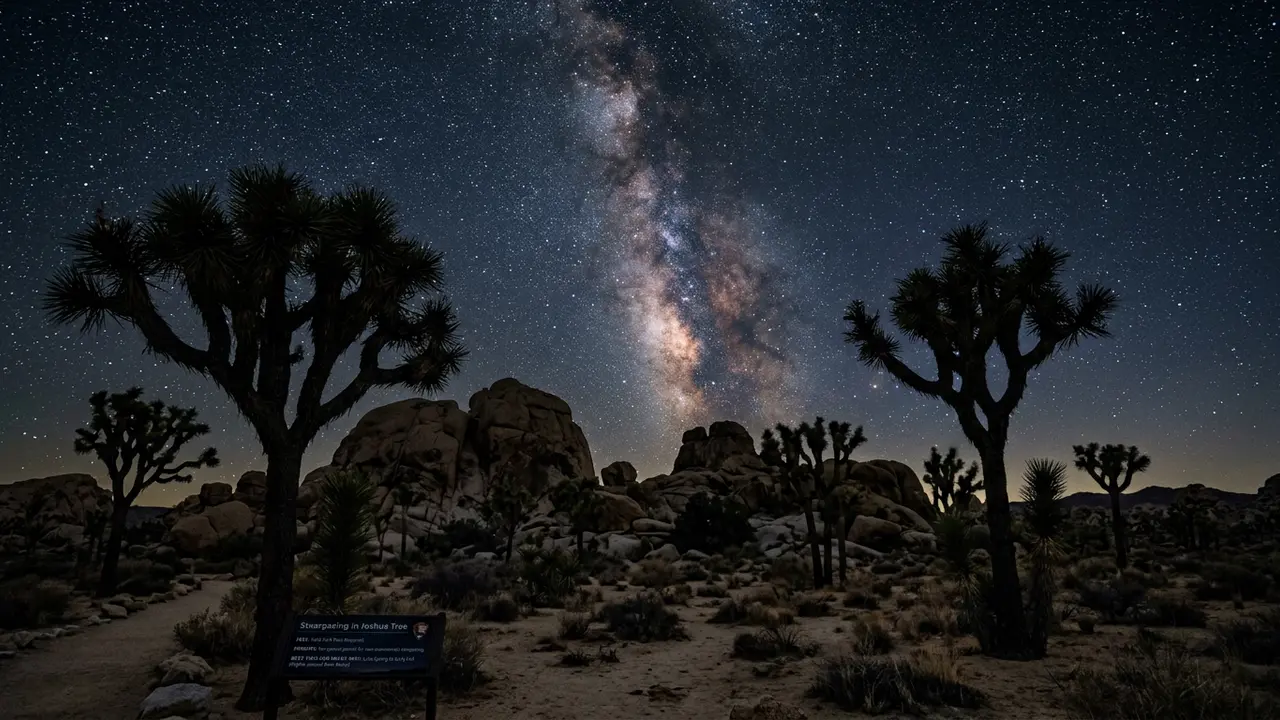
Star-filled night sky over Joshua Tree National Park's granite boulders, illustrating the Joshua Tree stargazing FAQ section on entrance fees and night access

Star-filled night sky over Joshua Tree National Park's granite boulders, illustrating the Joshua Tree stargazing FAQ section on entrance fees and night access

For a single overnight stargazing trip, the standard vehicle pass covers it, and it's good for a full week if the sky doesn't cooperate the first night and you want to come back. Anyone planning more than one Joshua Tree trip a year breaks even on the annual pass fast.
Pass typePriceValid for
Private vehicle$307 days, all passengers
Motorcycle$257 days, up to 2 motorcycles / 4 riders
On foot or bicycle$15 per person7 days
Annual park pass$5512 months from purchase

When Is the Best Time to See the Milky Way at Joshua Tree?

The Milky Way's core looks best on a moonless summer night, full stop.[10] That's two conditions stacked together, not one: summer lifts the galactic core high enough to read as a genuine arch of light instead of a faint smear near the horizon, and moonless rules out the single biggest thing that can flatten an otherwise clear sky.
Bright moonlight washes out fainter stars fast, so checking the moon's phase and its rise and set times matters as much as checking the weather forecast[11]. A first-quarter moon hanging in the sky until midnight can flatten the same view a new moon window would make spectacular three nights later. Build a trip around the new moon for your travel month before building it around anything else.
The Milky Way's core looks best on a moonless summer night, full stop.
Winter isn't a write-off, either. The galactic core sits low or below the horizon through the coldest months, but a clear winter night still delivers a genuinely dark desert sky and none of summer's crowds pressing in around the same handful of overlooks, one more reason best here depends on what you actually came out to see. For the full season-by-season case, the best time to stargaze in Joshua Tree breaks down summer's Milky Way core against winter's longer dark window in detail.

Where Are the Best Stargazing Spots, and Is Joshua Tree Crowded?

The National Park Service names four designated stargazing areas with parking:

  • Quail Springs
  • Hidden Valley
  • Cap Rock
  • Ryan Mountain
Cottonwood Campground and the stretch of Pinto Basin Road between the Cholla Cactus Garden and Cottonwood carry the darkest, least-trafficked skies in the park[12], the payoff for driving further from the two main entrances. For turn-by-turn directions to each pullout, see the best stargazing spots in Joshua Tree.
Crowding is the trickier question, and the honest answer leans on trip-planning sources rather than an official park count. March gets described as the park's busiest month, with December, April, November, and February following behind, a pattern from travel-blog analysis of visitation rather than an NPS statistic. If that holds for your travel dates, October and November evenings, and generally the hour just before sunset, tend to be quieter.
Crowding at a stargazing pullout isn't only about how many people are standing near you. It's about headlights. A parking area still filling up at 9 p.m. means fresh high beams sweeping across your night vision every few minutes, which matters more for a real stargazing session than the raw visitor count. Cottonwood and Pinto Basin Road solve both problems at once by sitting far enough from the entrances that casual evening traffic thins out fast.

Can You Day-Trip to Joshua Tree from Los Angeles, and How Cold Does It Get at Night?

Joshua Tree sits roughly 130 to 140 miles east of Los Angeles, depending on your starting point and which of the park's entrances you use, a drive that runs about two and a half to three hours outside rush hour, according to general trip-planning estimates rather than a single official mile marker. That makes an evening or day trip from LA genuinely workable: leave after work, catch sunset over the boulders, stay for the dark, and be home well before 1 a.m. if you don't linger. For the full range of routes in from LA, San Diego, and Palm Springs, see getting to Joshua Tree.
A day trip built around stargazing specifically, though, fights the clock twice. Summer buys the longest drive-home window since full dark doesn't arrive until well after 9 p.m., but it also means driving back through desert heat that hasn't broken yet. Winter flips it: an early sunset gets you under a dark sky by dinnertime, but you're driving home on tired eyes through genuinely cold desert air.

Featured · Article

What Is Light Pollution? Definition, Types, and Solutions

Light pollution is artificial light brightening the night sky, affecting 80% of the world. Learn the 4 types, wildlife and health effects, and how to fix it.

That cold surprises a lot of first-time visitors who picture Joshua Tree as uniformly hot. Night temperatures swing hard by season, roughly the 30s°F in winter, the 70s°F in summer, and somewhere in the 50s°F during spring and fall evenings, general seasonal ranges rather than a guaranteed number for any specific night. Whatever the season, the desert loses heat fast once the sun drops, and a jacket that felt unnecessary at 6 p.m. earns its place by 9.

Do You Need a Telescope, and Is It Safe at Night?
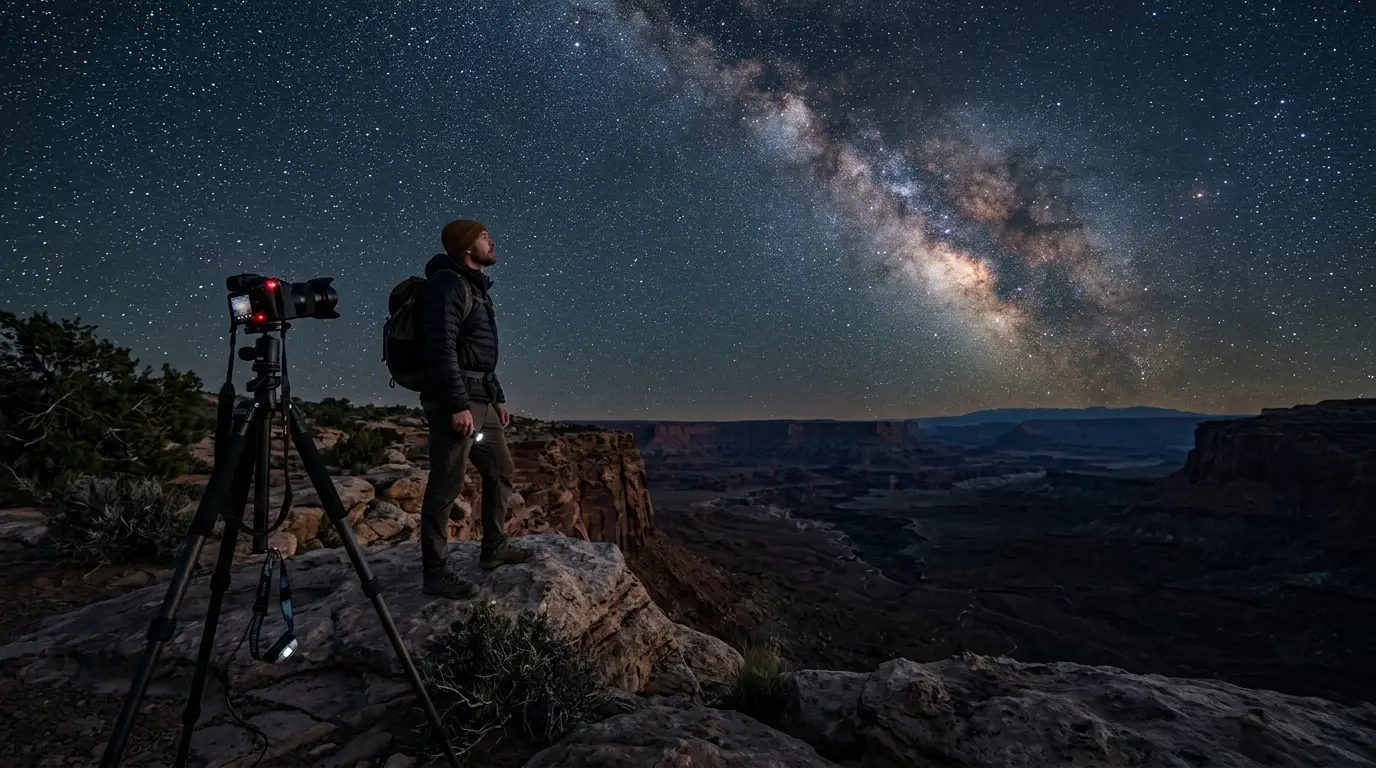
No, you don't need a telescope, and most first-time visitors shouldn't bother bringing one. Joshua Tree's night sky rewards naked-eye viewing and a decent pair of binoculars: the Milky Way's core, meteor showers, and the park's namesake yuccas silhouetted against a star field all read clearly without any equipment. NPS's own stargazing guidance leans on binoculars as an optional add-on, not a telescope as a requirement, which tells you plenty about what the park actually expects visitors to bring.
A telescope earns its keep for a narrower, more specialized target list: planetary detail, the Moon's craters up close, faint deep-sky objects that need real aperture to resolve. If that's the trip you're planning, bring one. If you just want to stand under the Milky Way for an hour, leave it in the car.
Safety at night comes down mostly to ordinary desert caution rather than anything specific to stargazing. The park is home to seven species of rattlesnakes[13], and negative encounters are genuinely rare as long as visitors keep their distance and stay on marked trails rather than reaching into rock crevices or stepping off-path in the dark. Bring a real flashlight, watch where you put your hands and feet, and the odds stay heavily in your favor.