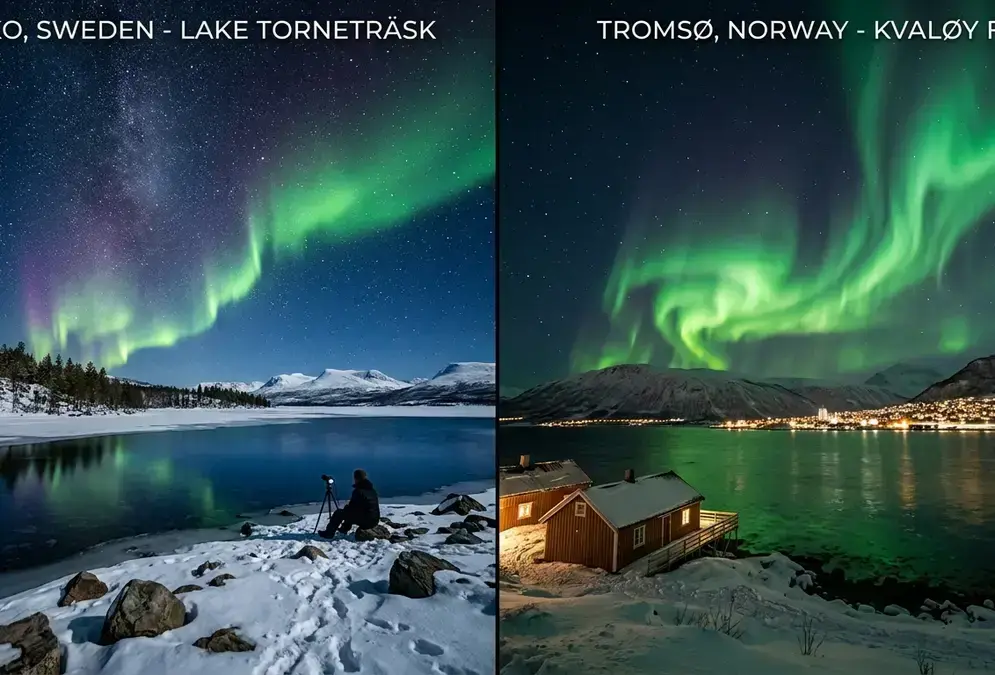

Tromsø vs Abisko at a Glance
Tromsø and Abisko solve the same travel problem in opposite ways. Tromsø, a fjord city on Norway's Arctic coast, sits inside the auroral oval itself: aurora shows up here at a Kp index of just 2, so you can land at the airport and stand under green sky the same night if the sky cooperates. Abisko Stargazing and Northern Lights in Tromsø cover both destinations' full geography if you want the deeper hub pages before reading on.
Abisko takes longer to reach and asks more of the traveler before the payoff arrives. It's a small village in Swedish Lapland, built around a single meteorological quirk: the Scandinavian mountains along the Norway-Sweden border strip moisture from incoming Atlantic weather before it reaches the valley, producing a documented clear-sky advantage locals call the Blue Hole. Lodging here leans toward a single STF mountain station at the foot of the region's aurora-viewing chairlift, rather than the dozens of hotels and tour operators clustered around downtown Tromsø.
Neither destination is the wrong answer. The honest version of this decision comes down to what you're actually optimizing for: raw activity you can reach in an afternoon, or a longer, quieter trip built around better odds of an unobstructed sky.
Aurora Visibility Odds: Oval Position vs Clear-Sky Reliability
Tromsø's advantage is geographic. The city sits close to the center of the auroral oval, the ring where geomagnetic activity concentrates most nights of the season, and aurora becomes visible there at Kp 2, a threshold most of continental Europe rarely reaches. December and January bring genuine 24-hour polar darkness, and January and February are widely cited as the strongest viewing months, combining the longest stretch of usable dark sky with solar activity near the peak of the current solar cycle[1].
Kp 2
Abisko can't match that raw activity on paper. It sits further south and outside the oval's densest core. What it offers instead is a better conversion rate between activity and an actual sighting: the Blue Hole rain-shadow effect keeps skies over the village meaningfully clearer, more often, than the marine climate battering Norway's coast. The Swedish Institute of Space Physics (IRF), headquartered an hour east in Kiruna, has studied the aurora in this exact region since 1957[2], which tells you the science has taken this stretch of Lapland seriously for a long time, even though IRF's own research is aurora physics rather than the cloud-cover mechanism itself.
Treat any number you see online claiming Abisko gets "twice as many clear nights" as Tromsø with real skepticism. That specific ratio isn't backed by a citable primary source. The honest comparison is activity versus reliability: Tromsø gives you more geomagnetic activity overhead on a given night; Abisko gives you a better chance of an unobstructed view of whatever activity is happening.
Getting There: Flights, Transfers, and Real Trip Cost
This is where the two destinations pull furthest apart. Tromsø Airport (TOS) sits about 5km from downtown, roughly a 10-minute transfer by taxi or the Flybussen shuttle[3]. Land, check into a hotel, and book a tour for that same evening if the forecast allows it.
| What matters | Tromsø | Abisko |
|---|---|---|
| Nearest airport & transfer | Tromsø Airport (TOS): ~5km, ~10 min | Kiruna Airport (KRN): roughly 1 hour by car (longer by train) |
| Direct flights between them | N/A | None; connects via a hub, fares vary by season |
| Typical trip length | 3-5 nights | 3-4 nights, often extended to include Kiruna/Jukkasjärvi |
| Cost model | Pay-per-tour; higher city accommodation | Lower nightly lodging; higher transfer cost |
Abisko has no airport of its own. The nearest one, Kiruna Airport (KRN), sits roughly an hour away by car or rideshare[4] (longer by train). There's also no direct flight between the two cities: getting from Tromsø to Kiruna means routing through a connection, and fares vary a lot by season and how far ahead you book, so check current prices directly rather than budgeting off a number quoted elsewhere. Budget the better part of a travel day for that leg alone if you're trying to combine both destinations in one trip, which is possible but genuinely ambitious rather than a quick add-on.
Getting to Abisko breaks down the train and transfer options in more detail, including the overnight sleeper from Stockholm that skips the Kiruna Airport leg entirely.
Transfer cost follows the same pattern as transfer time: a Kiruna-to-Abisko private transfer runs several times what a Tromsø airport taxi costs, though exact pricing shifts with the operator and season, so check current quotes before assuming a fixed number. Once you're on the ground, the balance partly reverses. Abisko's STF-run lodging and Kiruna's hotels tend to cost less per night than Tromsø's coastal hotel market, and Tromsø's pay-per-tour model can add up faster over a week than Abisko's flatter, quieter base-camp setup. None of this makes Abisko the "harder" choice in a bad way; it's simply a different kind of trip, fewer moving pieces once you've committed to the transfer, versus more flexibility and a wider service industry in Tromsø.
Weather and Climate: Coastal Fjord vs Inland Rain-Shadow
Tromsø's weather is shaped by the sea. The same Gulf Stream warmth that keeps its winters milder than you'd expect this far north also feeds a marine climate that throws persistent cloud cover at aurora hunters. That's the entire reason Tromsø built a minibus 'chase tour' industry in the first place: when the sky over the city clouds over, guides drive the group inland or along the coast, hunting a gap rather than waiting one out.
Abisko's advantage is written into the record books. Sweden's own meteorological authority, SMHI, names Abisko its textbook example of a rain shadow: the village averages only about 300mm of precipitation a year, among the driest recorded totals anywhere in the country, because the Scandinavian mountains along the Norwegian border wring the moisture out of incoming Atlantic weather before it descends into the Torneträsk valley[6]. Locals and aurora guides call the visible result the Blue Hole, a genuinely documented, if unquantified, clear-sky advantage over the exposed coast. Abisko's clear-sky microclimate explains the physics behind that number in full, if you want more than the postcard version.
Don't mistake any of this for a guarantee, or trust a precise multiplier if you see one claimed elsewhere. No citable source backs a fixed "X times clearer" comparison between the two skies, and even Abisko's own weather clouds over on a determined storm night. What the numbers actually support is a real, measurable dryness advantage, not a fixed ratio.
Abisko's whole reason for being on the map is that it mostly doesn't need to chase clear sky the way Tromsø does.
Abisko's whole reason for being on the map is that it mostly doesn't need to chase clear sky the way Tromsø does.
Trip Length, Cost, and What Else There Is to Do
Budget 3-5 nights in Tromsø if you're building the trip around a tour-based visit, often paired with a fjord cruise or a day trip into the Lyngen Alps. The city runs on a pay-per-excursion model: dozens of registered operators run nightly minibus chases, and you're free to skip a night or book two in a row depending on the forecast. Between aurora nights, Tromsø gives you whale watching, a lively restaurant scene, and museums covering Sami culture and polar history, so a cloudy evening isn't a wasted one.
Budget 3-4 nights in Abisko, and consider stretching the trip to include Kiruna and the Jukkasjärvi ICEHOTEL an hour east, since you've already made the harder journey to get there. This Abisko National Park lodge stands at the foot of the Aurora Sky Station chairlift, the region's marquee viewing point, and functions as a base camp rather than a hotel you tour out from. There's less to do between clear nights than in Tromsø, no fjord cruises, no whale watching, a quieter restaurant scene, so the trip suits travelers comfortable with early nights and long stretches of dark rather than city energy.
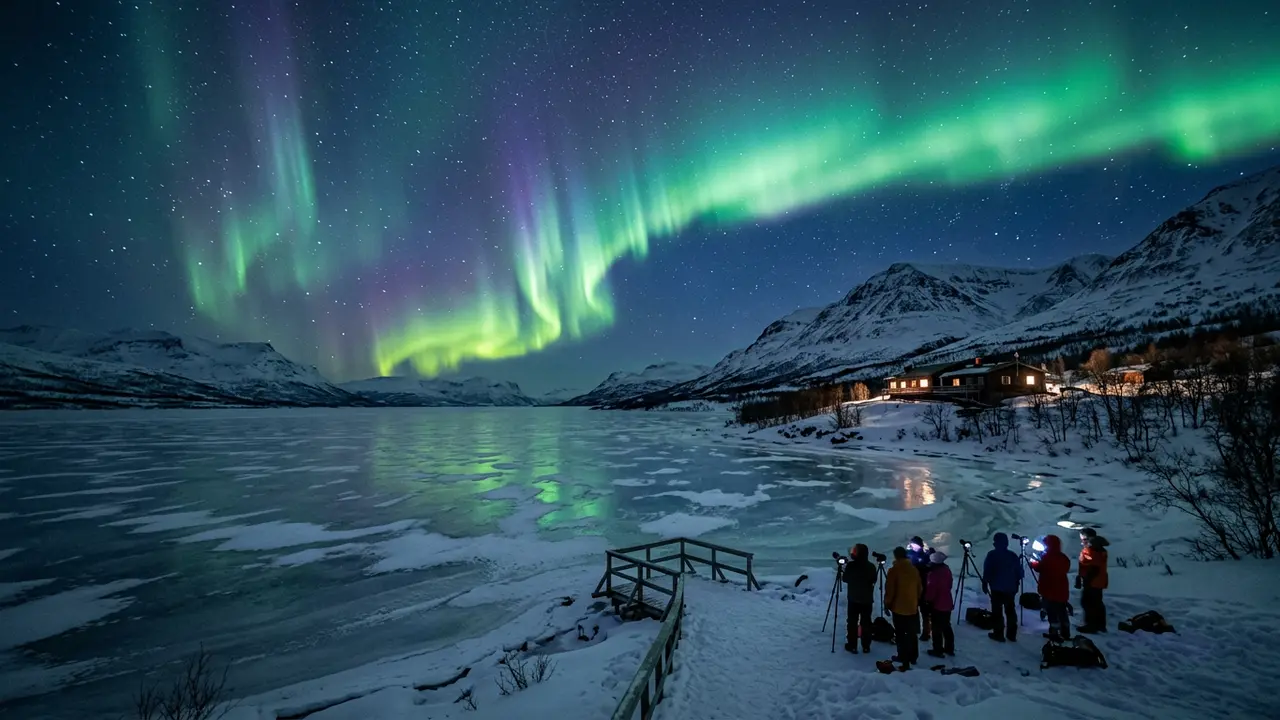
Featured · Destination
Abisko Stargazing
Abisko's rain-shadow microclimate keeps skies clear when nearby Arctic spots cloud over. Aurora season, the Sky Station, ICEHOTEL, and getting there by train.
If you'd rather have a guide handle the logistics on the Tromsø side instead of self-driving, the tour-versus-self-drive math works differently in each city, worth deciding before you book anything. In Abisko, most visitors skip a rental car entirely and rely on the train plus the Sky Station's own chairlift, since there's little reason to drive once you've arrived.
Which One Should You Pick? The Verdict by Traveler Type
Run through these honestly and the choice mostly makes itself.
Choose Tromsø if:
- You want short logistics: fly in, land minutes from your hotel, book a tour for that same night
- You're on a shorter trip, 3-5 nights, and want the flexibility to add a fjord cruise or a whale-watching day
- Coastal scenery, city restaurants, and a livelier base between aurora nights matter to you
- You'd rather pay per tour than commit to one remote base for the whole stay
Choose Abisko if:
- You're prioritizing clear-sky odds over raw geomagnetic activity, and you're willing to trade a longer transfer for it
- You're building a longer Swedish Lapland loop that already includes Kiruna or the Jukkasjärvi ICEHOTEL
- You've already done a coastal aurora trip and want to try the inland alternative
- Quiet, early nights, and a mountain-station base suit you better than city energy
Recommended tours
Tours are selected for quality, not commission. I earn a small fee if you book — at no extra cost to you.


A growing number of trips do link the two, flying into Tromsø for the coastal leg and connecting onward to Kiruna and Abisko for the inland half. It just isn't a spontaneous add-on, given the lack of a direct flight between them and the extra travel day it costs.
Neither destination is the objectively correct pick. If you're deciding for a first visit and want the fuller case for the harder-to-reach option, Is Abisko Worth It for Northern Lights Stargazing? makes that argument in full.