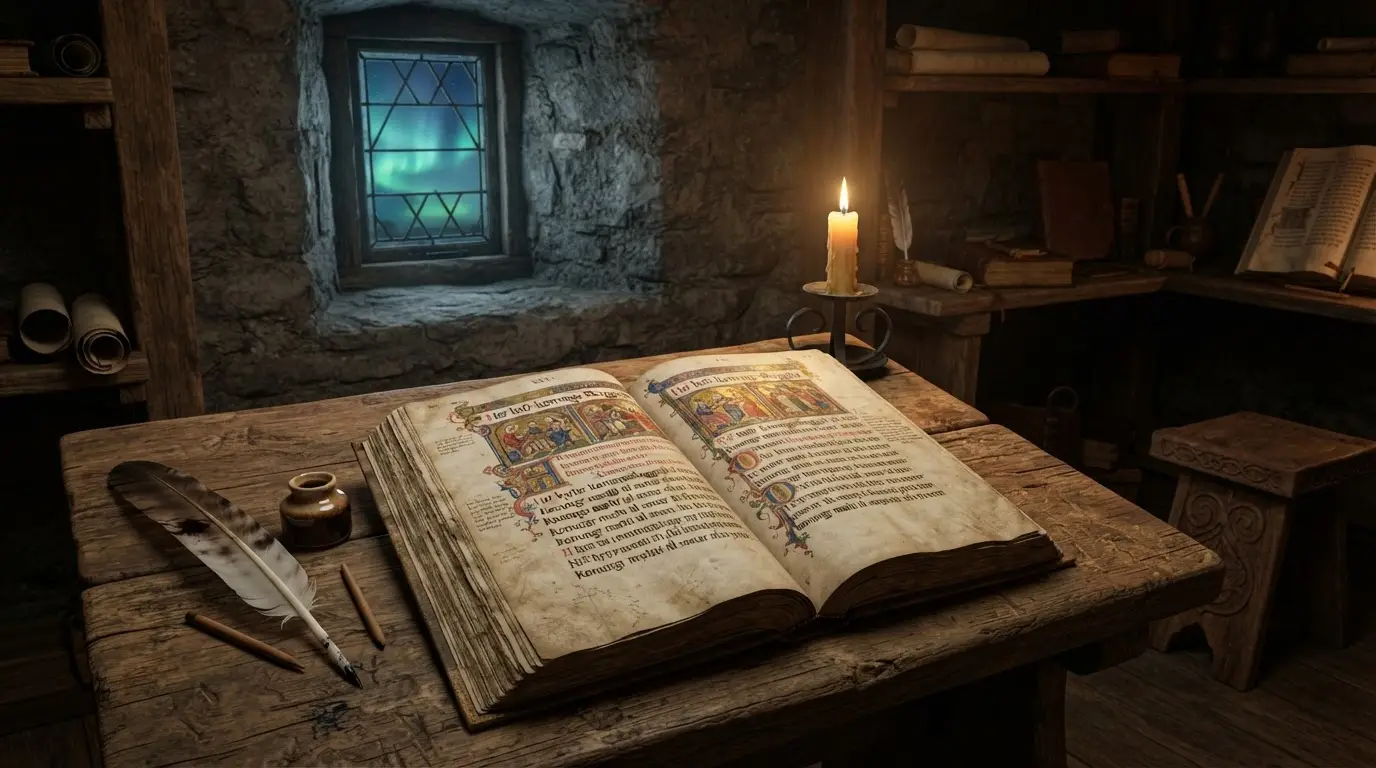

The King's Mirror everyone gets wrong
Konungs Skuggsjá, Old Norse for King's Mirror and rendered in Latin as Speculum Regale, is a Norwegian didactic text written in Old Norse around 1250 AD[1]. Not Icelandic. The confusion is understandable, since it belongs to the same Old Norse literary world that also produced the Icelandic sagas, and search results routinely blur the two together. It's part of a broader medieval genre called speculum literature, "mirror" texts meant to instruct a ruler or his heir by walking through law, trade, and natural philosophy in dialogue form. But the text itself was written for a Norwegian audience, by a writer working inside Norway.
It takes the form of a father-son dialogue, originally intended for the education of King Magnus Lagabøte, son of King Håkon Håkonsson[2]. Scholars trace its actual composition to Namdalen, a district roughly one hundred miles northeast of Nidaros, the medieval name for Trondheim[3]. One old theory credited the king's court chaplain, Master William, but the text's modern English translator found no evidence he wrote it, or that he had any real interest in the questions it raises[4]. A separate look at that same translation instead places the unknown author in Trøndelag or Trondheim and suggests he was a prominent figure at the Norwegian court[5], close to power but never named in the manuscript itself.
The oldest surviving copy doesn't settle his identity either. AM 243 bα fol., the most important manuscript of the text, was copied in Norway, probably Bergen, around 1275[6], a generation after the original was likely finished. A later analysis narrowed the composition window further, dating it to the century's later half, at any rate not long before 1260[7]. An anonymous Norwegian, writing from a remote district for a royal household, sometime in the 1250s: nothing in that sentence leaves room for Iceland.
What the dialogue actually says about the lights
The son asks his father directly what causes the lights burning in the northern sky. The father's answer opens with an admission of doubt: "I have no clear knowledge. I have often met men who have spent a long time in Greenland, but they do not seem to know definitely what those lights are."[8] That single sentence does two things at once. It frames the aurora as a genuinely open question rather than settled belief, and it locates the phenomenon specifically in Greenland, based on secondhand testimony from sailors and travelers, not in Norway and not in Iceland.
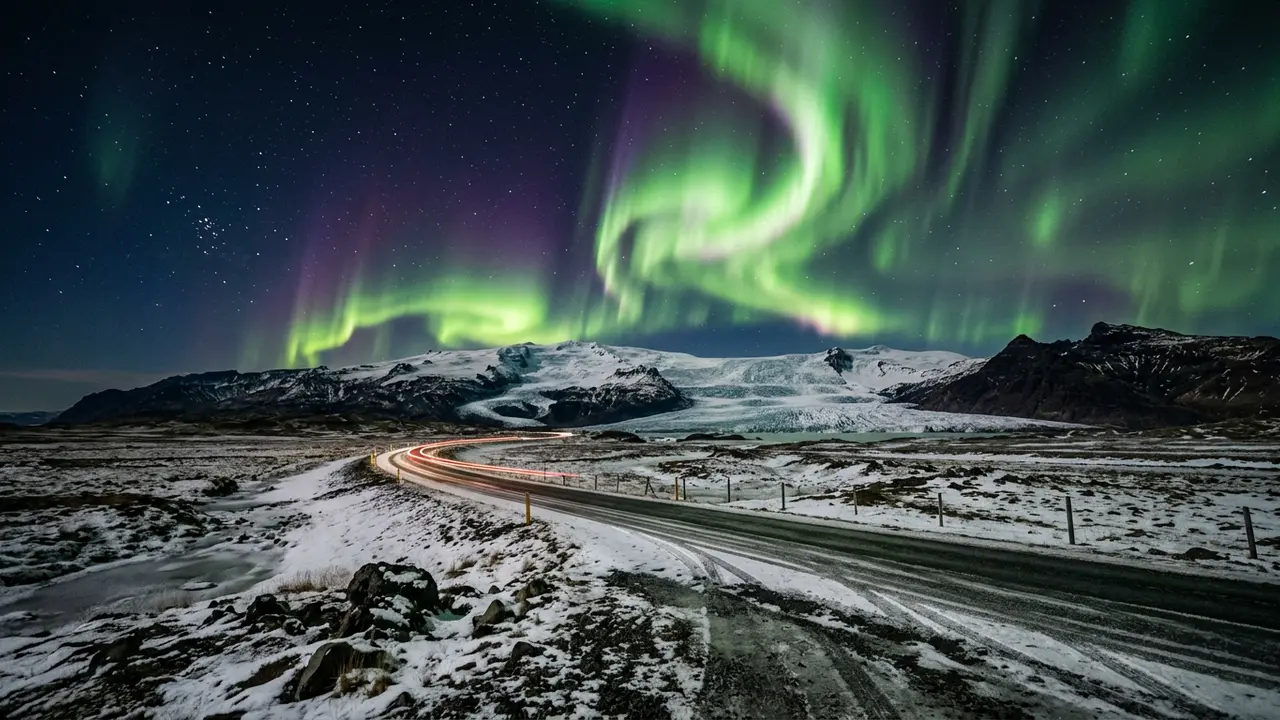
Featured · Destination
Northern Lights in Iceland
Iceland's whole-country aurora guide: best regions to base in, aurora season Sep–Mar, ice caves, winter driving reality, and where cloud cover ends every plan.
The physical description that follows is careful and visual. The lights, the father says, "resemble a vast flame of fire viewed from a great distance"[9], shifting and distant, sometimes dimming behind what looks like smoke or fog. The dialogue doesn't leave that detail unexplained: it proposes that the apparent smoke is really vapor rising from thawed, ice-free ground and sea nearby, collecting into something that only looks like dark fog from a distance[10]. It's the wrong explanation for the shimmer, but a genuinely physical one, no spirits and no omens, just water vapor doing something the author had convinced himself made sense.
What's notable is what's absent. There's no Bifröst, no Valkyries riding overhead, none of the mythological framing that shows up elsewhere in Old Norse tradition. The father treats the question the way he'd treat a question about earthquakes or ocean currents, as something with a physical cause, reported by witnesses, worth reasoning through carefully, even when the reasoning ends in acknowledged uncertainty.
Three rival theories, and the one he wouldn't confirm
Having admitted he didn't really know, the father doesn't stop there. He lays out every serious physical explanation he'd heard and lets his son judge for himself: "The men who have thought about and discussed these lights have guessed at three sources, one of which, it seems, ought to be the true one."[11]
I know nothing further that has been conjectured on this subject, only these three theories that I have presented; as to their correctness I do not decide, though the last mentioned looks quite plausible to me.
- A ring of fire circling the outer ocean, the idea that flames somehow wrapped around the edges of the known world, glimpsed from a distance[12]
- Escaping sunlight, the theory that at night, when the sun travels beneath the earth, an occasional gleam of its light shoots up into the sky[13]
- Radiant ice, his own preferred explanation: that frost and glaciers in the far north had grown so powerful they could radiate light on their own[14]
None of these hold up under modern physics. The real mechanism is charged particles from the sun colliding with the upper atmosphere, something no 13th-century writer could have guessed at, with no way to know about solar wind or the Kp index that today's forecasters use instead. But the shape of the reasoning is what earns this text its place in the history of ideas: fire, optics, and a kind of proto-thermal glow, three different physical mechanisms weighed against each other, with the explicit final word being a refusal to pick a winner: "I know nothing further that has been conjectured on this subject, only these three theories that I have presented; as to their correctness I do not decide, though the last mentioned looks quite plausible to me."[15]
That's an unusual thing for a medieval author to write down. Not "the gods did it." Not "here is the truth." Just three explanations, a lean toward one of them, and an admission he could be wrong.
Where Iceland actually fits into this story
So where does Iceland come in, if the text is Norwegian and the lights it discusses are Greenland's? Only through the wider Old Norse world all three places shared. Norway, Iceland, and the Norse settlements in Greenland were connected by the same language, the same legal and literary traditions, and the same restless seafaring culture that carried sagas, laws, and travelers' reports across the North Atlantic. The King's Mirror is a product of that world; it just happens to be the Norwegian, court-facing half of it, not the Icelandic half.
Iceland has its own, separate aurora tradition, built later and differently: folklore about hidden people, or huldufólk, associated with the lights, plus a much longer modern history of travelers going there specifically to see them. Reading the King's Mirror as an Icelandic aurora explanation collapses two distinct traditions into one, which is exactly the mix-up this piece exists to untangle. For Iceland northern lights vs Norway, or the best time for northern lights in Iceland, those are different, much more recent questions, with real answers, unlike the ones the King's Mirror settled on.
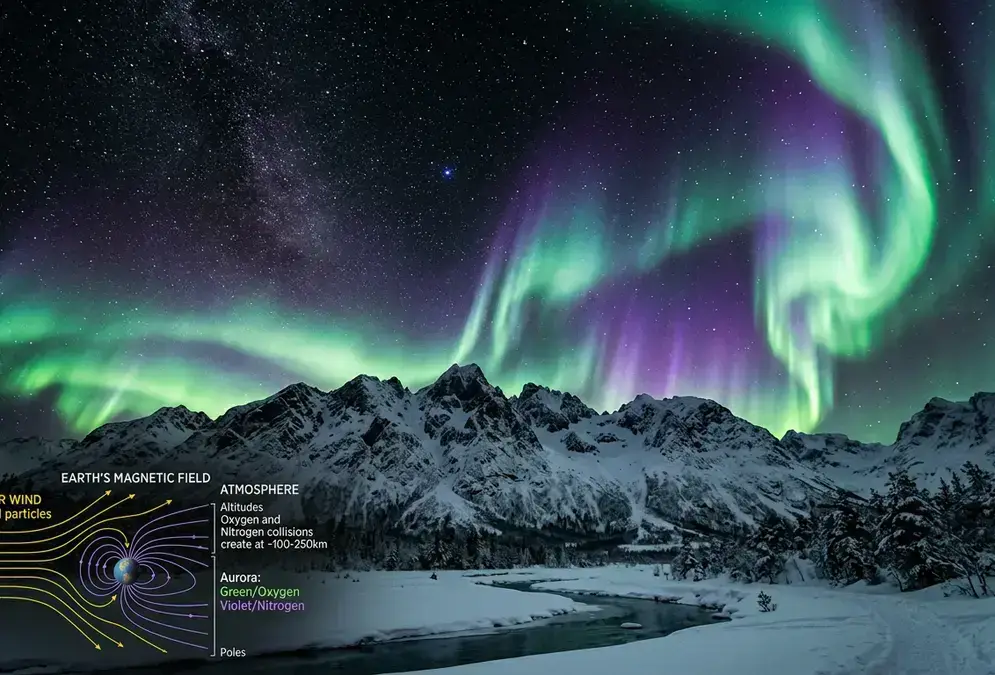
Featured · Article
What Causes the Northern Lights? The Science Explained
Solar wind collides with Earth's magnetic field, funneling charged particles toward the poles, where they excite oxygen and nitrogen into glowing color.
What the 13th-century text leaves behind isn't a place to book a trip around. It's a document of a writer refusing to fake certainty about something he'd only heard about secondhand, which, eight hundred years later, still reads as more honest than most modern guesses.