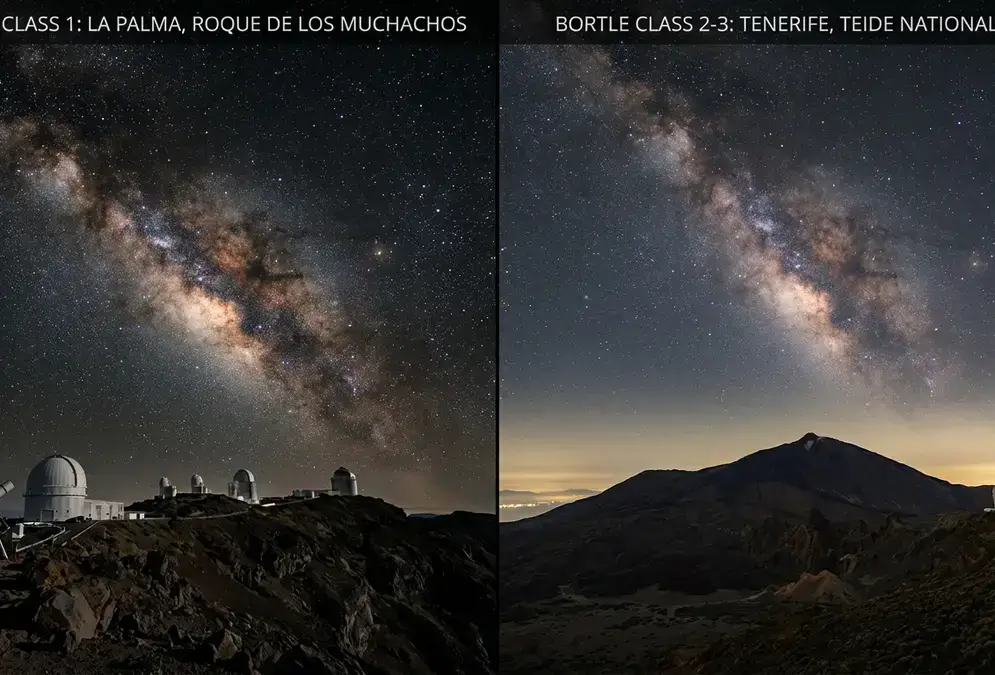

Observatory access: two night skies, two day-only telescopes
Both islands carry serious international recognition: La Palma became the world's first Starlight Reserve in 2012[1] — following a founding Starlight Declaration signed on the island in 2007 — and Teide National Park earned UNESCO World Heritage status in 2007 for its volcanic landscape[2]. Neither designation, though, tells you what actually happens when you show up after dark looking for a telescope.
Here is the fact that surprises most first-time visitors on either island: neither flagship observatory is open to the public at night. Both are working research facilities, and stray light or vehicle traffic from a night tour would compromise a live observation run. That single rule shapes everything else about how each island's stargazing trip actually works.
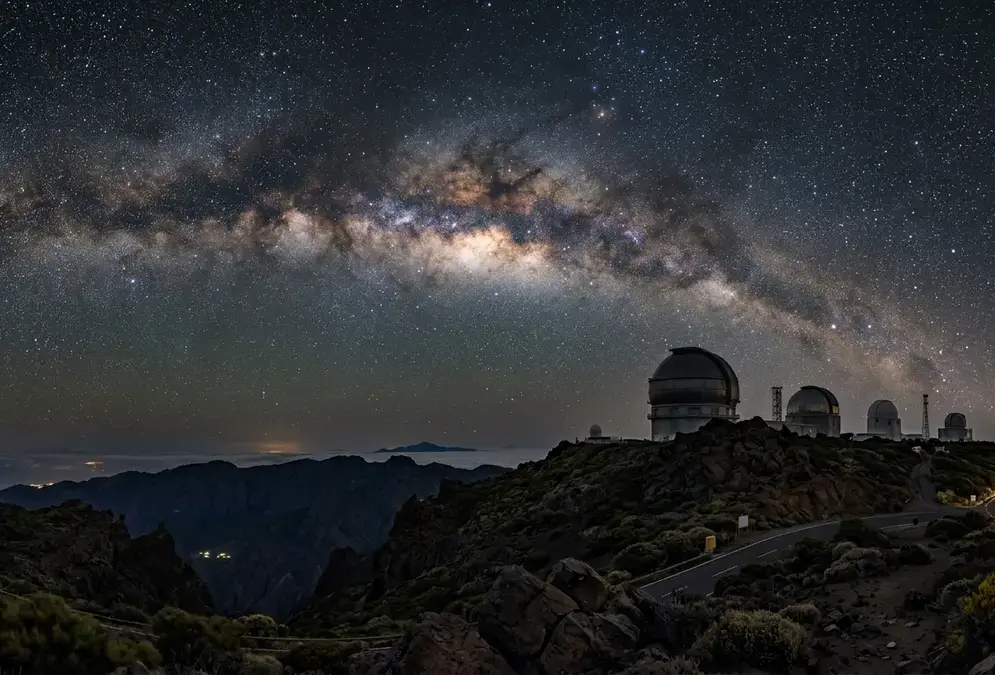
Roque de los Muchachos Observatory, at 2,396 metres on the rim of the Caldera de Taburiente, is a night-time optical and gamma-ray research site, home to the Gran Telescopio Canarias (GTC), a 10.4-metre mirror confirmed as the world's largest single-aperture optical telescope[3]. Independently operating Starlight-certified guides run guided day visits only, typically 90 to 110 minutes[4], priced around €20 for adults (€15 for children or La Palma residents), minimum age 6, reservation required[13]. Walk among the domes at noon; you will not be back after sunset.
Teide Observatory, at 2,390 metres[10] on the Izaña ridge, runs the opposite research focus: it is primarily a solar observatory, home to the GREGOR telescope alongside a smaller set of night-sky instruments. Like ORM, it is day-visit only, from €21 for roughly 1.5 hours[14], and visits pause entirely between December and March[5]. Where the two islands genuinely diverge is what happens after the day tour ends: Tenerife's caldera floor hosts an official, year-round commercial stargazing-tour program run through the national park concession, with tiers from a one-hour telescope session to a full sunset-dinner-and-stars evening. La Palma's night-time tour market is smaller and newer; most stargazers there still do it the way locals do, driving into Garafía after dark and finding a pull-off on their own.
Where you sleep: casas rurales versus a state-run Parador
Where you sleep decides how much of the night you actually get to use, and the two islands solve that problem in opposite ways.
La Palma's stargazing accommodation scene is casas-rurales-led: small, independently run rural houses scattered through Garafía, the island's darkest, least populated municipality. This restored rural house, a restored house at 1,042 metres[11], sits above the altitude band where the Atlantic cloud layer typically breaks up, with self-catering rates from around €31 per person per night. Two Starlight-certified alternatives round out the island's small but growing roster. None of it is large-scale hospitality; you are booking a house, not a hotel chain.
Featured · Destination
La Palma Stargazing
La Palma stargazing guide: the world's first Starlight Reserve since 2012, Bortle 1-2 skies above Roque de los Muchachos, plus where to stay and go year-round.
Tenerife's approach is Parador-anchored. Parador de Las Cañadas del Teide sits inside the national park boundary itself, the only hotel with that address, and its front door opens onto a sky where the Milky Way is already visible after dinner. It books out months ahead around new-moon weekends in summer. The Hotel Spa Villalba in Vilaflor, thirty minutes below the caldera, is the developed alternative: cheaper, spa-equipped, and a straightforward drive up after dinner. Between the two islands, Tenerife offers more rooms and more price tiers; La Palma offers fewer options but a genuinely quieter stay, and a bed inside Garafía cuts the drive to the ORM access road down to twenty or thirty minutes rather than the hour-plus it takes from the coastal towns.
Getting there: airports, ferries, and drive times
Access is where the practical gap between these islands is largest, and it starts with airport size.
Tenerife has two airports with direct connections from most major European hubs: Tenerife South (TFS) handles the bulk of international leisure traffic and sits roughly 45 minutes from Teide National Park, while Tenerife North (TFN) handles more inter-island and mainland Spanish routes. Land at either one, pick up a car, and you can be climbing the TF-21 toward the caldera within the hour.
La Palma Airport (SPC), in Breña Baja south of Santa Cruz de La Palma, is a smaller regional airport, connecting to roughly 21 destinations as of 2026, mostly reached via a stop in Tenerife or Gran Canaria rather than a direct flight from mainland Europe[6]. Airlines serving SPC include Binter Canarias, Canaryfly, easyJet, Iberia, and Vueling, among others; route lists shift by season, so check current connections before booking. If you fly directly into La Palma Stargazing rather than island-hopping, expect one extra leg compared with a Tenerife trip.
The two islands are also linked directly, which matters more than it looks: Fred Olsen Express and Naviera Armas both run a ferry between Los Cristianos, on Tenerife's south coast, and Santa Cruz de La Palma, a crossing of roughly two and a half to three hours[7]. A rental car is essential on both islands either way; neither has public transport reaching its stargazing sites. The driving itself differs too: Tenerife's TF-21 and TF-24 are wide, well-signed mountain roads built for tour buses, while La Palma's climb into Garafía is narrower, with tighter switchbacks that take longer to drive than the map distance suggests.
Crowds: a tenth of the population, a fraction of the traffic
Population is the cleanest proxy for how crowded a mountain road or a viewpoint will feel after dark, and the two islands are not close.
La Palma is home to roughly 84,000 people[8], against Tenerife's population of close to 964,000[9], the most populous island in Spain. That is not a small gap: it is over an order of magnitude, and it shows up exactly where you would expect: in the traffic on the summit road, the number of cars at any pull-off, and the light dome thrown up by any single town. A new-moon summer weekend at Tenerife's roadside miradores can mean a car park full of tripods and tour buses; the same night in Garafía usually means you and whoever else booked the same guide.
None of this makes Tenerife's sky bad; Bortle 2-3 conditions at the caldera are still a genuinely good dark sky by any European standard. It changes the experience of standing under it: busier, more social, and built for an island that receives roughly five million visitors a year rather than eighty-four thousand residents. The quietest hours on either island are the same, though: after 01:00, once the day-trip buses and the last guided tours have cleared out, both islands hand the sky back to whoever is still awake.
A new-moon summer weekend at Tenerife's roadside miradores can mean a car park full of tripods and tour buses; the same night in Garafía usually means you and whoever else booked the same guide.
Beyond the telescope: volcano landscapes on both islands
Stargazing is the draw, but neither island is only about the night sky.
La Palma's daytime centerpiece is the Caldera de Taburiente, a roughly nine-kilometre-wide erosion caldera with hiking trails along cliffs more than a thousand metres deep, at the heart of a national park that predates the island's astro-tourism reputation by decades. On the island's west coast, the 2021 Tajogaite eruption reshaped the coastline near Los Llanos de Aridane; the new lava field is now a visitor site in its own right, on the opposite side of the island from the observatory and unrelated to the stargazing trip.
Recommended tours
Tours are selected for quality, not commission. I earn a small fee if you book — at no extra cost to you.
Tenerife's daytime centerpiece is Mount Teide itself. The cable car runs from 2,356 metres to 3,555 metres[12], and a summit permit, no longer free since a 2026 eco-tax, buys the final 163 vertical metres to the crater rim. It is a bigger, more built-out day out than anything on La Palma, complete with a gift shop at the upper station and a sunset service that books out weeks ahead.
Read next · Article
What to Do in La Palma Beyond Stargazing
Beyond the night sky, La Palma packs a caldera hike, a guided volcano walk, pink salt flats, and a relict laurel forest into daylight hours worth planning for.
If your idea of a good afternoon is a quiet hike with almost nobody else on the trail, La Palma wins that comparison outright. If you want a marquee, photograph-ready summit experience with the infrastructure to match, Tenerife's cable car delivers something La Palma simply does not have, and the full write-up on Tenerife Stargazing covers the permit system in more detail. Either way, the daytime plan and the night plan work well together: a morning hike or cable-car ascent leaves you tired enough to nap through the afternoon heat and fresh again well before the sky turns dark.
How to choose: a decision framework
There is no honest version of this comparison that ends with a single winner. Both islands sit under UNESCO-recognized skies, both close their research observatories to visitors after dark, and both are legitimate stargazing trips in their own right. What differs is which trade-offs you would rather make, and that comes down to five things: observatory access, accommodation, ease of access, crowds, and what else there is to do.
| Factor | La Palma | Tenerife |
|---|---|---|
| Observatory access | Day-visit only, ORM (night-time research) | Day-visit only, Teide (solar research) |
| Night stargazing tour program | Smaller, growing market | Mature, official year-round program |
| Accommodation style | Casas rurales, Garafía | Parador plus hotels, wider range |
| Airport | One regional airport, ~21 destinations, plus ferry | Two airports, major European hubs |
| Population | ~84,000 | ~964,000 |
| Signature daytime landscape | Caldera de Taburiente, Tajogaite lava field | Mount Teide summit, cable car |
Pick La Palma if
- You want the quietest possible version of this trip, on an island with a tenth of Tenerife's population
- You are comfortable driving yourself and booking a small, independently run rural house rather than a hotel chain
- You would rather pair stargazing with a genuinely remote hike through the Caldera de Taburiente
- An extra flight connection, or a ferry crossing, does not bother you
Pick Tenerife if
- You want a mature, bookable night-tour program on the caldera floor with several price tiers
- You are travelling with people who are not dedicated stargazers and want a beach-plus-mountain holiday
- You want the widest possible choice of flights, hotels, and price points
- A busier viewpoint on a summer weekend is a fair trade for convenience and infrastructure