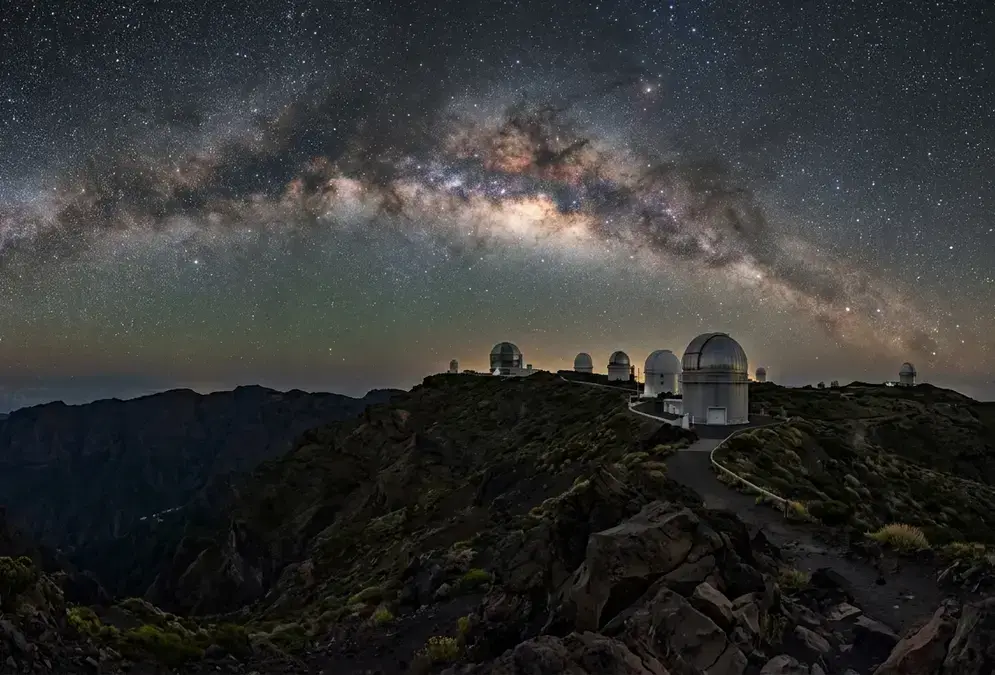

The short answer: yes, for a specific kind of stargazer
La Palma is worth a dedicated stargazing trip if darkness itself is the point, not a bonus tacked onto a beach holiday. The island's Starlight Reserve status isn't a marketing badge; it's the outcome of a law that predates the reserve designation by nearly two decades. Ley del Cielo (Law 31/1988) restricted outdoor lighting, radio interference, and aircraft flight paths across La Palma and northern Tenerife specifically to protect a working research observatory's night sky[1]. Nineteen years later, in April 2007, UNESCO, the International Astronomical Union, and the Instituto de Astrofísica de Canarias came to the island to sign the founding Starlight Declaration[2] — a manifesto, not a certification. The certification itself followed five years after that: in April 2012, Fundación Starlight named La Palma the first Starlight Reserve on Earth. Law first, recognition second: that sequence is not how most 'dark sky destination' branding actually works.
The honest version of 'worth it' comes with conditions attached. Three things separate the traveler who should book this trip from the one who shouldn't:
- You care more about sky darkness than about hotel choice, nightlife, or a wide menu of guided tours.
- You're comfortable driving mountain roads after dark and self-guiding at least one night.
- You don't need night access to the observatory itself, only to the sky above it.
If none of that describes you, Tenerife is the more forgiving choice: the island built for stargazers who also want a hotel bar and a direct flight from their home airport. If all three do describe you, the case for La Palma gets stronger from here.
What actually makes La Palma's sky different
Numbers make the case better than adjectives. La Palma holds roughly 84,000 people across the whole island, against Tenerife's roughly 964,000[3][4] — a population gap of more than eleven to one between two islands of broadly comparable size. That ratio shows up directly in the experience: less traffic on the mountain roads after dark, fewer cars queuing at any single viewpoint, and a light dome from any one town that barely registers against the sky above the caldera rim.
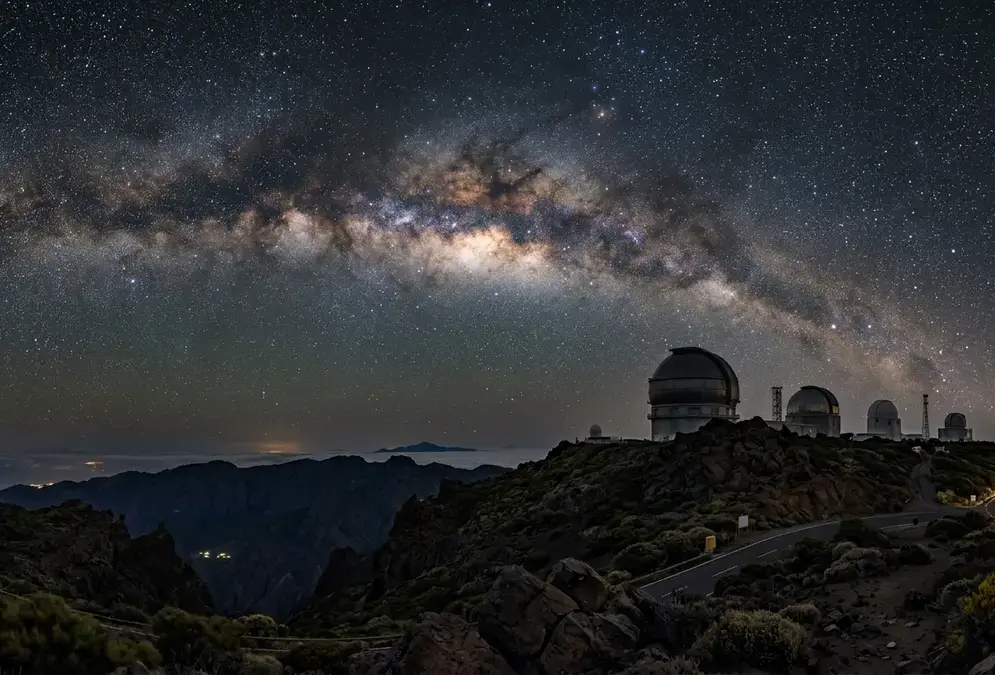
At the darkest sites, independent sky-quality readings put La Palma at Bortle Class 1-2[5], among the lowest ratings measured anywhere. Historical solar-minimum studies at the observatory logged sky-brightness figures that put the Roque de los Muchachos Observatory in the same conversation as Chile's Atacama and Hawaii's Mauna Kea for pure sky darkness. That comparison isn't tourism-board spin; it's the same body of astrophysical research that chose this exact ridge for the Gran Telescopio Canarias, the world's largest single-aperture optical telescope[6].
Featured · Destination
La Palma Stargazing
La Palma stargazing guide: the world's first Starlight Reserve since 2012, Bortle 1-2 skies above Roque de los Muchachos, plus where to stay and go year-round.
If you want to feel the difference before committing to a self-guided night on a mountain road, the operator-led alternative is the current best-reviewed guided option on the island. It's worth saying upfront, though, that the guided tour market here is thinner than Tenerife's — the next section covers that honestly, along with everything else La Palma doesn't have yet.
The observatory prestige, and its real limit
The Roque de los Muchachos Observatory (ORM), at 2,396 metres[6] on the caldera rim in the municipality of Garafía, hosts more than 20 telescopes and instruments operated by the Instituto de Astrofísica de Canarias. Beyond the GTC's 10.4-metre mirror, the site includes the William Herschel Telescope, a 4.2-metre instrument running since 1987, and the twin MAGIC Cherenkov telescopes, built for high-energy gamma-ray astronomy rather than visible light[6]. This is a working research site, not a visitor attraction dressed up as one.
Here's the access rule that catches first-time visitors off guard: ORM is a day-visit-only site. Guided day tours, led by independently operating Starlight-certified guides, run 90 to 110 minutes, cost around €20 for adults (€15 for children or La Palma residents), require a minimum age of 6, and need reservation in advance[7][10]. Gates close after dark so vehicle headlights and stray light don't interfere with live observation runs. If a tour operator offers you a 'night visit to the observatory,' that isn't part of the official IAC program, and it's worth asking hard questions about what you're actually being sold.
What that means in practice: the observatory sells you prestige and daytime access, not a night under the GTC's dome. The actual stargazing, the reason you came, happens lower down the mountain or at a handful of recognised roadside points, on your own or with an independent guide, not inside the ORM gates. For the full drive-by-drive route to the observatory and its visitor centre, see the Roque de los Muchachos Observatory guide.
What La Palma doesn't have yet
The stargazing tour market on La Palma is real but thin. Tenerife has enough competing operators that you can book a same-night guided session with equipment ranging from a shared reflector to a private astrophotography rig. La Palma's guided-tour scene is smaller and still growing rather than mature: most stargazers here still do it the way locals do, driving into Garafía or the recognised points around Las Tricias after dark and waiting for their eyes to adjust, rather than booking a polished commercial experience. If you want a curated, guide-narrated night with rental equipment and a fallback plan for cloud, that infrastructure is thinner here than on Tenerife, and it's worth knowing before you book.
Recommended tours
Tours are selected for quality, not commission. I earn a small fee if you book — at no extra cost to you.


Getting there also takes more planning. La Palma Airport (SPC) connects to roughly 21 destinations as of 2026, but most routes run through Tenerife or Gran Canaria rather than direct from major European hubs[8]. Tenerife, by contrast, has two airports serving direct flights from London, Madrid, Berlin, and Amsterdam in four to five hours. If your itinerary depends on a direct flight from your home airport, check the current SPC route list before booking; you may end up connecting through the island you almost chose instead.
21
The accommodation picture follows the same pattern: fewer hotels, fewer beach resorts, and no equivalent of Tenerife's Costa Adeje strip. That's a feature for anyone chasing darkness and a real drawback for anyone who wants a beach day built into the same trip. For a full ranked comparison of where to actually stay, weighing altitude against drive time to the observatory, see the best places to stay on La Palma for stargazing.
Not a seasonal gamble
Unlike a beach-and-resort island where 'off season' means empty hotels and a sky that stops mattering, La Palma's night sky has something worth seeing in most months, even though the marquee attraction, the Milky Way's galactic core, rises only from roughly April through October, a pattern inferred from the same climate mechanism as Tenerife's rather than independently measured for La Palma specifically. From November through March, when the core sits below the horizon, the winter sky over the caldera turns to Orion, Taurus, and the Pleiades, still under the same Bortle 1-2 darkness, just pointed at a different part of the sky.
The one real seasonal caveat is calima, the Saharan dust intrusion that peaks in December and February and can haze the sky at lower elevations[9]. The observatory itself, at 2,396 metres[6], usually sits above the dust layer and stays clear regardless, but a lodge or viewpoint down at 1,000 metres can lose real transparency during a strong episode. Check a current calima forecast before locking in winter dates; don't assume the whole island is unaffected just because the summit is.
The practical upshot: La Palma doesn't ask you to time a trip around a narrow summer window the way a beach holiday would. It asks you to pick the sky you want, galactic core or winter constellations, and check the dust forecast if you're going in deep winter. For the full month-by-month breakdown, read the best time to stargaze on La Palma.
The verdict: who should book this trip
La Palma is worth booking for:
- Purists chasing Bortle 1-2 who have already done a dark rural sky and want the real thing without a transatlantic flight.
- Repeat Canary Islands visitors who've already done Tenerife's beach-plus-stars combination and want the upgrade.
- Travelers who value quiet over convenience — an island of 84,000 people[3] with mountain roads that stay nearly empty after dark, even in August.
- Hikers and landscape travelers who want the Caldera de Taburiente and the 2021 Tajogaite lava field as a bonus to the stargazing, not the other way around.
Skip it, at least for now, if you need a same-night guided tour with polished equipment and a fallback plan for cloud, if your itinerary depends on a direct flight from your home airport, or if you want a beach day built into the same week. Tenerife handles all three better. If your budget and time allow both, the two islands are a ferry ride apart, and pairing them, Tenerife's infrastructure first, La Palma's darkness second, is arguably the smartest way to do the Canary Islands for stargazing. The full breakdown of that trade-off lives in La Palma vs Tenerife for stargazing.
The short version: La Palma earns its reputation honestly, through a 1988 law, a 2007 declaration, and a 2012 certification, not through marketing copy, and it delivers a genuinely darker sky than its more famous neighbor. What it asks in return is a rental car, more flight-connection patience, and accepting that the observatory itself is a daytime prestige visit, not a night under the GTC's dome. For the sky alone, that's a fair trade.