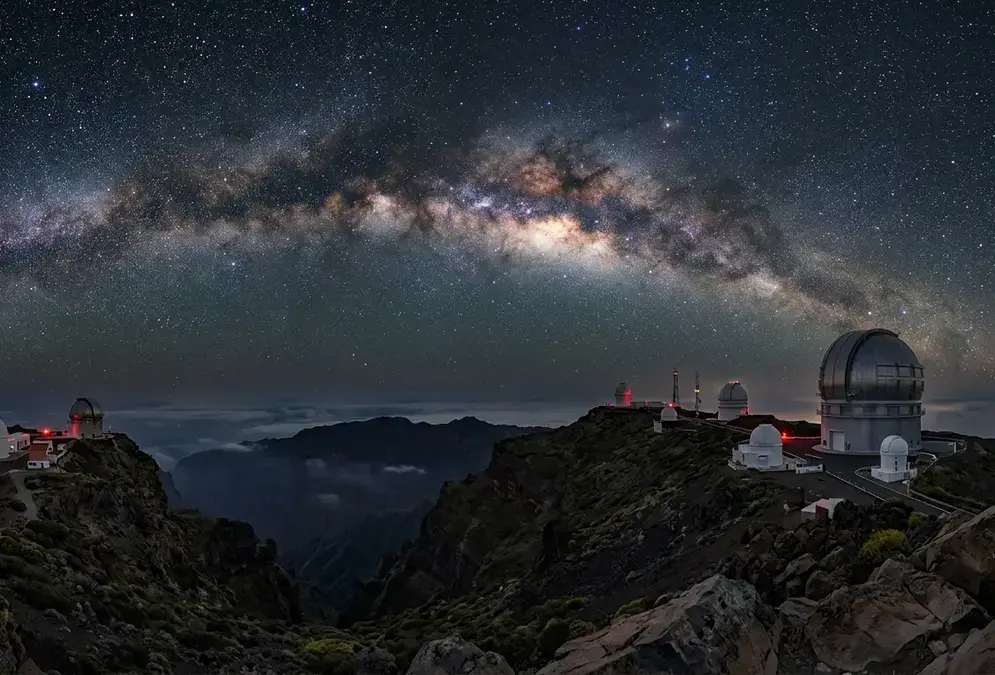

When is the best time to visit La Palma for stargazing?
There's no single peak month, and that's the honest answer before any calendar advice. The Isaac Newton Group, which co-runs the Roque de los Muchachos Observatory, logs roughly 70% of nights clear across a full year[1], so La Palma doesn't run on the tight seasonal window that drives aurora destinations elsewhere in this guide.
Three variables still decide whether a specific week delivers. The galactic core of the Milky Way is up March through October, with its steepest, most photogenic rising angle in March rather than the higher, longer-visible arc of June and July. Calima, the Saharan dust that hazes skies at lower elevations, carries its highest risk in December and February, with December averaging roughly 17 days of dust conditions in a typical year[2]; May and March are the safest months. And moon phase overrides both: book within four to five nights of a new moon, in any season, or a bright moon will wash out the Milky Way regardless of how clear the sky is.
70%
Can you visit Roque de los Muchachos Observatory at night?
No. This is the single most common misunderstanding about a La Palma stargazing trip, and it's worth stating plainly before you book anything. Roque de los Muchachos Observatory (ORM), at 2,396 metres on the caldera rim, is a working research facility protected under La Palma's Ley del Cielo, home to the Gran Telescopio Canarias, the world's largest single-aperture optical telescope[3].
It stays open to visitors only in daylight, and the gates close after dark so vehicle lights and stray illumination don't disrupt live observation runs. Guided day tours, run by the Starlight Foundation (working with the IAC) or the authorised operator La Palma Stars, last 90 to 110 minutes and start around €20 per adult, with children aged 6-11 and La Palma residents paying €15[4].
You walk the ridge, view the GTC and the MAGIC Cherenkov telescopes from outside their domes, and step inside one working dome to see how it operates. Book online in advance; there's no ticket desk at the gate, and some slots need a minimum group of ten. If a listing offers you a night visit inside the observatory itself, it isn't describing the official programme. The dark sky you actually came for happens lower down the mountain, in Garafía or at the recognised viewpoints, not behind the ORM gate.
Read next · Tour
Roque de los Muchachos Observatory Guided Visit
Daytime tour of the Roque de los Muchachos Observatory, La Palma, from €20. See the Gran Telescopio Canarias and MAGIC telescope in daylight, no night access.
Where are the best stargazing spots on La Palma, and do you need a tour?
Most independent stargazers head into Garafía, the island's darkest and least populated municipality, or the recognised viewpoints around Las Tricias, park in a marked pull-off, and wait for their eyes to adjust. No permit is required for roadside stops in this corridor; just stay off the road itself and use the designated parking rather than the shoulder on switchback sections.
Do you need a guided tour? Not really, and that's a genuine difference from Tenerife. La Palma's stargazing tour market is smaller and newer, a direct consequence of the island's lower tourism volume, so there's less formal infrastructure and fewer long-running operators to compare against each other. Guided sessions exist and are growing, typically a few hours from the coast up into the highlands with a local guide and telescope, and they're worth it if you want instruction rather than just a dark sky. Verify what's included (transport, telescope, guide credentials) before paying. If you'd rather not improvise your first night, the current top-rated pick is the La Palma stargazing tour.
How cold does it get at Roque de los Muchachos, and what should you pack?
Colder than most visitors expect from a Canary Islands beach trip. Real station data from AEMET's own weather station at the observatory (station C101A, 2,223 metres[5], in Garafía) puts the coldest monthly average at 2.6°C, recorded in February 2023, with a record low of -4.1°C on 11 January 2021. The warmest monthly average on record is 21.3°C, in August 2024, with an absolute high of 29.7°C that same month[5]. Even a mild summer night at altitude sits well below whatever the coast is doing.
Pack for those numbers, not for the forecast in Santa Cruz de la Palma:
- An insulated or down jacket, regardless of season
- A windproof outer shell, since wind at 2,000-plus metres[3] cuts through single layers fast
- Insulated boots, since volcanic rock loses heat quickly underfoot after dark
- Gloves and a hat, October through April at minimum
- A red-light headlamp, to find your footing without ruining your night vision
A rental car is not optional for any of this. There's no public transport to Garafía or the observatory road, and the drive up takes longer than the map distance suggests.
Featured · Destination
La Palma Stargazing
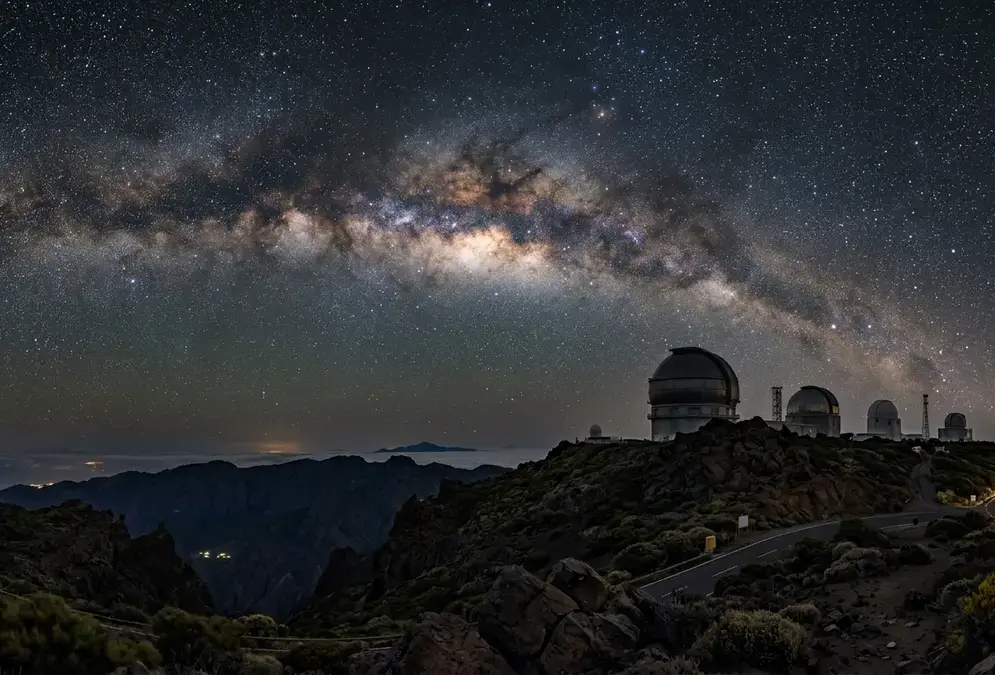
La Palma stargazing guide: the world's first Starlight Reserve since 2012, Bortle 1-2 skies above Roque de los Muchachos, plus where to stay and go year-round.
Do you need a telescope, and where should you stay?
No telescope required. Under La Palma's Bortle 1-2 rating, near the darkest end of the Bortle scale, the Milky Way's core and dust lanes are visible to the naked eye once your eyes adjust, and a pair of compact binoculars will show you more structure than most people expect at 2,000-plus metres[3]. Save the telescope for a guided session, where an operator already has one set up and pointed at something worth seeing.
Where you sleep decides how much of the night you actually get to use. Garafía, on the remote north side, is the island's darkest, least populated municipality, and Casa El Colmenero, a restored rural house at 1,042 metres[9], sits inside the altitude band where the Atlantic trade-wind cloud layer typically breaks up, the same mechanism that keeps the observatory summit clear. It carries no Starlight Foundation certification, but early guest reviews put it at 10/10, from roughly €31 per person per night[6]. For four more ranked options across different budgets, see the best places to stay on La Palma for stargazing.
Read next · Guide
Best Places to Stay on La Palma for Stargazing
Five La Palma lodges ranked for stargazing: altitude, distance to Roque de los Muchachos, and price-to-value on the world's first Starlight Reserve island.
Is La Palma better than Tenerife for stargazing?
Both islands hold Starlight Reserve status, so the honest answer depends on what you want from the trip. La Palma's darkest sites measure Bortle 1-2[7], among the darkest skies measured anywhere on Earth. What sets it apart isn't the number so much as the traffic: La Palma's population sits around 84,000, against Tenerife's roughly 964,000[8], so the crowd at any viewpoint and the light dome from any single town are both smaller by an order of magnitude.
What you give up is maturity. Tenerife's tour market, hotel infrastructure, and airport connections are all more developed, simply because far more people travel there. La Palma trades some of that convenience for a quieter island and a genuinely less-crowded mountain road after dark. For the full feature-by-feature breakdown, see La Palma vs Tenerife for stargazing.
| Factor | La Palma | Tenerife |
|---|---|---|
| Sky quality | Bortle 1-2 at Roque de los Muchachos | Bortle 1-2 at Teide, comparable dark-sky protection |
| Island population | ~84,000 | ~964,000 |
| Tour market | Smaller, newer; fewer long-running operators | More established, wider choice of guided tours |
| Getting there | Mostly connections via Tenerife or Gran Canaria | Direct flights from most of Europe |