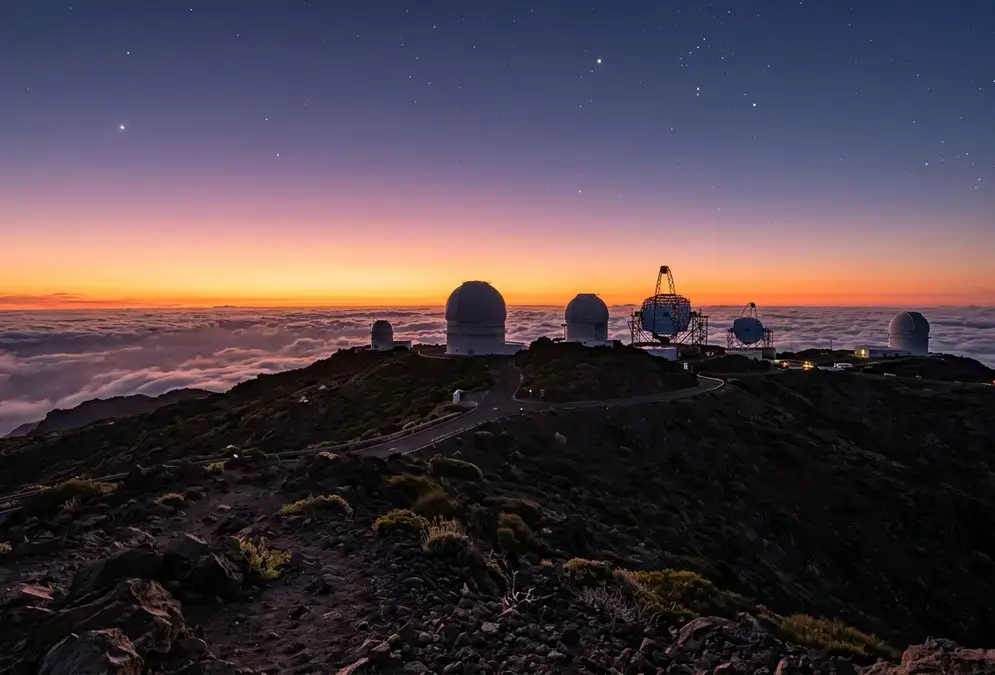
Most stargazing tours ask you to wait for full dark. This one starts the show at sunset. Near the Roque de los Muchachos ridge, at roughly 2,396 metres on La Palma's north side, the Atlantic trade-wind cloud layer sits far enough below the mountain that you watch the sun go down from above it, a flat white sea stretching to the horizon with the sun sinking into it like a coastline. A glass of wine, the guide pouring while the light turns orange, then violet. That's the opening act. The telescopes come out once the sky goes properly dark.
This combo, sunset above the cloud inversion followed by a guided telescope session, is a genuine, well-established tour type on La Palma, not a marketing invention. GetYourGuide alone lists it with 647 reviews at 4.4/5, and at least five operators run their own version: La Palma Natural, Isla Bonita Tours, Canary Live Experience, and others booking through Viator, Civitatis, and Musement. If you want the fuller picture of what's bookable across the whole island, including tours that skip the sunset and focus purely on the night sky, see the full roundup of night-sky tours. This page is about the specific sunset-to-stars format and what makes the cloud inversion above the Roque de los Muchachos worth building an evening around.
Why the sunset looks the way it does
The trick is elevation, not luck. The same trade-wind cloud layer that keeps the Roque de los Muchachos Observatory clear for the Gran Telescopio Canarias typically caps out somewhere between 800 and 1,850 metres depending on season. Anything above that band sits in dry, stable air, looking down on cloud rather than through it. At 2,396 m, near the observatory ridge, you're solidly inside that clear zone most evenings. Some operators' viewpoints sit a touch higher, around 2,400–2,430 m, but the physics is the same wherever the group parks: a marine cloud deck rolling out below, the sun dropping into it, and no haze between you and the horizon.
This is also why the sunset half of the tour is close to weather-proof in a way most sunset tours aren't. Coastal La Palma might be socked in under grey cloud on a given afternoon; up at the ridge, you're frequently standing in full sun above it. The main threat isn't cloud cover in the usual sense, it's calima, the Saharan dust haze that shows up mainly in January and February and can wash out both the sunset colours and the night sky for days at a stretch. Operators track it and will reschedule if a calima event is active on your date.
How the evening runs
Most versions of this tour follow the same shape, even though the operators differ. Pickup or self-drive gets the group to the meeting point, typically the Roque de los Muchachos Museum parking area or a hotel pickup point in Fuencaliente, Los Cancajos, Santa Cruz de La Palma, or Los Llanos de Aridane, in the mid-to-late afternoon. The drive up into Garafía and onto the ridge road takes longer than the map distance suggests; budget real time for the switchbacks.
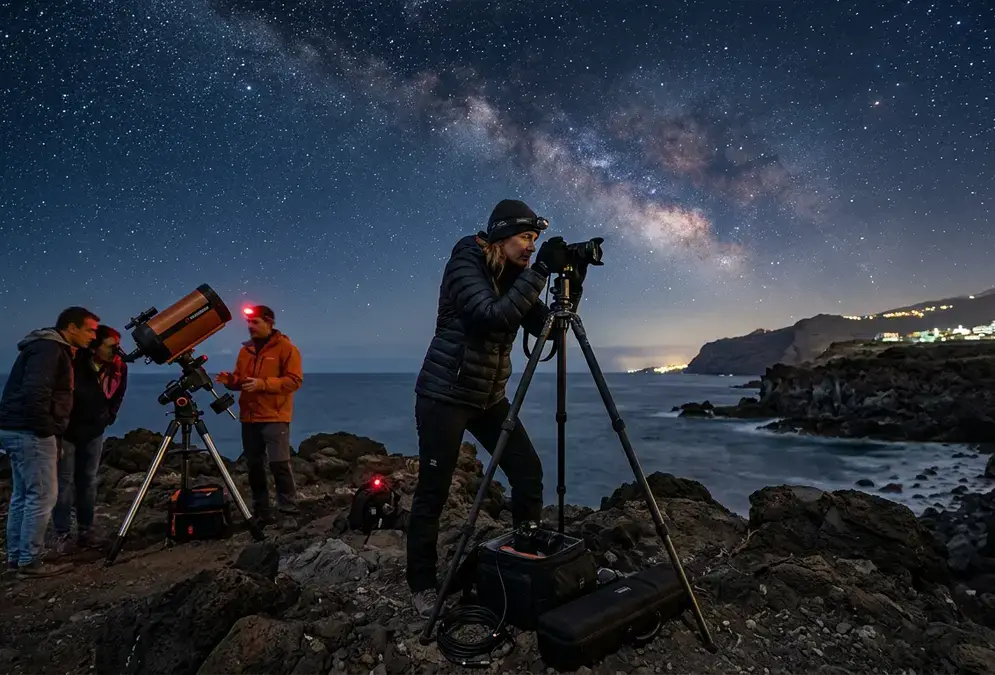
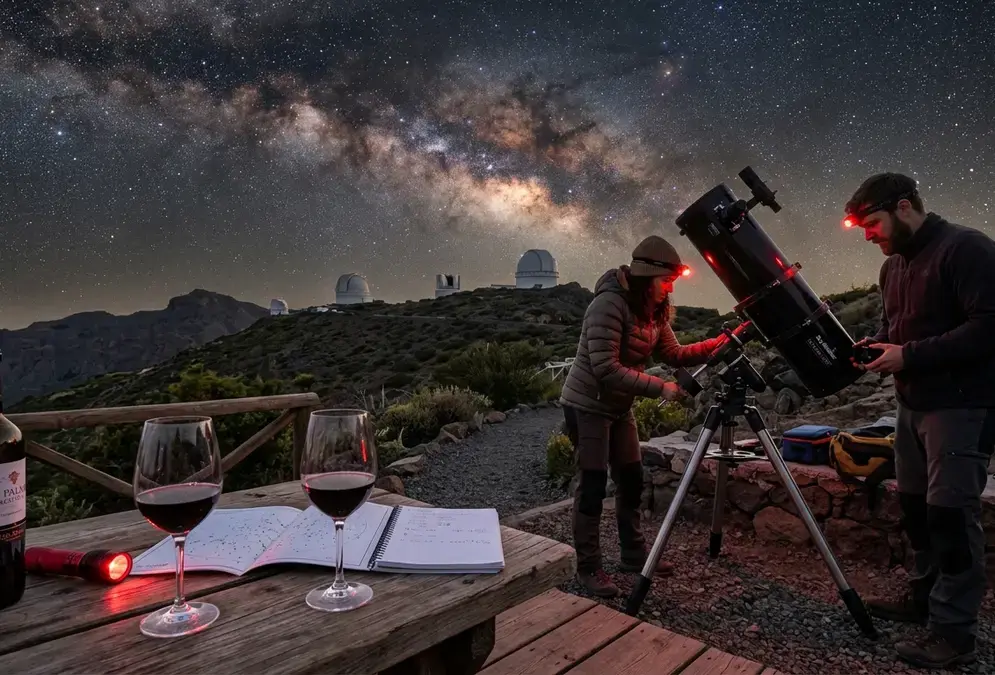
At the viewpoint, the guide, usually with a background in astrophysics or professional astronomy interpretation, walks the group through what's actually happening: the cloud inversion, the observatory's role, why this particular ridge became one of the best astronomical sites on the planet. Wine gets poured as the sun drops. Once civil twilight fades, roughly 30–45 minutes after sunset, the group moves into the stargazing half. A portable telescope, commonly a Celestron CPC 9.25, comes out on a sturdy mount, and the guide works through a target list: planets when they're up, star clusters, nebulae, and a naked-eye tour of the constellations visible that night. This is not a visit to the observatory itself. Roque de los Muchachos Observatory is a working research facility and a day-visit-only site; the telescopes you look through belong to the tour operator, set up independently near the ridge, not inside the observatory domes.
Standard tours run 4 to 6.5 hours door to door. A premium small-group tier extends the format to roughly 10.5 hours, folding in more driving time, a longer stargazing window, and a smaller group cap, priced from around €86.
Choosing an operator
The La Palma sunset-and-stars market has more operators than most single-tour categories on the island, and they don't all include the same things. A rough guide:
- GetYourGuide-listed "Stargazing Tour with Wine" — the widest-reviewed option, from €68, roughly 6–7 hours including hotel pickup from several south and west coast towns. A premium small-group version, capped at around 10 guests, runs from €86 over 10.5 hours.
- La Palma Natural (direct) — an approximately 4-hour session built around a Celestron CPC 9.25, an astrophysics-trained guide, and activity insurance. Meets at the Roque de los Muchachos Museum parking. Runs Monday to Friday, needs a minimum of 4 participants, and confirms or cancels for weather by WhatsApp around midday on the day. Free cancellation up to 24 hours out.
- Isla Bonita Tours and Canary Live Experience — smaller direct operators running their own bus or private versions of the same sunset-to-stars format; check current departure days and group sizes directly, since these run a thinner schedule than the GetYourGuide-listed options.
None of these require you to be an astronomy specialist, and none involve setting foot inside the working observatory. The differences that actually matter when booking are the group size (smaller groups mean more time at the eyepiece per person), pickup availability from your specific base, and whether the minimum-participant rule affects a small party travelling alone.
Before you book
Altitude is real, even without a cable car. At roughly 2,396 m, some guests feel mild effects, light-headedness or shortness of breath, especially if they've flown in recently or aren't used to elevation. It isn't a strenuous tour physically, but operators generally flag it as unsuitable for anyone with a history of serious altitude sickness or cardiac and respiratory conditions; check with the operator if that applies to you.
Pack for genuine cold, not a Canarian summer evening. Once the sun is down at this altitude, temperatures drop fast, often into single digits even in July and August, and closer to freezing in winter. A proper jacket, hat, and gloves matter more than the coastal forecast suggests. A red-light headlamp protects your night vision and everyone else's far better than a phone torch.
Moon phase changes what you'll actually see. Book within a few nights of new moon for the darkest sky and the clearest Milky Way; a full or near-full moon washes out the fainter detail regardless of how good the guide or the telescope is.
Free cancellation is standard, but the window is short. Most listings, including La Palma Natural, cancel or refund free up to 24 hours before departure, and confirm weather-based go/no-go decisions the same day, so keep your phone reachable on the day of the tour.
Sunset tour or a plain stargazing session?
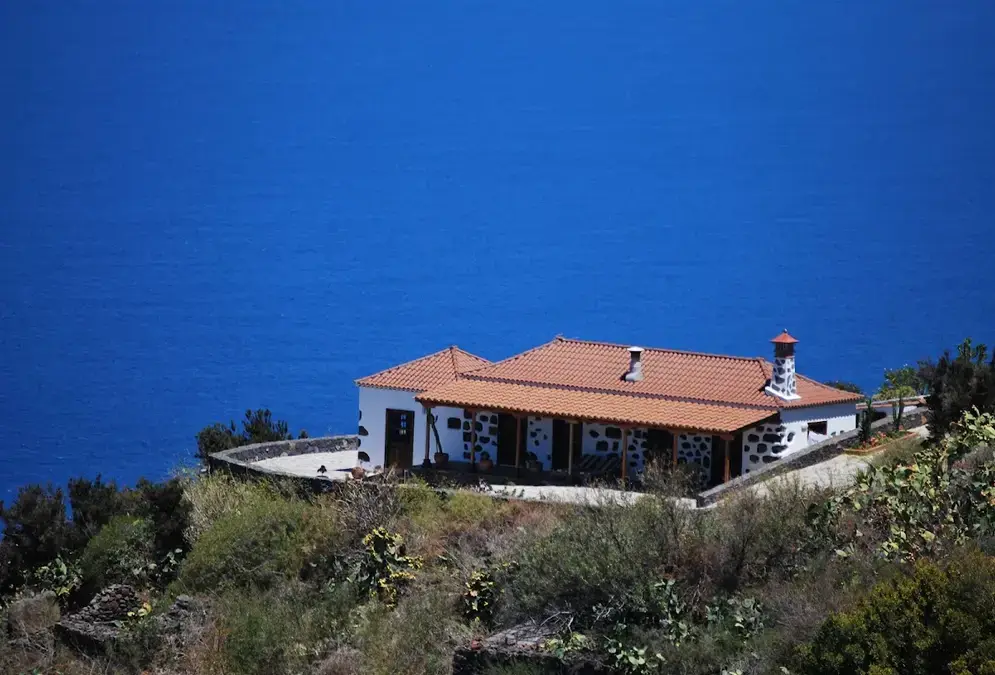
If your one priority is the darkest possible sky and you don't care about sunset, a straightforward night-only stargazing tour, or simply driving up independently after dark with your own red headlamp, is cheaper and shorter than this format. What the sunset-to-stars combo buys you is the cloud inversion view, which is genuinely its own experience and not available on a night-only booking, plus a full evening built around one outing rather than two separate trips up the mountain. For a broader comparison of what's bookable on La Palma, including tours that skip the sunset entirely, the La Palma stargazing tour page covers the wider market. If you're staying nearby, this Garafía rural house, a rural house at 1,042 m in Garafía that sits above the same cloud layer on its own terrace, is a strong base for a multi-night stay built around this kind of evening.