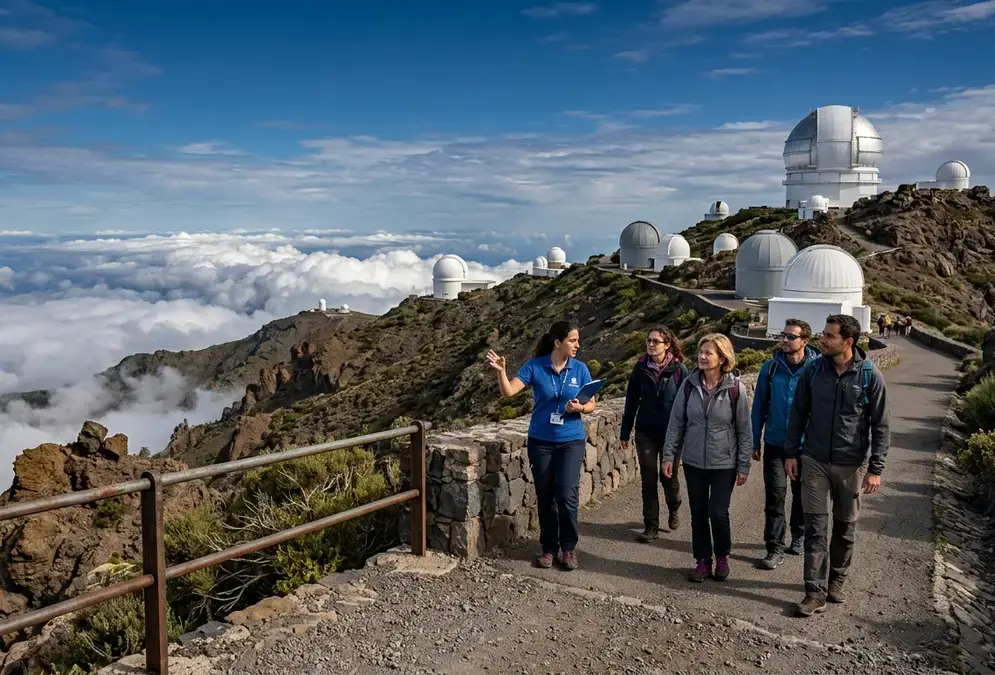
White telescope domes of the Roque de los Muchachos Observatory on La Palma at 2,396 metres, seen on a daytime guided tour, with the Gran Telescopio Canarias dome visible above a sea of clouds
Observatory Visit Free

Daytime science at the world's largest optical telescope

90–110 minutes (plus driving time from the meeting point)
Guided visits run year-round, weather permitting, booked online in advance through the Starlight Foundation (official, in collaboration with the IAC) or La Palma Stars, an authorised third-party operator. Tour dates are typically published 1–2 months ahead. Some La Palma Stars slots require a minimum group of 10. No walk-in tickets: there is no ticket desk at the observatory gate.
Visitor Centre, Roque de los Muchachos Observatory, Garafía, La Palma. Arrive with time to park and check in before your slot. Access is via the LP-4 mountain road, subject to Monday–Friday resurfacing works (08:30–17:00) from 15 June 2026 on the southern approach; the north route via Garafía is unaffected. No public transport serves the site; a rental car is required.
All activities

This is not a stargazing tour, not even close, and that distinction matters more here than almost anywhere else in the Canary Islands. The Roque de los Muchachos Observatory Guided Visit takes you inside a working research facility at 2,396 metres, on the caldera rim above La Palma's Garafía municipality, home to the Gran Telescopio Canarias (GTC), confirmed as the world's largest single-aperture optical and infrared telescope. You will see the GTC. You will not look through it, and you will not see a single star through any instrument here, because the tour runs entirely in daylight. The observatory does its real work after dark, hunting distant galaxies and faint targets with instruments too sensitive for a visitor's flashlight, let alone a tour bus. Night access for the public does not exist at Roque de los Muchachos, whatever a booking listing might imply.

What the tour covers

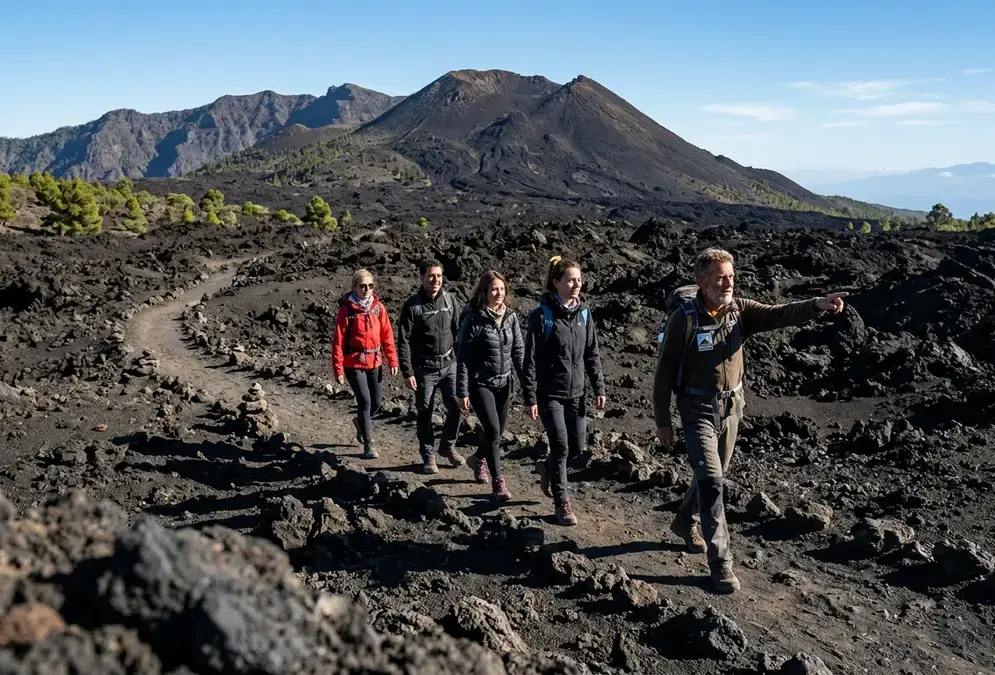
The guided visit runs 90 to 110 minutes, depending on which operator you book: the Starlight Foundation, working directly with the Instituto de Astrofísica de Canarias (IAC), or La Palma Stars, an authorised third-party operator. Both cover the same ground. You start at the Visitor Centre, then follow your guide along the ridge past the observatory's cluster of white domes.

The two instruments every guide points out first are the GTC, whose 10.4-metre mirror makes it the largest single-aperture optical and infrared telescope on the planet, and the MAGIC telescope, a pair of Cherenkov detectors built to catch gamma rays arriving from exploding stars and black holes. Depending on the day's route, you may also see construction at the Cherenkov Telescope Array (CTA) site, the next generation of gamma-ray astronomy taking shape on the same ridge.

You do not enter GTC or MAGIC. Both are active research instruments, restricted to IAC scientists and their collaborators, the same restriction that applies to GREGOR at Tenerife's Teide Observatory. What you do get is entry into a telescope dome interior, where the guide explains how the dome rotates to track a target and how the mirror is handled and maintained. The tour closes with a walkthrough of what the observatory's roughly twenty telescopes and instruments are collectively working on: research, not sightseeing, and it is that research that put La Palma's sky on the map long before anyone here sold a ticket.

Why Roque de los Muchachos is different from Teide

If you've read about Tenerife's Teide Observatory, don't assume this is the same tour with a different backdrop. Teide is a solar observatory: its flagship instruments study the Sun, which means their best work happens during the day, so a daytime visitor tour genuinely lines up with when the science happens. Roque de los Muchachos is the opposite. Its telescopes, the GTC most of all, are built to gather the faintest possible light from the deepest sky, which means their real work happens at night, precisely the hours the public cannot access. A daytime tour here describes what happens after you've gone back down the mountain.

That's not a shortcoming of the tour. It's the honest framing. You are touring a facility built around darkness, in daylight, because darkness is when the instruments are working and cannot be disturbed. If you want to experience the darkness this observatory was built to exploit, that happens lower down the mountain, on your own or on a dedicated night tour, not inside the ORM gate.

Booking, price, and who should think twice

Price: adults (12 and over) pay €20; children aged 6 to 11 pay €15; La Palma residents pay €15. Your tour ticket also carries a 50% discount on separate admission to the observatory's Visitor Centre exhibition, worth using if you have the extra half hour.

Minimum age is 6, set for safety reasons rather than content level, since this is a walking visit rather than a workshop. The operators are explicit about who should sit this one out: the visit is not recommended for anyone with anemia, heart disease, or respiratory conditions, and infants are excluded outright. Visitors aged 70 and over are advised to check with a doctor first. None of this is bureaucratic caution for its own sake. The observatory sits at 2,396 to 2,400 metres, where oxygen levels are measurably lower than at sea level, and the walking portion of the tour, while not strenuous, is enough to notice if you're not acclimatised.

Bookings are made online, in advance, through the Starlight Foundation or La Palma Stars. Some La Palma Stars slots require a minimum group size of 10, so a solo traveller or a couple may need to join a scheduled departure rather than book a private slot. Tour dates are typically published one to two months ahead, and cancellation is generally free up to 24 hours before your slot. The tour is also weather-dependent: high wind or poor visibility at 2,400 metres can trigger a reschedule with little notice, so build a flexible day around it rather than a tight one.

Getting there and logistics

There is no public transport to Roque de los Muchachos. A rental car is the only realistic way in, or you book one of the combined day-trip packages several La Palma operators run, pairing the observatory visit with a wider mountain or volcano tour. The access road, the LP-4, has resurfacing work underway on the southern approach, Monday to Friday, 08:30 to 17:00, from 15 June 2026; the northern approach via Garafía is unaffected, so route around the works if your visit falls on a weekday.

Pack a warm coat, whatever the season. The observatory sits well above the Canary Islands' beach heat, and the telescope dome interior in particular holds a chill that surprises visitors dressed for a Canarian summer. Languages on the guided visit are Spanish and English; La Palma Stars runs some Spanish-only Saturday slots, so confirm language before booking if English matters to you.

Observatory tour vs. stargazing tour: which one?

These serve different trips, and treating them as interchangeable is the single most common mistake in La Palma trip planning:

  • Roque de los Muchachos Observatory Guided Visit: Daytime science tour. You walk the observatory grounds, view the GTC and MAGIC telescopes from outside, step inside a working dome, and learn what roughly twenty instruments on this ridge are built to find. You do not look at the night sky. From €20. Duration 90 to 110 minutes. Runs year-round, weather permitting.
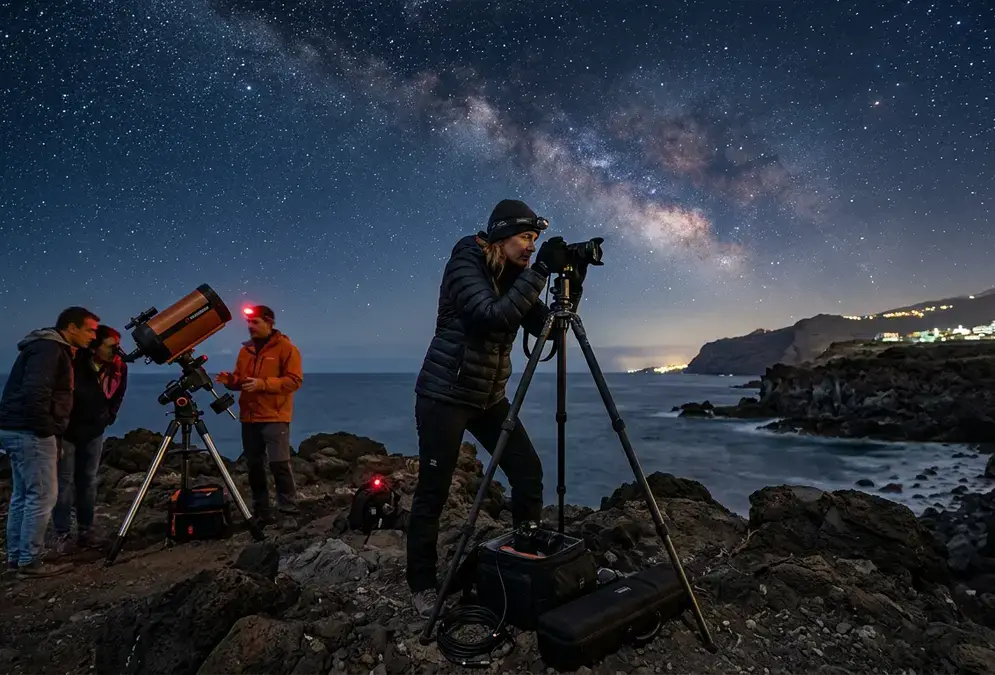
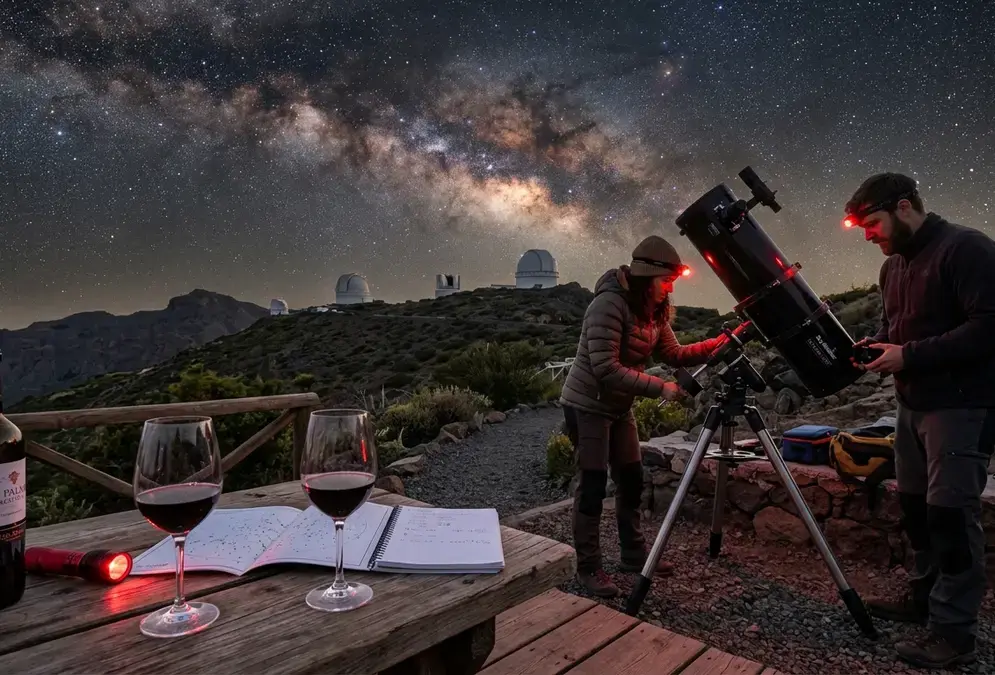
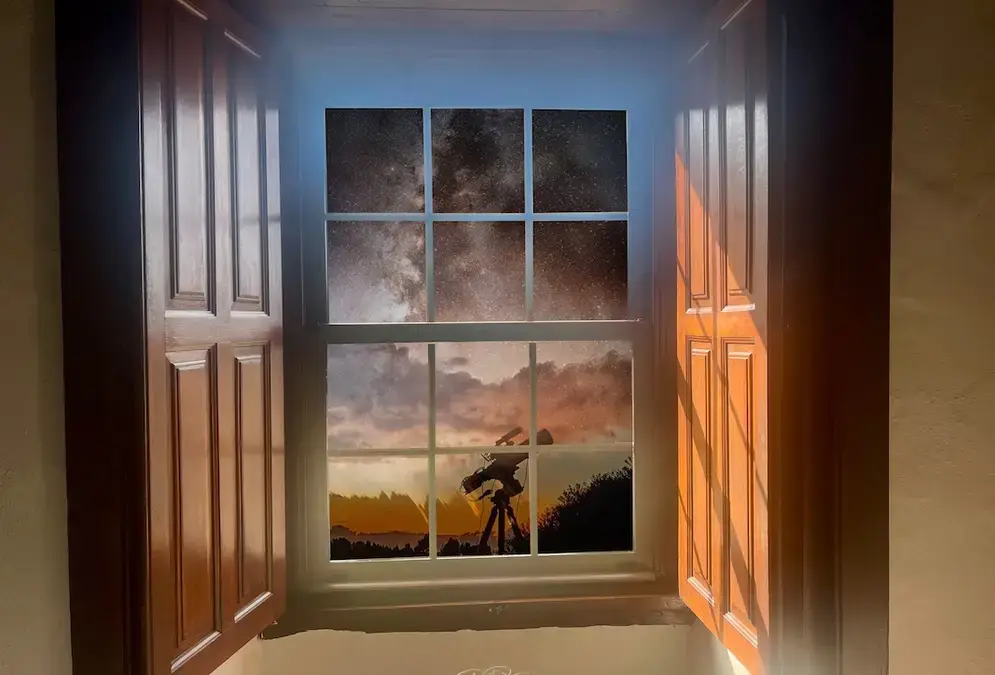
  • La Palma Stargazing Tour: Night-time observation, lower down the mountain, under La Palma's Bortle 1-2 skies, with a guide and a telescope pointed at the Milky Way, planets, and deep-sky targets. This is the tour that actually shows you a star.

Book the observatory visit if you want to understand what the GTC and MAGIC are actually looking for, and why this ridge became one of the most important optical research sites on Earth. Book the La Palma Stargazing Tour if you want to see the sky yourself.

The two pair well in a single trip: the observatory visit in the morning, when the domes are open and the guide has time to explain the science, and a stargazing session after dark, once the same telescopes you toured in daylight have gone back to work above you. For the island's Starlight Reserve status, its 1988 sky-protection law, and where to base yourself for the darkest nights, see the La Palma stargazing guide, and for a deeper look at the observatory's science and access rules, the Roque de los Muchachos Observatory guide.
Highlights

  • View the Gran Telescopio Canarias (GTC), the world's largest single-aperture optical and infrared telescope, from the observatory grounds
  • See the MAGIC telescope, the twin Cherenkov gamma-ray detector hunting for the universe's most energetic light
  • Step inside a working telescope dome and learn how it operates
  • Guided walk across the Roque de los Muchachos ridge at 2,396 metres, one of the best astronomical sites on Earth
  • Understand why ORM is a night-time research powerhouse closed to the public after dark
  • 50% discount on separate Visitor Centre admission included with your tour ticket

Included

  • 90–110 minute guided tour of the observatory grounds, led by a certified Starlight Foundation or La Palma Stars guide
  • Exterior viewing of the GTC and MAGIC telescope domes
  • Entry to one telescope dome interior, with installation and operations explained
  • 50% discount voucher for the separate Visitor Centre exhibition

Not included

  • Transport to the observatory: rental car or day-trip package required; no public bus service
  • Visitor Centre admission (discounted 50%, not free, and booked separately)
  • Night-time access: ORM does not open to the public after dark
  • Entry to GTC or MAGIC interiors: active research instruments restricted to IAC scientists
  • Food and drinks: pack water and snacks; no café at the site
  • Hotel pickup on the standard tour: self-drive unless you book a combined day-trip package

Practical information

Languages

Spanish, English, Spanish-only on some Saturdays (La Palma Stars)

Group size

Typically small guided groups; some operators (La Palma Stars) require a minimum of 10 people per booking.

Good to know before booking

  • Book online in advance via Starlight Foundation or La Palma Stars; no walk-in tickets at the gate
  • Some slots require a minimum group of 10 (La Palma Stars)
  • Minimum age 6, for safety reasons
  • Not recommended for visitors with anemia, heart disease, or respiratory conditions, or for infants
  • Medical consultation advised for visitors aged 70 and over
  • Rental car required: no public transport serves the observatory road
  • Weather-dependent: tours may be rescheduled or cancelled in adverse conditions

Prices & Booking

From €20 per adult (age 12+). Children aged 6–11: €15. La Palma residents: €15. Your ticket includes a 50% discount on separate admission to the observatory Visitor Centre. Cancellation is typically free up to 24 hours before your slot.

Guided visits run year-round, weather permitting, booked online in advance through the Starlight Foundation (official, in collaboration with the IAC) or La Palma Stars, an authorised third-party operator. Tour dates are typically published 1–2 months ahead. Some La Palma Stars slots require a minimum group of 10. No walk-in tickets: there is no ticket desk at the observatory gate.

An editorial guide to this experience. Book directly with the operator when you plan your trip.

Tags

roque de los muchachos gran telescopio canarias gtc magic telescope la palma canary islands guided tour astronomy science tour daytime iac starlight foundation cherenkov telescope array

Frequently asked questions

Is the Roque de los Muchachos Observatory tour a stargazing tour?

No. The Roque de los Muchachos Observatory Guided Visit is a daytime tour of a working research facility. You walk the observatory grounds, view the GTC and MAGIC telescopes from outside, step inside a working telescope dome, and learn about the site's research. You do not look through a telescope at stars, planets, or the Milky Way. If you want that experience, book the La Palma Stargazing Tour, which operates at night lower down the mountain.

Can I visit Roque de los Muchachos Observatory at night?

No. ORM does not allow public night access; it is a working research facility, and the telescopes are actively used by scientists every clear night. There is no official night-visit programme, and any listing offering night access to the observatory itself is not describing the official IAC-affiliated tour.

What will I actually see on the Roque de los Muchachos Observatory tour?

You'll see the Gran Telescopio Canarias (GTC), the world's largest single-aperture optical and infrared telescope, and the MAGIC telescope, a pair of Cherenkov gamma-ray detectors, both from outside their domes. Depending on the day's route, you may also see construction at the Cherenkov Telescope Array (CTA) site. The guide walks you inside the interior of a separate telescope dome to explain how it operates, and the tour includes a look at how the observatory's roughly twenty instruments contribute to current research.

How do I get to Roque de los Muchachos Observatory?

A rental car is the only realistic option; there is no public transport to the observatory. Alternatively, several La Palma operators sell combined day-trip packages that include transport alongside the guided visit. The access road, the LP-4, has resurfacing work on the southern approach Monday to Friday, 08:30 to 17:00, from 15 June 2026; the northern route via Garafía is unaffected.

Is this tour suitable for everyone?

Not everyone. Minimum age is 6. The operators advise against the visit for anyone with anemia, heart disease, or respiratory conditions, and infants are not permitted. Visitors aged 70 and over should check with a doctor first. The observatory sits at 2,396 to 2,400 metres, where oxygen levels are measurably lower than at sea level, so mild breathlessness on the walking portion is normal for unacclimatised visitors.

How much does the Roque de los Muchachos Observatory tour cost?

Adults (age 12 and over) pay €20. Children aged 6 to 11 pay €15. La Palma residents pay €15. The ticket also includes a 50% discount on separate admission to the observatory's Visitor Centre exhibition. Cancellation is typically free up to 24 hours before your slot.

What is the difference between the observatory tour and the La Palma Stargazing Tour?

The observatory tour runs during the day at the ORM research facility (2,396 m). You tour the grounds, view the GTC and MAGIC telescopes, and enter a working dome. You do not look at the night sky. It costs from €20 and lasts 90 to 110 minutes. The La Palma Stargazing Tour runs at night, lower down the mountain, under La Palma's Bortle 1-2 skies, with a guide and telescope pointed at real targets. The two pair well as a single day: the observatory tour in the morning, the stargazing tour after dark the same night.

How far in advance should I book the Roque de los Muchachos Observatory tour?

Tour dates are typically published one to two months ahead, so booking as soon as your travel dates are set is the safest approach, especially since some La Palma Stars slots require a minimum group of 10 and can fill around that threshold. There is no walk-in availability at the observatory gate.

Do I need to book the Visitor Centre separately from the observatory tour?

Yes. The guided tour and the Visitor Centre exhibition are booked and paid for separately, but your tour ticket includes a 50% discount on Visitor Centre admission. If you have the extra 30 minutes, it's worth combining both on the same visit.

Further reading

Sources