Why La Palma: the trade winds, the isolation, and the founding of Roque de los Muchachos Observatory
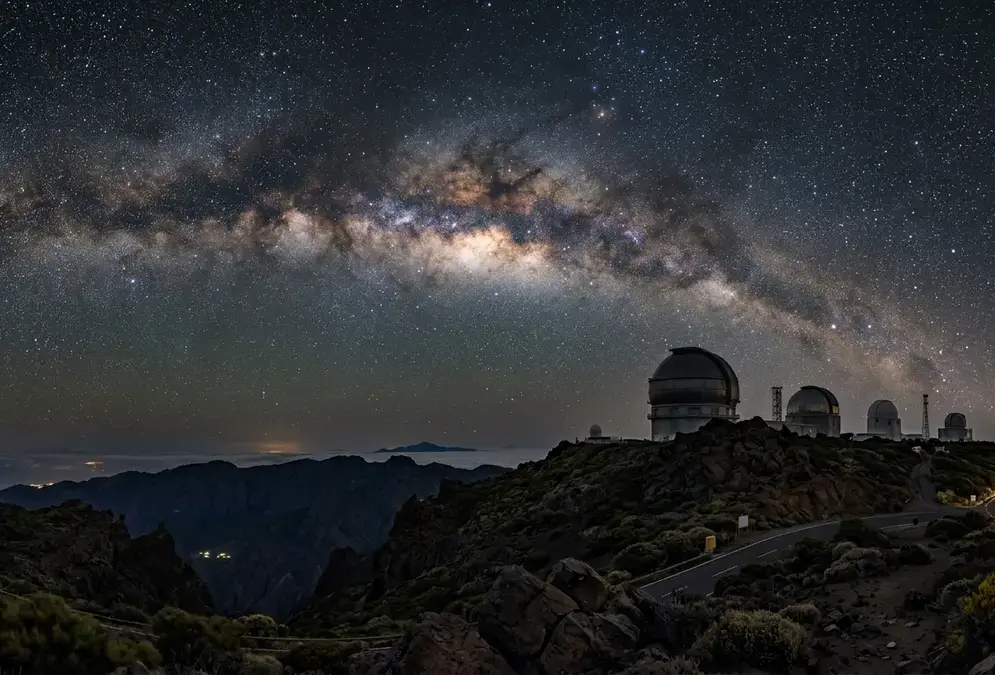
At 2,396 metres[1] above the Atlantic, on the northern rim of the Caldera de Taburiente, sits one of the greatest concentrations of astronomical hardware on Earth. The Roque de los Muchachos Observatory (ORM) hosts around twenty telescopes and instruments[1] in addition to its flagship, from a 10.4-metre giant to twin gamma-ray hunters that watch for flashes of light lasting billionths of a second. Unlike its sister site at Teide Observatory on neighbouring Tenerife, which specialises in daytime solar physics, ORM does its work after dark: optical and infrared astronomy, and, more unusually, ground-based gamma-ray astronomy.
The observatory's siting follows the same physical logic as Teide's: La Palma sits above the trade-wind inversion layer, the persistent band of cloud that traps moist air a few hundred metres above sea level and leaves the summit above it in dry, still, turbulence-free conditions. What sets Roque de los Muchachos apart is elevation and isolation. At nearly 2,400 metres[1], with the nearest large light source an hour's drive away and the Sky Law (more on that below) suppressing what light exists, the summit offers some of the darkest, steadiest skies available to any observatory in the northern hemisphere. La Palma, the world's first Starlight Reserve, is covered in full in our La Palma stargazing guide, from where to set up a telescope to which months give the steadiest air above the inversion layer.

Featured · Destination

La Palma Stargazing

La Palma stargazing guide: the world's first Starlight Reserve since 2012, Bortle 1-2 skies above Roque de los Muchachos, plus where to stay and go year-round.

ORM began as an international project and has stayed one. The site was first staffed by teams from Spain, Sweden, Denmark, and the United Kingdom[2], joined over the following decades by Germany, Italy, Norway, the Netherlands, Finland, Iceland, and the United States. The observatory is administered by the Instituto de Astrofísica de Canarias (IAC), headquartered on Tenerife[2], which also runs Teide Observatory as the second node of the same research infrastructure. Together the two sites make up the European Northern Observatory, but where Teide answers questions about the Sun a few hundred kilometres away, Roque de los Muchachos looks outward: at brown dwarfs in the Pleiades, quasars five billion light-years distant, and galaxies old enough to carry the fingerprints of the universe's first stars. For the month-by-month breakdown of clear-sky odds and calima dust risk on the mountain, see our best time for stargazing in La Palma guide.

The telescopes: from a 100-inch relic to the world's largest single mirror

Roque de los Muchachos operates roughly twenty telescopes and instruments, but four define what makes the site significant.
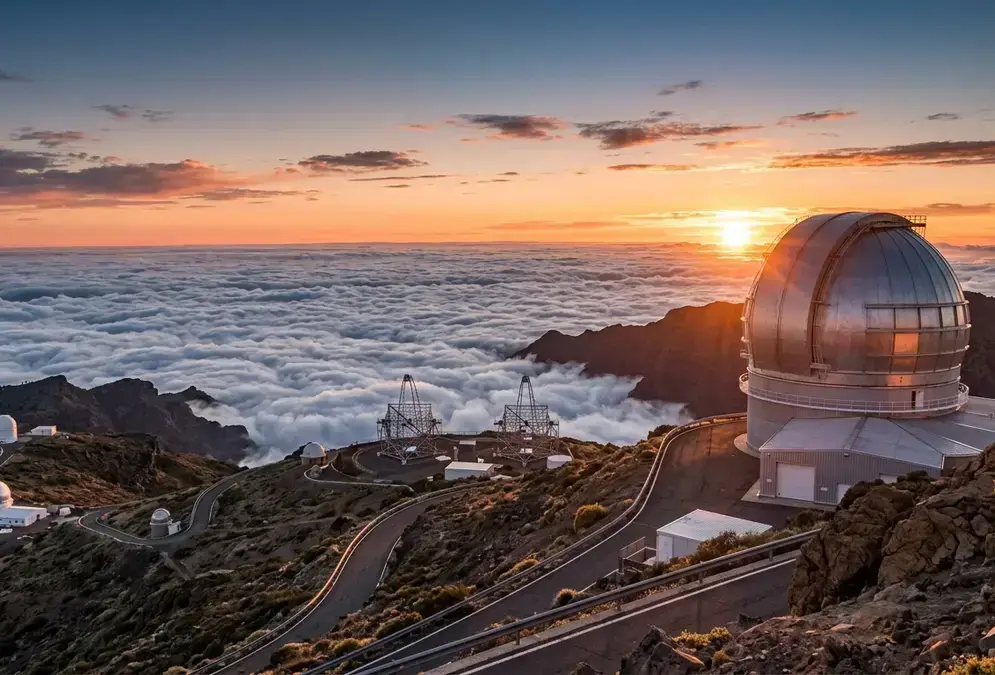
Gran Telescopio Canarias (GTC) is the flagship, and by one measure it's unmatched anywhere on Earth: a 10.4-metre segmented primary mirror, the world's largest single-aperture optical telescope, which saw first light on 13 July 2007, began routine science observations in 2009, and was formally inaugurated on 24 July 2009 by King Juan Carlos I[3] — a sequence spread across two years that reflects how a telescope this size gets commissioned in stages, not switched on overnight. The mirror itself is built from 36 hexagonal segments, together forming a light-collecting surface of 75.7 square metres[4], each segment nudged into alignment by computer-controlled actuators so the whole array behaves as one continuous surface. The IAC's own description of the telescope's mission is unambiguous about ambition: searching for Earth-like exoplanets, probing dark matter, and tracing the evolution of the most distant galaxies, quasars, and black holes.
Telescope domes of the Roque de los Muchachos Observatory at sunset on La Palma, the Gran Telescopio Canarias dome catching golden light above a sea of clouds

Telescope domes of the Roque de los Muchachos Observatory at sunset on La Palma, the Gran Telescopio Canarias dome catching golden light above a sea of clouds

The William Herschel Telescope (WHT), a 4.2-metre reflector, saw first light on 1 June 1987 and was, at the time, the third-largest single optical telescope in the world[5]. Nearly four decades on it remains one of the observatory's most productive instruments, and it holds a specific place in the story of substellar astronomy, covered next.
TelescopeApertureFirst lightNote
GTC10.4 m (segmented)2007World's largest single-aperture optical telescope
WHT4.2 m1987Third-largest in the world at the time
INT2.54 m (100-inch)Relocated from EnglandOriginally built at Herstmonceux Castle, Sussex
MAGIC (x2)17 m mirrors (Cherenkov)2004 / 2009Detects very-high-energy gamma rays
The Isaac Newton Telescope (INT) has the strangest biography of the four. It began life at the Royal Greenwich Observatory's site at Herstmonceux Castle in East Sussex, England, and was relocated to La Palma, where it was upgraded to a 100-inch (2.54-metre) aperture[6]. It now operates alongside the WHT as part of the Isaac Newton Group of Telescopes (ING) — a piece of British astronomical history rebuilt on a Spanish volcano.
  • GTC: 10.4 m segmented mirror, 36 hexagons, first light 2007, science operations from 2009
  • WHT: 4.2 m reflector, first light 1987, third-largest in the world at the time
  • INT: 2.54 m (100-inch), relocated from Herstmonceux Castle, England
  • Around 20 further telescopes and instruments cover everything from robotic survey cameras to solar-system tracking

What GTC found: a failed star, a fossil fingerprint, and a fading black hole

Roque de los Muchachos' most famous discovery is also the one most commonly told wrong, so it's worth being precise about what happened where. Teide 1, the first object ever confirmed to be a brown dwarf (a substellar body too small to sustain hydrogen fusion but too massive to call a planet), was actually found on the other island. The IAC team imaged it on 6 January 1994 using the 80-centimetre IAC-80 telescope at Teide Observatory, on Tenerife. What happened at Roque de los Muchachos came next: that December, the William Herschel Telescope recorded Teide 1's first spectrum, the data that let astronomers begin arguing the object was genuinely substellar rather than an ordinary faint red dwarf. The argument wasn't settled at La Palma either: full confirmation required the lithium test, a diagnostic that works because true stars burn through their lithium quickly while brown dwarfs retain it, and that evidence came from spectra taken by the Keck 1 telescope in Hawaii in November 1995[7]. Three telescopes, two islands, two continents, one confirmed brown dwarf. "Discovered at Teide, confirmed at La Palma" is the tidy version; the real one took nearly two years and three observatories.
GTC has kept adding to that legacy on a much shorter timescale. In March 2026, IAC astronomers used the telescope to observe a supermassive black hole fading at an extraordinarily rapid rate, the kind of measurement that needs exactly the light-gathering power a 10.4-metre mirror provides. Three months later, in June 2026, GTC data helped identify what the IAC describes as a "fossil fingerprint" of the universe's first stars, preserved in the galaxy NGC 1277[8]. Neither result would have been possible with the telescopes that came before it. That's the practical argument for building a mirror this size on a volcano in the Atlantic: some questions about the universe's earliest moments are only answerable if you can gather enough of its oldest, faintest light.
Timeline
  1. 6 Jan 1994

    Teide 1 imaged

    The IAC team images the brown dwarf candidate using the IAC-80 telescope at Teide Observatory, Tenerife, not La Palma.

  2. Dec 1994

    First spectrum, recorded at ORM

    The William Herschel Telescope records Teide 1's first spectrum, opening the case for a substellar classification.

  3. Nov 1995

    Confirmed by Keck 1

    Spectra from the Keck 1 telescope in Hawaii pass the lithium test, fully confirming Teide 1 as the first known brown dwarf.

  4. 13 Jul 2007

    GTC first light

    Gran Telescopio Canarias sees first light on its segmented 10.4-metre mirror.

  5. 2009

    GTC science operations begin

    Routine science observations start; the telescope is formally inaugurated on 24 July by King Juan Carlos I.

  6. Mar 2026

    Fading black hole observed

    GTC data captures a supermassive black hole fading at an extraordinarily rapid rate.

  7. Jun 2026

    NGC 1277 fossil fingerprint

    IAC astronomers identify a fossil fingerprint of the universe's first stars preserved in the galaxy NGC 1277.

Hunting gamma rays: the MAGIC telescopes and Cherenkov light

Not every telescope at Roque de los Muchachos looks at visible light. The two MAGIC telescopes (Major Atmospheric Gamma Imaging Cherenkov) do something stranger: they watch for faint blue flashes lasting a few billionths of a second, the afterglow of a single gamma-ray photon slamming into the upper atmosphere and setting off a cascade of secondary particles, a phenomenon called Cherenkov light.
Each MAGIC telescope carries a 17-metre mirror, making the pair the largest Cherenkov telescopes anywhere until Namibia's H.E.S.S. II was built. The first unit became operational in 2004; the second began taking data in July 2009, and running the pair together in stereoscopic mode, the same event caught by two mirrors from slightly different angles, sharpened the system's ability to tell a genuine gamma-ray shower from cosmic-ray background noise. Together they're sensitive to very-high-energy (VHE) gamma rays across roughly 25 GeV to 30 TeV, energies that don't come from anything as gentle as starlight: supernova remnants, pulsar wind nebulae, the violent surroundings of supermassive black holes. MAGIC's signature result came in 2006, when the array detected VHE gamma rays from 3C 279, a quasar roughly five billion light-years away, doubling the previous record for the most distant source of very-high-energy gamma rays ever recorded[9].
That detection mattered for more than bragging rights. Gamma rays from five billion light-years away have to cross that entire distance through intergalactic starlight, which should absorb higher-energy photons along the way. Catching them at all placed a hard constraint on how much background light fills the universe, a number cosmologists still argue over.

5 billion light-years

The distance to quasar 3C 279, source of the most distant very-high-energy gamma rays ever detected by the MAGIC telescopes — a 2006 detection that doubled the previous record.

The Sky Quality Law: how La Palma protects the observatory's night

None of this works without law. The Ley del Cielo (Law of the Sky), Spain's Law 31/1988, was passed by the Spanish Parliament on 31 October 1988 after a proposal from the Canary Islands Parliament, with implementing regulations approved on 13 March 1992[10]. It is, as far as anyone can tell, the only national law anywhere written specifically to protect the conditions astronomers need to do their work.
It is, as far as anyone can tell, the only national law anywhere written specifically to protect the conditions astronomers need to do their work.
The law regulates four distinct things: outdoor lighting on La Palma and on the part of Tenerife visible in a direct line of sight from La Palma; maximum levels of electromagnetic radiation, to stop radio transmitters from swamping sensitive instruments; activities that could degrade the atmosphere's clarity around the observatories; and the routes aircraft are permitted to fly overhead. Enforcement runs through the Technical Office for the Protection of the Sky Quality (OTPC), created within the IAC in January 1992 specifically to set and monitor the lighting specifications the law requires[10].
  • Lighting: shielded, downward-directed fixtures required across La Palma
  • Radio interference: electromagnetic radiation capped to protect sensitive receivers
  • Atmospheric quality: activities that could degrade clarity near the observatories are restricted
  • Air traffic: flight paths over the observatories are regulated
Walk through any town on La Palma after dark and the effect is visible: streetlights point down, not up, and there's markedly less glow on the horizon than you'd expect from a populated island. That's not an accident of small-town infrastructure. It's four decades of deliberate policy, written into national law because the Canary Islands Parliament asked for it before the observatory at Roque de los Muchachos had even finished being built out. If you visit, the same discipline applies to you: read our dark sky etiquette guide before you set up a telescope anywhere on the island.

Visiting Roque de los Muchachos: the daytime tour and how to pair it with a night on the mountain

Roque de los Muchachos does not offer night-time public access. It's a working research facility, not a museum, and the guided visits that exist run strictly in daylight[11]. That surprises people who assume a "world's biggest telescope" experience means looking through an eyepiece after dark; it doesn't, and no operator on La Palma will tell you otherwise.
The daytime guided visit is run by the Starlight Foundation, in partnership with the IAC, alongside authorised third-party operators. It costs around 20 euros for adults, runs roughly 90 to 110 minutes, and takes you past the GTC dome and the MAGIC telescopes with a guide explaining what each instrument is chasing. Full logistics, booking links, age limits, and altitude-health notes are covered in the Roque de los Muchachos Observatory tour guide, worth reading before you book since the minimum age, health restrictions, and the 2,396-metre[1] altitude catch a fair number of visitors off guard.
If you're deciding between La Palma and its solar-focused neighbour for a stargazing trip, La Palma vs Tenerife for stargazing breaks down which island suits which kind of visit: La Palma for night-sky depth and gamma-ray science, Tenerife for solar physics and slightly easier logistics.
The honest pitch for visiting Roque de los Muchachos in daylight is the same one that applies at Teide: understanding what the telescopes are doing makes the night sky more interesting, not less. Once you've stood next to the GTC dome and heard how a 10.4-metre mirror is assembled from 36 moving pieces, the point of light you see through your own modest travel telescope that same evening reads differently. You know, now, how much apparatus it took someone else to answer questions that faint light can't answer on its own.