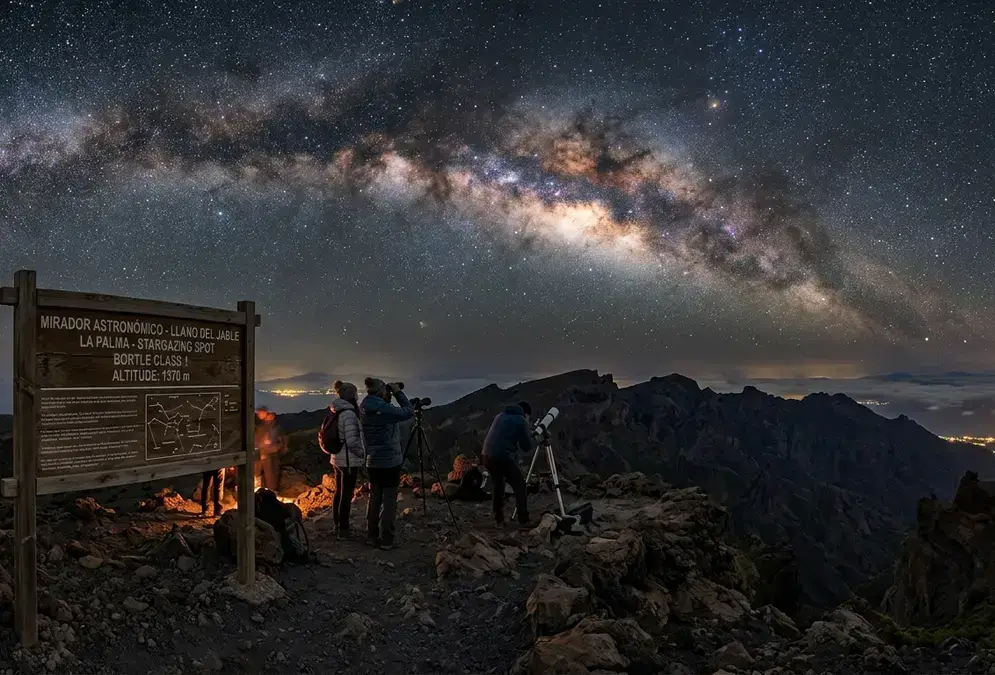

La Palma's official Miradores Astronómicos network
Most stargazing guides list scattered pull-offs and leave you to find them in the dark. La Palma did something different: the Cabildo de La Palma, the island's governing council, designed and signposted a network of Miradores Astronómicos (astronomical viewpoints) across the island, a structure that simply doesn't exist on Tenerife or almost anywhere else in the Canaries.
The project began in 2010 with two inaugural sites, Llano de las Ventas and Llano del Jable, and has grown to roughly 16 stops spanning the island's full altitude range, from low roadside pull-offs to high-altitude sites where the sky reliably clears the cloud layer below. Every stop carries the same basic kit: an information panel covering Moon observation, the main constellations, the Pole Star, and the island's Sky Law, plus at several sites public furniture, railings, benches, low-level lighting, and shared binoculars or telescopes.[1]
16
The Cabildo has also been drafting formal regulations to govern how the network gets used, an unusual step for a tourism department to take, and a sign the island manages its dark sky as infrastructure, not just a marketing line.[2]
That infrastructure sits on real legal protection. La Palma passed the Ley del Cielo in 1988, one of the first laws anywhere written specifically to protect night-sky quality for astronomical observation, and — following the 2007 Starlight Declaration signed on the island — has held Starlight Reserve status, the world's first, since 2012, when it was simultaneously named a Starlight Tourist Destination.[3] The law limits outdoor lighting, flight paths near the observatory, and radio transmissions that could interfere with the professional telescopes on the Roque de los Muchachos ridge. The Miradores Astronómicos network is the public-facing side of that protection: 16 places where anyone with a rental car can pull over and stand under the same protected sky the observatory uses for research. For the island-wide picture beyond these viewpoints, see La Palma Stargazing.
Roque de los Muchachos: the highest point, and why you can't stargaze at the summit
Roque de los Muchachos is the island's high point, 2,426 metres above sea level[4] — the observatory campus sits just below that summit, at 2,396 m — home to a working scientific facility you cannot simply wander into after sunset. The observatory grounds close to the public after dark, and alternative public observation points sit beyond a barrier at the junction of the LP-4 and LP-403, a short distance below the fenced research site.[4] The Instituto de Astrofísica de Canarias built here because the air is dry, stable, and clears the cloud layer, conditions valuable for professional research and for anyone chasing the darkest end of the Bortle scale.
Here's the part most trip-planning content gets wrong: you cannot drive up and stargaze at the summit itself. What you can do, once past the barrier, is use the alternative observation points, including two signposted network stops, Mirador Amateur Pico de la Cruz and Mirador al Infinito, both in the San Andrés y Sauces municipality near the ridge.[5] Turn your headlights off and skip the flashlight once you're set up: one set of headlights can wash out a dozen other people's night vision at once.
Featured · Destination
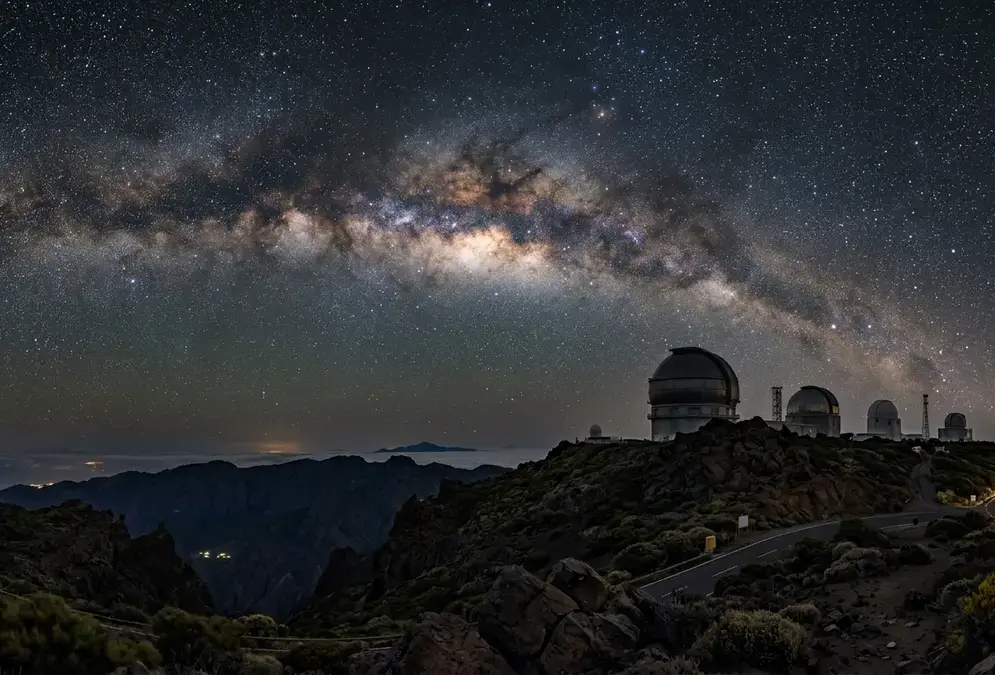
La Palma Stargazing
La Palma stargazing guide: the world's first Starlight Reserve since 2012, Bortle 1-2 skies above Roque de los Muchachos, plus where to stay and go year-round.
Standing at the barrier after your eyes adjust, the ridge above you is genuinely silent, no music, no chatter carrying up from the towns below, just wind and the occasional click of someone's tripod locking into place. The Milky Way's core, when it's up, sits high enough here that you don't crane your neck to find it; that's the actual argument for driving this far rather than settling for a lower, easier stop.
Altitude here runs noticeably colder than the coast, and near 2,400 metres[4], near-freezing nights are common outside summer; the the general stargazing gear checklist covers what you'll actually need.
Llano del Jable: the volcano-view balcony above the clouds
Llano del Jable, in the municipality of El Paso, was one of the two viewpoints that opened the network in 2010, alongside Llano de las Ventas, and it remains one of the easiest above-the-clouds sites to reach on the island.[1]
It sits at roughly 1,200 metres (some sources put it closer to 1,340 metres; treat the figure as approximate rather than exact), high enough that the trade-wind inversion usually keeps the cloud layer below it, covering the modest light pollution of the Aridane Valley beneath. The viewpoint has an information panel and ample parking, but nothing else, no bar, no shop, no shelter, so bring warm layers rather than counting on picking anything up locally.[7]
By day, the same spot looks out over the Aridane Valley with the reddish cone of Montaña Quemada in the foreground, and it doubles as one of the island's better sunset viewpoints before the sky turns properly dark. Worth knowing if you're nervous about the 2021 headlines: the Tajogaite eruption reshaped part of the Aridane valley floor below, but the lava field sits well downhill on the western coastal strip near Los Llanos de Aridane, not on the Jable plateau or anywhere near this viewpoint.[8]
Mirador del Time and Mirador Astronómico La Muralla: easy access, different personalities
Mirador del Time and Mirador Astronómico La Muralla sit minutes apart on the same road, the LP-1 between Los Llanos de Aridane and Puntagorda, and they could not feel more different once the sun goes down.
| Viewpoint | Altitude | Access | Best for |
|---|---|---|---|
| Alternative points near Roque de los Muchachos | ~2,400 m | LP-4/LP-403 junction, night barrier | Darkest sky, above every cloud |
| Llano del Jable | ~1,200 m | Paved, ample parking | Above the clouds, no services nearby |
| Mirador del Time | 594 m | Paved, LP-1 roadside | Valley and ocean view, on-site bar |
| Mirador Astronómico La Muralla | Roadside, LP-1 | Paved, no hike | Easiest access, Pole Star marker |
| Mirador Volcán de San Antonio | Southern island (Fuencaliente) | Paved | Best base for the south |
El Time, at 594 metres, is the lower and more social of the two. It's an elevated balcony over the Aridane Valley and the Atlantic, with a wide western horizon clear enough on a good night to pick out El Hierro, and it's one of the few network stops with an actual bar on site, serving a Spanish omelette and a barraquito coffee before you start observing. A tougher alternative exists too: a steep, rocky 3-kilometre zig-zag path climbs up from Tazacorte's old quay on the coast, for anyone who'd rather arrive on foot than by rental car.[9] It sits lower and closer to town light than the high-altitude stops, so it earns its place for the view and the convenience rather than for having the darkest sky on the island.
La Muralla sits directly beside the LP-1 near the km 83 marker in Tijarafe's Aguatavar area, next to the same-named restaurant, no hike required, park and walk a few steps to the railing.[10] It carries the network's standard kit, panels, railings, seats, lighting, binoculars and telescopes, plus a marker that helps first-timers find the Pole Star, and its information panel leans into local history: alongside Moon-observation basics, it covers how the Awara, La Palma's pre-Hispanic Benahoarita population, read the night sky into their own mythology, a detail most roadside viewpoints skip entirely.
Mirador Volcán de San Antonio, and the rest of the network
The south of the island has its own confirmed stop, Mirador Volcán de San Antonio in Fuencaliente. The rest of the network fills in gaps across the north and centre:[11]
- Mirador San Bartolo, in Puntallana
- Mirador del Molino, in Barlovento
- Mirador Montaña Buracas, in Garafía
- Mirador de Miraflores, in Puntagorda
None of them get the tourism-board attention of the four featured above, but they carry the same panels, the same Sky Law protection, and the same basic promise: pull over, park, and the sky above you is genuinely dark.
Recommended tours
Tours are selected for quality, not commission. I earn a small fee if you book — at no extra cost to you.
Worth naming specifically: Fuente de los Roques, a spot that gets recommended online as a stargazing destination, isn't actually part of the official program. It's a recreational picnic area inside Cumbre Vieja Natural Park, close to the Ruta de los Volcanes hiking trail, pleasant enough after dark if you're already out there, but not a signposted viewpoint with a panel, furniture, or any official standing.[12]
The south of the island looks different after dark than the north. Fuencaliente's volcanic cones sit low and dark against the sky, the Teneguía and San Antonio craters barely distinguishable from the surrounding pine forest until your eyes fully adjust, and the light from the coastal towns below stays low enough that it rarely intrudes on the view straight up.
Planning your night: which spot, and how it all fits together
Pick your spot by what matters most on the night you have:
- Darkest sky, no matter the drive: the alternative observation points below Roque de los Muchachos.
- Above the clouds, nothing else around: Llano del Jable.
- A view, a hot drink, and an easy walk from the car: Mirador del Time.
- Easiest roadside stop, with a cultural detail on the panel: Mirador Astronómico La Muralla.
- Traveling in the south of the island: Mirador Volcán de San Antonio.
Read next · Article
Best Time for Stargazing in La Palma
La Palma stargazing peaks May-September, but real AEMET data shows calima risk spikes in December and February, not January. Month-by-month planning inside.
None of these viewpoints require a permit. Formal rules governing the network are still being drafted by the Cabildo, so treat current access as free and unrestricted until on-site signage says otherwise.[13] If you're still deciding which month to go rather than where to stand once you arrive, when La Palma's skies are clearest covers the calima risk and moon-phase planning that decides whether any of these spots delivers on a given night.
And if you'd rather have someone else drive and point the telescope, this guided observatory-area session covers the current best-reviewed option. Whichever spot you pick, the sky above it is the same protected sky the observatory uses for research, free, public, and yours the moment you turn off your headlights.