AlGharameel Nature Reserve: AlUla's only certified stargazing session
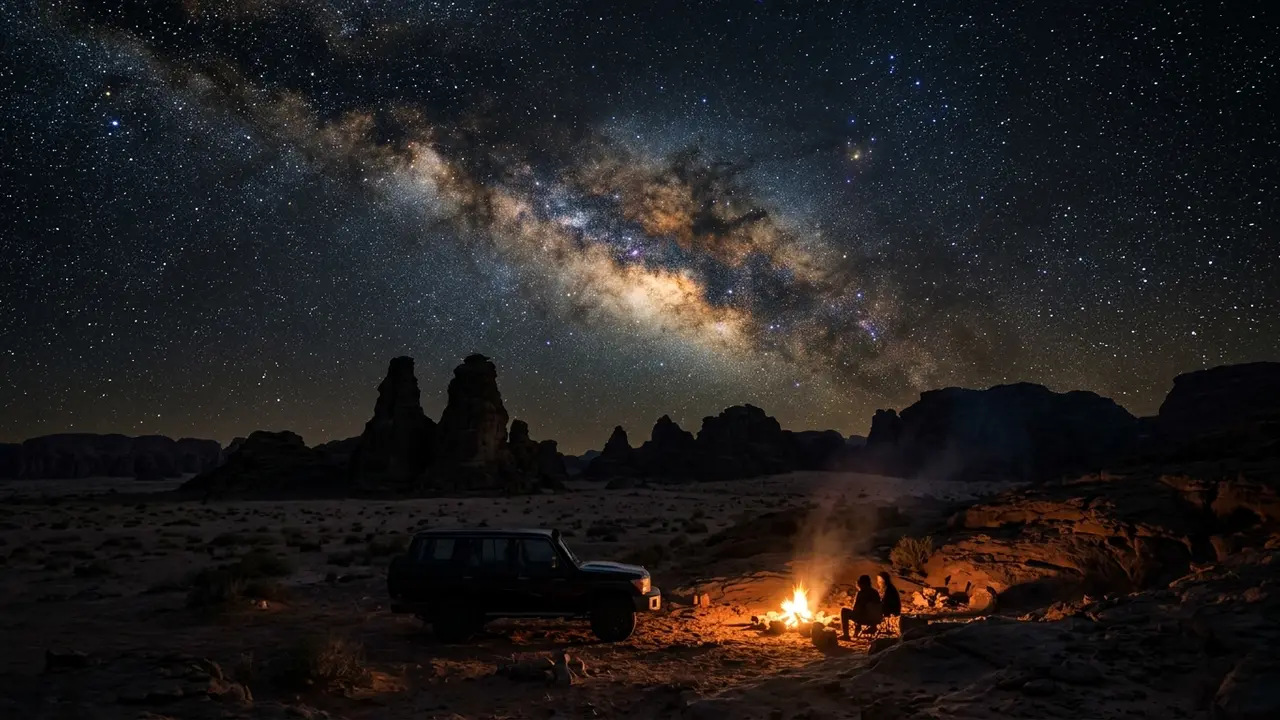
AlGharameel Nature Reserve, together with the neighboring AlUla Manara reserve, became Saudi Arabia's and the Gulf's first DarkSky International-certified Dark Sky Park in October 2024[1]. It's the only spot on this list carrying both an official dark-sky accreditation and a bookable stargazing product built specifically around it: the guided Stargazing at Gharameel experience.
Getting there is part of the experience. The evening runs on a 4x4 ride over off-road terrain, remote enough that phones can lose signal entirely once you're out[2]. The program itself adapts to the calendar rather than repeating the same script every night: full-moon evenings add a short landscape walk before the group settles in, while darker nights skip the walk and stay focused on constellations from the start.
Featured · Destination
AlUla Stargazing
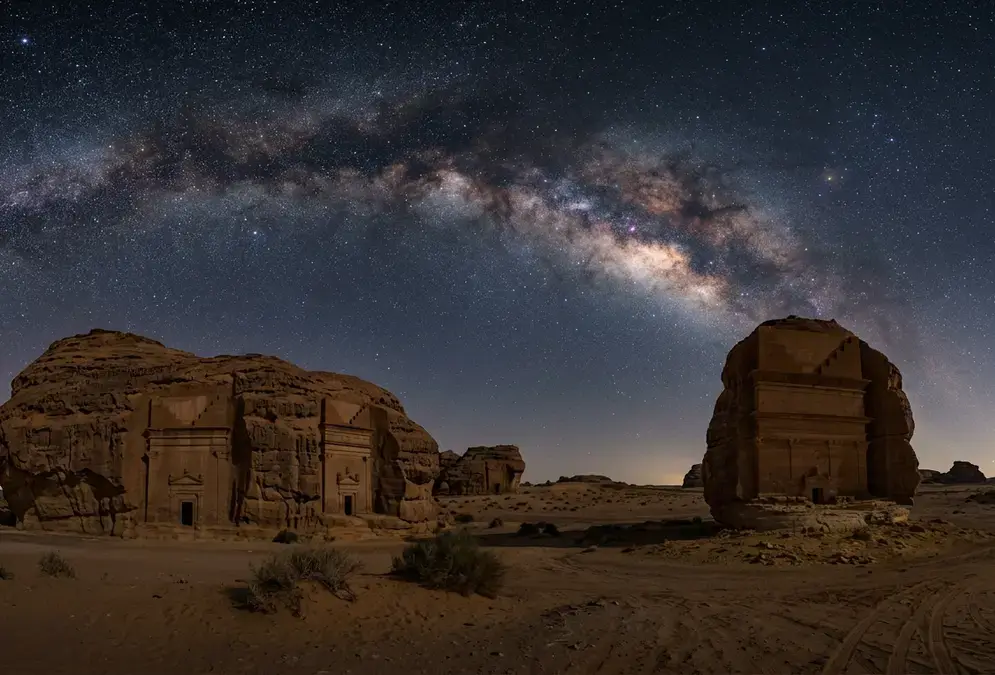
Stargaze above Hegra's 2,000-year-old Nabataean tombs in AlUla, the Gulf's first DarkSky-accredited Dark Sky Park. When to go, where to stay, and how to plan.
Every date ends the same way regardless of moon phase, with a grilled dinner cooked over a campfire under whatever sky the night delivers. Because this is a scheduled, guide-led session rather than an open patch of desert, book this evening telescope session ahead of your trip. It's currently the only named spot in AlUla where the darkness carries an actual accreditation, not just a marketing line.
Ashar Valley resorts: stargazing built into a canyon stay
AlUla's two resort-based stargazing programs both sit in Ashar Valley[3], the sandstone-canyon country that also serves as the gateway to Hegra, not the Harrat lava field a venue name here might suggest. This community-oriented Ashar Valley resort runs telescope-guided sessions for its own guests inside the Manara and AlGharameel reserve boundary. Nearby, Banyan Tree AlUla, itself set among Ashar Valley's sandstone cliffs[3], opens its own on-site Harrat Lounge for a periodic complimentary group stargazing session, on the resort's own grounds rather than out on the lava field; confirm current frequency directly with the resort before you book.
The trade-off here is access, not darkness. Both resorts sit inside or beside the certified reserve, so the sky overhead is the same protected sky the Gharameel tour uses. The difference is who gets to use it: these sessions run for hotel guests, not walk-up visitors, so a stay at one of these two Ashar Valley properties has to already be part of the plan.
Harrat Lounge
That's a genuinely different look from AlUla's actual Harrat: a stretch of ancient basalt lava field elsewhere in the region, black volcanic rock instead of the red sandstone cliffs surrounding these two resorts. Worth knowing the two aren't the same ground if you're picturing where you'll actually be standing. For what is and isn't documented about that lava field, see the Harrat Uwayrid legend versus the record. Worth building an evening around if a resort stay already has you there. Not worth a special trip on its own.
Jabal Ikmah: dark canyon country, guided access only
Jabal Ikmah is an open-air canyon library holding thousands of rock-cut inscriptions in Dadanitic, Lihyanite, Thamudic, and other ancient scripts, tucked into a narrow sandstone gorge with none of the light spill a modern settlement would bring. On paper, it's some of the darkest, most sheltered canyon terrain in the AlUla area. In practice, you can't just drive out there after dinner and wait for the stars.
Self-drive access isn't permitted at Jabal Ikmah[4]. The only way in is an organized tour, either a coach or a private premium 4x4, and those tours run on daytime schedules built around the inscriptions themselves rather than the sky above them. The Dadan and Jabal Ikmah tour itself is built around an on-site exhibition covering the layers of Dadan's history, with digital reconstructions alongside the physical artefacts, available exclusively to ticket holders rather than as a separate stargazing add-on.
On paper, it's some of the darkest, most sheltered canyon terrain in the AlUla area.
That doesn't rule the canyon out entirely; it just changes the honest pitch. If your Jabal Ikmah tour runs late enough that dusk catches you still out among the rock faces, you'll get a preview of how dark this terrain gets. A dedicated after-dark stargazing product here, distinct from the daytime inscription tour, hasn't been confirmed yet.
The desert around Hegra: guided by day, no separate night product
Hegra, Saudi Arabia's first UNESCO World Heritage Site, holds well over a hundred rock-cut Nabataean tombs, many of them decorated, standing free in the open desert rather than carved into a single cliff face. The archaeological zone sits well clear of any real settlement, and the same isolation that protects the tombs also protects the sky above them. It's easily the most atmospheric desert on this list to imagine standing under after dark.
Imagining it is, for now, mostly what you'll do unless you're camping nearby. Hegra can't be visited independently: no self-drive, no walking in on your own, since the site is too large to cover on foot without a guide. Tours run through a private premium 4x4 or a coach, start from SAR 95, and last roughly two hours[5], and every one of them is built around the tombs in daylight, not a scheduled night program.
Designated desert camping areas near the archaeological zone are the practical workaround. Pair a daytime guided tomb visit with a night spent camping nearby, and you're under the same stretch of low-light desert that surrounds the tombs, even without an official after-dark tour walking you through it. Just don't book a trip around a stargazing session at Hegra itself; that product doesn't exist yet, distinct from what Gharameel already runs. See pairing the Hegra day tour with Gharameel stargazing for how to actually book both halves of that day.
Wadi AlFann: the land-art valley that isn't a stargazing site (yet)
Wadi AlFann, the Valley of the Arts, turns up constantly in AlUla search results next to the reserve's actual stargazing spots, and it's worth being direct about what it is and isn't. It's a permanent land-art destination the Royal Commission for AlUla is still building, with large-scale commissioned artworks set into the desert landscape. It is not, as far as any official AlUla or DarkSky source confirms, a programmed stargazing site.
The confusion is understandable. Wadi AlFann occupies dramatic open desert, the kind of setting that looks built for a night under the stars in every render and photo the project has released. But nothing in Experience AlUla's listings, RCU's own materials, or DarkSky International's certification pages puts Wadi AlFann inside the accredited dark-sky zones, or programs it for night visits at all.
The valley is still under construction, with a rolling programme of pre-opening exhibitions running ahead of the finished site. Until that changes, treat Wadi AlFann as a daytime art pilgrimage, not a fifth stargazing spot on this list. If an after-dark product launches there eventually, this guide is worth revisiting; for now, the honest answer to whether you can stargaze at Wadi AlFann is no.
| Spot | Access | Stargazing status |
|---|---|---|
| AlGharameel Nature Reserve | Booked 4x4 tour | Certified Dark Sky Park with a dedicated stargazing tour |
| Ashar Valley resorts | Hotel guest only | Resort-run telescope sessions, no walk-up access |
| Jabal Ikmah | Guided coach or 4x4, daytime only | No dedicated night program confirmed |
| Desert around Hegra | Guided day tour, nearby camping | No dedicated night program confirmed |
| Wadi AlFann | Daytime land-art visits | Not a stargazing site; still under construction |
Planning your night: access rules, timing, and gear
AlUla runs on a guided-access model, not a self-drive one. That single fact decides more about your stargazing plan than the season does: Jabal Ikmah, Dadan, and Hegra all require a booked Experience AlUla tour, and Gharameel's stargazing session runs the same way, through a scheduled booking rather than an open gate.
The reserve's dark-sky footprint is also bigger than the two zones most listings mention. Beyond AlUla Manara and AlGharameel Nature Reserve, DarkSky International later extended certification to cover Sharaan National Park and Wadi Nakhlah Nature Reserve[6], strengthening the protected-lighting commitment across a wider stretch of desert than the Gharameel tour alone covers.
Recommended tours
Tours are selected for quality, not commission. I earn a small fee if you book — at no extra cost to you.
October through April is the window worth building a trip around, for comfort more than sky quality. AlUla's skies run clear most nights of the year regardless of season; the cooler months just make standing around after dark, or waiting out a 4x4 ride to Gharameel, bearable rather than brutal. Whatever month lands on your calendar, check the moon phase separately: a bright moon mutes the same fine detail here it mutes everywhere else. For the fuller planning picture, including where to stay and how to get to AlUla in the first place, see AlUla Stargazing.
Before booking anything, keep three practical constraints in mind:
- Book ahead, always. None of AlUla's named spots work as a walk-up visit; Gharameel, Jabal Ikmah, and Hegra all run through Experience AlUla's tour calendar.
- Pack for both extremes. Desert days can run warm even in the cool season, and temperatures drop fast once the sun is down.
- A hotel stay unlocks Ashar Valley stargazing. If Banyan Tree AlUla's or Our Habitas AlUla's stargazing sessions matter to your plan, book that as part of the room reservation, not separately.