
What you're actually signing up for
AlUla sells itself as Saudi Arabia's answer to Petra with a night sky thrown in, and that pitch quietly skips over how differently this destination actually runs. There is no free-roam version of this trip. Self-driving to Hegra is prohibited; every visit to the UNESCO World Heritage Site goes through an organised tour departing from the Hegra South Gate, with coach-tour access starting at SAR 95[1]. The desert stargazing session at Gharameel adds its own layer of friction: it requires a 4x4 off-road transfer, and mobile reception is unreliable once you're out there[2].
Getting to AlUla in the first place is its own project. Saudia and flynas run daily-to-weekly domestic service from Riyadh and Jeddah, flynas alone flying five times a week from Riyadh, while international links stay thin:
Featured · Destination
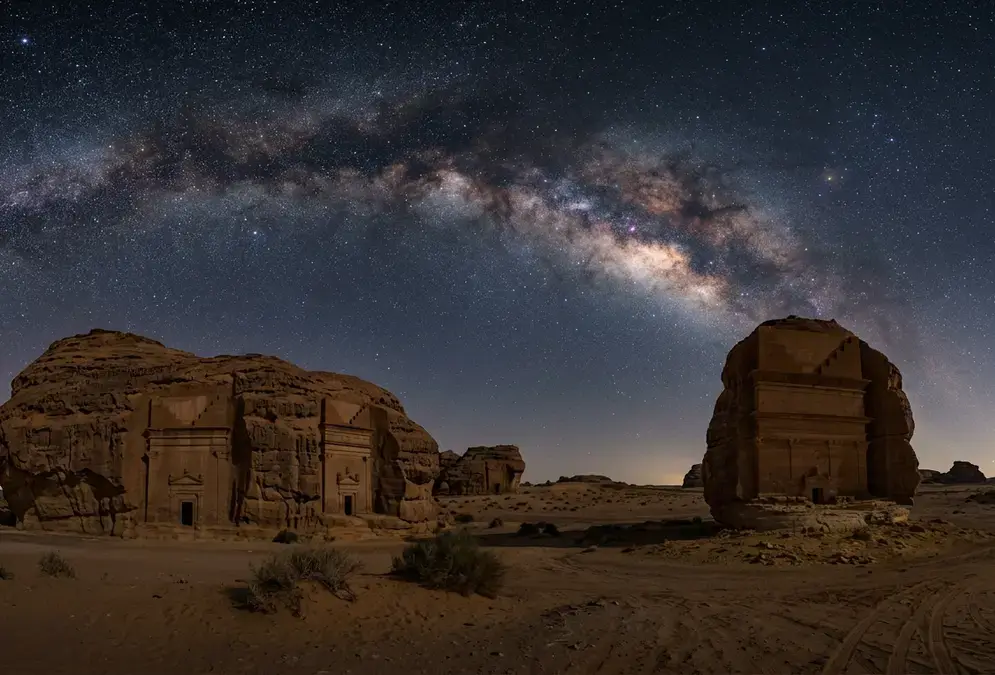
AlUla Stargazing
Stargaze above Hegra's 2,000-year-old Nabataean tombs in AlUla, the Gulf's first DarkSky-accredited Dark Sky Park. When to go, where to stay, and how to plan.
- flydubai: three times weekly from Dubai
- Qatar Airways: three times weekly from Doha
- Royal Jordanian: twice weekly from Amman[1]
Budget one-way fares start around SAR 260 (USD 70) from Riyadh and SAR 400 (USD 107) from Jeddah[1], and seats on the busiest routes sell out well ahead of peak dates, so booking flights early matters more here than at a destination with hourly departures[3]. For the full routing and visa picture, see How to Get to AlUla.
None of this is a dealbreaker on its own. It is, however, a set of access logistics most heritage or dark-sky destinations don't ask of visitors, and naming it honestly before the payoff section is the point of this article. For the destination itself, see AlUla stargazing.
The stargazing itself: what Gharameel actually delivers
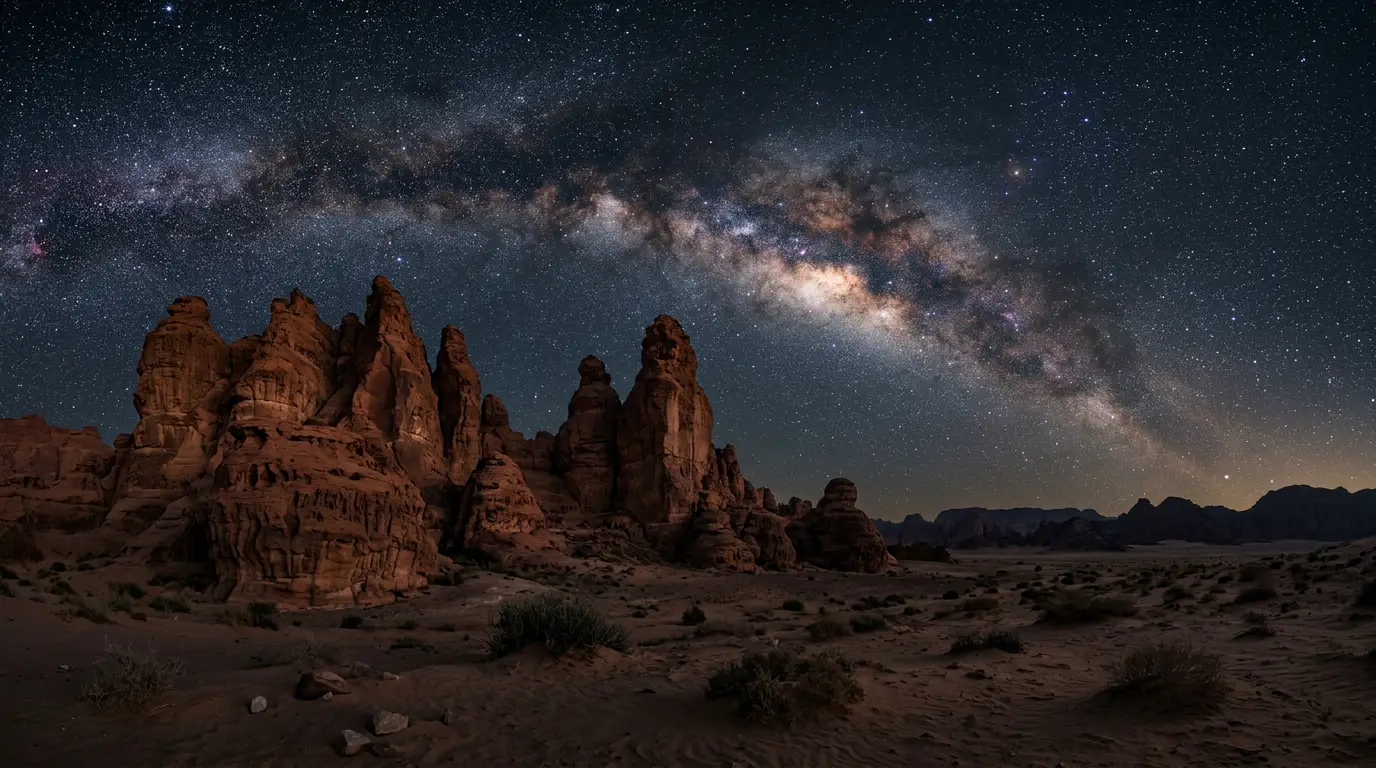
The flagship stargazing product here is the Gharameel session, a guided evening among Gharameel's sandstone rock formations that includes a campfire dinner and a 4x4 transfer out to the site[4]; confirm current pricing, exact duration, and any group-size requirements directly with the operator before you book.
What you get is a genuinely dark desert sky, framed by rock formations rather than a flat horizon, several hours from any real light source. One traveler account describes seeing meteors streak past with the naked eye during a single Gharameel evening; that's a welcome bonus if a given night delivers it, not a guarantee stamped on the ticket. Whether meteors show up or not, the baseline, the guide, the dinner, the transfer, the rock-formation setting, stays consistent enough to plan a trip around.
What you're actually paying for is the guided access and the setting, not a telescope-grade upgrade over what you'd see with your own eyes anywhere equally dark. If Gharameel is the centerpiece of your trip, book it through Stargazing at Gharameel well ahead of your dates, and confirm the current rate directly since it isn't published on the operator's own experience page.
The heritage payoff: Hegra and the case for going anyway
Hegra is the reason most people book AlUla in the first place, stargazing aside. It's Saudi Arabia's first UNESCO World Heritage Site, a field of rock-cut Nabataean tombs carved by the same civilisation responsible for Petra, and it draws a fraction of Petra's visitor numbers despite being every bit as photogenic. The site's own low visitor volume, a direct result of the guided-tour-only structure, is itself part of the draw for travelers tired of crowded heritage stops.
That low-key quality is itself part of the payoff. You're not shuffling through Hegra behind fifty other tour groups the way you might at Petra's Siq. The guided-tour-only structure that adds friction to independent travel also caps how many people are on-site with you at any one time, since the Royal Commission for AlUla controls the schedule end to end.
What makes AlUla genuinely unusual, rather than just another heritage stop with a nice sunset, is that the UNESCO site and the certified International Dark Sky Park sit on top of each other. Most travelers weighing a Petra trip against an AlUla trip are really weighing crowds-and-convenience against exclusivity-and-effort. Hegra gives you the tombs with room to actually look at them; a clear desert night at Gharameel gives you a sky Petra's more developed tourist infrastructure doesn't offer in the same way.
The real costs, start to finish
Price is where AlUla either earns the trip or loses it, and the honest math starts with accommodation, not tours. A three-night AlUla trip ranges from roughly SAR 2,500 (USD 667) at the budget end to SAR 25,000+ (USD 6,700+) for a luxury stay, and nearly all of that swing comes from where you sleep, since the core heritage tours combined cost under SAR 200[5].
Accommodation stock splits into four rough tiers:
| Accommodation tier | Example property | Nightly rate |
|---|---|---|
| Resort mid-range | Shaden Resort | $108-456, season-dependent |
| Apartment-style | Cloud7 Residence | from approx. $203 |
| Heritage boutique | Dar Tantora The House Hotel | from approx. $766 |
| Eco-luxury | Our Habitas AlUla / Banyan Tree AlUla | $294-3,726 (avg ~$437) / from ~$808 |
- Resort mid-range: Shaden Resort runs roughly $108 to $456 a night depending on season and room type[6]
- Apartment-style: Cloud7 Residence starts around $203 a night[6]
- Heritage boutique: Dar Tantora The House Hotel, inside AlUla Old Town's restored mudbrick village, starts around $766 a night[6]
- Eco-luxury: Our Habitas AlUla and Banyan Tree AlUla sit at the top of the market, with rates that swing hard by season: Habitas runs roughly $294 to $3,726 a night depending on season and villa type, averaging around $437, while Banyan Tree starts from roughly $808 a night[7]; check current pricing directly before booking, since a low-season stay and a peak-season stay at the same property can differ by thousands of dollars a night
Layer flights on top, the SAR 260-to-400 one-way fares covered above, and a genuinely thorough multi-night trip, flights, Hegra, one Gharameel evening, a mid-tier room, adds up to a meaningfully bigger number than a short domestic dark-sky weekend for most travelers reading this from outside the Gulf. That's not a reason to skip AlUla. It's a reason to book it on purpose, the same advice this site gives about any long-haul dark-sky trip.
Who should go, and who should skip it
AlUla suits a specific traveler well: someone who wants Nabataean ruins with room to actually look at them, treats a guided-access-only structure as a fair trade for lower crowds rather than an annoyance, and is planning a genuine multi-night stay rather than squeezing the destination into a single afternoon. Treating AlUla as a rushed day trip from Medina is flagged repeatedly by people who've done it as a mistake[8]; the heritage sites and the stargazing evening both deserve more time than a day-trip schedule allows. How Many Days in AlUla for Stargazing? works through the three-night-versus-five-night math in detail.
Summer, roughly May through September, is the other honest skip-it signal. Daytime heat makes outdoor exploration uncomfortable[8], and that discomfort doesn't stay outdoors after sunset the way it might at a higher-altitude dark-sky site; the desert simply holds the heat longer into the evening. Cooler months reward the trip in a way summer dates actively work against.
Who should think harder before booking: solo travelers and couples put off by Gharameel's guided, fixed-departure structure, budget travelers for whom the flight-plus-accommodation math above doesn't pencil out, and anyone who can't build in at least two or three nights. AlUla rewards patience and planning. It punishes a rushed, minimum-viable version of the trip more than most destinations on this site do.
The verdict on AlUla
Is AlUla worth it for stargazing? Yes, for the traveler who goes in with eyes open about what kind of trip this actually is. You're not getting a walk-up dark-sky park with a public observatory and a parking lot. You're getting a guided-access desert evening bolted onto one of the most under-visited UNESCO sites on Earth, at a price and a logistics cost that reward planning and punish improvisation.
The heritage payoff is real and largely unmatched: nowhere else pairs Nabataean tombs this significant with a dark desert sky this close by. The friction is real too: thin flights, no self-drive at the headline site, an unconfirmed group-size policy for the stargazing session (confirm directly with the operator), and a bill that climbs fast once you pick a nicer hotel. Neither cancels the other out.
Book AlUla for the sky-and-stone combination nowhere else on Earth offers, not because it's the easiest or cheapest dark-sky trip available. Plan three or four nights, book flights and the Gharameel session early, and go in knowing exactly which parts of the trip you control and which parts, the weather, the guided schedule, you don't.