
Three nights or five: what actually decides the number
Ask how many days AlUla needs and most answers reach for distance or traffic. Neither applies here. Hegra, Jabal Ikmah, and the Gharameel stargazing session all run on scheduled guided tours booked through Experience AlUla, the Royal Commission for AlUla's own booking platform, not on independent access. There is no self-drive route into the archaeological zone and no walk-up option at the desert stargazing site.
That single fact is what decides your trip length. You aren't planning around drive times between sites a few kilometers apart; you're planning around how many tour slots you can book and how those slots stack against desert heat, opening hours, and the phase of the moon. A three-night trip has room for exactly one heritage day and one stargazing evening. A five-night trip has room for a second evening in case the first one clouds over, plus a slower pace through the daytime sites.
- Hegra: guided tours only, booked ahead through Experience AlUla, with sessions running regularly rather than on a walk-up basis
- Jabal Ikmah: booked into the same guided-tour system as Hegra
- Gharameel stargazing: one seasonal, ticketed evening session with a minimum group size, not a walk-up desert outing
Book the nights first, then work backward to which tour slots you can actually secure. That order matters more here than it does almost anywhere else on this site. For the full destination rundown, from getting here to where to stay, see AlUla stargazing.
The 3-night itinerary: one heritage day, one stargazing evening, no slack
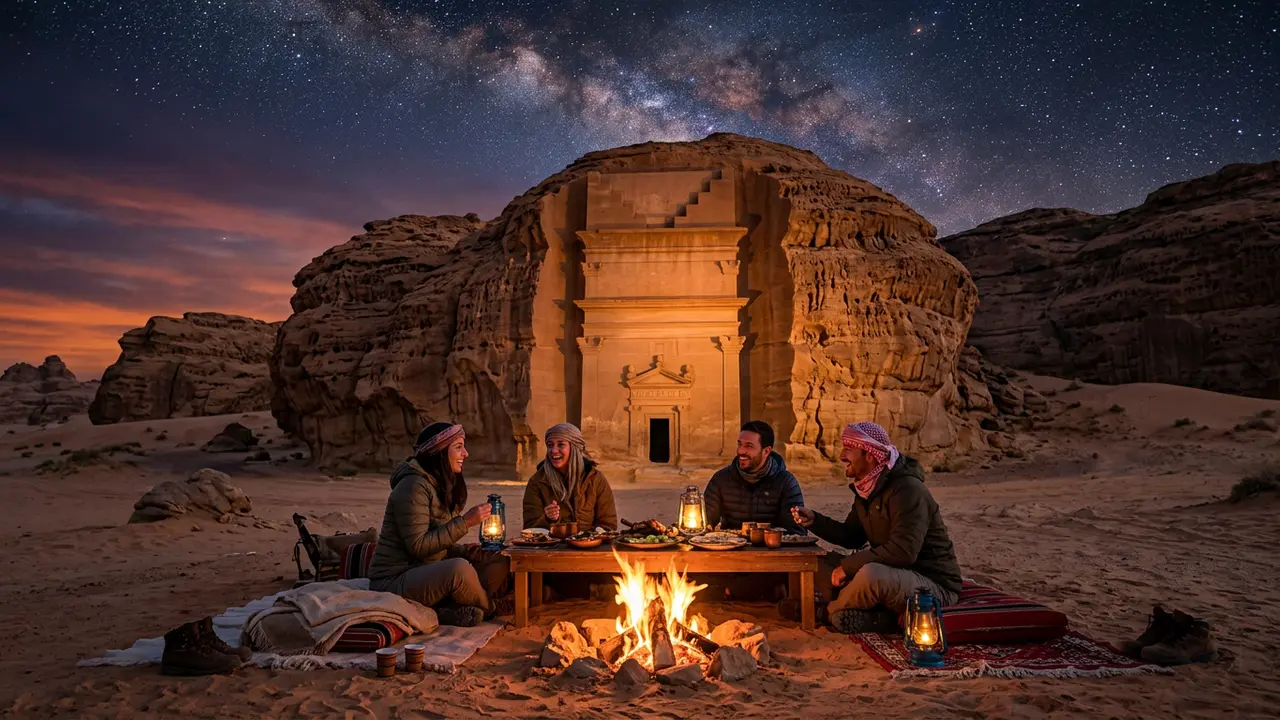
Day one is arrival and AlUla Old Town, the restored mudbrick village that works as a low-effort evening stop once you land jet-lagged and don't want to drive into the desert. Day two is the heritage core: Hegra in the morning, when the light is better for photos and the heat hasn't peaked, then Jabal Ikmah in the afternoon, the open-air canyon library holding Dadan kingdom inscriptions. Day three is Stargazing at Gharameel, the finale, an evening session with a campfire dinner rather than a daytime add-on.
Experience AlUla's own 3-Day Best of AlUla itinerary confirms the pacing logic even though it uses a different mix of sites: a Ridge Walk hike and Old Town on day one, an adventure activity and Hegra on day two, Jabal Ikmah and a spa slot on day three[1]. One major anchor per day, interleaved with meals, is how the destination's own tour operator paces a short stay, and it's the same math whether your third anchor is a spa treatment or a night under the stars.
Featured · Destination
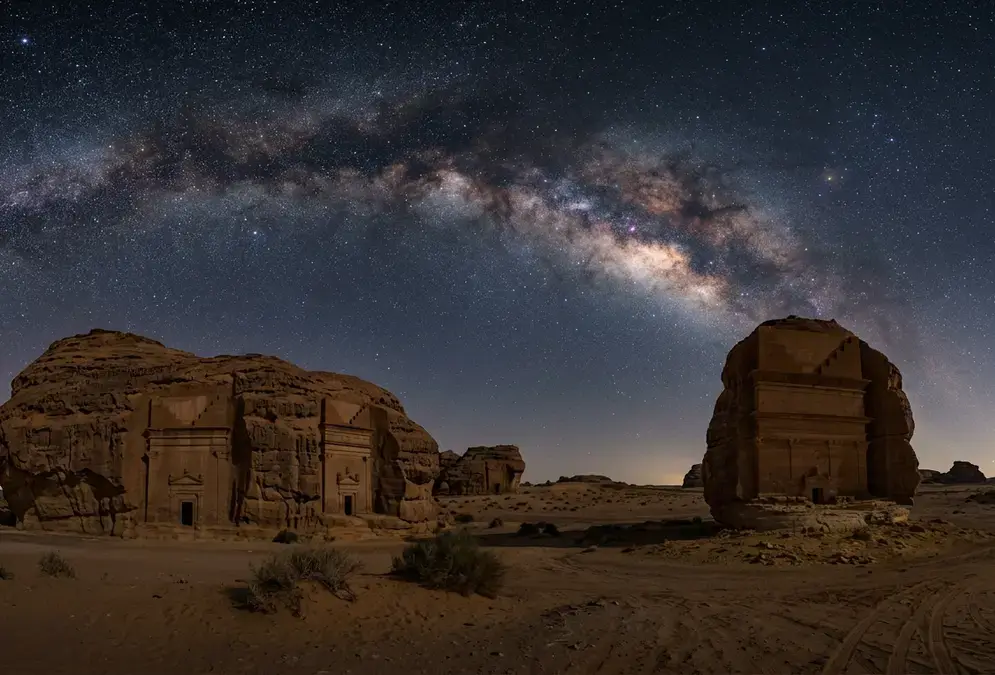
AlUla Stargazing
Stargaze above Hegra's 2,000-year-old Nabataean tombs in AlUla, the Gulf's first DarkSky-accredited Dark Sky Park. When to go, where to stay, and how to plan.
The catch with three nights is that it assumes everything works on the first try: one clear evening, one available Gharameel slot, one Hegra booking that doesn't collide with your flight times. Cut any of those close and the trip has no room to absorb it. If your dates are fixed, that's worth naming before you book, not after a cloudy first night.
Two extra nights buy weather insurance, not more heritage stops
Five nights doesn't mean five heritage sites. It means room for what a three-night trip can't absorb: a second stargazing evening in case the first gets clouded out or lands on a full moon, when the Gharameel program shifts to a moonlit landscape walk instead of a star-focused session (see best time for stargazing in AlUla for how moon phase and season interact), a full day for Old Town at a pace that isn't rushed between tour slots, and one adventure activity like the Ridge Walk hike or the Adventure Hub's sky-high activities to break up the heritage-site heat.
Wadi AlFann, the Valley of the Arts, is not on this list, and it shouldn't be on yours yet either. The permanent land-art valley is still under construction, not open for general day-trip visits the way Hegra or Jabal Ikmah are. The Desert X AlUla exhibition programme runs as a preview ahead of the finished site[5], so if land art is genuinely the draw, check the current exhibition calendar rather than assuming a Wadi AlFann day is bookable the way the rest of this itinerary is.
Spreading the heritage sites across more half-days also solves a problem three nights forces you to ignore: desert heat. Hegra and Jabal Ikmah are both outdoor sites with little shade, and stacking two of them into one afternoon works only because there's no alternative on a compressed schedule. Five nights lets you put Hegra in the cool of one morning and Jabal Ikmah in another, rather than doing both back to back.
The Gharameel evening: one night's worth, and whether a second is worth booking
A single Gharameel booking runs three to four hours and includes a 4x4 transfer into the AlGharameel Nature Reserve and a traditional Saudi dinner cooked over a campfire while the sky finishes going dark[2]. It's a naked-eye program, no telescopes, built around a bilingual guide working the sky by hand and laser pointer, and it changes shape depending on the calendar: on darker nights near new moon the session stays focused on stars and constellations, while a full-moon booking shifts toward a guided walk through the moonlit landscape instead[2].
Whether a second evening is worth booking comes down to what you're protecting against. There's no published venue rule capping guests to one Gharameel session per stay, but there's also no evidence repeat bookings are common practice, so treat a second night as itinerary insurance rather than something the tour itself expects. The two real risks a five-night trip protects against are weather, since a single cloudy evening otherwise sinks the whole reason for the trip, and moon timing, since a session booked near full moon delivers a lighter, different experience than the star-dense one most travelers picture when they book.
“On darker nights, the tour will solely focus on stars and constellations.”
Book Gharameel as early as your dates allow. The program runs seasonally and requires a minimum group of four, and the official listing doesn't publish a fixed weekly schedule, so confirm current availability directly with Experience AlUla rather than assuming a specific night of the week will be open. Staying somewhere with its own night-sky programming, like this Ashar Valley property, gives a five-night trip a low-effort fallback on any evening Gharameel isn't running.
Getting there is its own day, not part of the itinerary
AlUla International Airport (ULH) is a small regional airport, and most travelers reach it through Medina rather than flying in directly. Driving from Medina takes roughly four hours by the most direct route[3], though a realistic overland transfer, once you factor pickup logistics and traffic, runs closer to five hours[4]. Flying is faster on paper: Saudia, flynas, and flyadeal all run daily connections between Medina's Prince Mohammad bin Abdulaziz International Airport and ULH, though the flight itself is only part of the door-to-door time once check-in and the ride to each airport are counted[4].
~5 hours
Whichever option you pick, count it as its own partial travel day, not something folded into your on-the-ground itinerary. A three-night trip that treats the Medina transfer as a bonus fourth day, rather than a wash of your first evening, feels considerably less rushed than one that tries to squeeze Old Town into the same evening you land.
Match your trip length to what you actually want from AlUla
Three nights and five nights aren't the same trip with extra padding. They're different bets on what could go wrong. Use the table below as the gut check once you know which one you're making.
| Trip length | Heritage covered | Stargazing evenings | Best for |
|---|---|---|---|
| 3 nights | Hegra, Jabal Ikmah, Old Town | 1, no weather buffer | First-timers with fixed, tight dates |
| 4 nights | Same heritage core, less rushed pacing | 1 plus a light buffer | Travelers who want breathing room but not a second evening |
| 5 nights | Heritage core spread across more half-days, plus Old Town and one adventure activity | 2, one as weather/moon-phase insurance | Anyone who wants the trip to survive a cloudy or full-moon night |
Whatever you land on, book the Gharameel evening and your Hegra slot before you lock in restaurants or day trips. Tour availability, not your own schedule, is the real constraint on an AlUla itinerary, and the nights you can't get back are the ones you didn't book early enough.