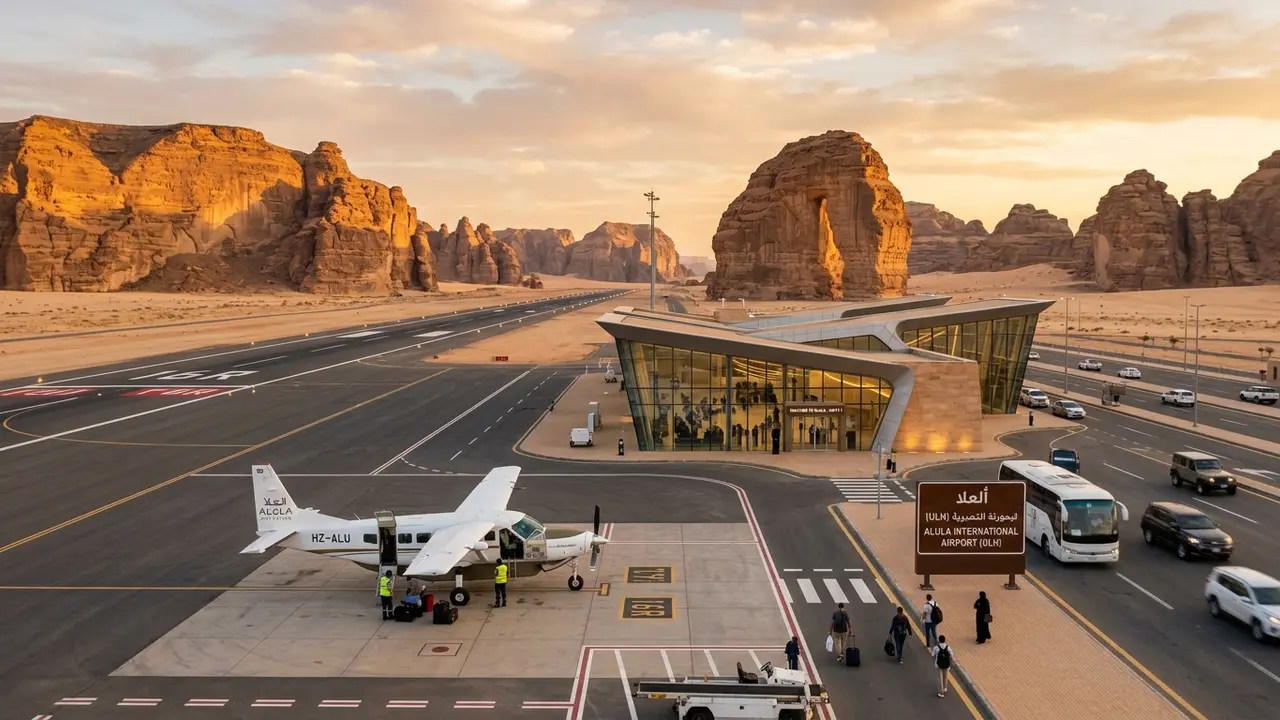

Why "just fly to AlUla" isn't quite true
Search for how to get to AlUla and the honest answer is messier than it should be for a destination this talked-about. AlUla has its own airport, but its international schedule is thin enough that most travelers end up routing around it rather than through it.
This guide covers AlUla International Airport's real, seasonal schedule, the Medina-and-drive workaround most visitors reach for anyway, what the e-visa program actually looks like right now, and how you get around once you've landed, including one heritage-site question this piece won't pretend to answer with total certainty. For the destination itself, the Bortle sky and the Nabataean tombs it sits above, see AlUla Stargazing.
Flying into AlUla itself: a thin, seasonal schedule
AlUla International Airport (ULH) is real, modern, and close to the historic core, roughly 25 km out. What's thin is the route map, not the airport itself: two international carriers serve it directly, both on a set weekly schedule rather than daily service, and beyond those two, everything else runs through a domestic Saudi connection.
| Route | Carrier | Frequency | Notes |
|---|---|---|---|
| Dubai → AlUla (ULH) | flydubai | Limited weekly | Seasonal — confirm current schedule |
| Doha → AlUla (ULH) | Qatar Airways | Limited weekly | Seasonal — confirm current schedule |
| Riyadh → AlUla (ULH) | Flynas / Saudi Arabian | Multiple weekly | Non-stop domestic |
| Jeddah → AlUla (ULH) | Saudi Arabian | Multiple weekly | Only direct carrier |
| Dammam → AlUla (ULH) | Flynas | Seasonal | Operating August-September 2026 |
Direct flights: Dubai and Doha, in season
flydubai operates a seasonal service from Dubai, and Qatar Airways operates a seasonal service from Doha[1], together forming the entire direct international air link most travelers have to AlUla right now. Both run on limited weekly frequencies rather than daily service, so confirm the current schedule directly with each airline before booking; if your dates don't land on an operating day, or fall outside the current seasonal window, the direct-to-ULH plan simply doesn't work, and the alternatives below aren't a downgrade so much as the actual plan.
Domestic connections: Riyadh, Jeddah, and (soon) Dammam
Past Dubai and Doha, AlUla connects mainly through domestic routes[2]:
- Riyadh: non-stop with Flynas and Saudi Arabian Airlines
- Jeddah: non-stop, Saudi Arabian Airlines only
- Dammam: a seasonal Flynas route currently operating, running August through September 2026
In practice, that means most international visitors reach AlUla through a two-leg routing: land at a bigger Gulf or Saudi hub first, then connect on a domestic hop, exactly what you'd plan for a genuinely remote destination rather than resent as an inconvenience.
The Medina backup: fly there, then drive four hours
Most trips to AlUla skip ULH altogether and route through Medina instead. Fly into Medina's international airport, then drive roughly four hours to AlUla, renting a car with a home driving licence plus an International Driving Permit (IDP), since hire cars themselves are cheap and easy to arrange once you've landed[1].
This isn't a consolation-prize routing. The destination's own trip-planning guidance treats the drive as a normal, even enjoyable, way in, and once you're behind the wheel it's easy to see why: open desert highway, mountain silhouettes on the horizon, no real reason to rush it. Fill the tank before you leave Medina regardless of season. Services thin out fast once you're deep in the desert corridor between the two, and there's no upside to testing a rental car's reserve tank on an unfamiliar road after dark.
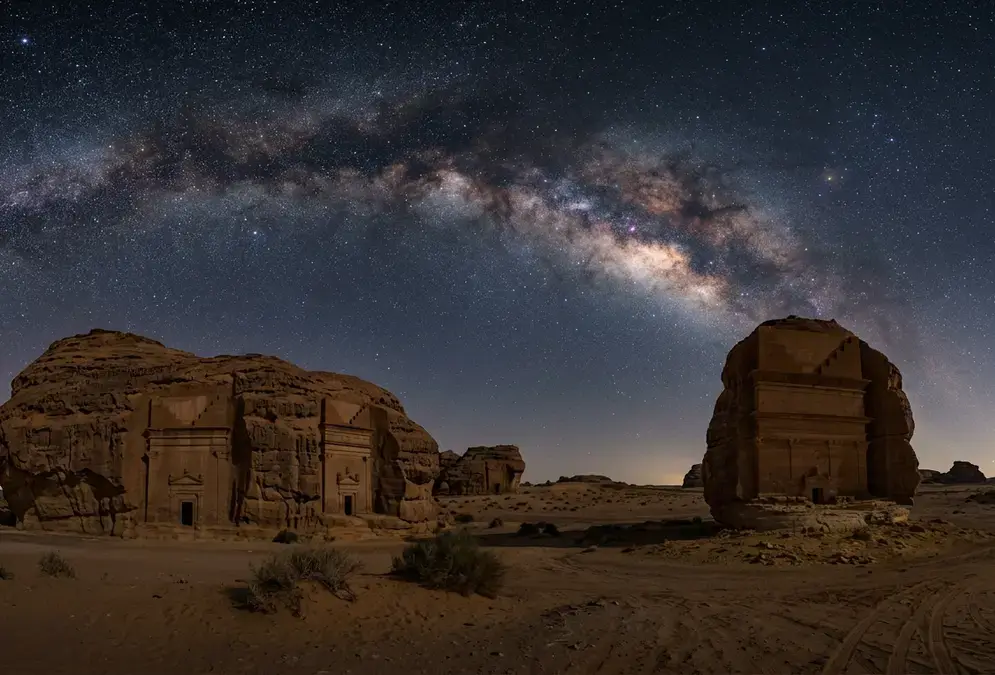
Featured · Destination
AlUla Stargazing
Stargaze above Hegra's 2,000-year-old Nabataean tombs in AlUla, the Gulf's first DarkSky-accredited Dark Sky Park. When to go, where to stay, and how to plan.
The e-visa: what to expect, and why we won't guess at specifics
Saudi Arabia runs an e-Visa program for tourism, issued online or on arrival, and the honest, short version is: it exists, it's official, and it covers a meaningful list of nationalities, plus a separate route for travelers who already hold a valid US, UK, or Schengen visa. When granted, the e-Visa is valid for 90 days[3]. Exactly which countries qualify is the kind of detail that shifts. Different sources circulating online right now cite slightly different eligible-country counts, which is itself a sign that repeating any single figure here would do readers a disservice the moment the policy changes.
The one source worth trusting is the program's own portal, visa.visitsaudi.com, run directly by the Saudi Tourism Authority. Check eligibility, current fees, and stay-length rules there before booking anything, not on a travel-blog summary however confident it sounds, and not on this page months after publication either. If AlUla is one stop on a longer Gulf itinerary, confirm the visa or entry route covers every country you're transiting through, not only Saudi Arabia.
Getting around once you land: self-drive, ride-share, and the heritage-site question
Once you're actually in AlUla, getting around splits into driving yourself and not, according to the destination's own trip-planning guidance[1]:
Recommended tours
Tours are selected for quality, not commission. I earn a small fee if you book — at no extra cost to you.



- Self-drive: the same rental car and IDP requirement that gets you in from Medina works just as well for day-to-day movement around the valley.
- Darb AlUla: a local ride-share app for point-to-point trips without renting anything.
- AlUla Public Transit: buses running every 30 minutes during operational hours.
- Airport taxis: available, but limited and strictly first-come, first-served.
Every 30 min
What this piece can't answer with total confidence is whether Hegra, Jabal Ikmah, or AlUla's other heritage sites can be visited independently once you've got a rental car, or whether they require a guided experience booked through the Royal Commission for AlUla (RCU). Self-drive is clearly endorsed for reaching AlUla and moving around it generally; whether that extends to walking up to Hegra's tombs on your own isn't spelled out anywhere I could verify. AlUla's own guided programs, like the Gharameel evening tour, already run this way: guide-led, timed to the season, booked ahead rather than showing up and self-accessing a site, and heritage visits may well follow the same pattern. Confirm directly with Experience AlUla before you assume self-access to any specific monument, and book the guided visit if one turns out to be required.
Booking order: get this sequence right
Once your travel dates are fixed, book in this order:
- Flights first: check flydubai's and Qatar Airways' current seasonal schedules against your dates before anything else, since ULH's entire direct international service depends on hitting one of a limited number of weekly slots.
- Visa second: apply through visa.visitsaudi.com as soon as flight dates are locked, since e-visa processing and eligibility rules are worth confirming well ahead rather than at the airport.
- Car hire and heritage-site bookings third: reserve the rental car for the Medina-to-AlUla leg, or the whole stay rather than day by day, and confirm directly with Experience AlUla whether the sites on your list need a booked guided visit.
None of this is complicated once it's laid out in order, it's just sequential, and it front-loads differently than a trip to a destination with its own busy international airport. Budget an extra travel day either way, whether that's a connection through Dubai or Doha timed to one of ULH's limited weekly flights, or the drive down from Medina. AlUla rewards travelers who plan the access logistics before the stargazing ones. Once the flights, visa, and car are sorted, the seasonal case for when to book covers which months to actually book them for.
AlUla rewards travelers who plan the access logistics before the stargazing ones.