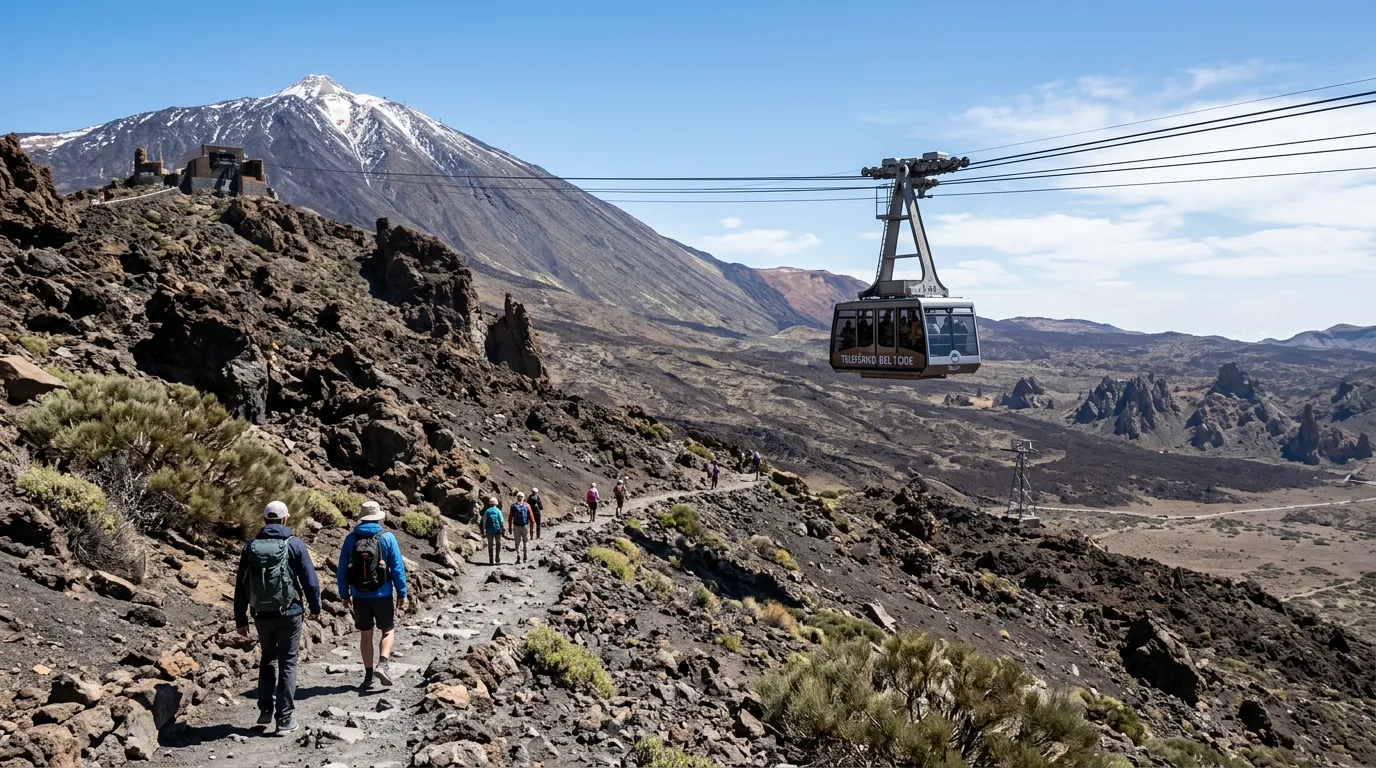

The Teide cable car at daybreak
The Teide cable car (Teleférico del Teide) lifts you from 2,356 metres to 3,555 metres in eight minutes, depositing you at La Rambleta just below the summit cone[1]. A round trip costs €42 for non-residents, and the morning slots, the 09:00 departure especially, are the ones to book. You rise through the trade-wind inversion layer around 1,600 metres, where the world below disappears into a flat white blanket of cloud and the caldera above sharpens into ochre, rust-red, and black volcanic terrain.
The cable car is 100% solar-powered, the first in the world to operate entirely off-grid[1]. Photovoltaic panels at the base station supply the full operation. It is a detail most visitors miss, and one that says something about how seriously Tenerife treats the protected status of its high-altitude environment.
100% solar
Three things to square away before you go up:
- Summit permit: required beyond La Rambleta for the final ascent to Pico del Teide (Route 10). Since January 2026, an eco-tax applies: non-residents pay €15 for an unguided ascent or €10 with a guide, while residents and children under 14 go free. The daily cap rose to 300 people, split into three slots of 100, and slots still go days ahead in summer. Routes 11 and 12 skip the summit and follow lower trails from the upper station without a permit.
- What to wear: even in July, when the coast is 28°C, the upper station sits at roughly 5 to 10°C with a steady wind. A down jacket, windproof shell, and closed shoes are non-negotiable. Trainers on volcanic scree feel unstable within minutes.
- Altitude: 3,555 metres is high enough to trigger mild altitude sickness. The cable car gains nearly 1,200 metres in eight minutes with no acclimatisation period. If you feel lightheaded, sit down immediately and descend on the next car.
The reward is the view: the shadow of Teide stretching across the Atlantic at sunrise is a perfectly triangular dark pyramid cast onto the cloud sea, and the caldera walls — Las Cañadas — form a 16-kilometre-wide amphitheatre visible in full only from altitude.
Hiking without the cable car
Not every Teide experience requires a €42 ticket. Three trails inside the national park cover the caldera's best scenery on foot; two cost nothing beyond the fuel to reach the trailhead, and the third now carries a small park access fee.
Montaña Blanca to La Rambleta (9 km one-way, 2,320→3,115 m elevation, roughly 5–6 hours up) follows the eastern flank of Teide on an old mule track through terrain that shifts from pumice fields to black lava and finally to the ochre sulphur-stained upper slopes[2]. The trail starts at the Montaña Blanca car park off the TF-21 and climbs consistently without technical sections, but the altitude and exposure make it a serious undertaking. Since January 2026, this route (trail PNT-07) is subject to the park's eco-tax: non-residents pay €6 on weekdays or €10 on weekends and public holidays. Start at first light, carry at least two litres of water per person, and turn around if the wind picks up above 40 km/h. The upper section offers no shelter.
| Trail | Distance | Elevation gain | Duration | Difficulty |
|---|---|---|---|---|
| Montaña Blanca | 9 km | 795 m | 5–6 hrs | Hard |
| Roques de García | 4 km | 100 m | 1.5 hrs | Easy |
| Sendero de los Azulejos | ~2 km | Minimal | 1 hr | Easy |
Roques de García loop (4 km, 100 m elevation gain, roughly 1.5 hours) is the classic caldera circuit. The trail circles the Cinchado rock formation, a photogenic finger of eroded lava that appears on half the postcards sold on the island, and continues past the Roques de García, a cluster of volcanic plugs weathered into surreal shapes. The loop starts from the Parador de Las Cañadas car park and is entirely on well-marked gravel path. This is the trail for visitors who want the caldera's scale without the physical commitment of a mountain ascent.
Sendero de los Azulejos gets its name from the blue-green copper oxide veins that streak the rock face along the route. A shorter, gentler option on the western side of the caldera, it works on a recovery day or as a warm-up before Montaña Blanca. The volcanic mineral colours, from azure to malachite green and rust red, make it one of the most photogenic short hikes in the park, and it sees a fraction of the foot traffic the Roques circuit does.
For the full list of miradores inside the park and how each maps onto a daytime hike plus a night session, the best stargazing spots in Tenerife guide covers the crossover in detail.
Anaga Rural Park: rainforest on a subtropical island
Drive northeast from Teide's barren caldera for an hour and you enter a different biome entirely. The Anaga Rural Park, declared a UNESCO Biosphere Reserve in 2015, covers the island's oldest volcanic massif in dense laurisilva forest[3]. This is a living relic of the subtropical woodlands that covered southern Europe during the Tertiary, surviving almost exclusively today on the Macaronesian islands: the Canaries, Madeira, the Azores. Walking through Anaga on a misty morning, with tree heather and Canarian laurel forming a closed canopy above you and moss covering every exposed surface, feels closer to hiking in Costa Rica than anywhere in Europe.
The park's trail network is well-maintained and rewards every level of ambition:
- Sendero de los Sentidos (Path of the Senses): a short, accessible loop near the Cruz del Carmen visitor centre, with three variants ranging from 350 metres to 1.3 km. Designed as an introduction to the laurisilva ecosystem, it works for visitors with limited mobility and for families with young children.
- Chamorga to Roque Bermejo: a longer day hike descending from the hamlet of Chamorga through deep ravines to a remote black-sand beach accessible only on foot or by boat, then climbing back out. About five hours round-trip with significant elevation change. Plan the return climb for the cooler part of the afternoon.
At the park's northern edge, Playa de Benijo marks the end of the road. Black volcanic sand, Atlantic rollers that break hard against the shore, and the Roques de Anaga, two jagged sea stacks, rising from the surf. It is not a swimming beach; the current is genuinely dangerous and there are no lifeguards. It is a place to sit, watch the waves, and register that you are standing on the oldest part of an island whose younger half is still forming under Teide. The chiringuito at the top of the steps does grilled squid with mojo verde and opens from roughly midday until sunset.
Beaches and natural pools: south versus north
Tenerife's coastline divides roughly along the line of Mount Teide. The south sits under a dry, sun-baked meridional climate shaped by its exposure to the Sahara; the north faces the open Atlantic and gets the waves, the cloud, and the cooler air instead. Both have their place in a daytime itinerary.
South coast: Playa del Duque in Costa Adeje is the polished end of the spectrum. Golden sand imported from the Sahara, calm water behind breakwaters, sun loungers for rent, and a promenade lined with restaurants where a grilled fish lunch and a glass of Listán Blanco runs around €25 per person. The water is warm enough to swim comfortably from June through October, and the beach is cleaned and raked every morning before the first sunbathers arrive. If your trip includes non-stargazing partners who want a conventional beach day, this is the one.
North coast: Playa Jardín in Puerto de la Cruz was designed by Lanzarote-born architect César Manrique in the 1990s. Black volcanic sand, terraced gardens with native Canarian palms and dragon trees, and waves strong enough to body-surf on a good swell. The beach breaks into three coves separated by volcanic rock outcrops, each with a different character. The north coast is greener, wilder, and roughly five degrees cooler than the south in summer, an advantage in August when the south pushes 35°C.
Read next · Article
Best Stargazing Spots in Tenerife
Seven Teide stargazing sites ranked by darkness and access. Which for Milky Way photography, which when mountain roads close, plus practical seasonal advice.
Natural pools: scattered along the north coast, these are volcanic rock basins filled by the Atlantic at high tide. The best-known is Charco de la Laja in San Juan de la Rambla, a cluster of three pools of varying depth protected from the open sea by a natural basalt wall. Entry is free, and while it is not a resort, it is not bare either: there are litter bins, a sunbathing terrace along the rock, a lifeguard on duty through the summer, and a couple of bars and cafés a short walk up from the water. The pools themselves are cold year-round. Go at high tide for the full effect; at low tide the pools are shallow and the setting loses its drama. The smallest pool nearest the cliff face is the warmest.
The contrast between Tenerife and Arctic winter destinations like Tromsø or Fairbanks is nowhere more obvious than on this coastline. Climb through pumice and lava on Teide's flank before lunch, then be floating in a tide-filled rock pool by mid-afternoon, same island, same day, no dry suit required.
La Orotava: colonial architecture, gardens, and wine
La Orotava sits at roughly 390 metres in the upper Orotava Valley, and it is the best-preserved colonial town on an island that has, in the south, bulldozed most of its architectural history to build resorts. The old quarter's steep cobbled streets, Canarian wooden balconies, and interior courtyards with palm trees reward an afternoon of walking without a fixed route.
Start at the Casa de los Balcones, a 17th-century mansion whose carved wooden balconies are the finest surviving example of traditional Canarian Mudéjar carpentry[4]. The house still operates as a workshop producing calado, the openwork embroidery distinctive to the Canary Islands, and the interior courtyard, three storeys of carved pine galleries around a central palm garden, is open to visitors for a small entry fee.
Featured · Destination
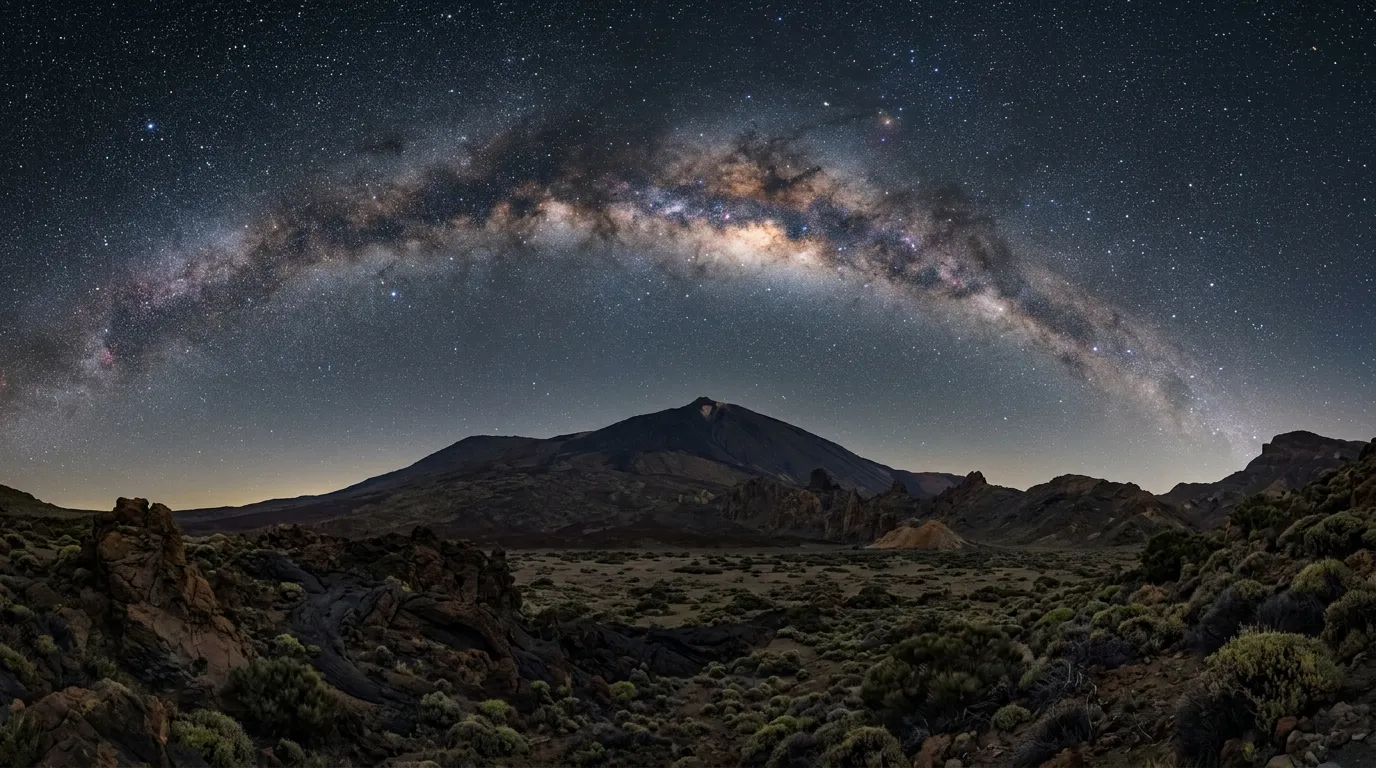
Tenerife Stargazing
Tenerife stargazing guide: Teide National Park's UNESCO Bortle-2 skies, 83 constellations visible. Observatory visits from €21, Parador hotel, and best tours.
Walk uphill from the Casa to the Iglesia de la Concepción. A parish church has stood on this site since 1516, but earthquakes in 1704 and 1705 destroyed that earlier building almost completely; the baroque structure standing today, its twin towers visible from the TF-5 motorway far below, was rebuilt between 1768 and 1788[4]. The interior is Canarian baroque: less gilded than its mainland Spanish equivalents, with unpainted volcanic stone columns and a Mudéjar coffered ceiling dating from that 18th-century rebuild. The Mirador Humboldt, named for the Prussian naturalist who visited in 1799 and called the Orotava Valley the most beautiful he had seen, opens onto a panorama of banana plantations descending in terraces toward Puerto de la Cruz with Teide rising behind. Go in late afternoon when the sun is behind you and the mountain catches the gold before sunset.
Recommended tours
Tours are selected for quality, not commission. I earn a small fee if you book — at no extra cost to you.


If you stay overnight in the valley, the Hotel Rural Victoria occupies a restored 17th-century manor house with a courtyard garden and mountain views from the upper terrace, positioning you for both a daytime La Orotava walk and a 45-minute drive up to the Teide caldera after dark.
Two seasonal events justify planning your dates around them:
- Corpus Christi (May or June, depending on the liturgical calendar): the town carpets its streets in hand-laid alfombras (carpets made from flower petals and coloured volcanic sand), a tradition dating to 1847. The designs, laid by neighbourhood associations through the night before the procession, cover the entire route from the town hall to the Iglesia de la Concepción[4].
- Fiesta de la Vendimia (late September): the Orotava Valley's wine harvest festival, celebrating the DO Valle de la Orotava appellation. The local Listán Blanco, grown in braided cordón trenzado vines that spread laterally across the volcanic soil, produces a mineral-driven white that pairs naturally with the grilled fresh fish served at the festival stalls.
The Teide Observatory by day
The Teide Observatory (Observatorio del Teide), operated by the Instituto de Astrofísica de Canarias, runs guided daytime visits from April through November[5]. Tickets cost €21 and the visit lasts roughly one and a half hours. This is not a stargazing session; no night visits are open to the public at any time of year, but it is the only way to see the instruments that underpin Tenerife's astronomical reputation.
The tour covers the GREGOR solar telescope, Europe's largest, and the Vacuum Tower Telescope (VTT), both dedicated to solar physics. Your guide will explain how the instruments track the Sun and what their data reveals about sunspot cycles, solar flares, and the corona. The observatory sits on the Izaña ridge at 2,390 metres, and on a clear day the view across the caldera toward Pico del Teide justifies the ticket on its own.
What the Teide Observatory Guided Visit does not offer, and what no public tour offers, is access to the professional night telescopes. The research-grade night instruments (the Carlos Sánchez infrared telescope, the IAC-80, the robotic STELLA telescopes) operate under strict light-protection protocols and are never open to casual visitors. If you are picturing a dome opening onto the Milky Way, that experience happens on a commercial stargazing tour elsewhere in the caldera, not at the observatory itself.
Book through the IAC website, not a third-party reseller. Summer slots fill weeks ahead. The tour runs in Spanish and English, and the guide's astronomical knowledge is genuinely high. This is a working research facility that runs visits as a side function, not a tourism attraction that happens to have telescopes.
A practical note that matters at altitude: the meeting point is at the observatory gate, roughly a 45-minute drive from the coast. No public bus serves the observatory, so you need a hire car. The road is paved all the way and the car park is large, but the last stretch above 2,000 metres can close in winter when snow accumulates. Check the IAC website for status before you drive.