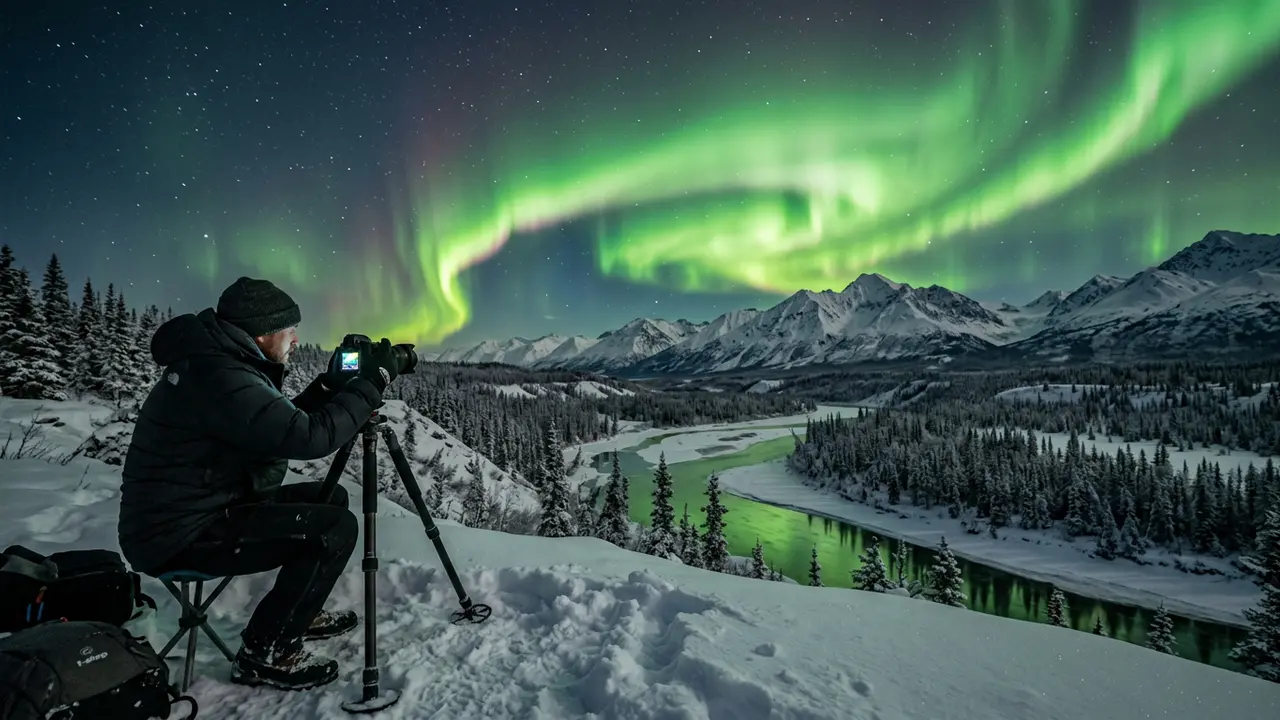
Aurora photography tours in Fairbanks turn the northern lights from a spectacle you watch into something you actually capture. The gap between a photograph that works and a blurry green smear comes down to camera settings, tripod stability, and having someone adjust both while the display is live. That's what these tours provide.
Most depart at dusk and drive 30 to 100 miles from downtown on roads that put Fairbanks's light pollution behind the horizon. Common staging grounds include the Chena Hot Springs Road corridor east of the city, hills north of Ester, and locations along the Steese Highway toward the auroral oval interior. Guides track the Kp index throughout the drive, routing toward clear sky and strong geomagnetic readings. Group sizes run 2 to 8 guests, small enough for the guide to check each person's histogram before the next long exposure.
What a guide teaches on the ice
The instruction begins before the aurora appears. Guides run through the starting setup while the van is still warm: manual mode, ISO 800 to 3200, aperture at f/2.8 or wider, shutter at 3 to 4 seconds for a moderate display. Focus in manual, set to infinity via live view, then locked in place. When the display intensifies (a Kp-5 or Kp-6 event looks nothing like a Kp-2), the guide shortens the shutter to catch movement and adjusts ISO to match aurora brightness.
Guides also work through the problems that kill images without being obvious: battery rotation at -20°F to -30°F, the fogging protocol when moving between cold air and heated shelters, and framing position to keep headlamp light out of a long test exposure. Tripods are included on most tours; the better operators use carbon-fiber rather than aluminum, which matters when temperatures drop below -30°F and metal hardware starts to seize. You bring a camera body and lenses or arrange a rental; everything else comes with the tour. If you'd rather build your own cold-rated kit for future trips, aurora photography gear for Fairbanks covers camera bodies, lenses, and battery care in more depth.
Small groups versus private tours
The standard group format works for committed amateurs happy to share a location. Guests working different foreground angles often produce strikingly different images from the same half-hour shoot. The guide circulates.
Private tours cost $725 to $2,999 for multi-night programs. The reasoning is direct: if astrophotography is the reason you flew to Alaska, private time pays off. You set the shooting angle, hold a location as long as the composition demands, and work through technical problems without group constraints. Some Fairbanks operators (including Scott Stone Photography and Expeditions Alaska) structure multi-night private programs specifically around long-exposure technique, covering composition and RAW processing alongside live aurora capture.
If photography is secondary to simply seeing the lights, a small-group tour at $95 to $250 delivers both.