
What the Atacama actually demands from your kit
San Pedro de Atacama sits at 2,407 m above sea level.[1] That number matters for gear for two reasons: cold nights and powerful UV. Daytime temperatures in the village reach 25 to 30°C in summer and 12 to 18°C in winter, but after dark the temperature at an outdoor observation site can drop to between -5°C and -10°C on winter nights.[2] Travellers who pack for the daytime heat and assume one jacket will be enough regularly end up cutting their stargazing sessions short.
The UV situation is equally underestimated. UV-B radiation increases by roughly 25 to 50% per 1,000 m of elevation gain.[3] At 2,407 m[1], with the sun passing nearly overhead at San Pedro's latitude of approximately 23°S, exposed skin burns faster than at sea level even on overcast days. The gear problem is that you need sun protection and cold-weather insulation in the same bag, often on the same day.
The gear list below works from that constraint outward: start with optics (the decision most travellers overthink), then night-vision essentials, then cold-weather layering, then sun and dust protection. Electronic accessories such as power banks and dust covers for lenses come last because they are the easiest to sort once the main categories are settled.
Optics: why binoculars beat a travel telescope
The most common gear question before an Atacama trip is whether to bring a small telescope. The honest answer: almost never worth it. The commercial observatories in San Pedro (SPACE Observatory, Atacama Lodge, and Ahlarkapin) provide access to mounted 12 to 16-inch instruments with staff who know how to find objects in the southern sky.[4] You will see more through those instruments in one guided session than you would manage in a week with an unfamiliar travel scope in the dark.
A portable telescope also requires polar alignment, cooldown time after being moved from your warm lodge room, and practice finding objects in a very narrow field of view. At altitude, where your hands may shake from cold or low oxygen, manually tracking an object at 100x magnification is genuinely difficult. Collimation drifts during air travel. None of that applies to a pair of binoculars.
Binoculars earn their place in the Atacama because the sky's most impressive targets are wide-field objects. The Large and Small Magellanic Clouds, the Milky Way's two satellite galaxies invisible from Europe and most of North America, span several degrees of sky each. The Eta Carinae Nebula, the Omega Centauri globular cluster, and the full southern Milky Way arch are all best appreciated with a wide view, not a narrow eyepiece. Dual-eye viewing also produces a brighter perceived image than monocular telescope viewing, even at lower magnification.
| Approach | Best targets | Setup required | Verdict for Atacama travel |
|---|---|---|---|
| Naked eye | Milky Way arch, Magellanic Clouds, meteor showers, naked-eye planets | None; optimal for dark adaptation | Essential, not optional — do this first every night |
| 10x50 binoculars | Magellanic Clouds detail, Omega Centauri, Eta Carinae Nebula, open clusters | None; ready immediately | Recommended: the right tool for the sky's best targets |
| 8x42 binoculars | Milky Way sweeping, brighter clusters, wide-field views | None; most portable format | Good travel compromise if weight is a constraint |
| Travel telescope (up to 90 mm) | Planets, double stars, lunar detail | Alignment, cooldown, collimation, dark-sky object-finding skill | Skip it — visit SPACE or Atacama Lodge instead |
| Guided observatory telescope (12-16 inch) | Galaxies, nebulae, planets, globular clusters | None; staff-operated | Book this: the best views you will get in San Pedro |
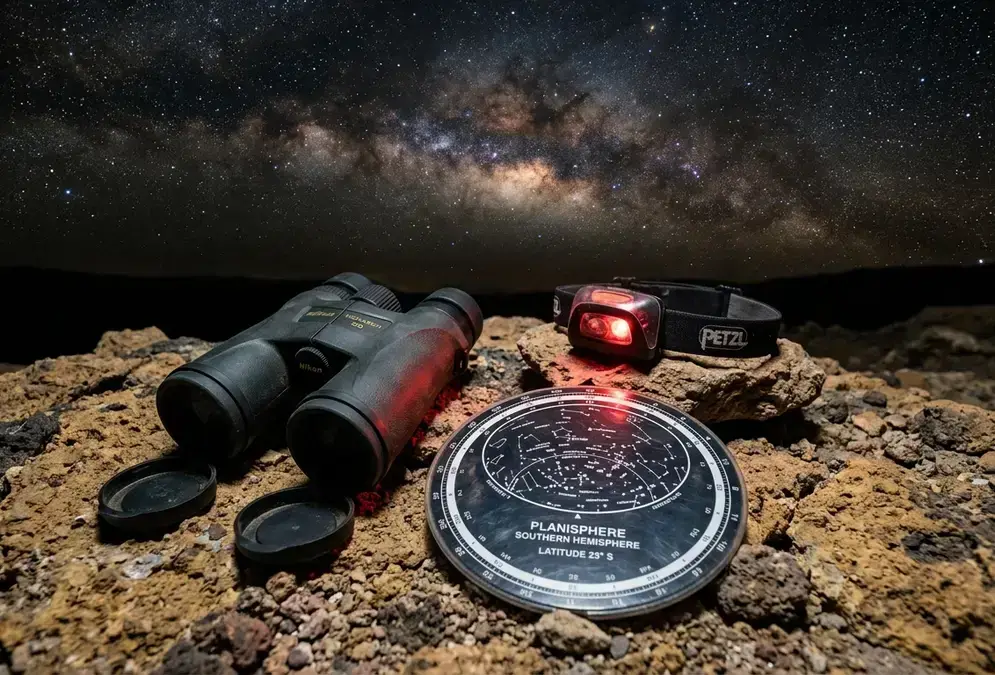
For the Atacama, the 10x50 is the standard astronomy binocular choice: 10x magnification, 50 mm aperture, exit pupil of around 5 mm (close to the dark-adapted human pupil diameter of 6 to 7 mm at altitude). The 7x50 format offers a wider field and a larger exit pupil, which helps if your night vision is not as strong, but is somewhat heavier. The 8x42 is the most compact travel option, slightly less light-gathering than the 50 mm formats but much easier to hand-hold steadily in the cold. Magnification above 10x requires a tripod adapter for steady viewing; at altitude, even warm hands tremble.
Red light, sky apps, and keeping your night vision
Dark adaptation is the process by which your eyes shift from cone-based daytime vision to rod-based low-light vision. It takes 20 to 30 minutes to develop fully, and a single exposure to white light resets it. This is not a technicality. On a guided tour, one person checking a white phone screen can take the whole group's eyes out of dark adaptation simultaneously.
A red headlamp solves this because human rod photoreceptors are minimally sensitive to wavelengths above roughly 650 nm (red). Red light allows you to adjust gear, check a star chart, or move around without resetting adaptation. Any headlamp with a dedicated red-light mode works; a specialised astronomy torch is not necessary. The single most important spec: the red mode should be dim, not just red. A bright red light still partially affects adaptation, especially at the shorter end of red wavelengths.
One practical Atacama note: battery performance drops sharply in cold conditions. At -5°C to -10°C, a standard alkaline battery can lose 40 to 50% of its stated capacity. A USB-rechargeable headlamp charged at your lodge before each session is more reliable than disposables.
For sky charts, an augmented-reality phone app that overlays constellation lines on a live camera view works well as a companion tool, especially for Southern Hemisphere beginners who do not recognise the southern constellations. The setup requirements that matter for Atacama use: enable red or night mode before going outside (not after you are already dark-adapted), disable auto-brightness, and download offline star maps before leaving your lodge. Mobile data coverage in the desert is unreliable once you are outside San Pedro town. An app that needs a data connection to load the sky is useless at the observation site.
A planisphere calibrated for approximately 20°S to 25°S latitude is useful if you want to learn the southern sky without a phone in hand. It works in red light, has no battery, and forces you to learn angular relationships between constellations rather than just point at bright dots. The celestial south pole is your reference out here, not Polaris. For a deeper look at what a guided session covers, see the Atacama stargazing astronomy tour, where guides work through southern-sky landmarks with a laser pointer before any telescope time.
Star trackers: relevant for photographers, not most visitors
A star tracker (also called a travel tracker or equatorial tracking mount) is a battery-powered mount that rotates at the Earth's sidereal rate, cancelling out Earth's rotation for a camera sitting on top of it. Without one, a camera exposure longer than roughly 15 to 20 seconds will record star trails rather than point stars. With one, exposures of 2 to 5 minutes become feasible, which makes it possible to capture the Milky Way's dust lanes, the Magellanic Clouds, and faint nebulae without specialist observatory access.
For astrophotography, a tracker is close to essential at the Atacama. The southern sky's most photogenic targets (the Magellanic Clouds, Omega Centauri, Eta Carinae) are faint enough that untracked exposures produce noise-limited results regardless of how dark the sky is. A compact travel tracker weighing typically 0.8 to 1.5 kg fits in a carry-on and mounts on a standard tripod ball head. Some accept binoculars as well as cameras, useful if you also want a steadier wide-field view while the camera runs.
Recommended tours
Tours are selected for quality, not commission. I earn a small fee if you book — at no extra cost to you.
For pure visual observing, you do not need a tracker. The guided commercial tours provide telescopes with driven equatorial mounts and you just look through the eyepiece. For the visitor whose primary goal is to experience the southern sky rather than photograph it, the tracker stays at home.
If you are bringing a camera regardless (and most travellers do), a tracker is worth the bag space. Polar alignment in the Southern Hemisphere uses the South Celestial Pole as the reference: Sigma Octantis, the faint south polar star at roughly magnitude 5.5[5], lies within about 1 degree of the pole but is dim enough to be invisible without genuinely dark skies. San Pedro's skies will show it plainly on a clear new-moon night. For advice on which nights to plan around, the best time for Atacama stargazing covers the season and moon-phase mechanics in detail.
Layering for a 35-degree temperature swing
The single most uncomfortable situation in the Atacama is being underdressed for a night observation session. Stargazing means standing or sitting still for two to three hours in conditions that may be at or below freezing. The practical rule: dress as if the temperature is 10°C colder than it actually is, because stillness eliminates the body heat you generate while walking.
-10°C
A three-layer system works for most Atacama conditions:
- Base layer: Moisture-wicking thermal or merino wool against skin. Merino is preferable for multi-day desert travel because it resists odour, regulates temperature across the day-to-night swing, and is comfortable against skin even when slightly damp from sweat during daytime hikes.
- Mid layer: Fleece or light down sweater. This is the layer you remove and repack when the afternoon is warm and pull back on as the sun drops.
- Outer layer: Insulated down or synthetic jacket. Essential for evening observation. Down compresses well and packs small; synthetic insulation performs better if there is any moisture, such as morning dew on the altiplano or condensation from breath in cold still air.
For extremities: a wool or fleece hat covering the ears matters more than most travellers expect. Gloves in two weights work well: thin liner gloves for fine motor control (adjusting binocular focus, operating a camera) with heavier overmitts worn between adjustments. Cold feet end stargazing sessions faster than anything else; wool or thermal socks are not optional for winter nights. A neck gaiter or buff closes the collar gap where warm air escapes the jacket. The Atacama packing list for cold altitude covers the full cold-altitude clothing system in more detail.
Sun, dust, and altitude: daytime gear
The UV exposure at 2,407 m[1] is not a secondary concern. With UV-B radiation running roughly 25 to 50% higher than at sea level[3] and the sun close to overhead at San Pedro's latitude, exposed skin burns faster than most visitors anticipate. SPF 50+ sunscreen is the practical minimum; lower factors provide meaningfully less protection under these conditions. Apply generously to face, neck, and any exposed skin, and reapply every two hours. Sweating and wind remove it faster at altitude.
Sunglasses should be rated Category 3 or 4 (UV400 blocking). Polarised lenses reduce the glare from the salt flats at the Atacama Desert, which can be intense enough to obscure detail in the landscape. A wide-brim hat protects face, ears, and neck; a hat with a back flap (legionnaire style) adds coverage on long walks. Lips burn quickly and are often the first uncomfortable reminder of UV neglect in the desert. SPF 30+ lip balm belongs in every pocket.
The Atacama wind carries fine volcanic dust that lodges in binocular eyepieces, camera sensor housings, and phone speaker grilles. A lens cloth in every jacket pocket, and a small dry bag or zip-lock pouch for optics when they are not in use, prevents the kind of grit damage that is expensive to fix after the trip. Dust caps on binoculars when not in use are simple insurance.
A portable battery bank matters because cold drains phone and camera batteries faster than expected, and some observation sites are beyond USB charging range. Charge the bank at your lodge before each session. Carry a 1.5 to 2 L water bottle for daytime excursions: altitude increases respiratory moisture loss, and staying hydrated at 2,407 m[1] helps prevent headaches that can otherwise cut a high-elevation day short.