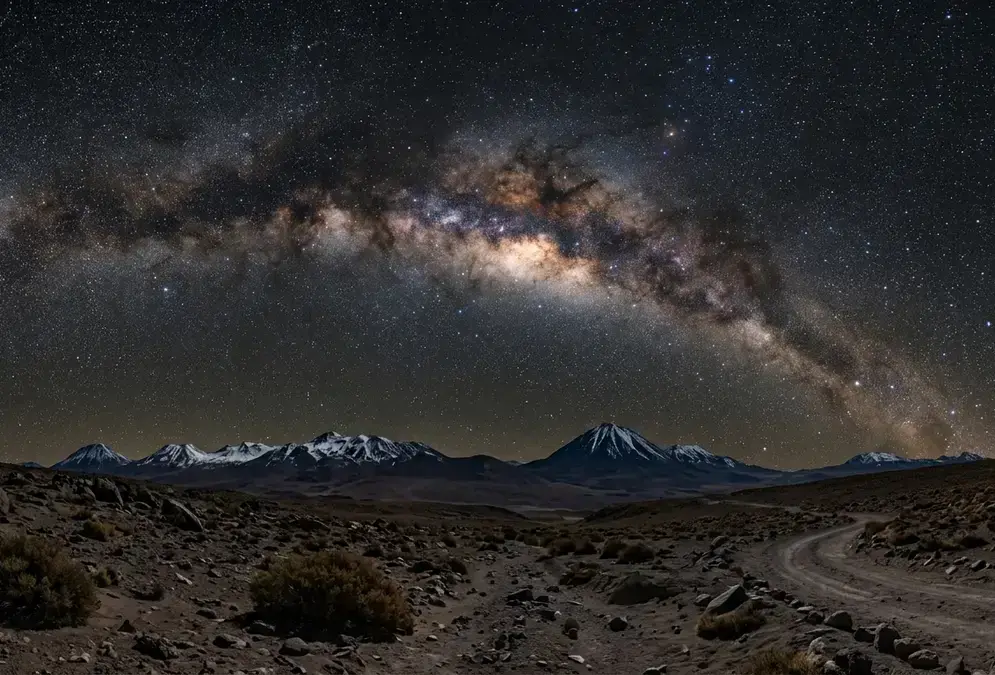

Why season and moon phase are both non-negotiable
Most stargazing guides tell you to visit the Atacama in winter. That's true, but it's half the answer. A full-moon night in July is considerably worse for Milky Way viewing than a new-moon night in April.
330+
The Milky Way's galactic core rises and sets like the Sun and Moon do: its position in the sky depends entirely on the time of year. From San Pedro de Atacama at roughly 22.9° South latitude, the galactic centre (in the constellation Sagittarius) climbs nearly overhead during the Southern Hemisphere's autumn and winter months, then spends the northern winter months below the horizon or rising only at dawn.[2] No amount of dark sky fixes that geometry.
The moon's illumination is the other hard constraint. A full moon produces enough ground-level light to read by and raises the sky's background brightness enough to erase the Milky Way's faint dust lanes and the dimmer nebulae entirely. Tour operators in San Pedro routinely advise booking within five nights of a new moon for serious deep-sky observing. In the Atacama Desert's Bortle 1–2 skies, even a half-moon degrades the experience measurably.
The optimal window is specific: new-moon nights between May and August. That intersection of peak galactic-core altitude and minimum lunar interference is what separates a life-changing sky from a merely excellent one.
The galactic-core season: April through October
The Milky Way's galactic bulge is visible from the Atacama for roughly seven months of the year, but quality varies significantly across that window.
April and May mark the start of the prime season. In April, the galactic core rises in the evening sky and sets before dawn; by mid-May it is overhead from roughly 22:00 until near sunrise. Night temperatures in April sit around 5°C at pre-dawn, manageable with a down jacket. Humidity is near zero. These are good months for photographers who want a warmer night without sacrificing sky quality too much.
June and July are the peak. The galactic centre transits near zenith (almost directly overhead) shortly after astronomical twilight ends, then arcs across the sky for most of the night. June averages a low of just 0.3°C (32.5°F)[3], and July can drop below freezing before dawn. Bring insulated layers and gloves; read the Atacama packing list for cold altitude before you pack. The reward is the longest dark window of the year aligned with the galactic core at its highest point. Under Bortle 1 conditions, the core casts a faint shadow.
August and September offer the best balance of sky quality and comfortable temperatures. August still delivers the galactic core high overhead through most of the night; by late September it begins to set earlier in the evening. September lows rise to around 4°C. For travellers who would rather not deal with near-freezing conditions, September is the easiest recommendation: excellent sky, mild nights, and the same near-zero humidity.
October is the tail of the season. The core is lower in the west by late evening and visibility shortens, but skies remain very dry and clear. Some operators describe October as underrated: fewer visitors and still good Milky Way conditions in the first half of the night.
Month-by-month breakdown: sky quality and what to expect
The table below summarises each month across the four factors that matter for trip planning: Milky Way quality (is the galactic core well-placed?), sky transparency (humidity, dust), typical night temperature at town level, and general reliability. All temperatures are for San Pedro town at 2,443 m; observatory sites at higher altitude are colder.[3]
| Month | Milky Way quality | Night temp (town) | Weather reliability |
|---|---|---|---|
| Jan | Poor (core rising at dawn) | ~10°C | Variable: Bolivian winter risk |
| Feb | Poor (core behind Sun) | ~9.5°C | Lowest: wettest month (~29 mm)[4] |
| Mar | Fair (core rising late) | ~8°C | Improving; rain tapering off |
| Apr | Excellent | ~5°C | Very reliable; near-zero rain |
| May | Outstanding | ~2°C | Outstanding; humidity near zero |
| Jun | Peak | ~0.3°C | Peak; coldest and driest |
| Jul | Peak | ~0°C | Peak; can go below freezing |
| Aug | Excellent | ~1°C | Excellent; nights warming slightly |
| Sep | Very good | ~4°C | Very good; best comfort/quality balance |
| Oct | Good | ~6°C | Very good; driest month of year |
| Nov | Fair (core setting earlier) | ~8°C | Good but moisture increasing |
| Dec | Poor (core lower, shorter) | ~10°C | Variable: Bolivian winter building |
A few months need explanation. March often surprises visitors: the Bolivian-winter rains are usually tapering off by mid-month, the galactic core is rising in the east before midnight, and temperatures are cooler but not cold. It's a legitimate shoulder option for travellers with flexible dates.
November sees a small uptick in moisture as the Bolivian winter begins to build again. Skies stay mostly clear, but the galactic core is now descending and sets earlier each night. Dedicated astrophotographers sometimes treat early November as a secondary window: less cold than June, more galactic visibility than December.
January and February are not a reliable choice for Milky Way work. See the next section.
The Bolivian winter: what January and February actually mean
The Bolivian winter (locally invierno boliviano) is not cold; it's wet. From roughly late December through February, thermal air masses over the Bolivian altiplano push moisture westward over the Andes. At San Pedro town level, mornings are often clear. The problem comes in the afternoon: convective clouds build, and by evening there's a meaningful chance of cloud cover or brief thunderstorms.
That doesn't mean these months are worthless. Even during the Bolivian winter, the Atacama averages only around 20 mm of precipitation in January and 29 mm in February[4] — extremely dry by global standards. Many nights in those months are perfectly clear. But the uncertainty is real: you might get five perfect new-moon nights in a row, or clouds could roll in on three of them. If you book a guided stargazing astronomy tour in January, check the operator's cancellation policy carefully.
Read next · Article
Atacama New-Moon Calendar: Plan Around the Dark Sky
How to read a lunar calendar for Atacama stargazing: the 29.5-day moon cycle, the full-moon tour blackout, and which months put the galactic core overhead.
The intensity of the Bolivian winter also varies year to year. Some years it barely materialises; others it extends into early March. There is no reliable way to predict the severity months in advance.
Two further points about December through February: the galactic core is not particularly well-placed anyway, and these months are peak tourist season for the broader Atacama region. Accommodation costs more, tours book out faster, and Valle de la Luna fills up. If you're planning primarily around stargazing, the case against January and February is both astronomical and logistical.
The new-moon dependency: how to align your trip with the lunar cycle
A lunar cycle is approximately 29.5 days. New moon to new moon, and back again. For trip planning, the practical window is roughly five nights before and five nights after new moon, giving you about ten nights per month when the sky is dark enough for serious deep-sky observing. Outside that window, a waxing or waning crescent still leaves most of the night dark, but the best work happens close to new moon.
The simplest approach: once you've settled on a travel month (May through September for best results), look up the new-moon dates for that month on a site like timeanddate.com's moon-phase tool filtered to the Antofagasta region.[5] Then build your itinerary so your observatory nights, or at least one night at a dedicated observation site, fall within that window. Most guided astronomy tours in San Pedro publish their calendar with moon-phase guidance; the better operators note which nights they're running deep-sky programmes versus planetary sessions.
A few practical notes. First, operators in San Pedro are generally transparent about this. If you email asking about moon phase for your dates, you'll get an honest answer. Second, don't discount the partial windows: a night at first quarter (50% illuminated) still leaves the second half of the night quite dark in Bortle 1–2 conditions. Third, if your travel dates are fixed and the moon is nearly full, a "Moon and planets" session is still scientifically interesting. A waxing gibbous Jupiter under magnification is spectacular. Just don't expect to photograph the Milky Way.
For a detailed calendar with specific monthly guidance, the Atacama new-moon calendar gives month-by-month dates and advice on how to cross-reference moon phase with weather patterns. One important note: do not rely on sites that publish specific 2026 moon dates without linking to a live lunar calculator. Moon phases are fixed by astronomy and easy to verify; exact dates are freely available from authoritative tools. The calendar gives you the pattern; verify the specific dates yourself.
Putting it all together: how to pick your dates
The decision tree is short. Start with your travel window and apply three filters in order.
Filter 1: eliminate the risk months. Unless cost or itinerary forces January or February, avoid them for dedicated stargazing. The potential is there, but so is the uncertainty. If those are the only months you can go, book a refundable tour, check weather forecasts from about a week out, and treat any clear night as a bonus rather than a given.
Filter 2: pick the right season for comfort versus peak sky. June and July give you the most Milky Way time overhead but also the coldest nights (near or below freezing before dawn). September and October are warm enough to stand outside for two hours in a down jacket, and sky quality is still very good. April and May sit in the middle. If astrophotography is your goal, go in June or July and dress for it. If you want a comfortable night out under an extraordinary sky, September works.
Filter 3: align with a new-moon window. Once you have a target month, spend ten minutes with a lunar calendar. If the new moon falls near the middle of your trip, you're positioned well. If it falls on your arrival or departure day, try to shift by two or three days. A seven-day trip centred on new moon gives you four or five reliably dark nights.[2]
Recommended tours
Tours are selected for quality, not commission. I earn a small fee if you book — at no extra cost to you.

For most people flying in from abroad, the practical sweet spot is late May, June, or early to mid-September: excellent Milky Way conditions, manageable cold, and reliable weather. Those are the months where experienced operators run their astrophotography workshops.
One final point: altitude at San Pedro is 2,443 m[3], and some observatory sites sit at 4,000 m or above. Allow your first day for rest. A stargazing session after a 3:00 am alarm on your first night, while your body is still adjusting to the elevation, is the most common way a good trip becomes an uncomfortable one. The acclimatisation guide covers what to expect and how to manage it.
The best lodges for Atacama stargazing lists properties that make it easy to align your stay with dark-sky nights. Some include guided sessions; others have private viewing terraces. Where you sleep matters almost as much as when — and once your dates are set, the best stargazing spots in the Atacama Desert covers exactly where to spend those new-moon nights.