
Why the moon phase matters more than the season
San Pedro de Atacama sits at 2,443 m above sea level[1] in one of the driest atmospheric columns on Earth. Professional observatories chose this plateau not for novelty but because the atmosphere here scatters almost no light. On a clear night, stars down to magnitude 7.5 or 8.0 are visible to the naked eye[2], roughly twice the depth of a good rural site in Europe or North America.
330+
That exceptional transparency works both ways. When the moon is full, scattered lunar light floods the sky with roughly 0.1 to 0.3 lux at ground level. In a Bortle 1 to 2 sky like the Atacama's, that is enough to reduce the limiting magnitude by three to four magnitudes and render the Milky Way's galactic arm detail invisible to the naked eye. The desert's own dryness and altitude, which normally eliminate light scattering, cannot compensate for a bright moon.
The practical consequence: a new-moon night in February, during the Bolivian winter rainy season when afternoon clouds are common, can still produce a spectacular sky the moment those clouds clear. A full-moon night in June, peak season by every other measure, produces a sky that supports moon and planet viewing but little else for deep-sky work.
Season matters for a different reason: which objects are overhead. But phase overrides season as the variable that determines whether a given night will be genuinely dark. Build your calendar around the phase first, then overlay the seasonal quality of what the dark sky contains.
How to read a lunar calendar for San Pedro
A lunar synodic month is approximately 29.53 days[3] — the time from one new moon to the next. The cycle runs: new moon (0% illumination) to waxing crescent, to first quarter (50%), to waxing gibbous, to full moon (100%), then back through waning gibbous, last quarter, and waning crescent before the next new moon.
For stargazing purposes, the calendar divides into three zones:
- Dark window: roughly the 5 nights centred on new moon (new moon minus 3 through new moon plus 4). The moon either rises and sets with the sun or sets early in the evening, leaving the sky fully dark for most of the night. This is the window you want.
- Shoulder window: the crescent phases, roughly days 5 through 8 after new moon (waxing) or days 22 through 26 (waning crescent before the next new moon). The moon sets by early evening or rises well after midnight, giving you a partial dark sky from approximately 22:00 onward.
- Bright window: first quarter through last quarter, centred on full moon. The moon dominates the sky for much or all of the night. Deep-sky tours are cancelled or restructured.
To apply this: open the moon-phase calendar at timeanddate.com filtered to San Pedro de Atacama or the Antofagasta Region and find the new-moon date in your target travel month. Your arrival should land two to three days before new moon at the latest. If you arrive two days before, the first evening in San Pedro falls inside the best window, and your remaining nights stay dark as the moon ages only slightly.
The key mistake travellers make is arriving one day after new moon and staying five nights. By night four, the crescent moon is visible in the western sky after sunset and growing brighter each evening. Arriving two days before new moon shifts all five nights into the optimal or near-optimal window.
Best time to visit the Atacama for stargazing covers the seasonal overlay in more depth, but the calendar move above is the single highest-leverage action in Atacama trip planning.
The galactic core season, month by month
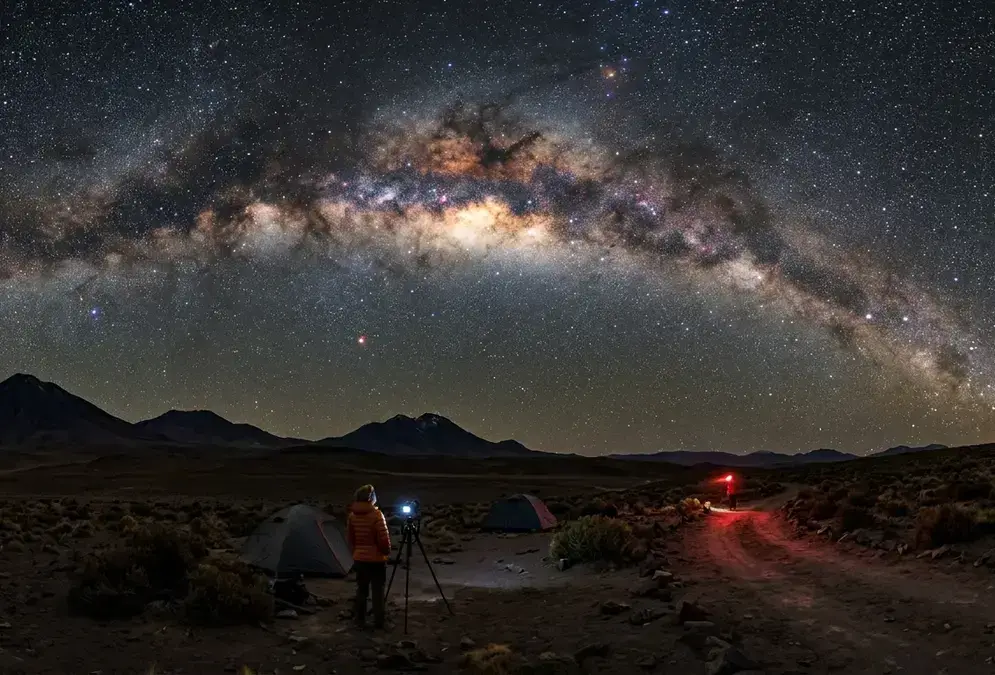
Knowing when the sky is dark is only part of the equation. The second variable is what the dark sky contains. For most visitors, that means the Milky Way's galactic core: the bright central bulge in Sagittarius that rises high above the horizon from Southern Hemisphere latitudes and produces the arch photographs that define the Atacama as a stargazing destination.
From San Pedro at approximately 23° south, the galactic centre transits at a high angle overhead, well above 60 degrees[4] during peak months. Observers in northern Europe or North America see the same object hugging the southern horizon at 15 to 20 degrees altitude, where atmospheric extinction dims it significantly. At the Atacama it is nearly overhead.
The seasonal pattern:
- November through February: the galactic centre is largely in the daytime sky or barely above the horizon at dawn. New-moon nights are dark, but there is no impressive Milky Way arch. These months suit other targets: the Large and Small Magellanic Clouds are prominent year-round, and the deep southern constellations are well-placed. If the galactic core is your primary target, avoid this window.
- March and April: the galactic core begins to rise in the evening sky. By April it is visible above the horizon well after astronomical twilight, climbing higher through the night. April new-moon nights combine improving core visibility with reasonable temperatures and almost zero precipitation.
- May through August: peak galactic core season. The centre transits high overhead during the first half of the night, the atmosphere is at its driest, and sky transparency is sharpest. June and July nights in San Pedro drop to near-freezing (June average low: 0.3°C[5]). The cold is real; warm layers are not optional. This is the sky at its absolute best.
- September and October: the core starts lower and sets earlier each evening but is still well-placed for the first part of the night. Temperatures are more comfortable, and precipitation remains near zero. A strong alternative for travellers who find June and July cold a barrier.
| Period | Galactic core | Night temps | Precipitation risk | Dark-sky quality |
|---|---|---|---|---|
| Nov–Feb | Poor to none | Mild to warm | Moderate (Jan–Feb) | Low |
| Mar–Apr | Fair — rising | Cool | Near zero | Good |
| May–Aug | Best — overhead | Cold to near-freezing | Near zero | Excellent |
| Sep–Oct | Good — lower arc | Mild | Near zero | Very good |
The best Atacama stargazing window is a new-moon night falling between May and August. New moon in September or October is a close second. Any new-moon window between April and October is worth planning around.
What tour operators do near full moon
The commercial observatories in San Pedro, including the SPACE Observatory, AtacamaStargazing, and Ahlarkapin, handle the full-moon week in one of two ways. Most suspend their standard deep-sky programmes entirely for approximately seven nights centred on the full moon. The telescope sessions that focus on galaxy clusters, faint nebulae, and the Milky Way's structure require genuinely dark skies, and with a full moon above the horizon the scientific interest of those sessions drops sharply.
Some operators pivot to a moon-and-planets format instead. A bright full moon is a spectacular telescopic target: craters, mountain ranges, and the terminator line at high magnification are genuinely impressive views. Venus, Jupiter, and Saturn are visible regardless of moon phase and remain excellent eyepiece targets on bright nights. These tours are scientifically worthwhile, just categorically different from a dark-sky session.
Read next · Tour
Atacama Stargazing & Astronomy Tour
Evening telescope session under the world's clearest skies. Book near new moon, avoid full moon. SPACE Observatory, San Pedro de Atacama — CLP 45,000.
For travellers, the practical implication is: check the full-moon dates for your target travel month before finalising flight dates. If your preferred window falls during the full-moon blackout period, you have three options. First, shift the trip by one to two weeks to catch the new-moon window. Second, book a moon-and-planets session explicitly and accept it as a different but valid experience. Third, plan the trip primarily around daytime excursions (Valle de la Luna, El Tatio, the altiplanic lagoons) with astronomy as a secondary goal.
AtacamaStargazing's booking page notes explicitly that full-moon tours remain scientifically interesting but are not dark-sky nights[6] — an honest framing. If you have travelled specifically for the Milky Way arch or deep-sky telescopic work, the full-moon week is not the window you need.
Finding your dark window: the planning arithmetic
The Atacama itinerary guide recommended by most specialist operators runs four to five nights. Working the moon calendar into that stay is simpler than it sounds.
Featured · Destination
Atacama Desert Stargazing
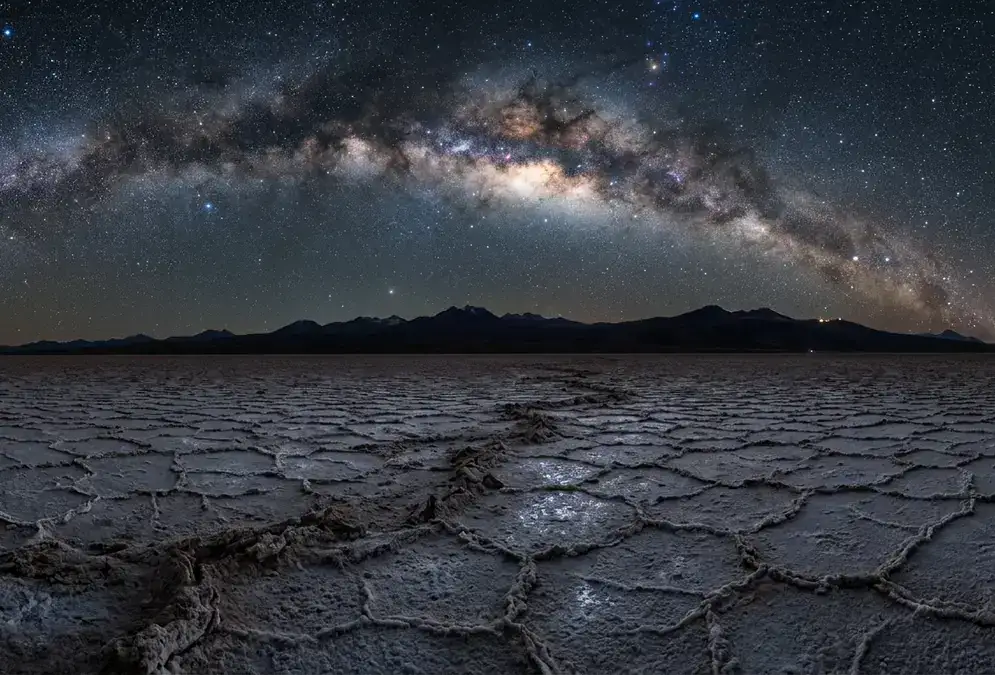
Earth's driest desert delivers Bortle 1–2 skies, 330+ clear nights a year, and the galactic core almost overhead. Guide: tours, lodges, season, getting there.
Start with the lunar calendar at timeanddate.com for the Antofagasta Region and pick the new-moon date in your target travel month. Count back two to three days from new moon: that is your ideal arrival date. A five-night stay beginning two days before new moon gives you one very dark arrival evening (thin waning crescent sets early), new moon itself, two nights of slight waxing crescent (moon sets by 21:00 or 22:00), and one final night as the crescent grows. Four of five nights fall inside the optimal or near-optimal dark window.
For a four-night stay, the arithmetic is similar. Arriving the day before new moon keeps three of four nights well inside the dark window. That extra half-day at altitude before the first evening observing session also helps acclimatisation at 2,443 m, where most visitors from sea level notice some effect in the first 24 hours.
Recommended tours
Tours are selected for quality, not commission. I earn a small fee if you book — at no extra cost to you.



If your calendar gives you a fixed window that does not neatly align with new moon, look at the waning crescent option. The final five days before the next new moon (approximately days 24 to 29 of the cycle) also produce very dark skies, with the moon rising only in the pre-dawn hours. A trip timed so you arrive around day 23 of the lunar cycle gives you the tail end of the dark period. Evening sessions are fine; pre-dawn tours run by some operators will be slightly compromised by the crescent moon on the horizon.
For anyone still deciding on trip length, the Atacama stargazing days guide maps each stay duration to what is realistically achievable alongside the major day excursions.
Observatory access and what to confirm before you book
The ALMA telescope array is located about 70 km from San Pedro. Its Operations Support Facility sits at 2,900 m; the Array Operations Site, where the antenna dishes are, sits at 5,000 m. ALMA ran a public visit programme for years, but as of June 2026 that programme is suspended[7] — the official ALMA website states it is working to reopen but gives no specific date. Check almaobservatory.org/en/visits/ before your trip. If it reopens, visits historically ran on Saturdays only, with prior approval required, and covered only the lower-elevation facility.
The ESO Very Large Telescope at Paranal sits roughly 560 km north of San Pedro by road, making it a separate trip rather than a day excursion from town. ESO runs active Saturday public visits[8] at two slots, pre-registration required. These are daytime visits to the telescope platform, not nighttime observing sessions.
For actual dark-sky telescope access, the commercial observatories in San Pedro are the product. SPACE Observatory uses a 16-inch reflector and runs two- to three-hour sessions. Ahlarkapin offers a culturally distinctive programme focused on the Atacameño astronomical tradition: the indigenous Likan Antai people mapped constellations not in star patterns but in the dark nebula patches between Milky Way star fields, identifying the Llama, the Fox, and the Toad in the dark clouds of the galactic arm. That perspective on the southern sky is worth booking for independently of the moon phase.
On prices: third-party travel guides put commercial observatory sessions in the USD 50 to 90 range per person. Verify current rates directly with operators, as these figures may be one to two seasons out of date.
Finally, a benchmark for Atacama darkness: in the Southern Hemisphere, the south polar point sits near Sigma Octantis, a faint star at approximately magnitude 5.5, close to the Small Magellanic Cloud. It is invisible without genuinely dark skies. Spotting it from San Pedro on a good new-moon night tells you exactly how dark the sky actually is.