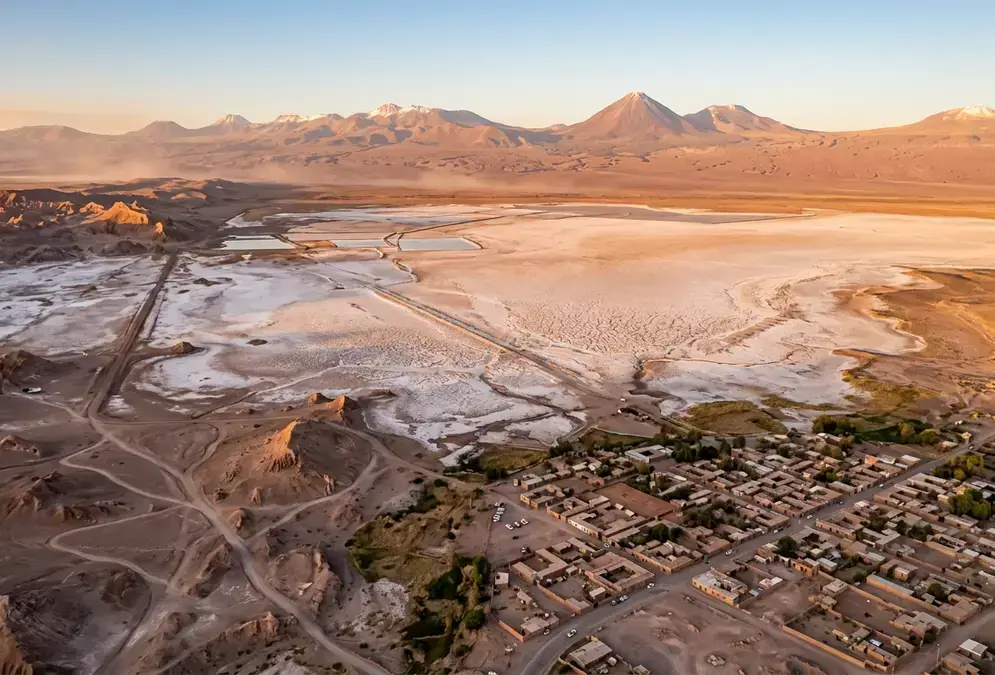

Why the order of your excursions matters
San Pedro sits at 2,443 m above sea level[1], which is high enough to produce headaches, broken sleep, and fatigue on arrival for many visitors who fly in from sea level. The town's altitude is manageable for most people within 24 hours. The problem is that the Atacama's signature excursions climb far higher: the geyser field at 4,300m reach approximately 4,300 m[2] and the altiplanic lagoons (Miscanti and Miñiques) sit around 4,200 m[3]. That is a 1,800 m gain above your sleeping altitude. Do either excursion before your body has adjusted and you will spend the best part of a day feeling ill.
The tours that stay at or near San Pedro's elevation are entirely safe on Day 1 or 2. Valle de la Luna (~2,400 m) and Laguna Cejar (~2,300 m) are at the same altitude band as town. The flamingo lagoons at Salar de Atacama (~2,300 m) are fractionally lower. Treat these as your warm-up days. The high-altitude excursions belong on Day 3 at the earliest, and Day 4 is safer if you had any symptoms on arrival.
The evening astronomy session at the SPACE Observatory is altitude-neutral: the observatory operates from town at around 2,450 m, so no acclimatization is needed. What it is not neutral to is the moon. SPACE cancels all tours for approximately one week around the full moon[4], and a near-full moon washes out the Milky Way even if you choose a different operator. Your astronomy session must fall within the new-moon window, which means planning your travel dates around the lunar calendar, not the other way around.
The altitude ladder: where each tour sits
Think of the Atacama excursions as a ladder with four rungs. The bottom rung covers everything at San Pedro's altitude or below: Valle de la Luna, Laguna Cejar, and the Salar de Atacama flamingo lagoons. These are safe any day of your trip. The second rung is the Puritama hot springs, sitting somewhere between 3,200 and 3,500 m above sea level, a meaningful step up that is fine after one night in town. The top rung holds El Tatio and the altiplanic lagoons, both just above 4,200 m, and both requiring at minimum two full nights of sleep at San Pedro first.
The SPACE Observatory stargazing session does not appear on the altitude ladder at all. It runs at town level and its only real constraint is the moon phase. Place it on whichever evening falls inside your new-moon window, regardless of what else you've done that day, with one caveat: avoid booking it immediately after El Tatio. The El Tatio tour wakes you at 04:00, takes you to 4,300 m, and returns you to San Pedro by early afternoon. Most visitors need a rest day after that, not a 21:00 astronomy session. Give the SPACE session its own evening.
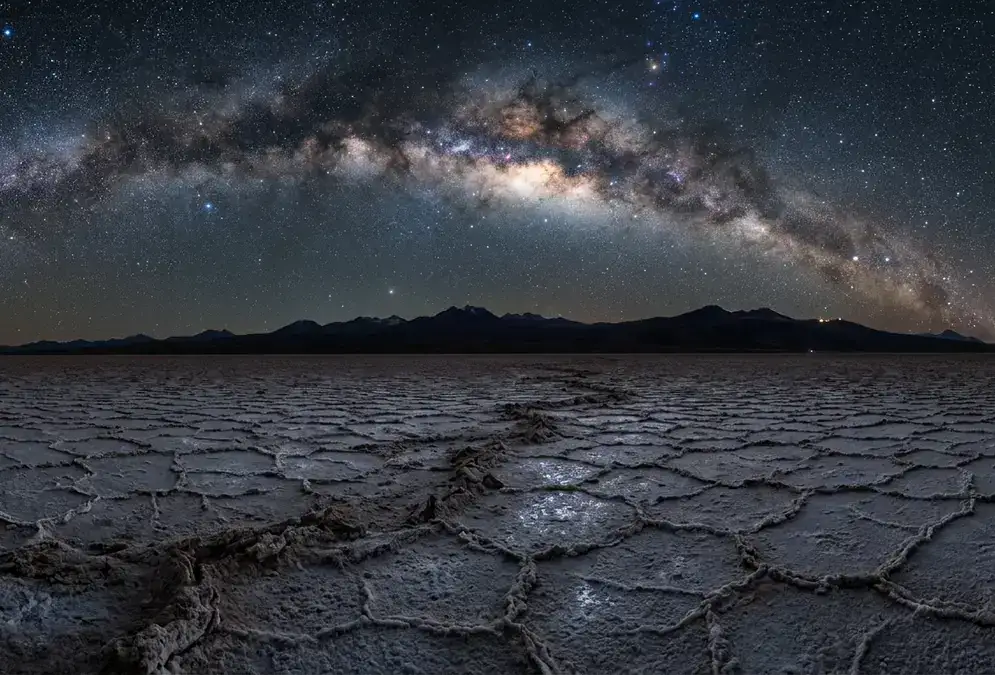
Featured · Destination
Atacama Desert Stargazing
Earth's driest desert delivers Bortle 1–2 skies, 330+ clear nights a year, and the galactic core almost overhead. Guide: tours, lodges, season, getting there.
Operator Nomades closes Laguna Cejar every Tuesday for environmental maintenance[5], so that's a day worth checking when slotting your schedule. Valle de la Luna closes for private events occasionally but is generally open daily. No other tours have fixed closure days that would force a rescheduling.
The 4-night itinerary, day by day
Four nights gives you the best balance: one day to acclimatize, two days at low altitude, the high-altitude excursions on Days 3 and 4, and a flexible final morning. Here is a workable order.
Day 1 (arrival): Fly Santiago to Calama (~2 hours), then transfer 100.5 km to San Pedro by shared shuttle or private vehicle (approximately 1 hour 10 minutes by road)[1]. Check in, hydrate, drink coca tea if offered. Light walk around the Plaza de Armas in the afternoon. Eat early and sleep early. This is not a sightseeing day; it is an investment in every day that follows. If your new-moon window falls tonight, do not push yourself to the observatory: your dark adaptation will be poor after travel, and you have more nights coming.
Day 2: Morning at Salar de Atacama flamingo lagoons: all three flamingo species present (Chilean, Andean, and James's Puna flamingo), and the white salt crust reflects hard enough to need sunglasses from the moment you step out of the vehicle. Return for lunch and a genuine afternoon rest. This rest is not optional if you want to be alert at 21:00: the combination of altitude, dry air, and disrupted sleep catches most visitors by Day 2. Evening: the SPACE Observatory astronomy session if your new-moon window is open. If the moon is too bright tonight, note which evening in your stay falls inside the window and hold it.
Day 3: Pre-dawn departure around 04:00 for El Tatio Geysers at ~4,300 m[2]. Steam columns peak at sunrise when ambient air temperature at the field can drop to -10°C in winter; in summer expect 0°C to -5°C at dawn. Most operators include breakfast on site. Return to San Pedro by midday. Spend the afternoon horizontal. Do not plan an evening tour today.
Day 4: Full day the high-altitude lagoons day trip: Piedras Rojas viewpoint (~4,200 m), Laguna Miscanti (4,140-4,200 m), Laguna Miñiques (4,100-4,150 m), and Socaire village. Depart 07:30, return around 18:00[3]. If tonight is your best new-moon evening and you feel well enough, the SPACE session is possible, but for most travelers this is the day the altitude fatigue accumulates. Assess honestly and move the session to Day 5 morning if you have a late departure.
Day 5 (departure): Transfer to Calama for your flight.
Compressing to 3 nights: what you lose
Three nights is enough time to see the Atacama if you accept two genuine trade-offs. First, you will not have fully acclimatized before your high-altitude excursion. Most healthy adults under 50 can tolerate El Tatio after two nights at San Pedro rather than three, but the risk of a rough morning is higher. Do not attempt both El Tatio and the altiplanic lagoons on a 3-night stay; pick one. Second, your margin for error is zero on the stargazing front. If the SPACE session cancels due to weather or you misjudged the moon phase, you have no recovery evening.
The 3-night sequence that works best: Day 1 arrive and rest, Day 2 Valle de la Luna and Laguna Cejar (both safe, both low-altitude), Day 3 your chosen high-altitude excursion (El Tatio or altiplanic lagoons, not both), Day 4 departure. The stargazing session goes on whichever evening falls inside the new-moon window, which for a 3-night stay often means Day 2 (the night before the high-altitude excursion). That is fine: the observatory is at town altitude and requires no special preparation.
Recommended tours
Tours are selected for quality, not commission. I earn a small fee if you book — at no extra cost to you.

If your dates give you a full moon on Day 2 and clear skies on Day 3, there is no good option on a 3-night stay. This is exactly why checking the lunar calendar before booking is treated separately in the final section of this article.
| Shape | Nights | Best fit for | What you miss |
|---|---|---|---|
| 3-night | 3 | Fit travelers with tight schedules; new-moon window confirmed | Second high-altitude excursion; no recovery evening if stargazing cancels |
| 4-night | 4 | Most visitors; the recommended baseline | Nothing critical; covers all main tours with one rest day built in |
| 5-night | 5 | Astrophotographers; anyone with history of altitude sensitivity | The altiplanic lagoons in better light; a second stargazing session |
Extending to 5 nights: what the extra day unlocks
A fifth night changes the feel of the trip more than the itinerary. The extra day absorbs the altitude fatigue that accumulates after El Tatio, gives you a genuine rest before the altiplanic lagoons circuit, and creates room for a second stargazing session. If your first astronomy evening was cloudy or the SPACE tour was full, the fifth night is your insurance.
For astrophotographers, five nights is the minimum. A serious astrophotography session requires 3-4 hours at a dark site outside town, ideally from around 22:00 to 02:00 during the galactic core's transit overhead. That is not compatible with a 04:00 El Tatio departure the following morning. Five nights lets you separate those two events cleanly: do El Tatio on Day 3, rest Day 4, then run your astrophotography session on night 4 or 5.
Read next · Tour
Atacama Stargazing & Astronomy Tour
Evening telescope session under the world's clearest skies. Book near new moon, avoid full moon. SPACE Observatory, San Pedro de Atacama — CLP 45,000.
The fifth day also opens up Valle de la Luna as a sunset experience rather than a transit from one tour to another. On a 4-night itinerary, Valle de la Luna often gets squeezed into the afternoon after another activity. On a 5-night stay you can spend a proper three hours there at sunset without rushing back. The valley's salt formations hold color for forty minutes after the sun drops behind the horizon, which most visitors on tight schedules miss entirely.
The new-moon constraint: book this before anything else
The moon phase is the single variable that can make a well-planned Atacama itinerary deliver nothing. SPACE cancels all tours for approximately seven nights centred on the full moon[4]; even if you book a different operator, the Milky Way's galactic arm is largely invisible during that window. San Pedro's Bortle 1-2 skies are widely cited by operators in the region[6] and the galactic core is bright enough to read by during the peak window in June and July, but none of that matters with a near-full moon overhead.
The optimal window is the 10 days centred on new moon: roughly five days before and five days after. Your flights, your lodge booking, and every other planning decision should fall inside this window, or you should understand clearly what you are trading away. A full-moon Atacama trip is still beautiful in the daytime; you will see the salt flats, the geysers, the flamingo lagoons. You will not see what most people come specifically for.
For May through August, any new-moon window is exceptional: the galactic centre of the Milky Way transits near overhead, the air is driest, and the Atacama's average of 330+ clear nights per year[7] is at its most reliable. September and April are excellent second-tier months with warmer nights. The January-February wet season reduces reliability due to the Bolivian winter cloud pattern, though most visitors still get at least a few clear nights. For a full breakdown of which months to target, read the month-by-month timing breakdown guide, and for exactly where to slot each named spot into the itinerary above, see the where in the Atacama to actually look up.