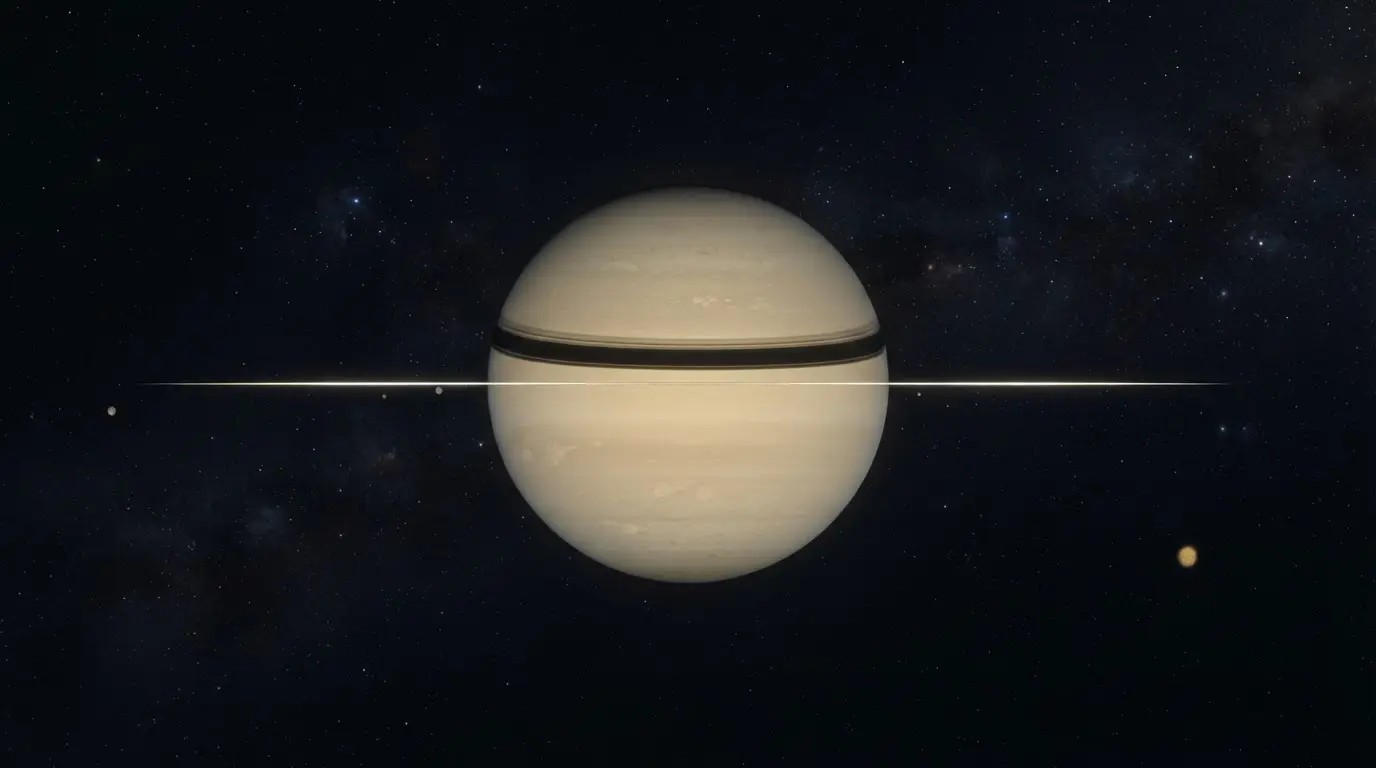

Why the rings disappear from Earth
Saturn's rings are enormous and almost absurdly thin. They reach up to 282,000 km from the planet, yet the main rings are typically about 10 metres thick[3]. Set the two figures against each other and you get roughly 28 million to one[3].
NASA's image team likens them to a razor blade in proportion[4]. Even at the thick end, under a kilometre, they drop out of sight when seen edge-on, even in powerful telescopes[5].
Saturn's axis is tilted 26.7 degrees[6], so over its 29.4-year orbit[7] we look at the rings from above, then from below. At the Saturnian equinox the Sun stands over the equator, and from Earth the rings, lying in that plane, turn edge-on[8]. If planets are new to you, stargazing for beginners is the place to start.
Galileo watched the same vanishing in 1612
In 1610 Galileo reported Saturn as three bodies, writing that it was "not a single star, but three together, which almost touch each other"[11].
By December 1612 the companions were gone. He found the planet solitary and perfectly round, its edge as clean as Jupiter's disc[12], and asked in a letter, "Has Saturn devoured his own sons?"[13]
Featured · Destination
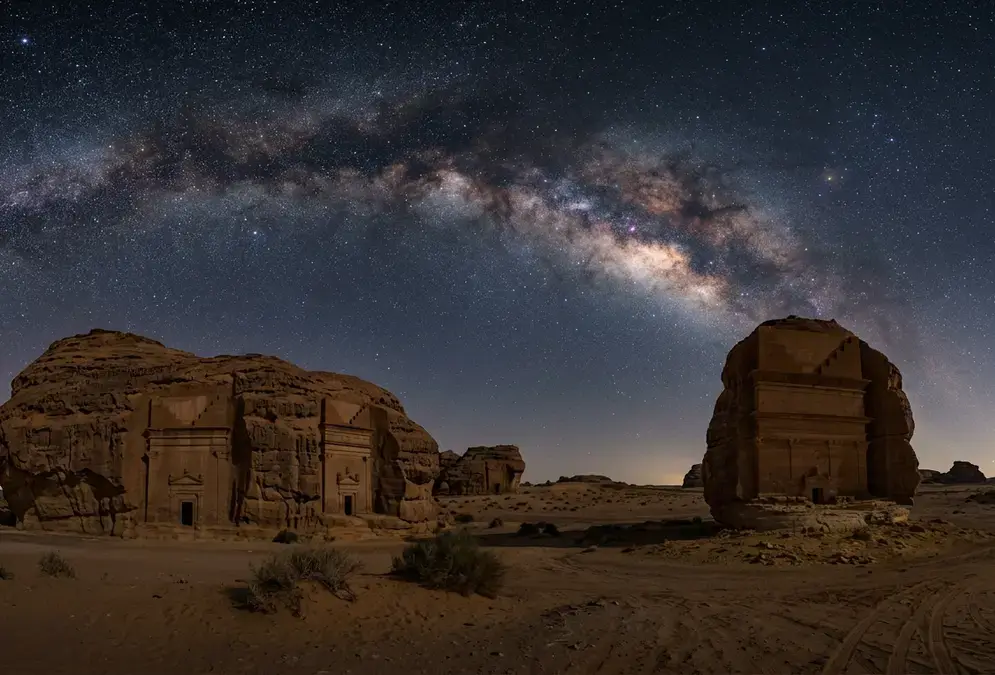
AlUla Stargazing
Stargaze above Hegra's 2,000-year-old Nabataean tombs in AlUla, the Gulf's first DarkSky-accredited Dark Sky Park. When to go, where to stay, and how to plan.
He wrote in 1612 that he did not know what to say "in a case so surprising, so unlooked for and so novel"[2]. The timing matters. His report dates from late 1612. The equinox came on 30 December 1612 and, by Oikofuge's calculation, Earth's single ring plane crossing on 17 February 1613[14]. Galileo was watching the rings thin toward that crossing, not the crossing itself.
By 1616, with the ring plane more open, he made another sketch[15], the one with the famous ears. The explanation arrived in 1655, when Christiaan Huygens proposed that Saturn was surrounded by a solid ring[16]. Crossings kept paying off for astronomers: between 1655 and 1980, 13 moons of Saturn were discovered during them[17].
Ring rain: how Saturn really is losing its rings
Ring rain is the loss that is real. Ice from the rings falls into Saturn's upper atmosphere and is destroyed there, its water reacting with the ionosphere[18].
The proof came from glow. Ground-based Keck readings of H3+ emission in Saturn's upper atmosphere landed close to the strikingly high figures Connerney's group had derived back in the 1980s[19], so a decades-old inference finally had a direct measurement to sit against.
NASA Goddard's team put the rate at an Olympic-sized swimming pool of water products every half hour[20]. That is 48 pools a day, over 17,000 a year[20].
On ring rain alone the rings are gone in 300 million years[21]. Add the material Cassini measured falling into Saturn's equator and they have less than 100 million[21]. Both are projections at today's rate, not a countdown.
The equatorial share comes from Cassini's Grand Finale, when the spacecraft dived between the planet and its rings 22 times[22]. Waite and colleagues used those dives to measure material flowing inward at 4,800 to 45,000 kilograms per second[23]. A tenfold spread like that is why I would not trust any single tidy number for the drain.
Young rings or old ones? Scientists still disagree
The drain rate says how long the rings have left. It says nothing about how long they have existed, and there the Cassini data split the field. Iess and colleagues measured the rings at 0.41 times the mass of the moon Mimas[24].
So little ice looks easy to stain. Meteoroid pollution, scientists estimated, would take between 10 and 100 million years to darken it[25], and Iess's team concluded the rings emerged no more than 100 million years ago, back when dinosaurs roamed Earth[26]. In 2019 Iess said most of the community was convinced the rings formed recently[27].
The older reading was already young: 100 to 400 million years, from more than a decade of Cassini observations[28]. In 2024 Ryuki Hyodo's team at the Institute of Science Tokyo modelled micrometeoroid impacts and found they vaporize, leaving little if any dark residue[34].
If dust does not stain the ice, bright rings prove nothing about age. Hyodo's model allows rings as old as about 4.5 billion years[29], with 2.25 billion the halfway mark[30]. That old end is 45 times the ceiling Iess proposed.
Nobody has settled it. Until someone does, the ring-rain clock tells us how fast Saturn is losing its rings, not whether we happen to be looking at a newborn system or a middle-aged one.
The rings are already tilting back into view
Nothing about the rings changed between March 2025 and now. Only the angle did. At the 4 October 2026 opposition they are inclined 7.5 degrees by one published figure[31]; sources differ a little, so call it under 10 degrees.
That is well under half of the full 26.7-degree opening, which will not arrive until around 2032[32]. Expect a slim ellipse this autumn, not the showpiece.
Featured · Article
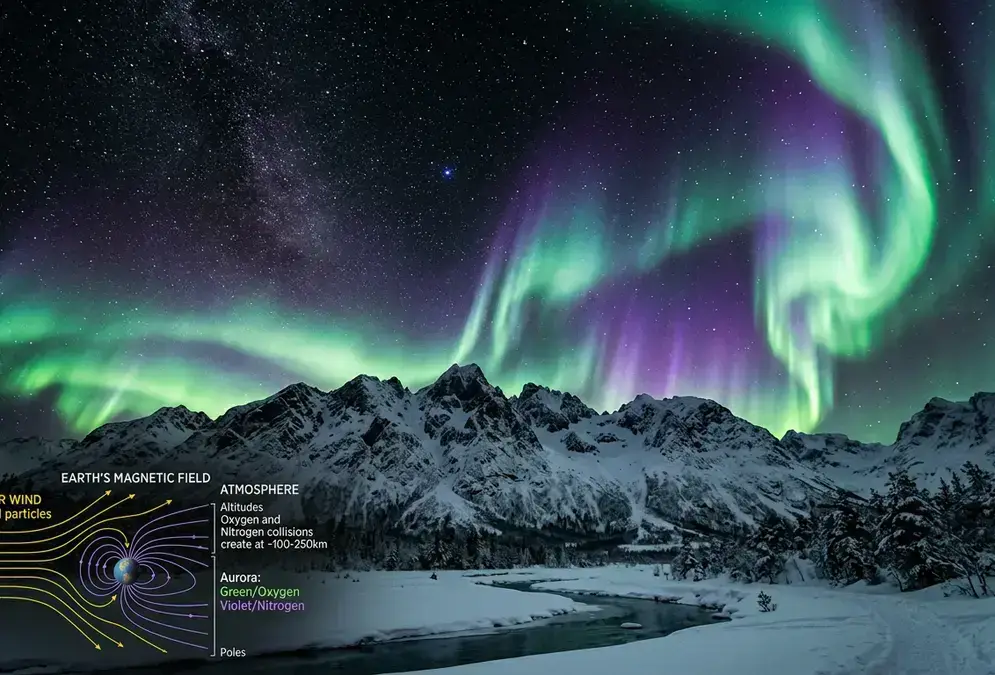
What Causes the Northern Lights? The Science Explained
Solar wind collides with Earth's magnetic field, funneling charged particles toward the poles, where they excite oxygen and nitrogen into glowing color.
Everything about the night itself, from timing to sky position, lives on the Saturn opposition page, and the best budget telescope guide covers the gear question.
The next crossing, by Oikofuge's calculation, falls on 15 October 2038[33]. The rings will thin out again then, and come back. The ring rain will not.