
What you're actually signing up for
San Pedro de Atacama is a small village at 2,443 m above sea level in northern Chile's Antofagasta Region. The town itself takes about 20 minutes to walk across. There's a decent main street with restaurants, gear shops, and tour operators. It's not rough travel, but it's not resort travel either.
Getting there takes commitment. Most international visitors fly into Santiago, connect to Calama on a domestic LATAM or SKY flight (roughly two hours), then take a shared shuttle or taxi for 100 km along Route 23 to San Pedro. Door to door from most European or North American cities, you're looking at 20-plus hours of travel time each way.
Featured · Destination
Atacama Desert Stargazing
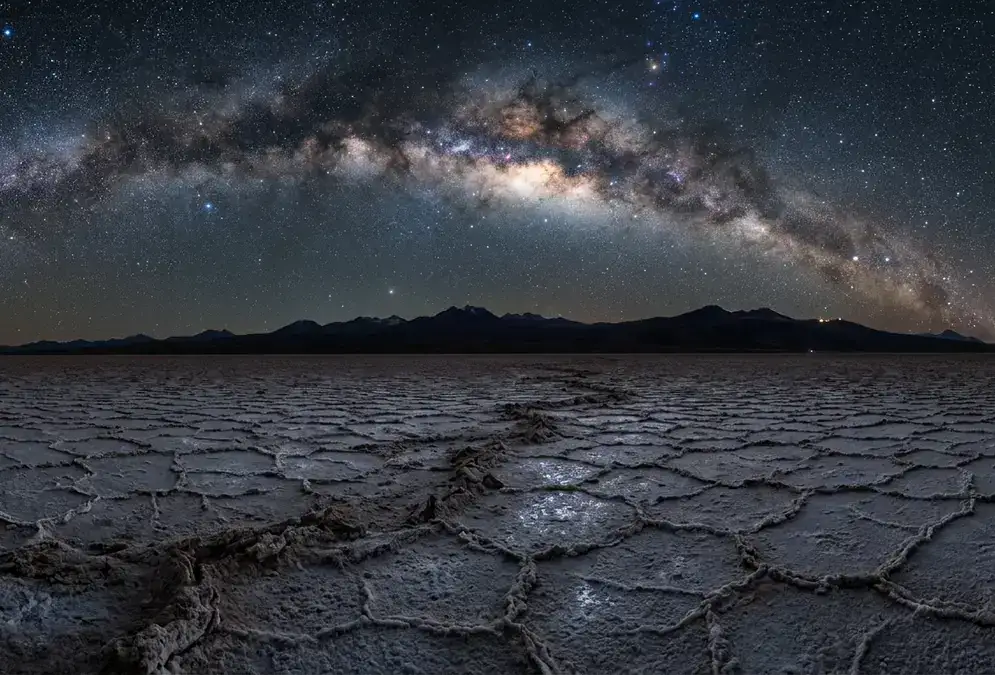
Earth's driest desert delivers Bortle 1–2 skies, 330+ clear nights a year, and the galactic core almost overhead. Guide: tours, lodges, season, getting there.
Once you arrive, you're at altitude. Soroche -- altitude sickness -- is a real consideration at 2,443 m, and the excursions that make the Atacama worth visiting (El Tatio geysers at ~4,300 m, the altiplanic lagoons at ~4,200 m) push considerably higher. Plan your first day for rest, not adventure. Try to visit El Tatio on Day 3 at the earliest.
And then there's the moon. The anchor experience here is telescope stargazing through SPACE observatory (spaceobs.com) or a similar operator. SPACE cancels all tours for approximately seven nights around the full moon. Build your trip around the new-moon window or you'll find yourself with a beautiful dark sky and no tour available -- or worse, a tour under a washed-out full moon that obscures the Milky Way.
The skies: what actually separates the Atacama
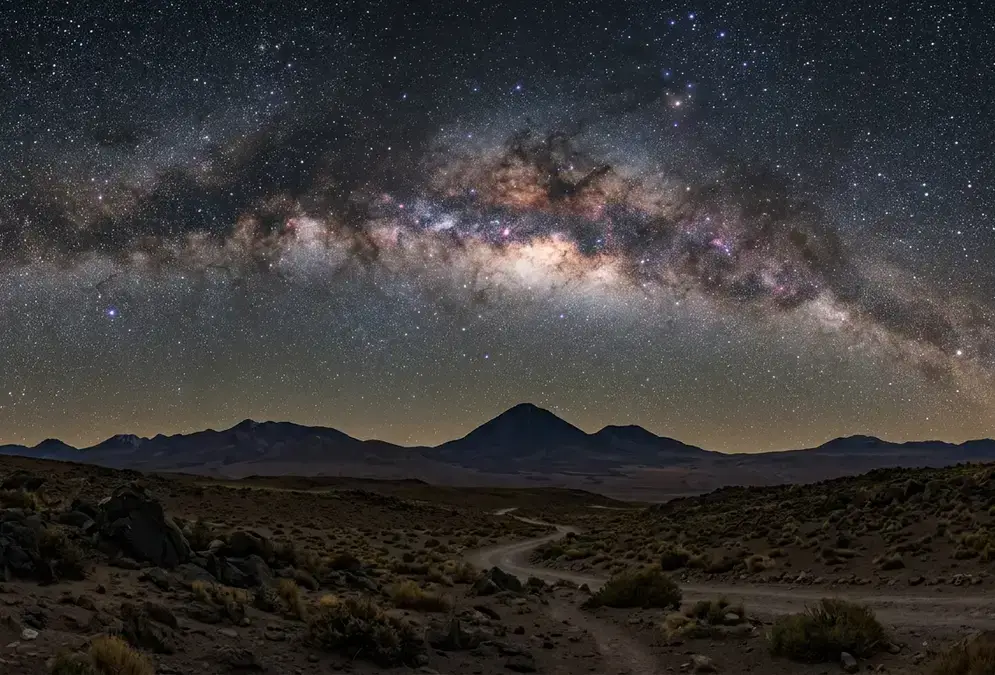
The Atacama isn't famous for stargazing because of marketing. The European Southern Observatory chose the broader Atacama plateau for its Very Large Telescope at Paranal (2,635 m) and ALMA at 5,000 m for the same atmospheric reasons that make the area exceptional for visitors: extreme aridity, high altitude, near-zero cloud cover, and a Southern Hemisphere latitude that puts the galactic centre almost overhead. For how ALMA, Paranal, and the ELT differ instrument to instrument, see Atacama observatories explained.
330+
Widely cited as Bortle class 1-2 (based on tour operators and corroborated by ESO's site-selection data), the skies around San Pedro push naked-eye limiting magnitude to around 7.5-8.0 on moonless nights. That's meaningfully darker than a typical rural European or North American site. Under good conditions, the Milky Way's galactic arm is bright enough to cast a faint shadow -- a phenomenon described by multiple guides and operators but that requires genuinely exceptional Bortle 1 conditions.
For the galactic core specifically: from 23 degrees south latitude, the galactic bulge transits at 60-70 degrees above the horizon during June and July. If you've tried to photograph or simply see the galactic centre from mid-northern latitudes, where it barely clears the horizon, this is a completely different experience.
SPACE observatory runs the biggest public telescope operation in the Atacama -- their 12 to 16-inch reflectors are marketed among the largest public telescope setups in the Southern Hemisphere (an operator claim, not independently verified, but the equipment is genuinely substantial). Groups of 14-16 people share each telescope per session. The Atacama stargazing astronomy tour format runs 2-3 hours with multilingual guides; book well in advance, as SPACE reports turning away walk-ins most nights.
The landscape: more than one reason to go
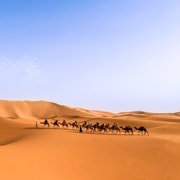
The Atacama works as a trip even if you're not a dedicated stargazer, because the landscape cluster around San Pedro is extraordinary by any measure. Within a two-hour drive, you have Valle de la Luna (Moon Valley) with its wind-eroded salt amphitheatres and dunes that go gold and violet at sunset; Salar de Atacama and Laguna Chaxa, where three Andean flamingo species coexist on a ~3,000 km2 salt flat; El Tatio geyser field, the largest in the Southern Hemisphere with 80-plus active geysers at 4,300 m; and the altiplanic lagoons circuit including Piedras Rojas and the turquoise Lagunas Miscanti and Miniques, backdropped by snow-dusted volcanoes.
For anyone interested in the best time to visit for stargazing, the good news is that the optimal stargazing window (April through September, any new-moon period) also overlaps with the most comfortable weather for daytime excursions. Nights get cold -- near freezing in June and July -- but days stay clear and mild at around 15-17 degrees Celsius.
The concentration matters. You don't need to cross the country to see different ecosystems; they're all within 110 km of the same village. That's unusually efficient as extreme-landscape destinations go, and it's a major reason why the trip compounds in value relative to its complexity. For a closer look at which of these named spots actually works best after dark, see the the ranked list of the desert's best viewpoints.
The real costs and friction points
Price is the most common honest objection to the Atacama. San Pedro is a small town with a captive market and no competition on key experiences. The SPACE astronomy tour runs around USD 50-55 per person. El Tatio costs CLP 40,000-70,000 per person (roughly USD 45-80 depending on the operator and group size) for the full-day trip. Add accommodation -- budget options exist but mid-range lodges run USD 150-300 per night -- and a four-night trip per person can easily reach USD 800-1,200 before international flights.
Flights are the other cost anchor. There are no international connections to Calama. Every international visitor routes through Santiago, adding a domestic connection. Chilean domestic fares (USD 80-200 one way, depending on advance booking) are manageable, but the routing adds half a day in each direction. The road from Calama to San Pedro is 100.5 km and takes about 70 minutes; shared shuttles run around USD 12-15 per person, which helps.
For planning accommodation, reading the guide to the best lodges for Atacama stargazing is worth doing before you book, because lodge location and amenities vary significantly and some properties actively support stargazing in ways others don't.
Altitude deserves its own honest paragraph. Calama itself sits at 2,260 m -- there's no low-altitude buffer on arrival. When you land and transfer to San Pedro at 2,443 m, you're already at altitude. Most visitors feel fine; some get headaches, poor sleep, or fatigue on Day 1. The excursions to El Tatio (4,300 m) and the altiplanic lagoons (4,200 m) carry meaningful soroche risk for anyone who hasn't acclimatised for two to three nights in San Pedro first. This isn't a reason to avoid the trip, but it's a real planning constraint that affects your itinerary sequence.
| Excursion | Max altitude | Acclimatisation needed |
|---|---|---|
| Stargazing at SPACE observatory | ~2,450 m | None |
| Valle de la Luna sunset | ~2,500 m | None |
| Salar de Atacama / Laguna Chaxa | ~2,350 m | None |
| Laguna Cejar floating | ~2,450 m | None |
| El Tatio geysers (pre-dawn) | ~4,300 m | 2-3 nights minimum |
| Altiplanic lagoons circuit | ~4,200 m | 2-3 nights minimum |
Who the Atacama suits -- and who it doesn't
The Atacama delivers best for a specific traveler profile: someone who wants to see the Milky Way in genuinely dark skies, cares about the excursions enough to find altitude worth managing, and has the flexibility to time their trip around the lunar calendar. For that person, this is probably the most accessible Bortle 1-2 site in the world with serious tourist infrastructure.
It works well for astrophotography beginners who want to attempt a Milky Way shot under ideal conditions without committing to a multi-week polar expedition. A clear June night at 2,443 m with a 330+ clear-night-per-year baseline, pointed at a galactic core that's 60 degrees above the horizon -- you'd be hard pressed to find better conditions that are this reachable.
Recommended tours
Tours are selected for quality, not commission. I earn a small fee if you book — at no extra cost to you.
It also works well for general adventure travelers who treat stargazing as one component of a broader itinerary. The landscape is exceptional enough on its own terms that even someone who gets clouded out one night (rare, but it happens) won't feel the trip was wasted.
For planning how many days to allocate, most people find four to five nights the right balance: Day 1 for acclimatisation, two to three evenings in the new-moon window for stargazing, plus time for the major daytime excursions without rushing.
Who should think harder before going: travelers with a history of soroche, anyone who won't plan around the lunar calendar (booking on a full-moon week is a waste of the destination's main draw), budget travelers for whom USD 1,000+ per person is prohibitive, and anyone expecting a beach-and-resort rhythm who will find the dusty, high-altitude village setting jarring.
The verdict on the Atacama
The Atacama is worth it for the traveler who does the planning. Specifically: align your arrival with a new-moon window, give yourself at least four nights, don't rush El Tatio before Day 3, and book SPACE observatory before you book flights. None of this is complicated. It just requires doing it.
What you get in return is a sky that most people in the northern hemisphere have never seen. Not a slightly better version of what you see at a dark site in rural France or New Mexico -- a genuinely different category of experience. The galactic centre overhead, Bortle 1-2 darkness, 330 nights a year where this is the default. ESO built its flagship telescopes here for the same reason you're going.
The cost is real. The altitude is real. The logistics are real. But San Pedro remains the most tourist-friendly, infrastructure-supported entry point to skies of this quality anywhere on Earth. Chile's domestic air network keeps it reachable. The SPACE observatory and several competing operators mean you don't need your own telescope.
A week well-planned in the Atacama is harder to replicate than it looks.