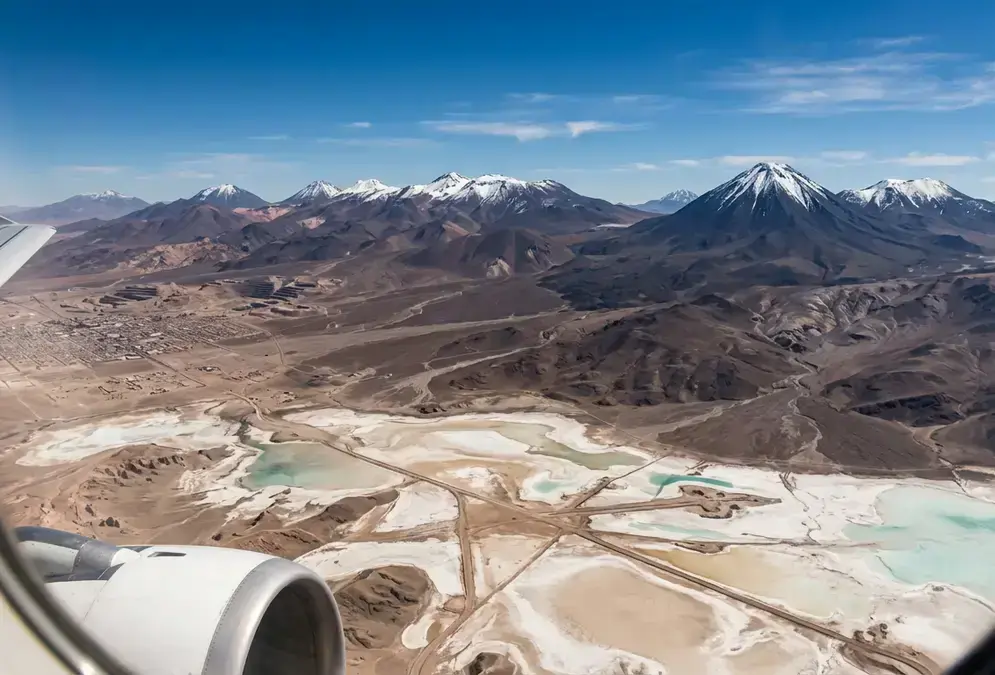

Why the standard route is fly-then-drive
Santiago sits at sea level on Chile's central coast. San Pedro de Atacama is 2,443 m up in the Atacama plateau, roughly 1,650 km north. There is no train. The overnight bus from Santiago to Calama takes 18 to 20 hours, which some travellers use to save an accommodation night, but it arrives in Calama at dawn after a night of interrupted sleep at altitude — a rough start before the 100 km road transfer to San Pedro.
Most international visitors fly. The flight is domestic once you're in Chile, so if you arrive in Santiago on an overnight transatlantic or transpacific flight, you'll typically clear customs, pick up luggage, recheck at the domestic terminal, and connect to Calama the same day. LATAM and SKY Airline between them operate roughly 10 flights a day on the SCL–CJC route, which means there's generally a departure within two hours of whenever you land.
10
The road segment from Calama to San Pedro is genuinely pleasant — a single paved highway through ochre desert, with the volcanic arc of the Andes rising ahead of you. It's 100.5 km[1] and takes about 1 hour 10 minutes by shared shuttle under normal conditions.
The Santiago–Calama flight
Calama's airport is Aeropuerto El Loa, IATA code CJC. The flight from Santiago Arturo Merino Benitez (SCL) takes approximately two hours. It's a domestic Chilean route, so check-in and security are faster than for international connections — plan for 1.5 hours before departure if you're checking bags, 45 minutes if you're not.
Both LATAM and SKY Airline cover this route. Fares vary substantially depending on how far in advance you book — early purchases can be reasonable, last-minute prices spike. Budget for this leg as part of your overall Chile travel cost rather than expecting a cheap domestic hop. If you're already in Chile, booking two to three weeks ahead gets you the better end of the fare range.
One practical note: Calama airport is small. The arrivals hall is compact and shuttle operators meet arriving flights in the forecourt. You don't need to pre-arrange everything in advance, though booking a transfer ahead of time removes the negotiation step when you're tired and altitude-affected.
Calama to San Pedro: your transfer options
Once you land at CJC, you have three practical ways to cover the 100 km to San Pedro.
Shared shuttle (transfer colectivo): This is what most independent travellers use. Operators park in the arrivals area and load departures once enough passengers accumulate from each flight. The fare runs roughly USD 12–15 per person[2] at current rates — an approximate figure that shifts with inflation and exchange rates, so confirm on arrival. Journey time is around 1 hour 10 minutes. The ride is comfortable; you'll share a minivan with other passengers heading to San Pedro.
Private taxi or remise: Faster to depart (no waiting for other passengers), useful if you're travelling with a group and can split the fare, or if you have a lot of luggage. Costs more per person than a shared shuttle but can be cost-neutral for groups of three or four.
Read next · Article
Calama to San Pedro de Atacama: Transfer Options
Shared shuttle, private transfer, rental car, or bus from Calama airport (CJC) to San Pedro de Atacama — 100.5 km, ~1h10 on Route 23. What to book and when.
Rental car: Several agencies have desks at CJC airport. Renting gives you independence for day excursions once you're in San Pedro — particularly useful if you want to explore at your own pace rather than relying on guided tours for sites like Laguna Cejar or the altiplanic lagoons. The road to San Pedro (Route 23) is paved and well-marked, so driving it is straightforward in daylight.
What about the bus from Santiago?
Several long-distance bus companies connect Santiago to Calama and occasionally directly to San Pedro. The journey from Santiago to Calama is 18 to 20 hours on a night bus — buses typically depart late evening and arrive early morning. Comfort class (cama or semi-cama) is decent on Chilean long-haul routes, with reclining seats that approach flat.
The main use case for the bus is cost: it's substantially cheaper than flying. If budget is a primary constraint or you genuinely don't mind spending a night on a bus, it's viable. The downside is arriving in Calama sleep-deprived and already at 2,260 m altitude, then immediately continuing to San Pedro at 2,443 m. That is not an ideal start for altitude acclimatisation.
A separate option: fly Santiago to Antofagasta, Chile's coastal regional capital, and continue 300 km east by road to San Pedro (3 to 4 hours). Antofagasta is closer to San Pedro than Santiago is, but it's still a long road leg. Most travellers have no specific reason to route through Antofagasta, so Calama remains the logical hub. If you're planning the full trip including how many nights you actually need, the Atacama itinerary guide covers how to stack the journey against your available days.
Arriving in San Pedro: the first two hours
San Pedro de Atacama sits at 2,443 m above sea level[1]. Calama, where you land, is at approximately 2,260 m — so you're already at altitude when you step off the plane, with no low-elevation buffer.
The altitude difference between Calama and San Pedro is modest (roughly 180 m), but what matters more is the jump from wherever you started. If you flew directly from sea level — Lima, Santiago, Buenos Aires — you'll be going from near-zero to 2,443 m in a single day. Some travellers feel nothing. Others get a headache within a few hours, have trouble sleeping the first night, or feel unusually tired.
The practical advice: don't plan a demanding excursion on your arrival day. Rest, drink more water than feels necessary, skip alcohol that first evening. Many lodges in San Pedro offer coca tea on arrival, a traditional Andean remedy many visitors find helpful. Whether it has a measurable physiological effect is debated in the research, but it does no harm and is part of arriving properly.
For the serious altitude sites — El Tatio Geysers at 4,300 m and the altiplanic lagoons at 4,200 m — wait at minimum until your third full day in San Pedro. These are the excursions that catch out travellers who feel fine in town but overestimate their acclimatisation at higher elevations. See the dedicated Atacama altitude guide for the full breakdown.
How to sequence your booking
The practical order: book your Santiago–Calama flight first, since it's the capacity-constrained leg and fares are lower when booked ahead. Once you have that flight confirmed, book your San Pedro accommodation — town fills up around new-moon windows from April through September, when every astronomy tour runs at capacity.
For the Calama transfer, you can book a shared shuttle online in advance through one of several operators, or simply walk out of arrivals and arrange it on the spot. Pre-booking is worth it in peak season (May–August) when multiple flights arrive close together and shuttle seats are claimed quickly. Off-peak, there's always capacity.
If you're flying into Santiago on a transatlantic connection, build in at least one buffer night in Santiago rather than connecting same-day. International arrivals at Santiago can clear customs in 30 minutes or take two hours depending on queue length. Missing your domestic connection to Calama because your transatlantic flight was delayed adds a day to your trip and costs more than a Santiago hotel night.
The best time for Atacama stargazing article covers how to align your travel dates with new-moon windows — the single highest-leverage decision you'll make for the quality of your night sky.