
What does 'Abisko' actually mean?
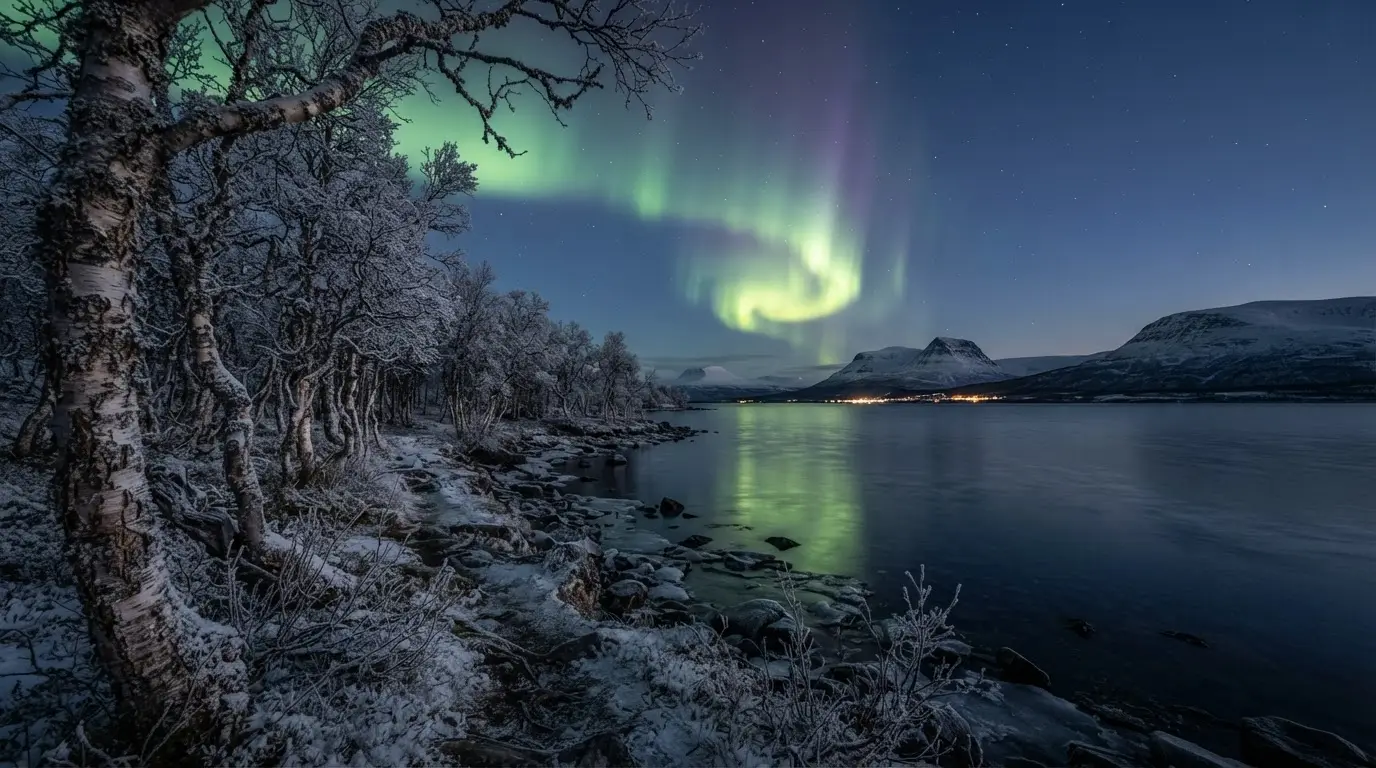
The village's name is a Swedish rendering of Abeskovvu, the Northern Sami name recorded for the same place[5]. Northern Sami speakers across this stretch of Sapmi used a terrain-descriptive naming convention: mountains, valleys and streams were named after what they looked like, not after people[6]. Abeskovvu follows that pattern. It describes the birch forest crowding the shoreline, not a person or an event.
The closest translation is "the forest by the big lake"[4]. The lake in question is Torneträsk, the enormous body of water the national park sits beside today. Torneträsk does most of the descriptive work in the name; the forest is simply what you'd see standing on its shore.
Say Abeskovvu next to Abisko and the relationship between the two is still audible, even though the meaning behind either name isn't obvious from the Swedish spelling alone.
Torneträsk, the 'big lake' in the name
Torneträsk is not a small pond flattered by a grand name. It covers 330 square kilometres[1], and the county administrative board (Länsstyrelsen Norrbotten), which manages the park, calls it Scandinavia's largest alpine lake[7]. Abisko National Park sits on its southern shore, in Kiruna Municipality, roughly 195 km north of the Arctic Circle[3].
Featured · Destination
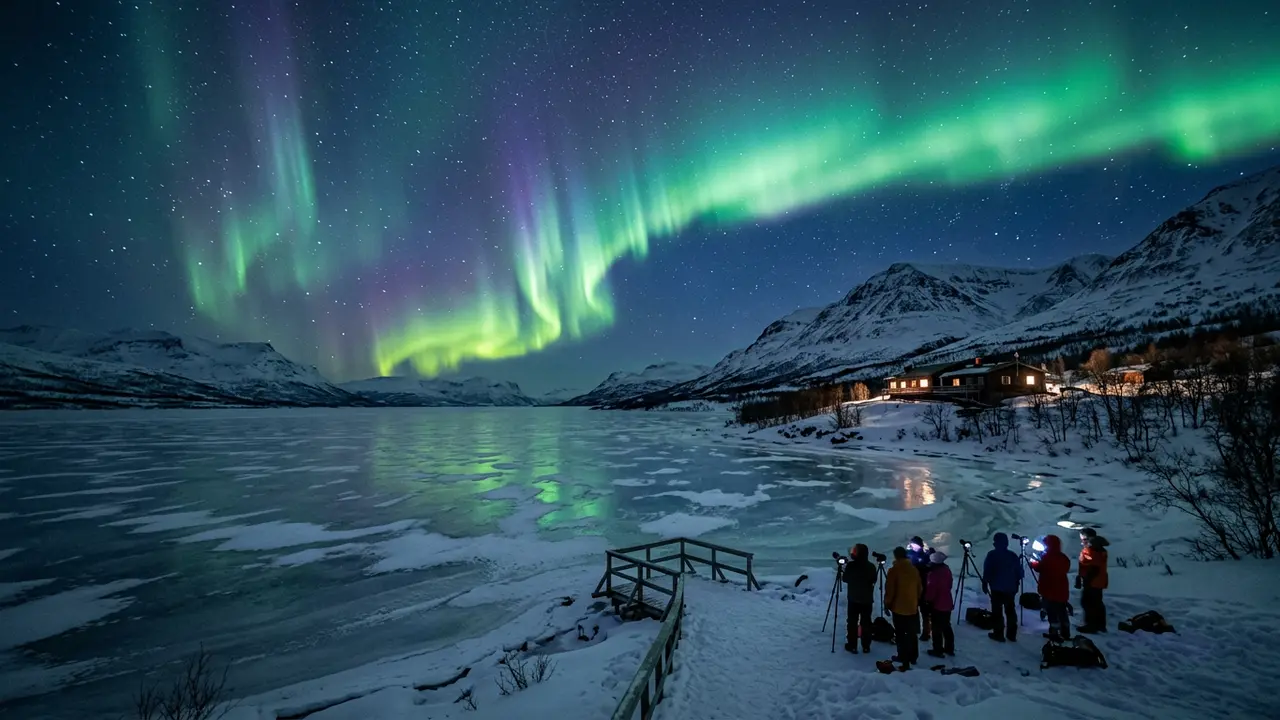
Abisko Stargazing
Abisko's rain-shadow microclimate keeps skies clear when nearby Arctic spots cloud over. Aurora season, the Sky Station, ICEHOTEL, and getting there by train.
The park itself is smaller, 77 square kilometres[3], and dates only to 1909[2], a little over a century of protected status against the millennia Sami herders had already spent working this same ground before any boundary line existed[9]. The lake predates the paperwork by a wider margin still. Most visitors today reach the shore through Abisko Stargazing trips built on the same geography the name describes.
Lakes this size change the air around them regardless of what a village is called. Cold air pools differently over open water than over forest, and that local effect layers on top of the region's larger weather patterns, the ones that matter most once you're planning around clear skies rather than a place name.
Sapmi and the Sami people who named it
Abisko sits inside Sapmi, Sami country, which stretches across the northern parts of Sweden, Norway and Finland, and Russia's Kola Peninsula[8]. For millennia, Sami families used this specific stretch of it seasonally[9]:
- Moving reindeer herds between forest land and mountain pasture
- Hunting and fishing along the route
- Leaving pitfall traps for reindeer and moose that are still visible in the terrain today[10]
The Sami were originally hunters and gatherers; the shift toward herding domesticated reindeer as a primary livelihood came later, in the 17th century[11].
Recognition came later still. Sweden's parliament did not formally recognise the Sami as an indigenous people until 1977[12]. Reindeer husbandry in the area today runs through a sameby, an administrative and economic union tied to a defined territory, not a village in the everyday sense[13]. Kiruna Municipality administers the area day to day, but the sameby's authority runs on its own track, tied to reindeer rather than to town boundaries.
Why the same geography also makes Abisko a magnet for aurora watchers
The name describes shelter, and shelter is exactly why Abisko's skies stay clear so often. The Scandinavian Mountains sit between the village and the wet Atlantic air moving in off the Norwegian coast, putting Abisko in a rain shadow[14]. By Swedish standards it's a cloudy place, yet it's also one of the driest in the country, and dry, clear nights are what actually matter for the sky overhead[14].
That combination, mountains cutting off moisture and a location 195 km north of the Arctic Circle[3], is why operators and researchers treat Abisko as one of the more dependable spots on the aurora map, not just a scenic one. The name never mentions any of this. It was given by people describing what stood in front of them: a lake, and the forest along its edge[4].
This is the detail worth caring about more than the marketing: a rain shadow doesn't guarantee a clear sky on any single night. It shifts the odds across a season, and that shift, not a guarantee, is the real promise behind "aurora capital."
Featured · Article
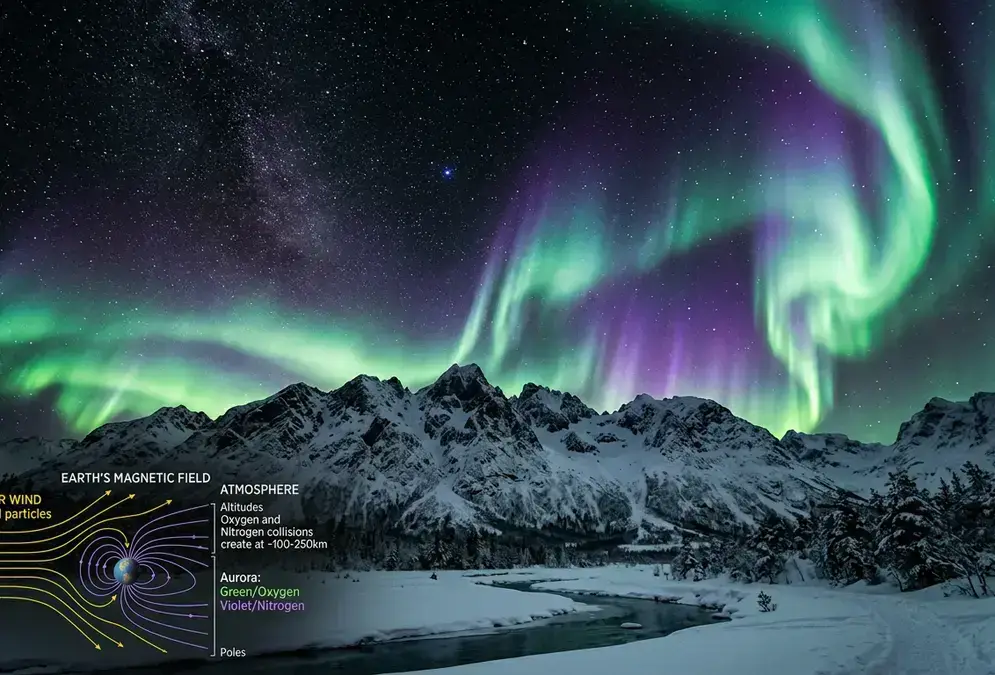
What Causes the Northern Lights? The Science Explained
Solar wind collides with Earth's magnetic field, funneling charged particles toward the poles, where they excite oxygen and nitrogen into glowing color.
None of that guarantees a clear night on any given trip. Check Best Time for Stargazing in Abisko before booking, and consider the Aurora Sky Station tour if you want a fixed viewing platform above the treeline rather than a spot on the shore.
Abisko today: a park, a research station, and still Sapmi
The 1909 park boundary formalised something already old, protection for terrain Sami families had used long before conservation law existed. The sameby system that governs reindeer husbandry here predates the park by centuries and still runs alongside it[13]. What's changed since 1909 is mostly who's visiting, and why.
If the name and the landscape behind it have you planning a trip, start with logistics rather than etymology. Getting to Abisko covers the route in, and How Many Days in Abisko for Northern Lights? covers how long to actually stay once you're there.
Abeskovvu was never meant to describe an aurora destination. It described a forest and a lake. The reason it still works as both is that nobody has found a better description of this particular shoreline in the centuries since.