All articles
Written by Maya Okonkwo
  • 8 min
  • 32 sources

Atacama Stargazing FAQ: What First-Timers Ask Before Booking

Atacama stargazing FAQ for first-timers: altitude sickness, tour cost, permits and entry rules, best season and moon phase, with straight answers and links.
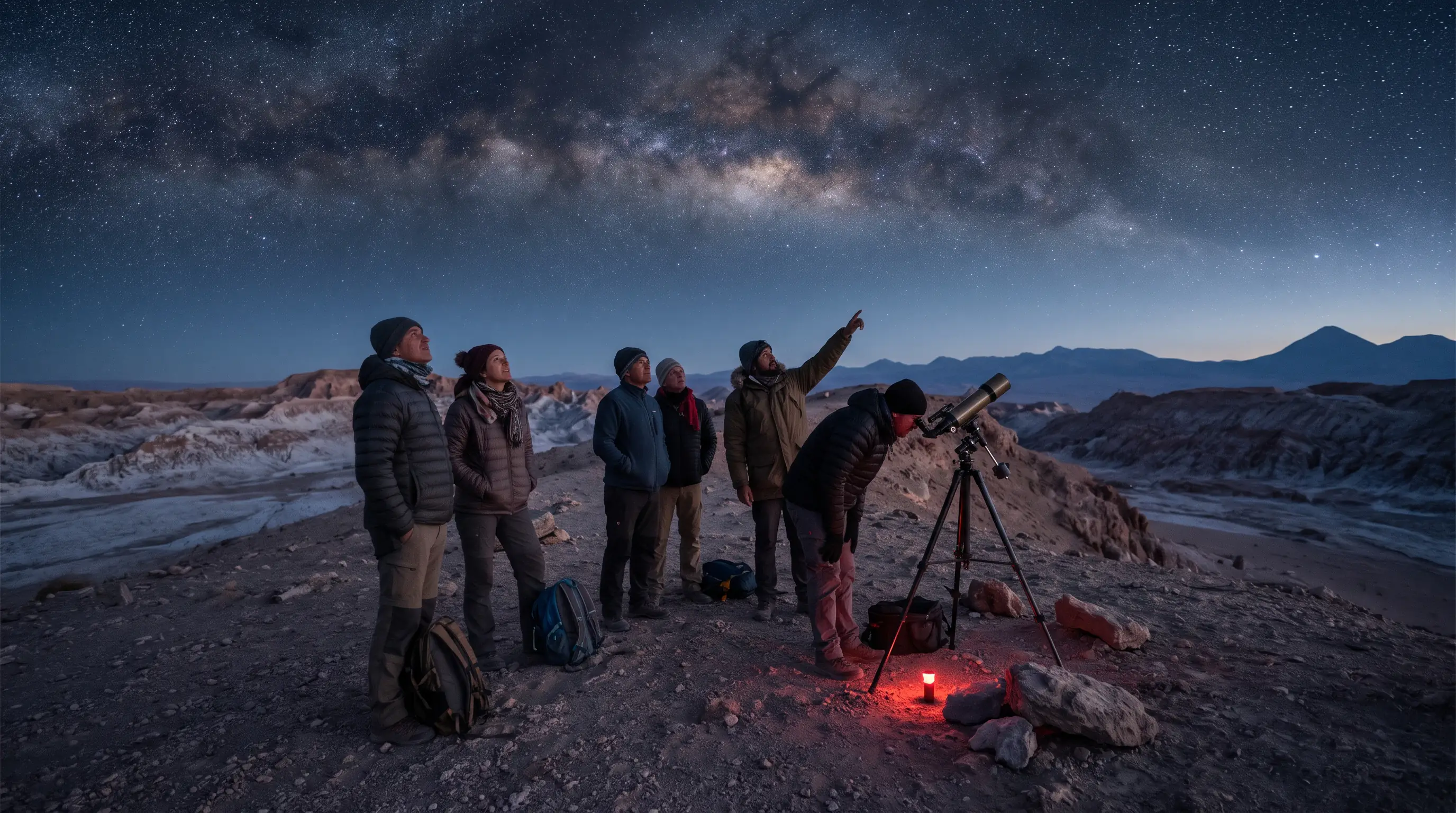
Atacama stargazing FAQ hero: Milky Way over the pale salt-crust ridges of the Cordillera de la Sal near San Pedro de Atacama, a small tour group beside a telescope in silhouette, Andean volcano on the horizon

Winter nights in San Pedro routinely fall below freezing and can reach −10 °C, so a two-hour tour means dressing for the coldest number on the forecast.

Go in a new-moon window and give altitude a day to settle: San Pedro de Atacama sits at about 2,400 m, mild altitude sickness is common[1], and it usually fades within 12 to 48 hours if you climb no higher[2]. A group stargazing tour starts around CLP 25,000 per person[3]. The full moon has no single answer: one operator runs tours through it[13], so ask yours before you book.
San Pedro elevation
2,400 m
About 8,000 ft; mild altitude sickness is common[1]
Altitude sickness recovery
12-48 hours
Typical window if you climb no higher[2]
Group tour, per person
CLP 25,000
One operator's 2.5-hour listing, Nov 2026[3]

Will altitude and cold ruin the first night?

Mild trouble is likely; serious trouble is rare. Any unacclimatized traveler sleeping at 2,450 m or higher, and sometimes lower, is at risk of altitude illness, and San Pedro sits just under that line, so a headache and a bad night's sleep on arrival are ordinary[4]. The symptoms feel like a hangover, which is why the advice is dull and works: drink water, skip the pisco sour, and keep the first day's walking gentle.

Keep night one for sleep

Book the stargazing session for night two or later. Night one is for water, an easy walk and an early bed.
The sharper risk is the next step up. El Tatio's geysers sit at more than 4,300 m[21], and Piedras Rojas and the high lagoons are also far above town, so the order you do things in matters more than any pill, a sequence laid out in Atacama altitude acclimatization. For medium-risk itineraries the CDC says acetazolamide prophylaxis would be beneficial and worth considering, and for high-risk ones it strongly encourages it[22][23]; the dose it gives is 125 mg every 12 hours, starting the day before ascent[24]. Which tier your itinerary falls into, and whether the drug suits you, is a question for a doctor before you fly. Confusion, stumbling or drowsiness that looks like drunkenness is the signal to descend and get help, not to sleep it off.
Cold is the other half of the answer. Winter nights in San Pedro routinely fall below freezing and can reach −10 °C[5], and a tour means standing nearly still for two hours, which is colder than any walk. Dress for the lowest number on the forecast, not the afternoon: a base layer, a fleece, a down jacket, a hat and gloves, with the jacket going on before you leave the vehicle rather than after the shivering starts.
On safety, the practical risks at night are cold, uneven dark ground and altitude, and a guided session takes care of the last two logistics for you. Sernatur, Chile's national tourism service, keeps a directory of registered services, and its office on the main plaza in San Pedro will point you to registered operators[6]. A registered operator is a better first filter than the lowest price.
Plan the first two days around the altitude, not around the tour. Arrive, eat lightly, drink water and walk the town at an easy pace, and leave the high excursions and the stargazing session for later in the stay. The usual trap is stacking El Tatio's pre-dawn start on top of a late night under the stars.

How much does a tour cost, and what happens on the night?

A group tour starts around CLP 25,000 per person for 2.5 hours with two 16-inch telescopes, going by one San Pedro operator's listing in November 2026[3]. Photography-focused and private sessions usually cost more, and listed prices move, so compare what is included rather than the headline number. That figure covers the sky session only; the whole-trip budget, with lodging, transfers and El Tatio on top, is worked out in is the Atacama worth it.

A typical evening runs like this:

  • Hotel pick-up inside town, then a short drive to a dark-sky site
  • A briefing on what you will see, then naked-eye observing while your eyes adapt
  • Telescope time on planets, star clusters and whatever is well placed that night
  • Optional photo time, a hot drink and the ride back to your hotel
Formats differ more than prices suggest. One listing runs two hours in all, with a pick-up inside San Pedro's urban radius, about 20 minutes to the observatory, a guided session of about an hour, and a minimum age of 4[7]. The 2.5-hour tour above spends more of its time at the eyepiece. Guides on these outings supply the telescopes and usually share Andean sky lore[8], which suits a first night better than a phone app and a blanket on a rock.
Whichever you book, ask how many people share each telescope. Group size changes your eyepiece time more than the sticker price does, so a smaller group at a somewhat higher price can be better value than a crowded one at the lowest.

Four questions separate a good operator from a forgettable one:

  • Is it registered with Sernatur, and can it show you?
  • How many people share each telescope?
  • What is the moon and weather policy, and is there a refund?
  • Does the price include hotel pick-up and a hot drink?
I would also ask what the guide points out with the naked eye. A session that teaches you the southern sky's orientation before the telescopes come out is worth more on a first night than a longer list of deep-sky objects you cannot yet place. ESO's images from the San Pedro area show what the guide has to work with: the Carina Nebula, the Southern Cross and the Coal Sack, and Alpha and Beta Centauri strung along the Milky Way[17], with the globular cluster Omega Centauri beside the two stars[18], the Small Magellanic Cloud and 47 Tucanae clearly visible[19], and the Large Magellanic Cloud in a twilight frame[20].
Timing the booking helps too. Reserve once you know your arrival day, then confirm on the afternoon itself, since operators judge cloud and wind from forecasts and may offer another night. A flexible operator at a slightly higher price beats a rigid one at the lowest.

Do you need a permit, a visa or a ticket?
Your passport is the paperwork that matters. Citizens of South America, the EU, the US, Canada and Australia need no visa to enter as tourists, and it is worth carrying your lodging reservation in case it is checked. Animal and plant products, fruit and snacks included, must be declared to the SAG agricultural service on arrival, and undeclared items risk confiscation and high fines[9]. UK passport holders can stay up to 90 days without a visa and must keep the tourist card to hand back when they leave[10].
Nothing in the entry requirements or the Sernatur rules creates a stargazing permit for a visitor. Operators have their own obligation: Chilean law requires lodging and adventure-tourism services to register with Sernatur[11], though astronomy tours are not named in that rule, so ask any operator whether it is registered before you pay.
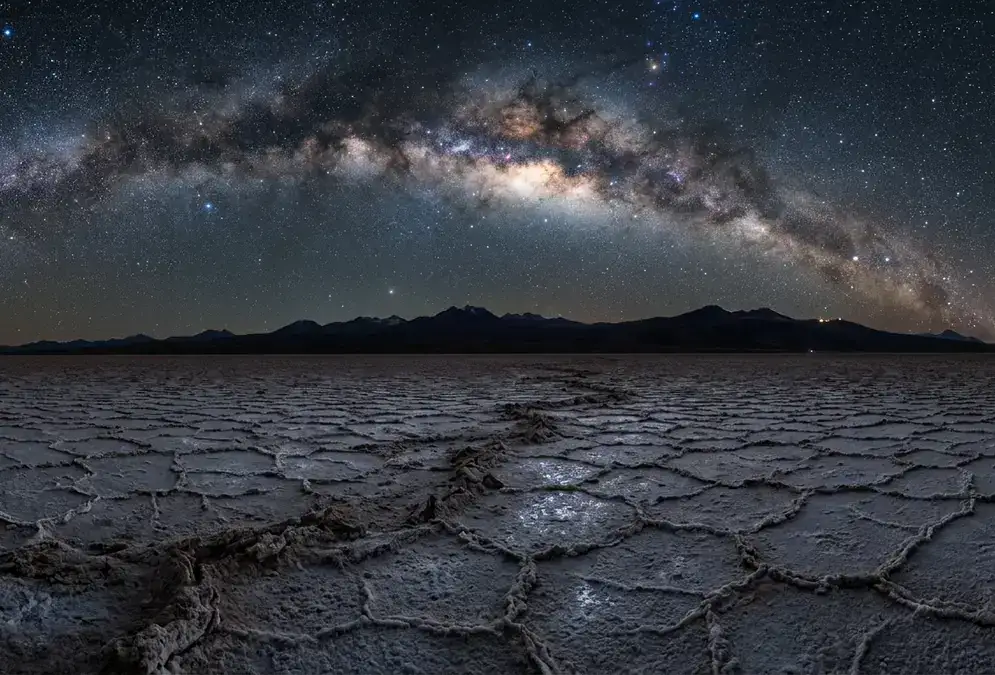
Milky Way arch over the Atacama Desert salt flat at new moon, galactic core high overhead with the Andes silhouetted against star-filled sky

Featured · Destination

Atacama Desert Stargazing

Earth's driest desert delivers Bortle 1–2 skies, 330+ clear nights a year, and the galactic core almost overhead. Guide: tours, lodges, season, getting there.

Valle de la Luna is the one place with a ticket. General admission runs around CLP 10,000-10,800 depending on source and date: CLP 10,800 in November 2026, with children aged 1 to 12 free[28][29], while Chile Travel's English page still lists CLP 10,000[30], so check the price at the gate. Opening hours differ by source, so check them at the gate too; the last group enters by 4:00 PM, groups are capped at 12 and tickets are best bought in advance[12]. Even the last group waits only for sunset inside the reserve, so the stargazing itself happens elsewhere; the best stargazing spots in the Atacama Desert are mapped by what each one shows you.
Read what the price includes before you pay. A combined sunset-and-stargazing outing may or may not fold in the Valle de la Luna entry, so ask whether it is included or charged on top, and whether the fee is quoted in pesos or dollars.

When should you go, and does the moon matter?
Go in the Southern Hemisphere winter and book around the new moon. The winter months suit the Milky Way, September is the milder choice with warmer nights, and the so-called Bolivian winter, the altiplanic summer rains of January and February, carries the real cloud risk: that rain reached Chile's El Loa province in January and February 2025[31] and flooded San Pedro on 23 January 2026[32]. The month-by-month reasoning is worked out in best time to visit Atacama for stargazing, and I would steer a first-timer toward September for the balance of sky and comfort.
NASA puts the best window for dark skies at about two weeks either side of the new moon[25], and a near-full moon creates skyglow comparable to light pollution that hides faint stars and objects[26]; for the Milky Way, a bright moon can be reason enough to stay home[27]. Operators handle it differently: one runs tours even during a full moon, though it also notes that weather forecasts are not 100% accurate[13], so ask yours what a full-moon night looks like. If your dates are fixed, the Atacama new-moon calendar for stargazing shows which nights to pick, and a quick message to the operator about its moon policy costs nothing.
Cloud and wind are the other reasons a tour gets called off. Refunds differ by operator: one returns 100% of the payment if the tour is suspended for weather[14]. Read the cancellation terms before paying and leave a spare night in your schedule, since one cloudy evening can take a short trip's best chance away.
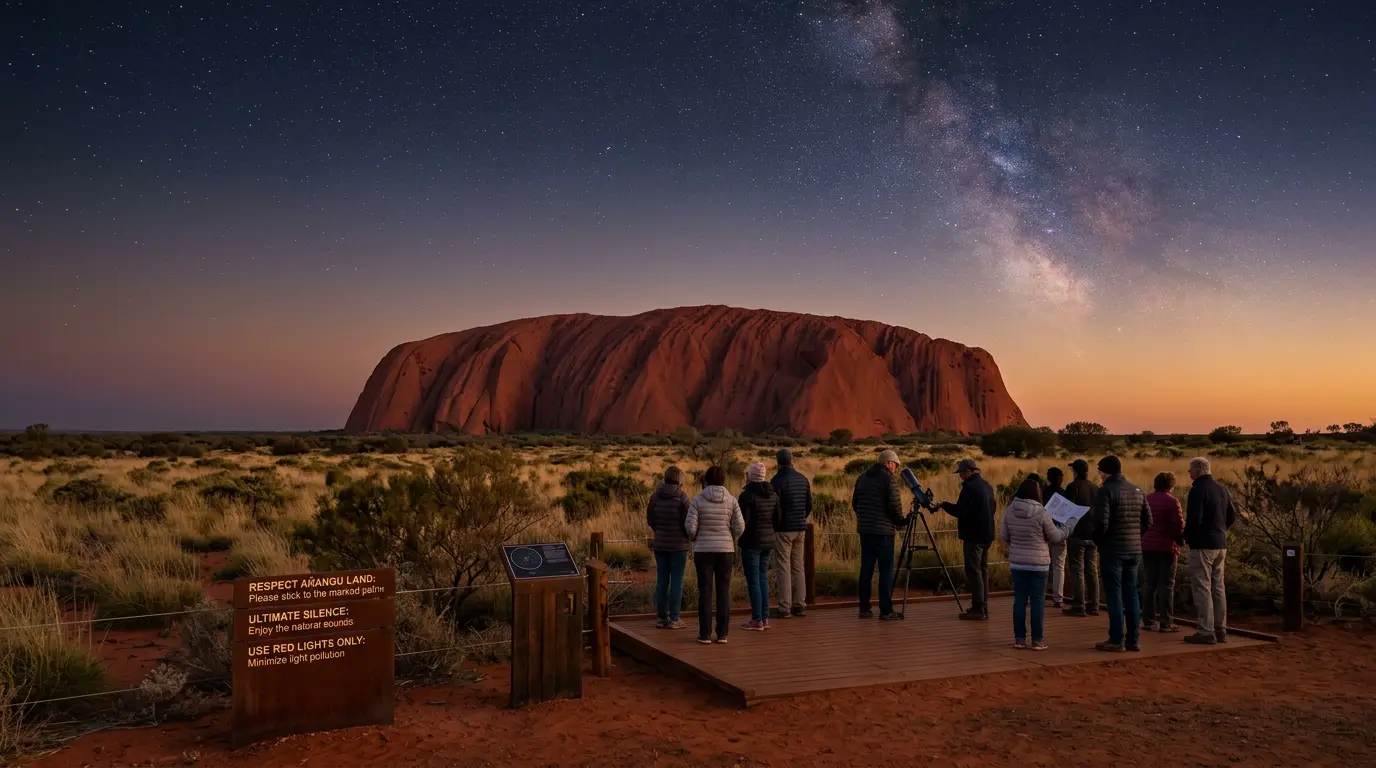
Wide, respectful photograph of Uluru glowing red at dusk under a star-filled sky on Anangu land, capturing Uluru's cultural significance and the visitor etiquette every stargazer should know

Featured · Article

Uluru Cultural Significance and Visitor Etiquette

Uluru is Anangu land under joint management. Here's why the 2019 climb closure is settled policy, what you can't photograph, and real visitor etiquette.

Where the tour falls in your stay matters as much as the date. Book it for the middle of the trip, not the first night, when altitude is at its worst, and not the last, when a cloudy forecast leaves no second chance. If the new moon lands mid-trip, consider two sessions on different nights and treat the second as insurance.
The Bolivian-winter months deserve a hedge rather than a ban. Not every January or February brings storms, but the odds are less reliable than in the dry winter, so a refundable booking and a spare night are worth more then than any telescope upgrade.

Can you stargaze for free, and can children come?

Naked-eye viewing from the edge of town costs nothing, and planets and bright constellations stand out even there. Town lights wash out faint detail, which is what the dark sites and the telescopes are for.
For a free guided option, ESO runs tours of its Paranal Observatory every Saturday of the year at no charge, with compulsory online registration because capacity is limited. ESO provides no transport, so you need a car or a hired driver, and children under four cannot enter for safety reasons[15]. It is a daytime visit that complements a night tour rather than replacing one.

Recommended tours

Tours are selected for quality, not commission. I earn a small fee if you book — at no extra cost to you.
Public visits to ALMA are not currently offered; only media or educational visits are possible[16]. For how Paranal, La Silla and ALMA differ in what a visitor can actually do, see Atacama observatories explained. Children are the open question after dark: ESO's under-four rule is fixed, while night tours set their own limits (one San Pedro listing starts at 4), so ask before you book.
A few small habits improve the free option. Walk away from the plaza lights, give your eyes time to adapt, and use a red light instead of a phone screen, which resets your night vision each time you check it. Binoculars add more to a naked-eye night than most people expect.

Frequently asked questions

What should an Atacama stargazing FAQ settle before a first trip?

Four decisions: when to go relative to the new moon, how to pace altitude, what a tour costs and which operator to trust. The sections above give each a short answer, and the linked articles carry the detail on season, altitude and moon phase.

Is stargazing in the Atacama Desert safe?

On a guided tour, yes. The main risks are cold, dark uneven ground and altitude rather than the sky itself. Choose a registered operator, dress for freezing nights, take the first day easy and carry water. Confusion, stumbling or drowsiness is a reason to descend and seek help.

Do you need a guide to stargaze in the Atacama?

You do not have to book one. Naked-eye viewing from the edge of town costs nothing, but a guide supplies the telescopes, picks the targets and shares the Andean stories that go with the sky. For a first night the guided session is easier, and it avoids driving unlit desert roads.

How long does an Atacama stargazing tour take?

Roughly two to two and a half hours door to door on the formats described above, including pick-up at your hotel and the drive from town. Start times shift with sunset, so confirm the pick-up time when you book rather than assuming a fixed hour.

Can children join a stargazing tour in San Pedro de Atacama?

Often, but limits vary by operator. One listing sets a minimum age of 4, and ESO's Paranal tours do not admit children under four. Ask before booking, and pack extra layers, since a still two-hour session in freezing air is hard on small children.

Are Atacama stargazing tours cancelled for clouds or wind?

They can be. Operators judge from forecasts that are not always right, so a tour may run when observing is still feasible or be suspended when it is not. Refund terms differ: one operator returns 100% for a weather suspension. Read the policy and keep a spare night in your plan.

Can you visit ALMA or Paranal as a tourist?

ESO's Paranal tours are free and run on Saturdays, with compulsory online registration and no transport provided. Public visits to ALMA are not currently offered; only media or educational visits are possible. Paranal is a daytime visit, so it sits alongside a night tour rather than replacing it.

Do I need to book Valle de la Luna in advance?

Buying ahead is recommended. Groups are capped at 12, the last group enters by 4:00 PM, and general admission is around CLP 10,000-10,800 depending on source and date, so check the fee at the gate. Visitors wait for sunset inside the reserve, which means the actual stargazing happens at another site.

How many nights do I need for Atacama stargazing?

More than one, so a cloudy evening does not end the trip, and with the first day kept easy for altitude. The Atacama stargazing how-many-days article sets out a plan around weather risk and moon phase, and the new-moon calendar helps you pick the nights.

Sources

32 references Show
  1. Wikipedia (opens in a new tab)

    “The town lies at an average of 8,000 feet (2,400 m), thus visitors often experience mild altitude sickness such as dizziness, lethargy and headaches.”

  2. cdc.gov (opens in a new tab)

    “AMS generally resolves within 12–48 hours if travelers do not ascend farther.”

  3. nomades.com (opens in a new tab)

    “CLP$ 25.000 per person.”

  4. cdc.gov (opens in a new tab)

    “Any unacclimatized traveler proceeding to a sleeping altitude of ≥2,450 m (≥8,000 ft)—and sometimes lower—is at risk for altitude illness.”

  5. Wikipedia (opens in a new tab)

    “Nighttime temperatures routinely drop below 0 °C (32 °F) and can reach as low as −10 °C (14 °F) in the winter.”

  6. chile.travel — Anotalas tres experiencias que debes vivir en san pedro de atacama (opens in a new tab)

    “Puedes consultar en la Oficina de Sernatur ubicada frente a la plaza principal de San Pedro de Atacama o buscar directamente en los servicios registrados de Sernatur.”

  7. tur.com (opens in a new tab)

    “Realizaremos el pick up en nuestro alojamiento dentro del radio urbano de San Pedro de Atacama para comenzar la actividad astronómica y trasladarnos hasta el observatorio.”

  8. chile.travel — Anotalas tres experiencias que debes vivir en san pedro de atacama (opens in a new tab)

    “Durante la contemplación de cielos, los guías te contarán la cosmovisión andina y te facilitarán telescopios para observar los astros en profundidad.”

  9. chile.travel — Entry and visa requirements (opens in a new tab)

    “If you are a citizen of South America, the European Union, the United States, Canada, or Australia, you will not need a visa to enter as a tourist.”

  10. gov.uk (opens in a new tab)

    “You can visit Chile for up to 90 days without a visa.”

  11. serviciosturisticos.sernatur.cl (opens in a new tab)

    “De acuerdo a la ley 20.423, los servicios de Alojamiento y Turismo Aventura deben estar registrados obligatoriamente en Sernatur.”

  12. chile.travel — Visiting moon valley (opens in a new tab)

    “The valley opens at 8:00 AM and the last group can enter no later than 4:00 PM, where they are able to wait for the sunset inside the reserve.”

  13. atacamastargazing.com (opens in a new tab)

    “At AtacamaStargazing, we conduct tours even during a full moon.”

  14. nomades.com (opens in a new tab)

    “In case of suspension for weather conditions, we will refund 100% of your payment.”

  15. eso.org — Paranal (opens in a new tab)

    “The guided tours are free of charge, but registration is compulsory as capacity is limited.”

  16. eso.org — Visitors (opens in a new tab)

    “Please note that public visits to ALMA are currently not offered; only media or educational visits are possible.”

  17. eso.org — Gerd huedepohl 04 (opens in a new tab)

    “Along the Milky Way we can distinguish, from bottom to top: the Carina Nebula, the Southern Cross and the Coal Sack, and Beta and Alpha Centauri.”

  18. eso.org — Gerd huedepohl 04 (opens in a new tab)

    “The bright spot to the right of these two stars is the globular cluster Omega Centauri.”

  19. eso.org — Gerd huedepohl 04 (opens in a new tab)

    “On the left of the image, the Small Magellanic Cloud, an irregular galaxy neighbouring the Milky Way, is clearly visible together with the globular cluster 47 Tucanae to its upper left.”

  20. eso.org — Gerd huedepohl 3 (opens in a new tab)

    “Right above the rock at the centre of the picture, the Large Magellanic Cloud, a neighbourhood galaxy of the Milky Way is visible.”

  21. chile.travel — Geiseres del tatio (opens in a new tab)

    “Los Géiseres del Tatio revelan la energía volcánica de los Andes a más de 4.300 metros sobre el nivel del mar.”

  22. cdc.gov (opens in a new tab)

    “Medium risk: Acetazolamide prophylaxis would be beneficial; consider its use.”

  23. cdc.gov (opens in a new tab)

    “High risk: Strongly encourage acetazolamide prophylaxis, and have the traveler carry dexamethasone for emergency use.”

  24. cdc.gov (opens in a new tab)

    “An effective dose for prophylaxis that minimizes the common side effects of paresthesia is 125 mg every 12 hours, beginning the day before ascent and continuing the first two days at altitude, and longer if ascent continues.”

  25. science.nasa.gov (opens in a new tab)

    “The best time to observe the stars, with regard to the Moon's brightness, is the two weeks before and after the new moon phase.”

  26. science.nasa.gov (opens in a new tab)

    “This has a similar effect to that of human-created light pollution, as it makes faint stars and other faint objects in the sky harder to see.”

  27. science.nasa.gov (opens in a new tab)

    “For those hoping to observe meteor showers or the Milky Way, a bright Moon can be the thing that causes you to stay home on a given night.”

  28. puntoticket.com (opens in a new tab)

    “Niños de 1 a 12 años no pagan entradas.”

  29. emol.com (opens in a new tab)

    “la cual se mantiene vigente desde el 15 de enero y se mantendrá por los próximos días.”

  30. meganoticias.cl (opens in a new tab)

    “En la jornada de este viernes, se registraron inundaciones en San Pedro de Atacama, región de Antofagasta, debido a la intensa lluvia que está afectando a la zona.”