All articles
Written by Maya Okonkwo
  • 6 min
  • 40 sources

Sami Culture Around Tromsø Follows the Reindeer's Year

Who the Sámi herders around Tromsø are, how a reindeer year runs on seasons and snow, and where joik, the lavvu and duodji fit into living culture today.
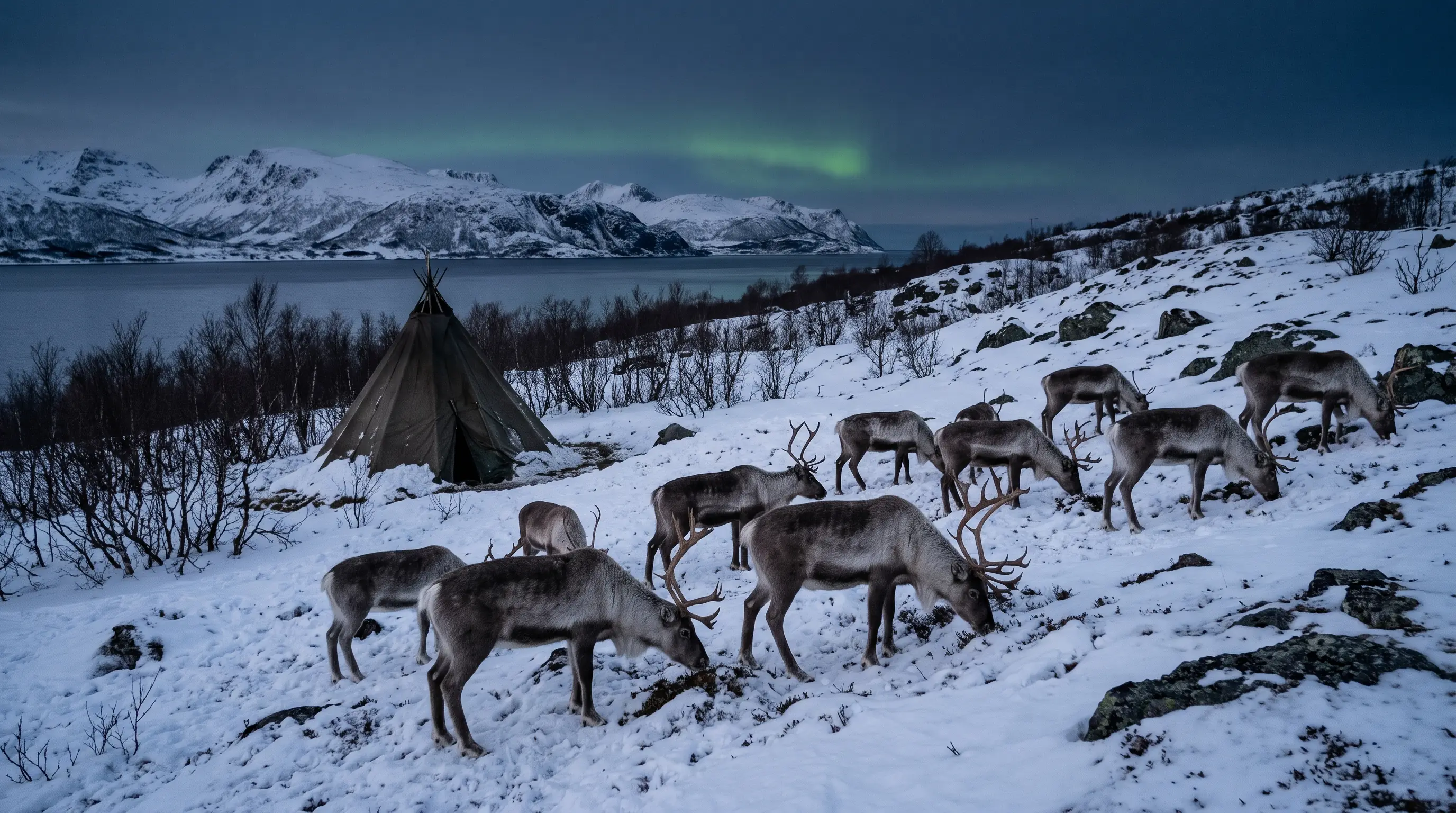
Sami culture Tromso northern lights scene: a reindeer herd crossing a snowy slope at dusk with a faint green aurora over the fjord

Herders near Tromsø move between a winter pasture at Mievki/Mauken and a summer pasture at Stuoranjárga/Tromsdalen.

The reindeer herders near Tromsø are relative newcomers to the coast: the district studied most closely moved its herd to the Troms coast only in the 1950s, leaving inland Finnmark and a very different climate behind[1]. That migration, and the winter work of keeping animals fed close to a city, is the working core of Sámi culture here, with joik, the lavvu and duodji tied to the same year. It is one district's story rather than a portrait of every Sámi community, and for a visitor the practical route is daytime and institutional: a museum exhibition or festival week, the Sámi Duodji label as the check on any craft, and distance as the rule near any herd.
Herd moved to Troms coast
1950s
Tromsø-area herders left inland Finnmark for the coast[1]
Lavvu design in use
1,000+ years
Sámi oral tradition: well over a thousand years[17]
Sámi Parliament in Norway
39 members
Elected from seven constituencies every fourth year[4]

Who the Sámi are, and where Tromsø fits

No single country holds Sámi culture. The Sámi, an Indigenous people, have traditional territories in Finland, Norway, Sweden and Russia[2], so a herding district outside Tromsø is one corner of a map that crosses four state borders. In Norway the people have their own elected assembly, the Sámi Parliament, which first opened in Karasjok on 9 October 1989[3] and now seats 39 representatives from seven constituencies, re-elected every fourth year[4].
Reindeer husbandry is only one thread of that culture, and it is geographically lopsided. Most of Norway's Sámi reindeer husbandry happens in Finnmark, with smaller herding areas in Troms, the county around Tromsø, and in Nordland and Trøndelag[5]. A herd within sight of Tromsø is therefore an outpost of a Finnmark-centred system rather than its heartland.
That culture has been pressed hard. Boarding schools in the assimilation era took Sámi children away from their families to teach them Norwegian[6], and joik, the lavvu and duodji survived that pressure unevenly. Aurora belief is one strand, and what is actually documented about pointing and whistling at the lights is narrower than the popular warning.

How a herding year runs: seasons and earmarks

A Sámi herding year follows grazing, not the calendar: the herd works its way to the coast for spring and summer, then inland for autumn and winter[7]. Dates matter less than snow.
Ownership is written into the animals themselves. A calf is marked with small cuts in its ear[8], and Norway has thousands of distinct earmarks[9]. Holding earmarked reindeer gives a herder a voice in decisions about the herd and a route into learning the work and building a herd of their own[10]. In practice the earmark is a property mark and an entry ticket at once: it says whose animal is whose, and it is how a newcomer starts.
Green aurora borealis arching over a snow-covered fjord near Tromsø, Norway, with mountain silhouettes and calm water reflections during polar night

Featured · Destination

Northern Lights in Tromsø

At 69.6°N inside the auroral oval, Tromsø sees aurora at Kp 2. Peak season November–February. Best viewing spots, tour advice, and aurora forecast strategy.

One account dates traditional Sámi herding to the 17th century[11], which makes the system old but not timeless, and the coastal routes near Tromsø are far newer still. That matters here: the herders on the city's doorstep are working a system with long roots and a short local history.

The herd within sight of Tromsø

A herding unit close to the city, the Mievki-Stuoranjárga/Mauken-Tromsdalen district, keeps its reindeer at a winter pasture at Mievki/Mauken and a summer pasture at Stuoranjárga/Tromsdalen, moving between them with the city in view[12]. Winter there overlaps with northern lights season in Tromsø, so the herd and the aurora visitors share the same dark months.
Winter is also the hard season. Reindeer live on lichen buried under the snow[13], so snow conditions decide where a herd can stay, which helps explain why the Sámi language has an extensive vocabulary for describing snow[14].
The coastal climate is not the inland one, and a warm spell or rain on snow can lock pastures under ice, leaving reindeer nearly unable to reach feed[15]. In a city that sells clear, cold nights, a thaw is the herder's bad news. A mild evening for a visitor can be a hard week for the herd.
None of this makes the Mievki district a stand-in for every Sámi community near Tromsø: it is one herding unit with its own route and its own history. For a visitor the practical consequence is modest but real. Whatever you see on a hillside in winter is someone's working herd, and the weather that sends you to the window is the same weather that decides whether those animals can eat.

Joik, lavvu and duodji: three practices tied to the herd

Three practices show how Sámi culture and the herd fit together: a sung tradition, a portable home and a craft that uses the animal itself.
Traveler photographing the Milky Way arc above a dark desert horizon on an astrotourism trip, tripod-mounted camera capturing star trails against a certified dark-sky park backdrop

Featured · Article

What Is Astrotourism? The Complete Beginner's Guide

Astrotourism means travel built around dark skies: meteor showers, auroras, the Milky Way. What it means, where to go, and how to plan your first trip.

  • Joik, the native Sámi musical expression, traditionally gave a young person a personal joik that followed them through life and affirmed kinship[16].
  • The lavvu is a portable tent whose design, by Sámi oral tradition, is well over a thousand years old[17]. For herders, home is wherever it goes up on the migration trail[18], and it is still used today as shelter during migrations and as a cultural symbol[19].
  • Duodji is Sámi handicraft, split into hard work in wood or bone and soft work in cloth and leather[20], with reindeer widely used because the tradition is to use every part of the animal[21].
Under assimilation pressure from about 1850, yoiking came close to disappearing altogether[22]. Joik was condemned as sinful, and in the 1950s it was forbidden in schools in Sámi areas, yet it has since been revived and mixed with jazz, metal and rock[23]. The multi-artist Nils-Aslak Valkeapää is credited with starting that revival almost single-handedly in 1968[24]. Regional names differ too: luohti in the northwest of Sápmi, vuolle and vueliea further south[25].

What this changes for a winter visit to Tromsø

Look for the label, not the look. Two certification trademarks, Sámi Duodji and Sámi Made, belong to the Sámi people and are managed by the Saami Council[27], and goods carrying Sámi Duodji follow traditional materials, techniques, forms and uses[28]. That makes the label the quickest check on who stands behind a product.

Sámi Made is not the same mark as Duodji

The Sámi Made mark tells a buyer only that a Sámi or Sámi-owned company made the product[29], a wider category than handicraft. For traditional craft, look for Sámi Duodji.
Daytime is where this culture is easiest to meet on its own terms. A programme built around what to do in Tromsø beyond the aurora gives duodji and the herding year more room than a single evening can. I haven't made the Tromsø trip yet, and when I plan it, the daytime slot for this goes early in the stay: once you know what a thaw does to a pasture, a warm forecast reads differently.
For the daytime, start with an institution. The Arctic University Museum in Tromsø has curated two exhibitions on Sámi culture, one in the late 1990s and one from 2013 to 2015[30], and its open exhibitions have included Ravdnji – The Strong Current, on Sámi heritage in the Tromsø area[31]. For Sámi National Day on 6 February 2026 the museum held a public afternoon with a workshop where visitors could try Sámi braiding[32], and Tromsø's Sami Week, an annual festival of Sámi industries, culture and sports held around the same date, has been arranged every year since 2004[33][34]. Programmes change from year to year, so check what is on for your dates.
Duodji gets its context in the same circle. Sámi Stories, a past show from the museum with the Northern Norway Art Museum, set historical duodji, among them a reindeer milk scoop, a shaman's drum and a cradle, beside contemporary art[35], and Visit Norway notes that traditional duodji are now valued as art by collectors worldwide[36]. A museum is where you learn what good duodji looks like, and the Sámi Duodji label above is how you check a shop.
Three questions work as a quick filter for anything presented as Sámi culture:
  • Who owns and runs it? Sámi Made exists to answer exactly that.
  • If it is a craft, is it marked Sámi Duodji, or only Sámi Made?
  • Which district and which herders does it come from? A specific answer beats a claim about how all Sámi do things.

Recommended tours

Tours are selected for quality, not commission. I earn a small fee if you book — at no extra cost to you.


If the herd itself is the draw, remember it is a working herd. The Mievki-Stuoranjárga/Mauken-Tromsdalen district works close to Tromsø[37], and its herding family has kept to the same winter-and-summer circuit since 1957, nearly seventy years between the same two pastures[38]. The trekking association DNT asks hikers to keep the same caution and distance around any herd[39] and to stay calm and let reindeer retreat undisturbed[40]. DNT is a trekking association, so this is its guidance rather than a legal rule.
The cold you stand in is the cold the herd lives in, so dressing for an Arctic winter in Tromsø is worth getting right before any outing. For the herders, that same winter is a working season under pressure from thaws and ice.

Frequently asked questions

Who are the Sami people and where do they live?

The Sámi are an Indigenous people with traditional territories in Finland, Norway, Sweden and Russia. In Norway they elect their own Sámi Parliament, and reindeer herding, handicraft and joik remain the parts of the culture visitors are most likely to hear about.

Do Sami people live in Tromsø today?

Sámi reindeer herders work in a district close to the city, where the herd moves between a winter pasture at Mievki/Mauken and a summer pasture at Stuoranjárga/Tromsdalen. The herders of that district came from inland Finnmark in the 1950s, so their story is one district's, not a portrait of every Sámi community near Tromsø.

How does Sami culture around Tromsø connect to the northern lights?

Aurora belief is one strand of Sámi culture, and the documented warnings about pointing and whistling at the lights are narrower than the popular retelling. Most of the living culture around Tromsø runs through reindeer husbandry, joik, the lavvu and duodji instead. The aurora season and the herding winter simply overlap.

What is joik, and is it just a song?

Joik is the native Sámi musical expression and is reminiscent of singing, though it is not simply a song. A young person traditionally received a personal joik that followed them through life, and joik was also used to calm reindeer. It was condemned as sinful and forbidden in schools in the 1950s, and it has since been revived and mixed with jazz, metal and rock.

What is a lavvu, and do Sami still use one?

A lavvu is a portable tent. Sámi oral tradition holds that the design has been used for well over a thousand years, and herders still use it as shelter during reindeer migrations and as a cultural symbol.

What does the Sámi Duodji label mean?

Sámi Duodji is a certification trademark owned by the Sámi people and managed by the Saami Council, and products carrying it follow traditional materials, techniques, forms and uses. Sámi Made is a separate mark for anything made by a Sámi or Sámi-owned company, a wider category than handicraft.

Why do reindeer herders near Tromsø worry about warm winters?

Reindeer live on lichen buried under snow, and on the coast a warm spell or rain on snow can lock pastures under ice, which makes the feed nearly impossible to reach. A thaw that feels mild to a visitor can therefore be bad news for a herd.

Sources

40 references Show
  1. link.springer.com — 978 3 031 42289 8 2 (opens in a new tab)

    “In the 1950s, they moved their herd to the coastline of Troms, which has different climate conditions compared to inland Finnmark”

  2. sametinget.no (opens in a new tab)

    “The Sámi are an indigenous people with traditional territories within the national borders of Finland, Norway, Sweden and Russia.”

  3. sametinget.no (opens in a new tab)

    “The Sámi Parliament was first opened 9th October 1989 in Karasjok by H.R.H King Olav V.”

  4. sametinget.no (opens in a new tab)

    “The Sámi Parliament is a representative elected assembly with 39 representatives elected by seven constituencies every fourth year.”

  5. link.springer.com — 978 3 031 42289 8 2 (opens in a new tab)

    “Most Sámi reindeer husbandry in Norway is located in Finnmark, but reindeer husbandry is also practiced in Troms, Nordland, and Trøndelag.”

  6. laits.utexas.edu (opens in a new tab)

    “Sami children were forced to leave the families and go to boarding schools to learn Norwegian.”

  7. laits.utexas.edu (opens in a new tab)

    “During the spring and summer months the herders move out towards the coast and during the fall and winter they move inland.”

  8. laits.utexas.edu (opens in a new tab)

    “Reindeer are branded by making small cuts into the ears of calves.”

  9. laits.utexas.edu (opens in a new tab)

    “There are thousands of different earmarks in Norway.”

  10. link.springer.com — 978 3 031 17625 8 3 (opens in a new tab)

    “Having earmarked reindeer gives access to decision-making (about the reindeer and herd) and a prospect of learning reindeer husbandry and establishing a vital herd.”

  11. laits.utexas.edu (opens in a new tab)

    “The Sami have practiced traditional reindeer herding since the 17th century.”

  12. link.springer.com — 978 3 031 42289 8 2 (opens in a new tab)

    “The reindeer herd on migration between their winter pasture in Mievki/Mauken and their summer pasture in Stuoranjárga/Tromsdalen.”

  13. laits.utexas.edu (opens in a new tab)

    “The reindeer live on lichen, which is buried under the snow.”

  14. laits.utexas.edu (opens in a new tab)

    “The Sami language has a rich vocabulary for describing snow.”

  15. link.springer.com — 978 3 031 42289 8 2 (opens in a new tab)

    “pastures making it nearly impossible for the reindeer to reach the feed and act as grazing barriers”

  16. nordics.info (opens in a new tab)

    “When a young person began to play a role in the community they received a yoik that followed them throughout life and reaffirmed kinship with other group members.”

  17. polarpedia.eu (opens in a new tab)

    “It is known from Sami oral tradition that the lavvu design had been used for well over a thousand years.”

  18. laits.utexas.edu (opens in a new tab)

    “Time is measured in the passing of the seasons and home is where the lavvu is set up on the migration trails.”

  19. polarpedia.eu (opens in a new tab)

    “Lavvu is still used today by the Sami of northern Scandinavia”

  20. snl.no (opens in a new tab)

    “Det er vanlig å skille mellom hard og myk duodji, hvor hard refererer til sløyd i tre eller bein, mens myk refererer til sløyd i stoff og skinn.”

  21. snl.no (opens in a new tab)

    “Reinsdyret ble mye brukt til duodji, for tradisjonen er å bruke alle deler av dyret.”

  22. nordics.info (opens in a new tab)

    “Under the harsh assimilation from ca. 1850 until relatively recently yoiking suffered more and was on the verge of disappearing totally.”

  23. visitnorway.com (opens in a new tab)

    “Joik was condemned as sinful, and in the 1950s, it was forbidden to use joik in schools in Sami areas.”

  24. nordics.info (opens in a new tab)

    “In 1968 the multi-artist Nils-Aslak Valkeapää singlehandedly revitalized the yoik.”

  25. nordics.info (opens in a new tab)

    “In the northwest they are called luohti, moving south vuolle and vueliea”

  26. nordics.info (opens in a new tab)

    “Yoiks were used to calm reindeer and keep predators away.”

  27. saamicouncil.net (opens in a new tab)

    “Sámi Duodji and Sámi Made are certification trademarks owned by the Sámi people and managed by the Saami Council.”

  28. saamicouncil.net (opens in a new tab)

    “Products carrying the Sámi Duodji label follow traditional materials, techniques, forms and uses.”

  29. saamicouncil.net (opens in a new tab)

    “The Sámi Made trademark tells the buyer that a product is made by a Sámi or a Sámi-owned company.”

  30. journals.uio.no (opens in a new tab)

    “This article focuses on the set up, reception, and social scientific discursive fields that have informed two exhibitions about Sámi culture curated over time by Tromsø University Museum.”

  31. en.uit.no (opens in a new tab)

    “Open exhibitions, including Ravdnji – The Strong Current, about Sámi heritage in the Tromsø area”

  32. en.uit.no (opens in a new tab)

    “A workshop where you can try Sámi braiding”

  33. msm.no (opens in a new tab)

    “Sami week is an annual festival in Tromsø based on Sami industries, culture and sports, and is held in connection with Sami National Day on February 6th.”

  34. msm.no (opens in a new tab)

    “The Midnight Sun Marathon Foundation has arranged Sami week annually since 2004.”

  35. nnkm.no (opens in a new tab)

    “Featuring a selection of contemporary artworks and traditional duodji (handicraft)—including a reindeer milk scoop, shaman’s drum, cradle, and a selection of hats and dolls”

  36. visitnorway.com (opens in a new tab)

    “Today, traditional duodji are considered to be valuable pieces of art by collectors from all over the world.”

  37. link.springer.com — 978 3 031 42289 8 2 (opens in a new tab)

    “This case study investigates one reindeer herding unit that herds their reindeer close to Tromsø in Troms,Northern Norway”

  38. link.springer.com — 978 3 031 42289 8 2 (opens in a new tab)

    “Since the winter of 1957, the Oskal family has moved between winter pastures in Mievki/Mauken and summer pastures in Stuoranjárga/Tromsdalen outside Tromsø”

  39. dnt.no (opens in a new tab)

    “Regardless of classification, all reindeer are highly sensitive to stress, and hikers should maintain an identical level of caution and distance around any herd.”

  40. dnt.no (opens in a new tab)

    “Remain calm if you encounter reindeer, allowing them to retreat undisturbed”