All articles
Written by Maya Okonkwo
  • 5 min
  • 42 sources

Why NASA Tests Mars Rovers in Chile's Atacama Desert

NASA tests Mars rover prototypes in the Atacama for its extreme dryness and salty soils. Here is the science behind ARADS and the desert's underground life.
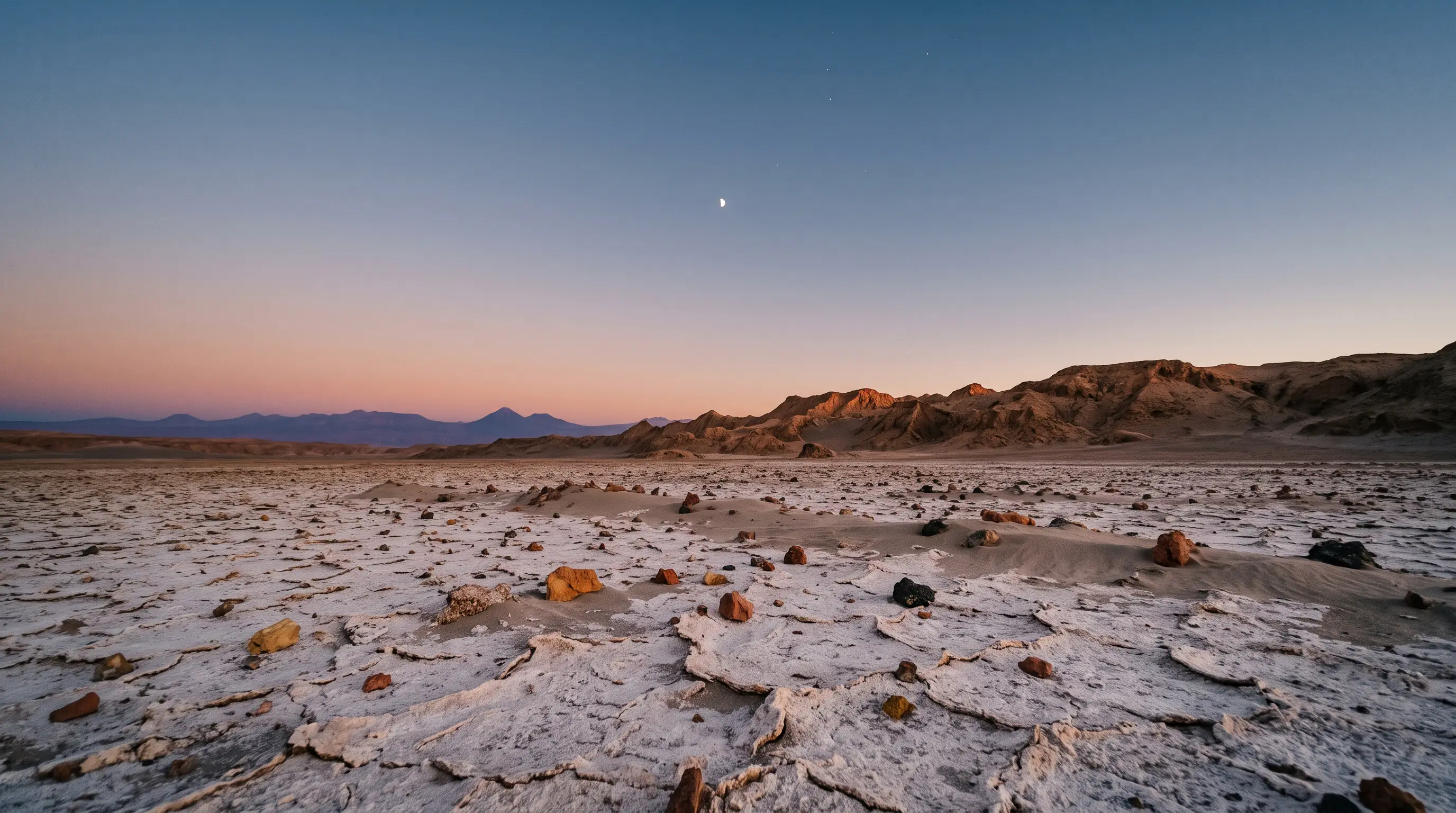
NASA-style drilling rover on salt-crusted ground in the Atacama Desert at dawn, a Mars analog landscape of cracked pale soil, a distant volcanic range and the last stars fading overhead

ARADS spent one month a year in the field from 2016 to 2019, and its rover's drill is built to reach two meters down.

The Atacama is considerably warmer than Mars, yet NASA calls the region remarkably similar to the Red Planet today and names two reasons: extreme dryness and soil chemistry.[4] The payoff is rehearsal for the life search itself, and Brian Glass, principal investigator of ARADS (Atacama Rover Astrobiology Drilling Studies), said instruments tested in a Mars-analog environment "will help us figure out the best ways of looking for past or current life on Mars, if it existed."[5] The test base was Yungay Station, a mining ghost town owned by the University of Antofagasta, which is a different place from the Valle de la Luna that visitors walk through.[6]
Rain per decade at ARADS
1 cm
In NASA's test area, rain can fall as little as 1 cm a decade[1]
Hyperarid core's age
15 million yrs
Arid for 150 million years, hyperarid for the last 15 million[2]
K-REX2 drill depth
2 m
NASA says the rover's drill reaches 6.5 ft through salt and rock[3]

Three conditions that make the Atacama a Mars analog

The hyperarid core of the Atacama matches Mars on three counts at once: extreme dryness, the highest UV radiation levels on Earth, and highly saline, oxidizing soils.[7] Temperature is not on the list. On the ground, the match looks like this:
  • In the area where NASA tested its rover, rain can be as little as one centimeter per decade.[1]
  • The hyperarid core has been arid for 150 million years and hyperarid for the last 15 million.[2]
  • Two significant rain events in 2015 and one in 2017 broke the pattern, forming hypersaline lagoons that lasted several months.[8][9]
Mountains, a cold ocean current and a subtropical high-pressure belt are why the Atacama is the driest desert on Earth, and for Mars researchers the ground they leave behind is the point: dry, salty and oxidizing.

How a 2003 soil study put Yungay on the Mars map

The modern Mars-analog case for the Atacama starts in 2003, when Yungay, a site in the hyperarid core, was suggested as a good analog model of Mars, and the way scientists read the desert changed with it.[10] The logic is older. Before the Viking missions, a team from the Jet Propulsion Laboratory inspected soil samples from deserts around the world, so testing Mars questions on desert soil predates the 2003 suggestion.[11]
The soil itself explains the interest. Analysis of samples from the driest regions found extremely low levels of organic matter,[12] and that organic-depleted, near-sterile condition offers an interesting Earth analog of the martian surface material.[13]
For a rover team that turns a vivid comparison into an engineering question. What does an instrument have to do to find organics in ground that holds almost none?

What ARADS actually tested in the field

ARADS, the Atacama Rover Astrobiology Drilling Studies project, spent one month a year in the Atacama from 2016 to 2019 under Brian Glass of NASA's Ames Research Center.[16] At its center sat K-REX2, an Ames-built rover prototype about the size of Spirit and Opportunity, with a drill that NASA says reaches two meters (6.5 feet) through salt, rock layers and parched soil.[17][3]
Given a destination, the rover navigates a rugged, Mars-like surface on its own, then drills and passes samples to its onboard instruments automatically.[18] Autonomy matters more as the hole gets deeper. The drill digs about 20 times deeper than the Mars 2020 rover is meant to, and at that depth NASA says working independently becomes essential.[19]
Mars adds constraints the Atacama can only rehearse. The drill has to set up and stabilize on a planet with less than half the gravity of Earth,[20] and the 2016 season tested a prototype of the Wet Chemistry Laboratory that flew on Phoenix in 2007.[21] An onboard instrument searches for 512 different biological compounds.[22]
The 2017 season was the proof of concept. The team drilled from the rover to depths of up to two meters,[23] and Glass said the drill, rover and robot arm combination "behaved beautifully in the field."[24] The final 2019 deployment added remote operations, with a team in California running the rover in Chile.[25]

What lives there, and why Martian life would hide underground

The short version: the life here is patchy and mostly hidden, and I would call the desert a proving ground for methods rather than a source of exotic biology.
Most life in the extreme Atacama exists as microbial colonies underground or inside rocks.[26] If Mars ever had life, surface dryness and radiation would likely have pushed it below ground too, which is why the Atacama is good practice for the search.[27]
Salt is part of the hiding place. Salt habitats may be the last refuge for life in a region otherwise devoid of plants, animals and most types of microorganisms.[28] Analyses at Salar Grande detected the biosignatures of bacteria and archaea associated with halite, nitrate and perchlorate salts at a depth of 2 m, the same depth NASA says the K-REX2 drill is built to reach.[29][3]
Carnegie Mellon's Zoë rover tested the other half of the problem, finding life across a landscape. Zoë drilled into the soil of the Atacama in 2013 and discovered unusual, highly specialized microbes.[30] In one two-week experiment it autonomously traversed 50 kilometers, drilling and recovering samples several times each day.[31] The life it found was patchy, tied to water availability, scarce nutrients and soil chemistry.[32] I read that as a warning that one borehole proves little.
Zoë's methods did not stay in Chile. Early research developed multi-kilometer autonomous traverse and instrument-targeting methods that NASA's Mars rovers now use.[33] Stephen Pointing of Yale-NUS put the result plainly: "We have shown that a robotic rover can recover subsurface soil in the most Mars-like desert on Earth."[34] The microbes reported from the hyperarid core are known dry- and radiation-tolerant strains also present elsewhere in the world.[35]

The moonscape near San Pedro is not the test site
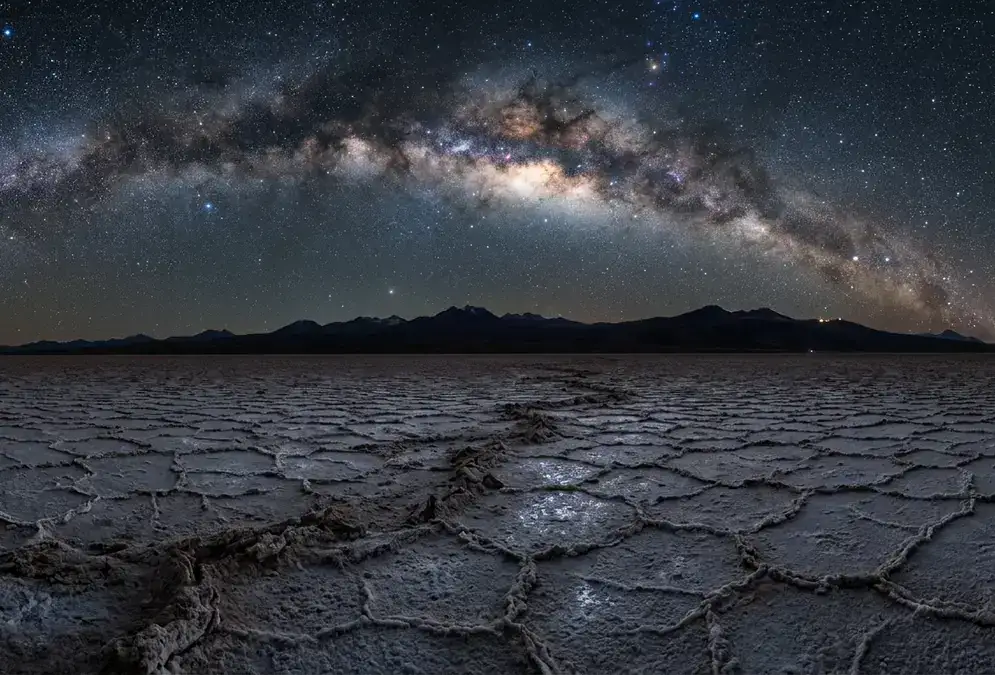
Valle de la Luna lies 13 km from San Pedro de Atacama, the base for the best stargazing spots in the Atacama Desert, inside the Cordillera de la Sal, a range about 100 km long known for its salt and clay formations.[36] Some sectors go several consecutive years without a drop of rain.[37]
Milky Way arch over the Atacama Desert salt flat at new moon, galactic core high overhead with the Andes silhouetted against star-filled sky

Featured · Destination

Atacama Desert Stargazing

Earth's driest desert delivers Bortle 1–2 skies, 330+ clear nights a year, and the galactic core almost overhead. Guide: tours, lodges, season, getting there.

Wind and water have carved its stone and sand, and a white layer from the region's dry salt lakes covers it.[38] The valley is part of Reserva Nacional Los Flamencos and was declared a Nature Sanctuary in 1982.[39]

Recommended tours

Tours are selected for quality, not commission. I earn a small fee if you book — at no extra cost to you.
The name fits: it is a moonscape, and a good one. The ARADS rover work, though, happened at Yungay Station, a different place.[6] Treat the valley as scenery in the same desert, not as a test site.

What the same dry air does for the night sky
The dryness that makes the Atacama a Mars stand-in also makes it an astronomy site. ESO chose Cerro Paranal, one of the region's Atacama observatories, a 2,635-m mountain about 120 km south of Antofagasta and 12 km inland from the Pacific coast, for its excellent atmospheric conditions and its remoteness.[40][41]
ESO records the sky there as clear or photometric about 75% of the night time in winter (April to September) and 80% in summer (October to March).[42] Those are Paranal numbers, not a promise for every pull-off near San Pedro, but they show what dry air at altitude buys an observer.
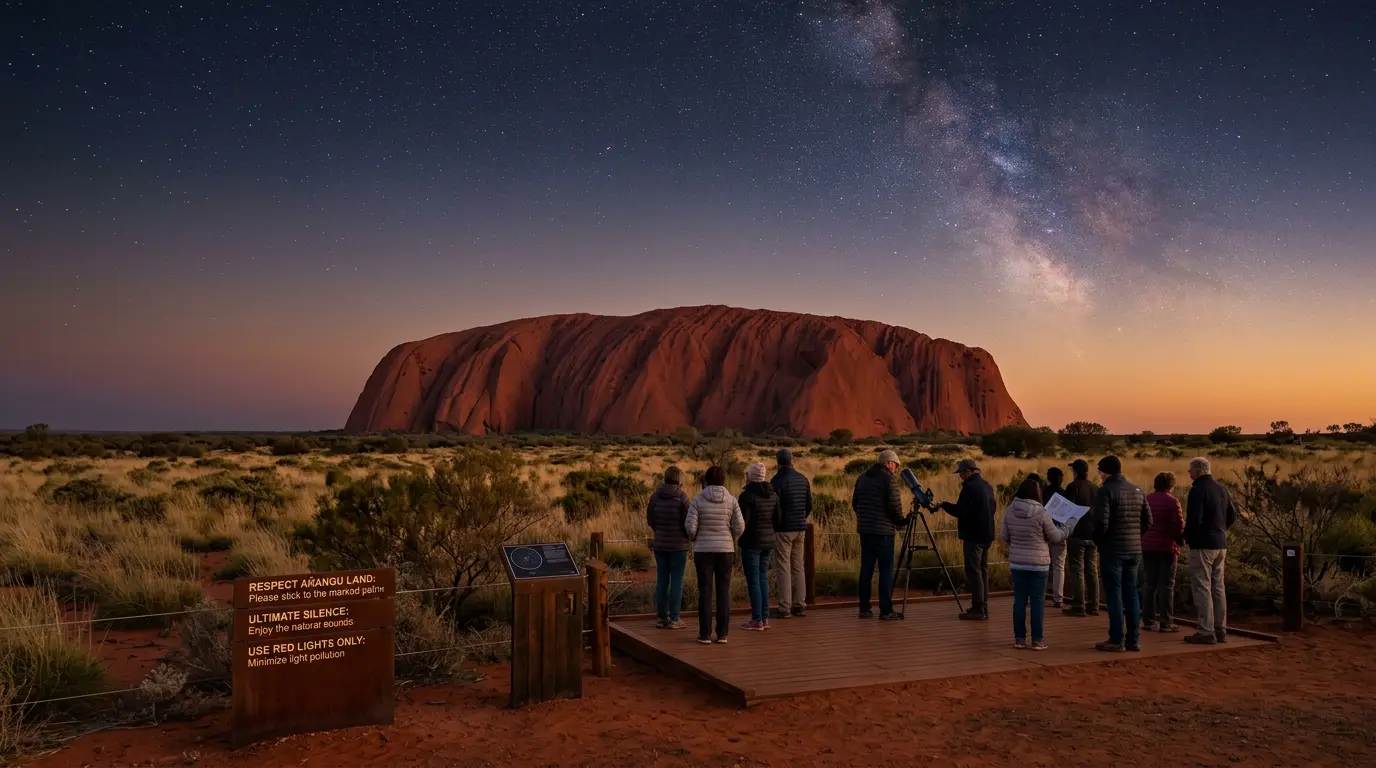
Wide, respectful photograph of Uluru glowing red at dusk under a star-filled sky on Anangu land, capturing Uluru's cultural significance and the visitor etiquette every stargazer should know

Featured · Article

Uluru Cultural Significance and Visitor Etiquette

Uluru is Anangu land under joint management. Here's why the 2019 climb closure is settled policy, what you can't photograph, and real visitor etiquette.

For a stargazer the Mars science is a bonus, not a reason to book. The sky is the reason, and whether the Atacama is worth the trip comes down to your dates and how you handle altitude.

Frequently asked questions

Why does NASA use the Atacama Desert as a Mars analog?

NASA points to extreme dryness and soil chemistry, even though the region is considerably warmer than Mars.[4] Researchers add the highest UV radiation levels on Earth and saline, oxidizing soils,[7] and the hyperarid core has stayed hyperarid for the last 15 million years.[2]

What is NASA's ARADS project in the Atacama?

ARADS, the Atacama Rover Astrobiology Drilling Studies project, was led by Brian Glass of NASA's Ames Research Center. Its team spent one month a year in the Atacama from 2016 to 2019 testing a drilling rover and life-detection instruments.[16]

How dry is the Atacama Desert where NASA tests Mars rovers?

In the ARADS test area, rain can be as little as one centimeter per decade.[1] Even the core gets rare surprises: significant rain events in 2015 and 2017 formed hypersaline lagoons that lasted several months.[8][9]

How deep can the K-REX2 rover drill in the Atacama?

NASA describes the drill as capable of reaching two meters (6.5 feet) through salt, rock layers and parched soil,[3] and in 2017 the team drilled from the rover to depths of up to two meters.[23]

Is there life in the Atacama Desert that scientists study for Mars?

Yes. Most life there exists as microbial colonies underground or inside rocks,[26] and salt habitats may be its last refuge in the driest areas.[28] What Zoë found was patchy, tied to water, scarce nutrients and soil chemistry.[32]

Did Atacama soil experiments suggest Viking could have missed organics on Mars?

One laboratory experiment points that way. Yungay soil with 32 ppm organic carbon, mixed with 1% magnesium perchlorate and heated, lost most of its organics as water and carbon dioxide.[14] It is a published argument about what heating does to organics, not proof that Viking missed anything.

Can you visit the Atacama sites where NASA tests Mars rovers?

The ARADS field work was based at Yungay Station, a mining ghost town owned by the University of Antofagasta.[6] Don't plan a trip around seeing it. For scenery in the same desert, Valle de la Luna is 13 km from San Pedro de Atacama.[36]

Sources

42 references Show
  1. NASA — Atacama rover astrobiology drilling studies arads (opens in a new tab)

    “it can rain as little as one centimeter, or less than half an inch, per decade here.”

  2. pmc.ncbi.nlm.nih.gov (opens in a new tab)

    “has remained arid for the past 150 million years, and hyperarid for the past 15 million years”

  3. NASA — Atacama rover astrobiology drilling studies arads (opens in a new tab)

    “Called K-REX2, it is equipped with a drill capable of reaching two meters (6.5 feet) down through salt, rock layers and parched soil to retrieve a sample for analysis.”

  4. NASA — Atacama rover astrobiology drilling studies arads (opens in a new tab)

    “Despite being considerably warmer than Mars, the region is remarkably similar to the Red Planet today, due to its extreme dryness and soil chemistry.”

  5. astrobiology.nasa.gov (opens in a new tab)

    “Putting life-detection instruments in a difficult, Mars-analog environment will help us figure out the best ways of looking for past or current life on Mars, if it existed”

  6. astrobiology.nasa.gov (opens in a new tab)

    “Their work was primarily at Yungay Station, a mining ghost town at one of the driest places in the Atacama, owned by the University of Antofagasta in Chile.”

  7. frontiersin.org (opens in a new tab)

    “extreme dryness, the highest UV radiation levels on Earth, and highly saline and oxidizing soils”

  8. pmc.ncbi.nlm.nih.gov (opens in a new tab)

    “in 2015, two significant rain events were recorded on March 25 and August 9; and in 2017 another one was recorded on June 7”

  9. pmc.ncbi.nlm.nih.gov (opens in a new tab)

    “resulting in the formation of previously unrecorded hypersaline lagoons, which have lasted several months.”

  10. frontiersin.org (opens in a new tab)

    “this view dramatically changed in 2003, when Yungay, a site located in the hyperarid core of the Atacama, was suggested to be a good analog model of Mars”

  11. frontiersin.org (opens in a new tab)

    “in advance of the Viking missions, a team from the Jet Propulsion Laboratory inspected soil samples from deserts around the world”

  12. ntrs.nasa.gov (opens in a new tab)

    “pyrolysis-GCMS analysis of soils collected from these regions revealed extremely low levels of organic matter.”

  13. ntrs.nasa.gov (opens in a new tab)

    “the condition of organic-depleted, near-sterile soil offers an interesting Earth analog of the martian surface material”

  14. frontiersin.org (opens in a new tab)

    “Yungay samples containing small amounts (32 ppm) of organic carbon were mixed with 1% of magnesium perchlorate and then heated, most of the organics present were decomposed to water and carbon dioxide”

  15. frontiersin.org (opens in a new tab)

    “As the Phoenix Lander found perchlorates in the Martian regolith”

  16. NASA — Atacama rover astrobiology drilling studies arads (opens in a new tab)

    “Each year from 2016 to 2019, the ARADS team, led by Brian Glass of NASA’s Ames Research Center, in California’s Silicon Valley, is spending one month working in the heart of the Atacama.”

  17. NASA — Atacama rover astrobiology drilling studies arads (opens in a new tab)

    “At the center of the ARADS project is an Ames-designed and -developed rover prototype that is about the same size as the Spirit and Opportunity rovers already on Mars.”

  18. NASA — Atacama rover astrobiology drilling studies arads (opens in a new tab)

    “When given a target destination, the rover can navigate autonomously over a rugged, Mars-like surface, then drill and transfer samples to the onboard scientific instruments automatically.”

  19. NASA — Nasa is testing a drill to search for life on mars on its own (opens in a new tab)

    “When digging 20 times deeper than that, as the ARADS drill will do, working independently becomes essential.”

  20. NASA — Atacama rover astrobiology drilling studies arads (opens in a new tab)

    “all on a planet with less than half the gravity of Earth.”

  21. astrobiology.nasa.gov (opens in a new tab)

    “a prototype version of the Wet Chemistry Laboratory (WCL), which flew on the Phoenix Mars mission in 2007.”

  22. NASA — Atacama rover astrobiology drilling studies arads (opens in a new tab)

    “the rover instrument will search for 512 different biological compounds.”

  23. phys.org (opens in a new tab)

    “successful in their primary objective to drill from the rover to depths of up to two meters”

  24. phys.org (opens in a new tab)

    “The drill, rover and robot arm combination behaved beautifully in the field”

  25. NASA — Atacama rover astrobiology drilling studies arads (opens in a new tab)

    “starting with the great distance between California and Chile.”

  26. astrobiology.nasa.gov (opens in a new tab)

    “most life in the extreme Atacama Desert in Chile exists as microbial colonies underground or inside rocks.”

  27. phys.org (opens in a new tab)

    “That makes locations like the Atacama good places to practice looking for life on Mars.”

  28. NASA — Atacama rover astrobiology drilling studies arads (opens in a new tab)

    “These salt habitats could be the last refuge for life in this extremely dry region that is otherwise devoid of plants, animals and most types of microorganisms.”

  29. frontiersin.org (opens in a new tab)

    “detected the biosignatures of bacteria and archaea associated with halite, nitrate, and perchlorate salts at a depth of 2 m.”

  30. cmu.edu (opens in a new tab)

    “drilled into the soil of Chile's Atacama Desert in 2013 and discovered unusual, highly specialized microbes.”

  31. cmu.edu (opens in a new tab)

    “During the two-week experiment, the robot autonomously traversed 50 kilometers of the world's most arid desert, drilling and recovering samples several times each day.”

  32. cmu.edu (opens in a new tab)

    “The microbial life discovered in the Atacama was patchy, which was related to water availability, scarce nutrients and soil chemistry.”

  33. cmu.edu (opens in a new tab)

    “Early research developed multi-kilometer autonomous traverse and instrument targeting methods, which are both now used on NASA's Mars rovers.”

  34. cmu.edu (opens in a new tab)

    “We have shown that a robotic rover can recover subsurface soil in the most Mars-like desert on Earth”

  35. pmc.ncbi.nlm.nih.gov (opens in a new tab)

    “these species are known dry- and radiation-tolerant strains also present elsewhere in the world”

  36. meteored.cl (opens in a new tab)

    “una cadena montañosa de unos 100 kilómetros de largo que se caracteriza por sus formaciones geológicas de sal y arcilla”

  37. meteored.cl (opens in a new tab)

    “es común que pasen varios años consecutivos sin que caiga una sola gota de agua”

  38. imaggeo.egu.eu (opens in a new tab)

    “It is marked by the presence of various formations of stone and sand which have been carved by wind and precipitation, and covered by a vast white layer that originates from the extensive dry salt lakes existing in this region.”

  39. Wikipedia (opens in a new tab)

    “Valle de la Luna is a part of the Reserva Nacional los Flamencos and was declared a Nature Sanctuary in 1982 for its natural environment and strange lunar landscape”

  40. eso.org (opens in a new tab)

    “Cerro Paranal is a 2,635-m high mountain, about 120 km south of the town of Antofagasta and 12 km inland from the Pacific Coast.”

  41. eso.org (opens in a new tab)

    “Cerro Paranal was chosen because of its excellent atmospheric conditions and its remoteness.”

  42. eso.org (opens in a new tab)

    “The sky is clear or photometric about 75% of the night time in winter (April-September) and 80% of the night time in the summer (October-March).”