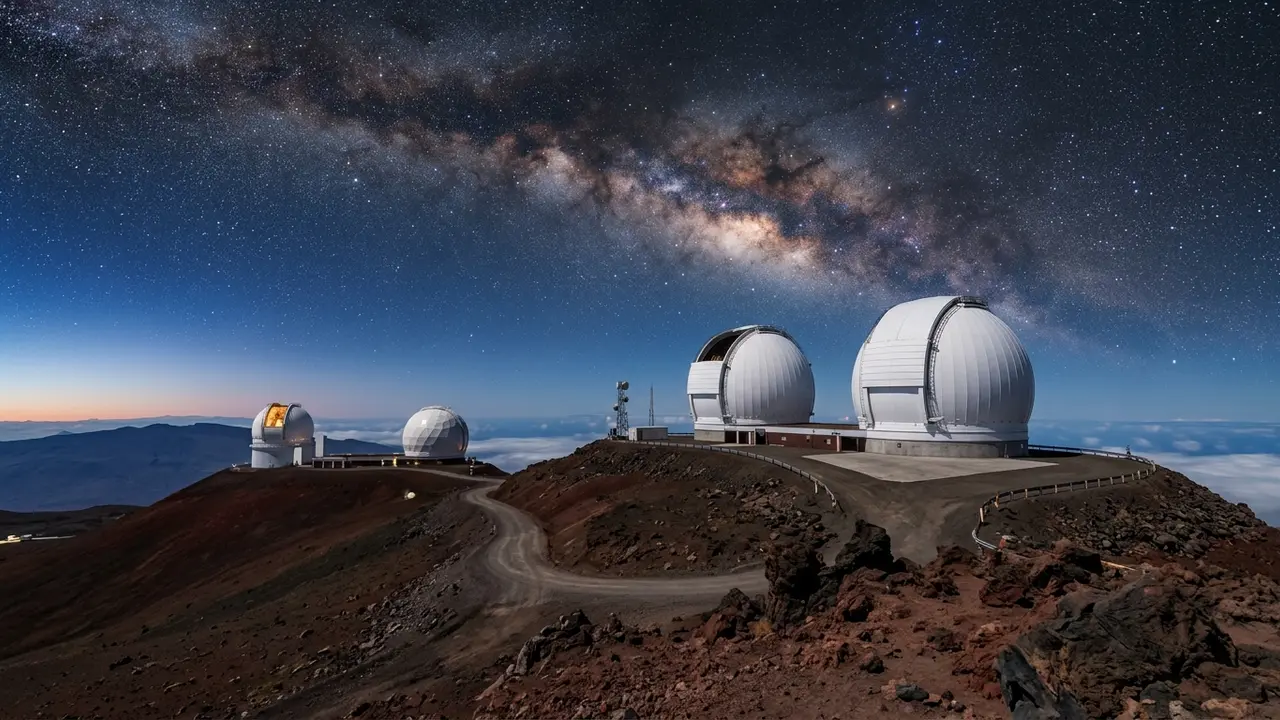

Why this summit sees better than almost anywhere on Earth
Astronomers didn't choose Mauna Kea by accident. The summit tops out at 13,796 feet (4,205 meters)[1] above sea level, higher than nearly every other ground-based observatory site on Earth, and that altitude buys real optical advantage: the summit sits above roughly 40% of the atmosphere[2], leaving most of the water vapor that fogs infrared and submillimeter observations somewhere below the telescope domes rather than in front of them.
Altitude alone doesn't make a great observing site; plenty of tall, cloudy mountains prove that. What sets Mauna Kea apart is what happens in the air above it. The atmosphere there is extremely dry, which is exactly what makes it so good for infrared astronomy[3]. Combine that with the mountain's isolated, smooth volcanic shape, and the turbulent air currents that ruin a night's seeing at rougher sites mostly don't form here. Astronomers found the summit superb for nighttime viewing, thanks to the thin air, steady trade winds, and its position surrounded by open ocean[4]; the technical term is seeing, and Mauna Kea's is about as good as ground-based observing gets, which is exactly why so much adaptive-optics and infrared work happens here instead of at lower, wetter sites.
None of this is subtle to the eye. Drive up past the tree line and the sky doesn't just get darker, it gets still: stars stop flickering the aggressive way they do from a backyard at sea level, because there's simply less turbulent air sitting between your eye and the star.
Above 40%
A sacred mountain, and a contested summit
None of this happens in a cultural vacuum, and an article about Mauna Kea's telescopes owes that fact a place near the top, not a footnote at the bottom. Mauna Kea is sacred in Native Hawaiian religion and culture, and some Native Hawaiian groups have long opposed further summit development as incompatible with that status[5]. Observatories have shared the mountain with that history for more than half a century, and the relationship has never been simple.
That tension is sharpest around the Thirty Meter Telescope (TMT), a planned next-generation instrument that has drawn sustained controversy over its potential cultural and ecological impact[6]. This article won't adjudicate that dispute or guess how it ends, because it hasn't: Mauna Kea's future as a site for new construction remains genuinely contested, not a settled question. For the deeper history behind Mauna a Wākea and what respectful visiting looks like in practice, see Mauna Kea Cultural Significance and Visitor Etiquette.
Featured · Destination
Mauna Kea
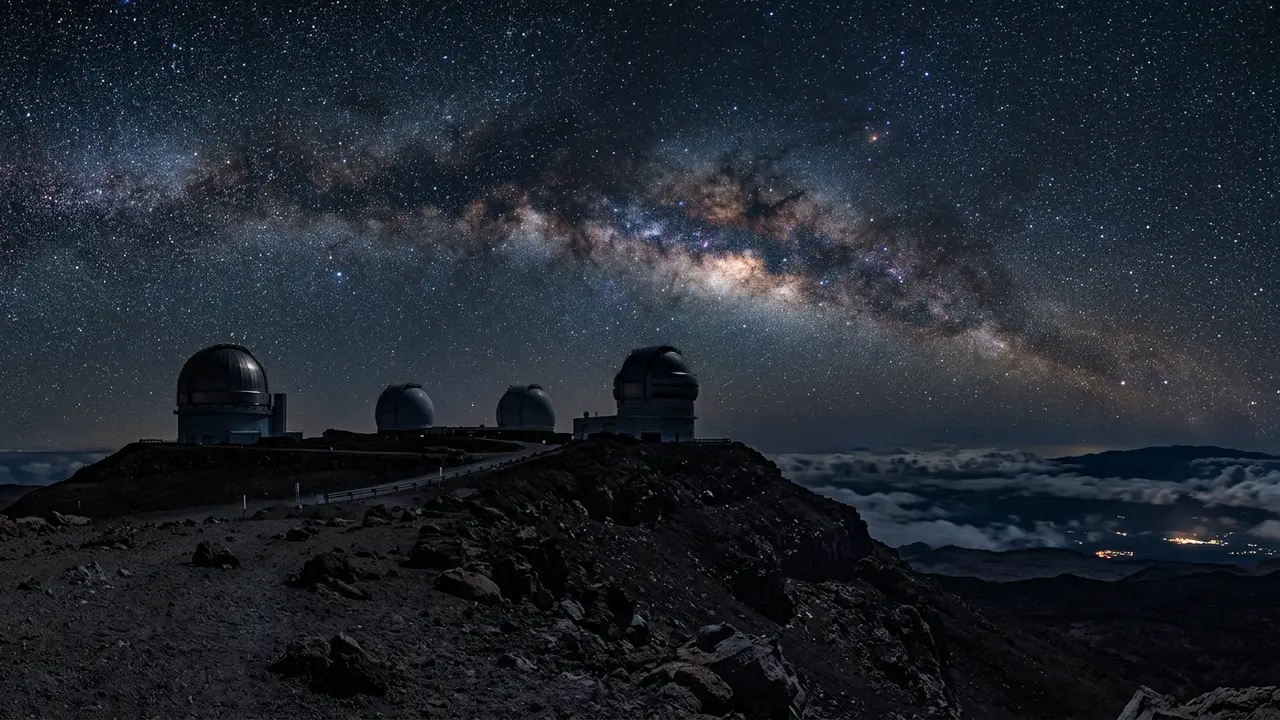
Mauna Kea is sacred to Native Hawaiians and home to world-class observatories. Here's how to plan respectful, safe Mauna Kea stargazing at the Onizuka VIS.
What follows here is deliberately the science and engineering side of the story: what's actually built on the summit, why the site works so well, and who operates it. That's one real half of Mauna Kea. It was never meant to be the whole mountain.
The giants: Keck, Subaru, and Gemini North
Three telescopes do most of the work of explaining why Mauna Kea's name means something to working astronomers, and each approaches the same summit differently.
W. M. Keck Observatory runs twin telescopes, Keck I and Keck II, each with a 10-meter segmented primary mirror[7], among the largest optical/infrared telescopes anywhere on Earth. Their size and Mauna Kea's steady air together make them workhorses for adaptive optics, the technique of correcting starlight in real time for atmospheric blur, and Keck's data has underpinned discoveries ranging from direct exoplanet imaging to tracking stars orbiting the black hole at the center of the Milky Way.
Japan's Subaru Telescope takes a different approach, pairing a single 8.2-meter primary mirror[8] with an unusually wide field of view, letting it survey large patches of sky in one exposure instead of zooming in on a single target. That makes it as useful for cataloguing thousands of distant galaxies as for chasing one faint object.
| Observatory | Aperture | Type |
|---|---|---|
| Keck I & II | 2 x 10 m | Optical/infrared |
| Subaru | 8.2 m | Optical/infrared |
| Gemini North | 8.1 m | Optical/infrared |
| CFHT | 3.6 m | Optical/infrared |
| UKIRT | 3.8 m | Infrared |
| JCMT | 15 m dish | Submillimeter |
| SMA | 8 x 6 m array | Submillimeter |
| IRTF | 3 m | Infrared |
Gemini North, with its 8.1-meter mirror[9], is the northern half of a two-observatory partnership with Gemini South in Chile, built so astronomers with time on one telescope can follow up with the other and cover both hemispheres of sky. It's a quieter kind of engineering choice: not the biggest mirror on the mountain, but part of a design built around global coverage rather than raw aperture.
Between them, these three facilities cluster more large-mirror astronomy onto one summit than almost anywhere else on the planet: a two-story mirror doing exoplanet imaging a short walk from another built purely for wide-field surveys, and a third splitting its nights with a twin telescope on the far side of the world.
Beyond the giants: infrared, submillimeter, and legacy instruments
Not every important instrument on Mauna Kea is chasing the biggest mirror. Several of the summit's most scientifically productive facilities work in wavelengths the human eye can't see at all, and that's mostly the point.
- Canada-France-Hawaii Telescope (CFHT) — a 3.6-meter telescope built after Canada and France agreed to fund it in 1973[10], one of the longer-serving facilities on the mountain and still active in wide-field imaging surveys.
- UK Infrared Telescope (UKIRT) — a 3.8-meter infrared telescope that has been slated for decommissioning[11], a reminder that Mauna Kea's observatory roster isn't fixed; instruments retire as newer technology takes over their science case.
- James Clerk Maxwell Telescope (JCMT) — a 15-meter submillimeter dish[12], tuned to a part of the spectrum between infrared and radio waves that's ideal for studying the cold gas and dust clouds where stars are actually born.
- Submillimeter Array (SMA) — not one dish but an interferometer of eight 6-meter dish antennas[13] working in concert, combining their signals to resolve detail no single dish that size could manage alone.
- NASA Infrared Telescope Facility (IRTF) — a 3-meter instrument operated by the University of Hawai'i's Institute for Astronomy on NASA's behalf[14], historically a workhorse for planetary science, from asteroid characterization to tracking the atmospheres of solar system planets.
This is also work that doesn't produce postcard images. It answers questions optical light physically can't: what a star-forming cloud is made of, how cold dust behaves before it collapses into a planet, what a dust-obscured galaxy actually looks like once you stop trying to see it in visible light.
Professional-grade submillimeter dishes aside, plenty of stargazing on Mauna Kea happens with far more modest gear, lower down the mountain. See where on the mountain to actually look up for where to actually set up a backyard telescope.
Who operates Mauna Kea's observatories
No single agency owns Mauna Kea's telescopes. The summit's observatories sit within the Mauna Kea Science Reserve, and the reserve hosts twelve facilities housing thirteen telescopes[15], a genuinely international roster spanning the United States, Japan, Canada, France, the United Kingdom, and the multiple partner nations behind Gemini North's consortium.
Day-to-day scientific coordination on the mountain runs through the University of Hawai'i's Institute for Astronomy (IfA), which has overseen astronomical operations on the summit since the observatory era began there and continues to operate facilities like the IRTF directly for NASA[14]. That structure, a public university coordinating the science while sovereign governments and international consortia fund and run individual telescopes, is unusual, and it's part of why Mauna Kea reads more like a small international research campus than a single national facility.
None of that funding structure resolves the cultural questions raised earlier. International science partnerships and Native Hawaiian sovereignty concerns aren't opposing arguments that cancel each other out. They're two separate, both true facts about the same mountain, and Mauna Kea's ongoing story is what happens when neither one goes away.
Featured · Article
What Is Light Pollution? Definition, Types, and Solutions
Light pollution is artificial light brightening the night sky, affecting 80% of the world. Learn the 4 types, wildlife and health effects, and how to fix it.
Can you visit? What to actually book
Almost none of what's described above is open to casual visitors, and that's by design. Keck, Subaru, Gemini North, and the summit's other research facilities are working observatories, not tourist attractions, and general public access to the true summit is limited and altitude-restricted, and not where most travelers should be aiming anyway.
What is genuinely open, and built for exactly this purpose, is the Visitor Information Station, sitting several thousand feet below the summit on the access road. It's where casual stargazers actually go for free evening programs, working telescopes, and staff who can talk through both the science on the mountain above and its cultural context. The Onizuka Center Visitor Station Program covers what a typical evening there looks like.
For the trip-planning questions this article has deliberately left aside, when to go, what to pack, how moon phase changes what you'll see, see Mauna Kea Stargazing and Best Time for Mauna Kea Stargazing. And if you're weighing Mauna Kea against a very different kind of dark-sky destination, Mauna Kea vs. Big Bend for Stargazing covers that comparison in full; it isn't one this article is trying to make. Long before any dome stood on that summit, Native Hawaiian navigators were already reading the same stars without a single instrument; see Hawaiian star navigation and wayfinding for how that tradition worked.
The telescopes up there will keep doing what they've done for decades: catching light that never reaches sea level clearly, from a mountain that means something entirely different depending on who's standing on it.