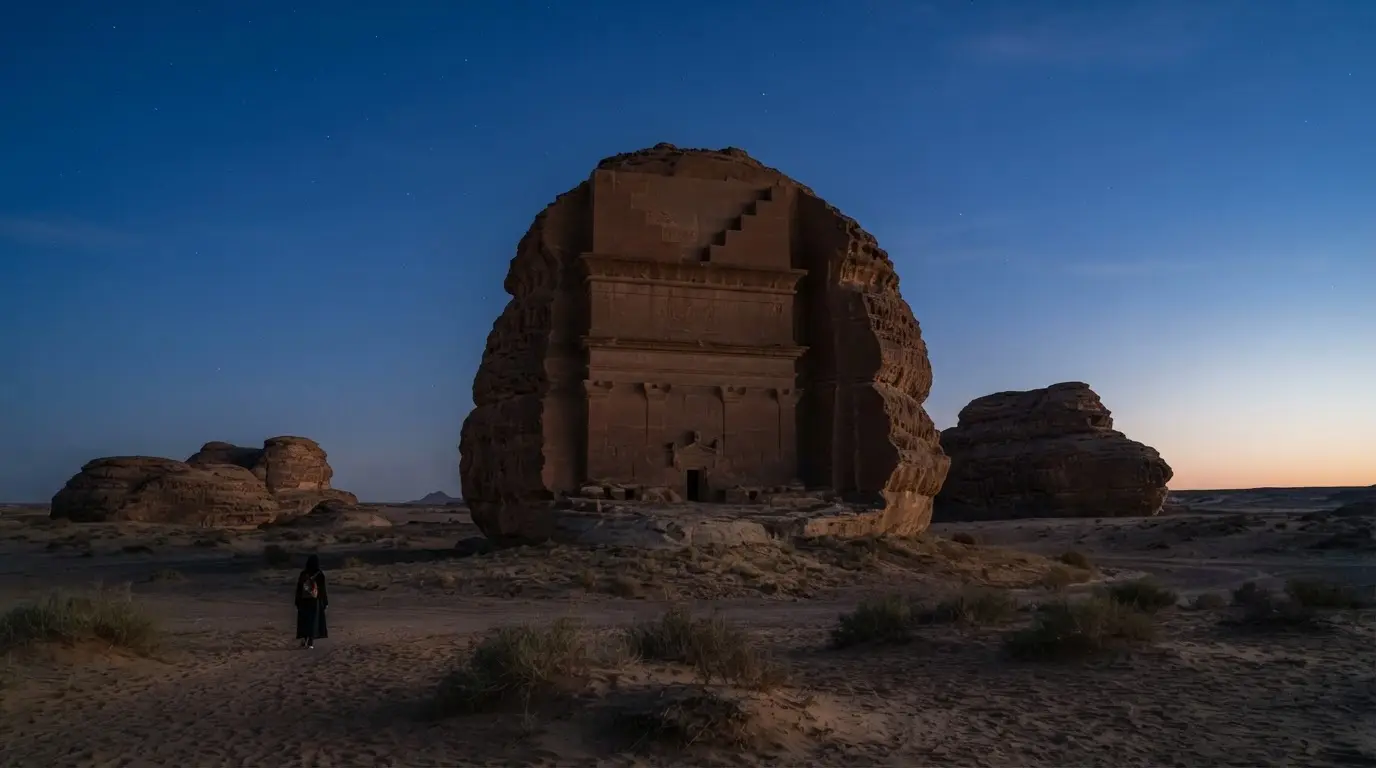
Charles Doughty at Hegra: AlUla's First European Scholar
I've seen dark skies firsthand in the Atacama altiplano, Namibia's NamibRand Nature Reserve, and Morocco's Merzouga dunes; every other destination I write about is built from measured Bortle and SQM data, cloud climatology, and primary sources like park services and the International Dark-Sky Association.
- Doughty's stay at the site
- 2 months
- He waited for the pilgrim caravan to return, copying inscriptions[19]
In this article
Jump to a section
A Christian riding with the hajj
Two months waiting at Mada'in Salih
What the copied inscriptions proved
Featured · Destination
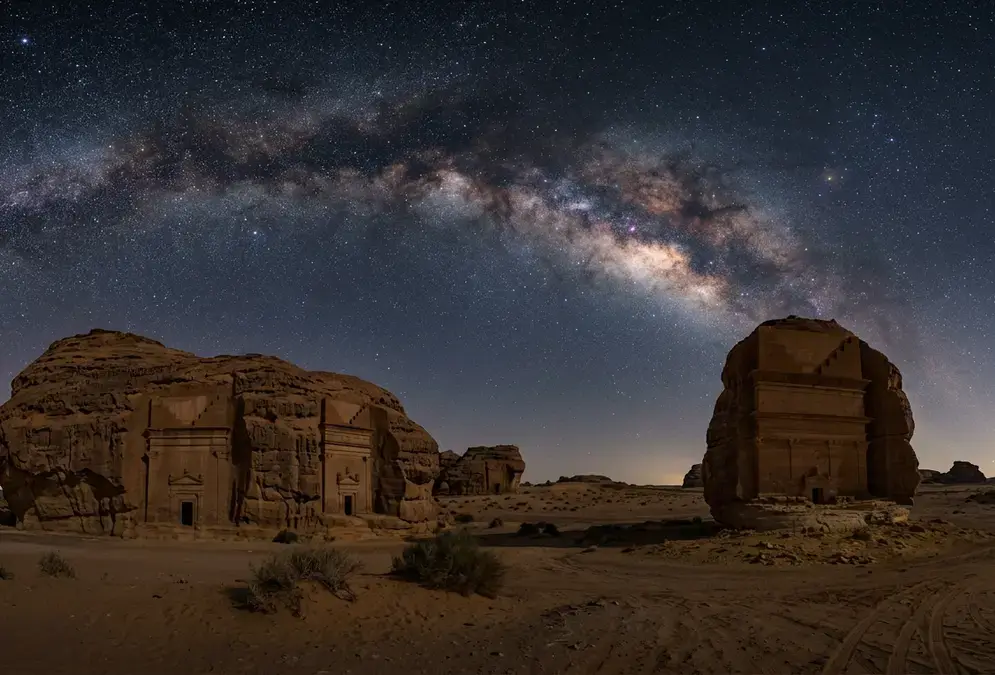
AlUla Stargazing
Stargaze above Hegra's 2,000-year-old Nabataean tombs in AlUla, the Gulf's first DarkSky-accredited Dark Sky Park. When to go, where to stay, and how to plan.
Huber, Euting and the Dominicans
Featured · Article
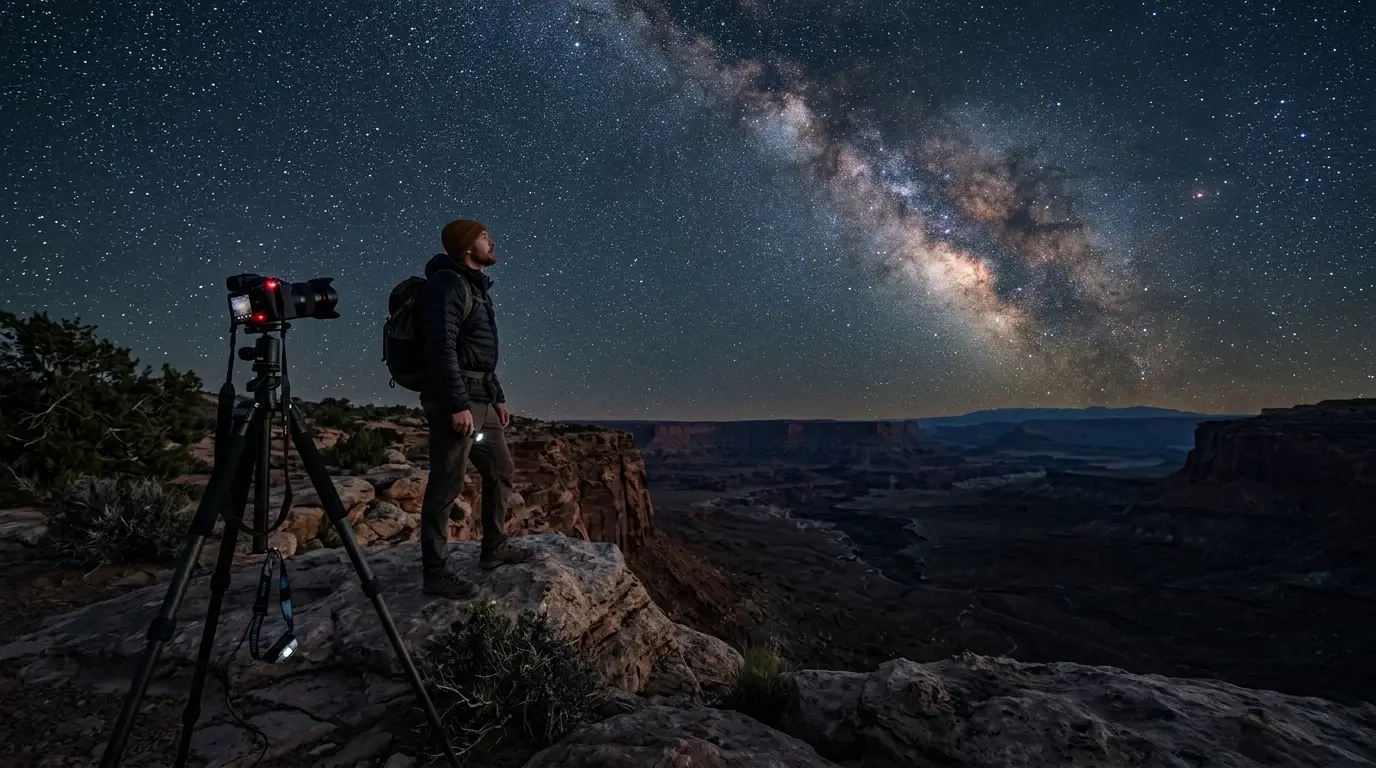
What Is Astrotourism? The Complete Beginner's Guide
Astrotourism means travel built around dark skies: meteor showers, auroras, the Milky Way. What it means, where to go, and how to plan your first trip.
From caravan stop to Dark Sky Park
Recommended tours
Tours are selected for quality, not commission. I earn a small fee if you book — at no extra cost to you.
Frequently asked questions
Who was Charles Doughty?
When did Charles Doughty visit Hegra?
Was Charles Doughty the first European at Hegra?
What is Travels in Arabia Deserta?
Who explored Hegra after Doughty?
How does Charles Doughty's visit fit into Hegra's AlUla history?
Can you stargaze at Hegra today?
Sources
48 references Show Hide
- Legado Andalusí, Charles Doughty: an extreme traveller in the heart of Arabia (opens in a new tab)
“He left Damascus on Thursday 10 November 1876”
- Aramco World, The Obstinate Mr. Doughty (1969) (opens in a new tab)
“he hoped to remain under the protection of the caravan—6,000 men, more than 12,000 camels—as far as Mada'in Salih”
- Aramco World, The Obstinate Mr. Doughty (1969) (opens in a new tab)
“suddenly he thirsted to be the first man to record the forgotten city's mysteries.”
- Hegra Conservation Project, The history of Hegra (opens in a new tab)
“Despite this, its position along the pilgrimage route to Mecca ensured it retained a residual role as a stopover for pilgrim caravans”
- Barnaby Rogerson, review of Doughty (opens in a new tab)
“Thus he was the first European scholar to visit Medina Salih and his record of the inscriptions that he found, positively identified this 'lost city' of the Nabateans”
- Aramco World, The Obstinate Mr. Doughty (1969) (opens in a new tab)
“He returned to Damascus, spent eight months there in intensive study of Arabic.”
- Encyclopaedia Britannica, Charles Montagu Doughty (opens in a new tab)
“He began his journey to northwestern Arabia at Damascus in 1876 and proceeded southward with pilgrims headed for the hajj at Mecca as far as Madāʾin Ṣāliḥ.”
- Doughty, Travels in Arabia Deserta, vol. 1 (T. E. Lawrence introduction) (opens in a new tab)
“Doughty was a pioneer, both as European and Christian, in nearly all the districts he entered.”
- Legado Andalusí, Charles Doughty: an extreme traveller in the heart of Arabia (opens in a new tab)
“He suffered terribly from the lack of support from the British consulate, and subsequently the Turkish authorities refused to grant him safe conduct.”
- Legado Andalusí, Charles Doughty: an extreme traveller in the heart of Arabia (opens in a new tab)
“he intended to follow the Hajj caravan (pilgrimage to Mecca) without his Turkish commander being aware of it, and without concealing the fact that he was a Christian and a stranger.”
- Doughty, Travels in Arabia Deserta, vol. 1 (opens in a new tab)
“I went only to the Kurdish Pasha of the Haj, Mohammed”
- Doughty, Travels in Arabia Deserta, vol. 1 (opens in a new tab)
“then to bring a firman of the Sultan, saying, ' The hajjaj”
- Doughty, Travels in Arabia Deserta, vol. 1 (opens in a new tab)
“This may be told to-morrow in the ears of the Pasha ; then”
- Doughty, Travels in Arabia Deserta, vol. 1 (preface) (opens in a new tab)
“Arrived at the place, after three weeks' tedious riding, amongst that often clamorous, mixed and in their religion devout pilgrim-multitude”
- Doughty, Travels in Arabia Deserta, vol. 1 (opens in a new tab)
“Hamra, where is commonly none. For there is also but a”
- Doughty, Travels in Arabia Deserta, vol. 1 (opens in a new tab)
“In such continuous marching, 150 long miles, many of the wayworn people die.”
- Doughty, Travels in Arabia Deserta, vol. 1 (opens in a new tab)
“At ten o'clock of the starry night we set forth, and rode descending in a deep ground with cliffs, till two in the morning”
- Doughty, Travels in Arabia Deserta, vol. 1 (opens in a new tab)
“the next station is that fabulous Medain Salih, which I was come from far countries to seek in Arabia.”
- Arab News, AlUla (opens in a new tab)
“Doughty lingered at the site for two whole months, awaiting the return of the pilgrimage caravan, visiting the monuments and carefully recording many of the ancient inscriptions on the site.”
- Doughty, Travels in Arabia Deserta, vol. 1 (opens in a new tab)
“As the Arabs were accustomed to the Nasrany I began to wander alone, in all the site of Medain Salih.”
- Barnaby Rogerson, review of Doughty (opens in a new tab)
“To this end he travelled with a stack of blotting paper to make squinches of the inscriptions”
- Doughty, Travels in Arabia Deserta, vol. 1 (opens in a new tab)
“We were come last to the Mahal el-Mejlis or senate house, here”
- Doughty, Travels in Arabia Deserta, vol. 1 (opens in a new tab)
“the face of a single crag is hewn to a vast monument more than forty feet wide, of a solemn agreeable simplicity.”
- Doughty, Travels in Arabia Deserta, vol. 1 (opens in a new tab)
“The bright night shone about us very cold, and half numbed we could not sleep ; before morning I found but 38° F.”
- Euting, Nabataean inscriptions (archive.org text) (opens in a new tab)
“dem Engländer Charles M. Doughty, der unter grossen Mühsalen 1876 — 78”
- Euting, Nabataean inscriptions (archive.org text) (opens in a new tab)
“Documents epigraphiques recueillis dans le Nord de l’Arabie par M. Charles Doughty [publ.”
- In Libris, Doughty, Documents épigraphiques (1884) (opens in a new tab)
“Paris, Imprimerie nationale, 1884.”
- Encyclopaedia Britannica, Charles Montagu Doughty (opens in a new tab)
“There he studied monuments and inscriptions left by the ancient Nabataean civilization. His observations were published by Ernest Renan.”
- In Libris, Doughty, Documents épigraphiques (1884) (opens in a new tab)
“Renan wrote the preface and supervised the publication of Doughty's work in Paris.”
- In Libris, Doughty, Documents épigraphiques (1884) (opens in a new tab)
“With 57 plates, mostly heliographed, of archaeological inscriptions, sites and maps, 9 folding.”
- Wikipedia, Nabataean inscriptions (opens in a new tab)
“Funerary inscriptions are among the most significant, especially those from Hegra (Mada'in Salih), which include dated tomb inscriptions referring to Nabataean kings”
- Doughty, Travels in Arabia Deserta, vol. 1 (T. E. Lawrence introduction) (opens in a new tab)
“Doughty' s collections of these primitive Arab scripts have been surpassed ; but he holds the enduring credit of their discovery.”
- Doughty, Travels in Arabia Deserta, vol. 1 (opens in a new tab)
“Little remains of the old civil generations of el-Hejr, the caravan city ; her clay-built streets are again the blown dust in the wilderness.”
- Barnaby Rogerson, review of Doughty (opens in a new tab)
“The Travels would take Doughty nine years to write”
- Encyclopaedia Britannica, Charles Montagu Doughty (opens in a new tab)
“Eventually, however, the book came to be regarded as a masterpiece of travel writing, and it was still being published in the early 21st century.”
- Doughty, Travels in Arabia Deserta, vol. 1 (T. E. Lawrence introduction) (opens in a new tab)
“a book not like other books, but something particular, a bible of its kind.”
- Wikipedia, Charles Montagu Doughty (opens in a new tab)
“He was awarded the 1912 Royal Geographical Society's Founder's Medal for his travels and writings.”
- IAS Arabia, High Jinks in Arabia: Julius Euting's epigraphic adventure (opens in a new tab)
“he set out from Damascus in 1883 with the French-Alsatian explorer, Charles Huber, on a dangerous expedition into the deserts of northern Arabia in quest of ancient inscriptions and graffiti.”
- Euting, Nabataean inscriptions (archive.org text) (opens in a new tab)
“NB.! 3 Mann Besatzung enthält) 10 Tage blokirt blieb, bis er durch mich, als”
- Euting, Nabataean inscriptions (archive.org text) (opens in a new tab)
“hatte (26. — 28. März 1884), während Doughty ungefähr ebensoviel Monate an”
- Euting, Nabataean inscriptions (archive.org text) (opens in a new tab)
“theil der Reise zusammengewesen war, und der leider im Juli 1884 ein Opfer”
- IAS Arabia, High Jinks in Arabia: Julius Euting's epigraphic adventure (opens in a new tab)
“It is a travel account that entitles Euting to a place, with Doughty and Huber, as one of the founding fathers of Saudi Arabian archaeology.”
- CNRS News (opens in a new tab)
“Antonin Jaussen and Raphaël Savignac, two Dominican priests from the French Biblical and Archaeological School of Jerusalem.”
- Jaussen and Savignac, Mission archéologique en Arabie, vol. 1 (opens in a new tab)
“Le dimanche 17 mars 1907, nous quittions Jérusalem dans l'après-midi”
- Clio, dossier on Madain Salih (opens in a new tab)
“les expéditions scientifiques menées entre 1907 et 1910 par Antonin Jaussen et Raphaël Savignac, pères dominicains de l’École biblique et archéologique française de Jérusalem”
- UNESCO World Heritage Centre, Al-Hijr Archaeological Site (Madâin Sâlih) (opens in a new tab)
“is the first World Heritage property to be inscribed in Saudi Arabia.”
- Arab News, Saudi Arabia's desert night skies (opens in a new tab)
“In October 2024, AlUla Manara and Gharameel Nature Reserve, two key protected areas covering a total of 2,334 sq. km, were formally designated as an International Dark Sky Park.”
- Arab News, Saudi Arabia's desert night skies (opens in a new tab)
“This certification, awarded by the organization DarkSky International, was a first for the Gulf region.”