Four brothers, one sky father, several tellings
Start with the family, where the accounts first part. Te Taumutu Rūnanga names Aoraki, Rakirua, Rakiroa and Rarakiroa as the sons of Ranginui and Pokoharuatepō[3]. Te Karaka, Ngāi Tahu's magazine, calls Aoraki the eldest son of Raki[6]. Raki is the southern dialect form of Rangi[7], so both accounts name the same sky father.
Tā Tipene O'Regan's recital, transcribed in a Ngāi Tahu teaching resource, says Aoraki was the son of Rakinui's first wife[8]. A whakapapa from Matiaha Tiramōrehu, as published in 1997, opens with Aoraki as the first child[9], which reads as a different framing from the four-brothers account.
None of this is confusion. Ngāi Tahu's own teaching resource describes its animation, built on Tiramōrehu's whakapapa, as presenting "a version of one of the Ngāi Tahu creation stories"[10]. Arowhenua adds that the tradition is central to the Waitaha, Rapuwai, Kāti Hawea, Kāti Mamoe and Kāi Tahu tribes[11]. Several peoples carried it, and they did not carry it identically.
For how the iwi read the night sky itself, see Ngāi Tahu star lore at Aoraki Mackenzie. This piece stays with the mountain.
The descent, the wreck and three causes
In Te Taumutu's account the brothers board Te Waka o Aoraki and travel down through the heavens[12]. Te Karaka gives the motive in another form: Aoraki and his brothers could not separate their father from his new love, and chose to return to the heavens, to their own mother Pokoharua-te-pō[13].
The wreck is where the tellings diverge most. Three accounts, three causes:
Only O'Regan's recital names the rock alone as the cause. Te Taumutu and Arowhenua put the failure inside the canoe, in a leader's concentration or nerve. Te Karaka's account reaches the same rock[17], and I claim no cause for it beyond that. I would not rank the others.
Stone, and what became of the wreck
Centuries pass. The upturned canoe petrifies and the brothers turn to stone, Aoraki tallest[1]. Te Karaka adds the detail that their hair turned white, and that they became the highest peaks of Kā Tiritiri o te Moana, the Southern Alps[17].
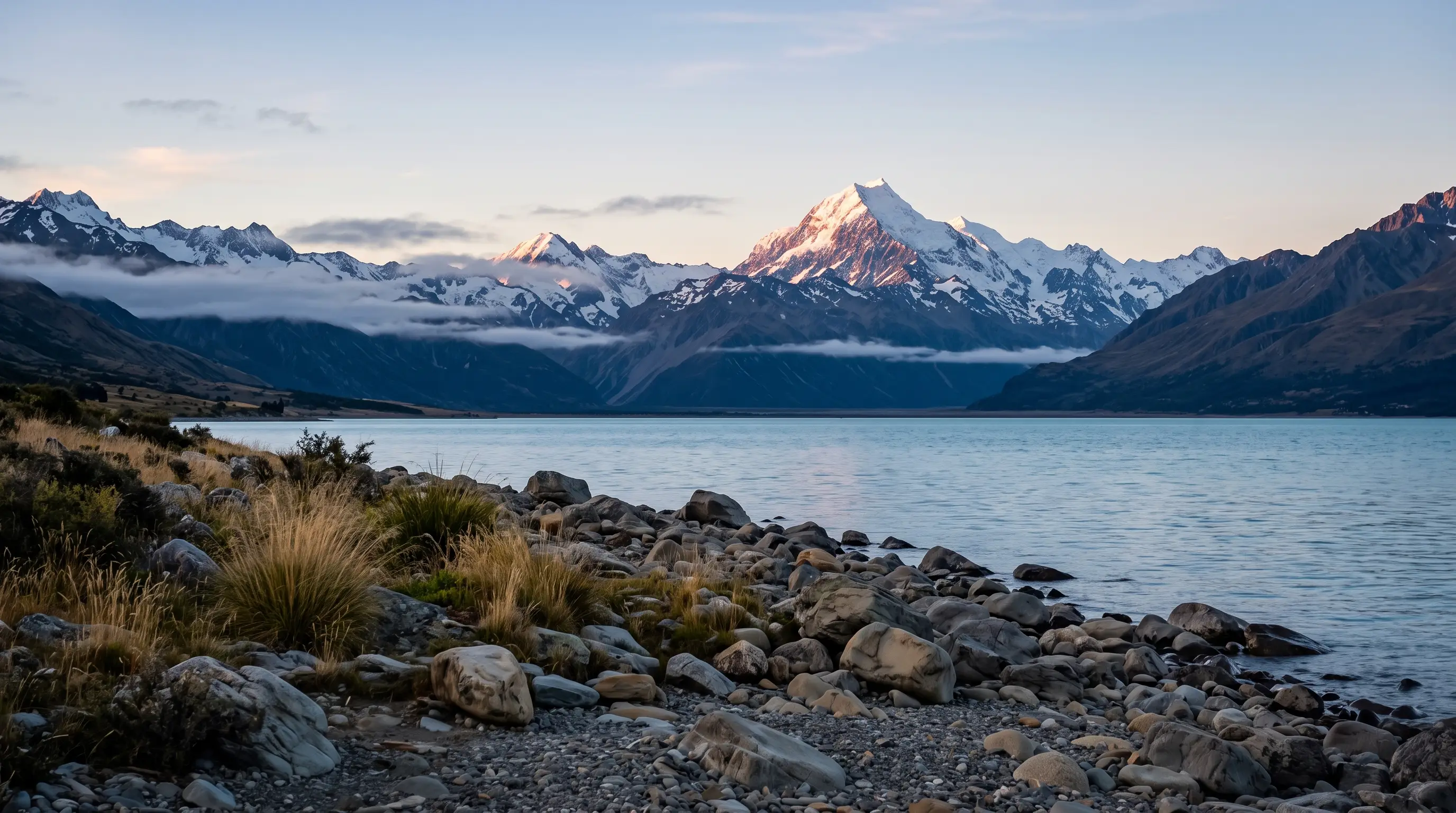
For Arowhenua they are the first mountains in New Zealand[19]. Te Taumutu records the later names: the canoe is now the South Island, Rakirua, Rakiroa and Rarakiroa are Mount Teichelmann, Mount Dampier and Mount Tasman, and Aoraki is Mount Cook[20].
Featured · Destination
Aoraki Mackenzie Stargazing
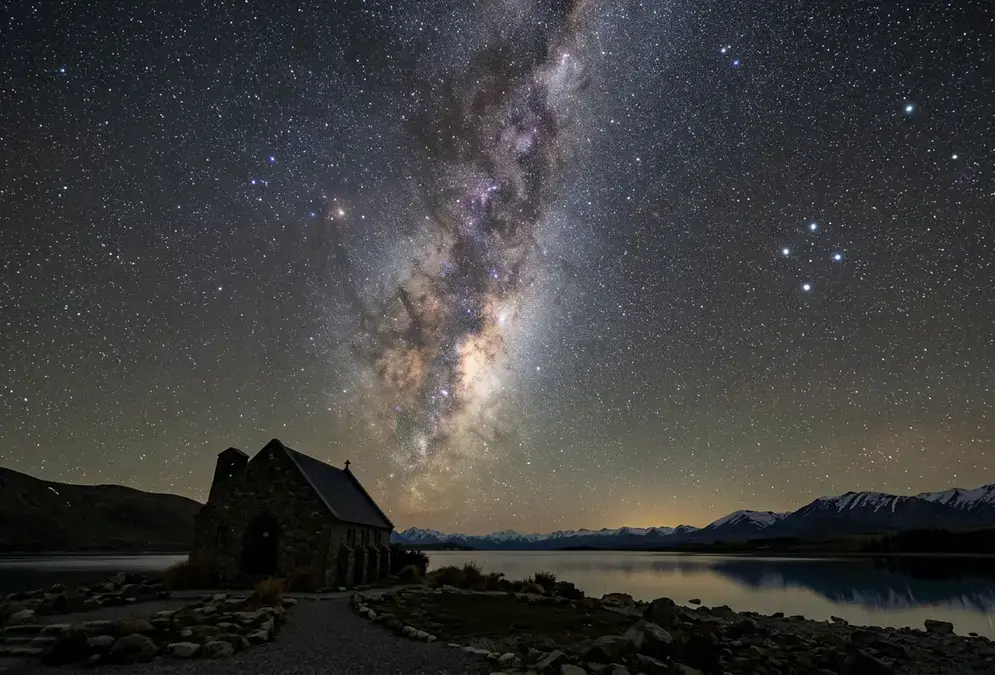
Aoraki Mackenzie is one of only four Gold Tier Dark Sky Reserves on Earth: Bortle 2 skies over Lake Tekapo, the Southern Cross, and Mount John Observatory tour.
The park is reached along SH80, which ends at a very small alpine village inside it[21]. DOC says Kea Point's viewing deck looks out to Mount Sefton, The Footstool and Aoraki / Mount Cook[22], and the Hooker Valley Track leads to Hooker Lake at the mountain's foot[23]. The Tasman Glacier View Track also gives Aoraki / Mount Cook on a clear day[24], after a steep climb of 300+ steps[25].
Who reshaped the wreck
Te Taumutu says Ranginui sent three mokopuna, Tūterakiwhanoa, Marokura and Kahukura, down from the heavens to transform the broken waka[26]. The raked-together pieces of the wreck are now Te Pātaka o Rākaihautū, Banks Peninsula, and the shallows beside them Te Waihora[27]. Marokura carved bays and estuaries and stocked them with fish[28].
The story did not end with the shaping. At Te Taumutu, the spiritual essence of Tūterakiwhanoa still resides in Te Waihora[29].
O'Regan's recital gives the work to someone else: Aoraki's grandson, Tū te Rakiwhanoa, who came and shaped the land[30]. The spelling of that name drifts between sources, so I keep each source's form.
Arowhenua points north: the smashed prow of the waka survives as the islands and deep sounds at the top of the South Island[31]. Rākaihautū's lake-making is a separate tradition, in the Geographic Board's account naming the lakes of Te Waka a Aoraki, the canoe of Aoraki, meaning the South Island[32]. I treat it as a companion, not another version.
An ancestor, not a landmark
DOC calls Aoraki "the most sacred of ancestors" to Ngāi Tahu, the one from whom the iwi descend[33]. That changes what a first-time visitor is looking at.
The mountain also holds Tōpuni status, which DOC describes as a public symbol of Ngāi Tahu manawhenua and rangatiratanga[34]. Arowhenua says that, largely on this basis and as the principal marae in the region, Kāti Huirapa and Arowhenua people act as kaitiaki, guardians, for Aoraki and the land around it[35].
A whakataukī quoted in Te Karaka puts the permanence in one line: "The people will perish but the mountains shall remain."[36]
Featured · Article
What Is Light Pollution? Definition, Types, and Solutions
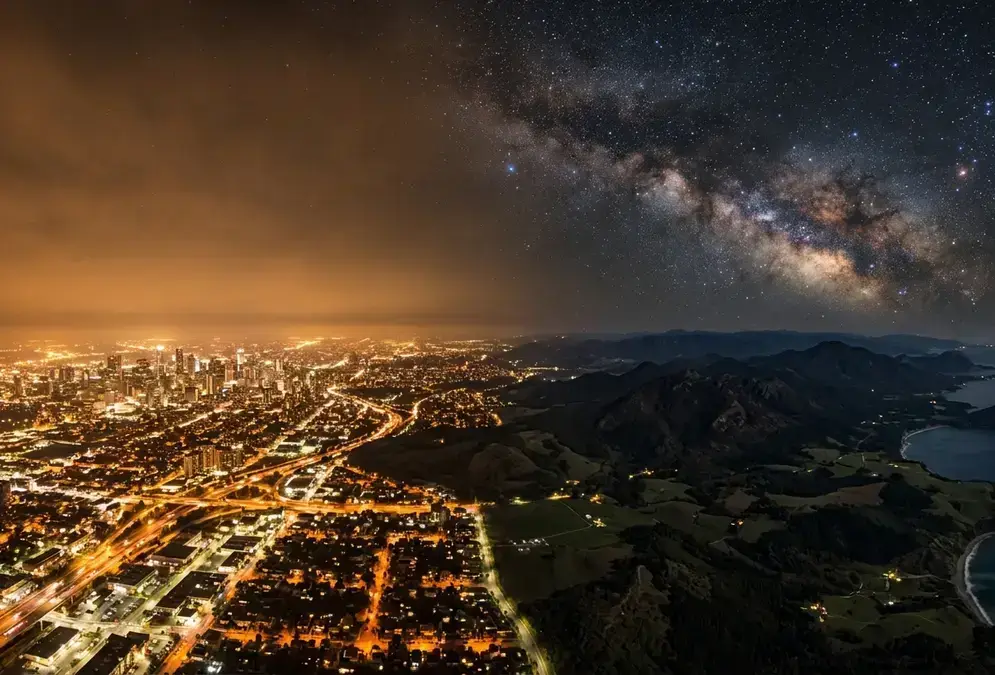
Light pollution is artificial light brightening the night sky, affecting 80% of the world. Learn the 4 types, wildlife and health effects, and how to fix it.
Recommended tours
Tours are selected for quality, not commission. I earn a small fee if you book — at no extra cost to you.
The climbing question has a precise answer, and nothing I found calls it a ban. DOC records the Ngāi Tahu belief about the head of an ancestor[2], while also describing the park as a top mountaineering area for novices and experts[37]. ClimbNZ says climbers are asked to respect Ngāi Tahu's wishes by not standing on the very top[38]. The 1894 first ascent[4] belongs to mountaineering history, and DOC prints both on the same page.
DOC sets other conduct for the park: recreational drones are not allowed anywhere in it[39], and leaving waste, human waste included, is unacceptable to Ngāi Tahu because the waters flowing from Aoraki are sacred[40]. Other places ask visitors a similar question; Uluru's cultural significance and visitor etiquette works through one.
Where the story meets the dark-sky reserve
The reserve is how many travellers meet this story. It was designated in 2012 and was the first to reach Gold Tier[5]. It sits in the centre of the South Island, in the place known as Te Manahuna, the Mackenzie Basin[41], and Ngāi Tahu puts the number of manuhiri a year at more than 45,000 for star gazing tours on Ōtehīwai (Mount John) and other digital and outdoor experiences[42].
Why the reserve carries the mountain's name beside the basin's, I could not establish; no source I found states it. What the record does show is Ngāi Tahu involvement in the visitor story. Ngāi Tahu's own account names Tewera King of Arowhenua and Waihao and David Higgins of Moeraki among the whānau who shared ancestral stories with the project[43]. The Aoraki Mackenzie stargazing destination page covers the reserve itself.
On retelling, Ngāi Tahu's teaching resource says to use and uplift Ngāi Tahu sources as the primary information source[44]. I found no formal iwi page setting out rules for retelling, so I have done the narrower thing: attributed each detail and invented none.
“If you must bow your head, then let it be to a lofty mountain.[45]”
For the night itself, dark sky etiquette covers lights and manners, and the southern sky stargazing guide for Aoraki covers what is overhead. For daytime, see what to do in Aoraki Mackenzie beyond stargazing.