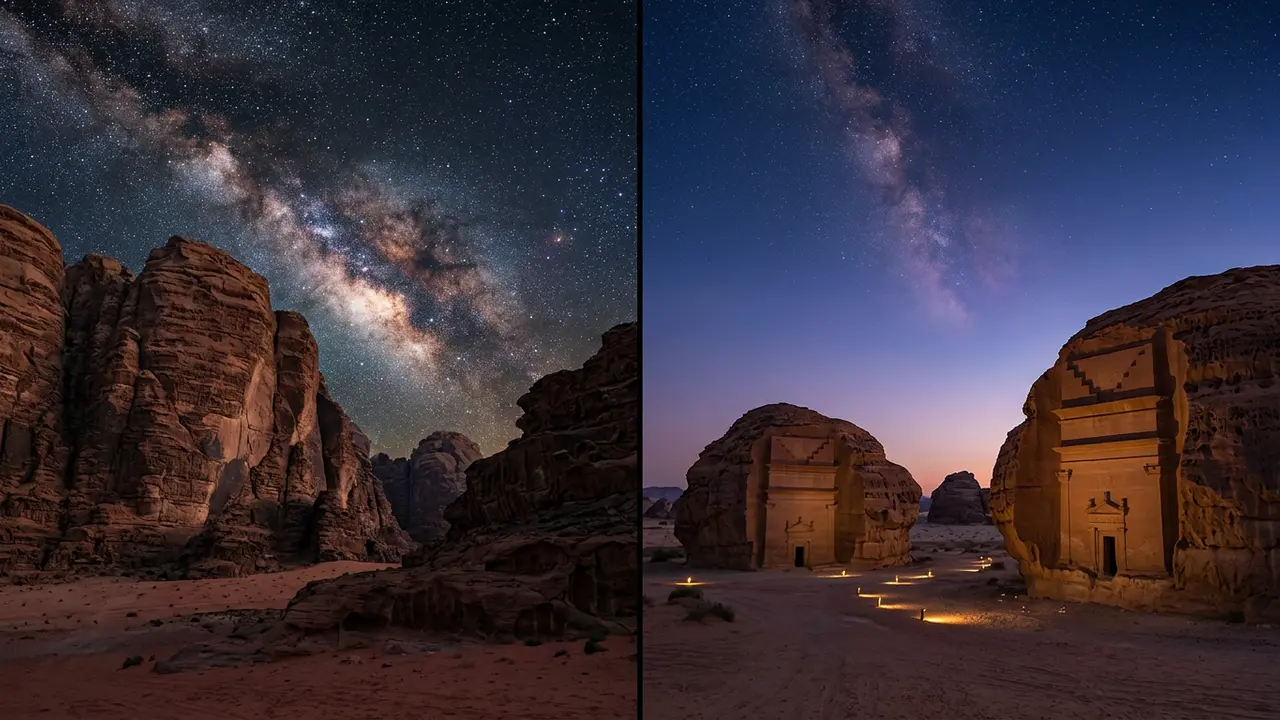

UNESCO Status: Two Very Different Kinds of World Heritage
Wadi Rum and AlUla both carry serious heritage credentials, but they're not the same credential, and confusing them muddies an otherwise clean comparison. Wadi Rum Protected Area was inscribed as a UNESCO World Heritage Site in 2011 as a mixed site, recognized for both its natural rock-desert landscape and its cultural record of ancient camps, inscriptions, and caravan routes[1]. Mixed sites are rare: most UNESCO listings worldwide qualify on natural or cultural grounds alone, not both at once. For the full breakdown of what that designation does and doesn't cover, see the UNESCO status explainer.
AlUla's flagship listing works differently. Hegra, the Nabataean necropolis roughly an hour from AlUla town, became Saudi Arabia's first UNESCO World Heritage Site in 2008[2], inscribed purely on cultural grounds. It's the largest conserved Nabataean settlement outside Petra, a sister city carved from the same rose-tinted sandstone by the same Arabian trading empire two thousand years ago. Neither designation says a word about how dark either sky gets after sunset. That part of the story starts below.
| Designation | Wadi Rum | AlUla / Hegra |
|---|---|---|
| UNESCO type | Mixed (natural + cultural), 2011 | Cultural only, Hegra inscribed 2008 |
| What it recognizes | Rock-desert landscape plus ancient inscriptions and trade routes | Nabataean tombs and hydraulic engineering |
| Rank in-country | Jordan's iconic wilderness UNESCO site | Saudi Arabia's first-ever UNESCO listing |
Grassroots Bedouin Camps vs a Royal Commission Mega-Project
Ask who actually runs tourism in each place and the contrast sharpens fast. Wadi Rum's camps are mostly run by the Zalabieh Bedouin community, who settled the valley around 1980 and still make up the majority of Rum Village today[3]. Book a night in Wadi Rum stargazing territory and you're usually paying a family, or a small cooperative built from a handful of them, directly for a goat-hair tent, a fire, and a jeep route they've run for two generations.
AlUla runs on the opposite model. Its astrotourism push comes from the Royal Commission for AlUla, part of Saudi Arabia's Vision 2030 plan to build an entire tourism sector from close to nothing. The centerpiece is Manara, an astrotourism observatory and visitor center commissioned by the Royal Commission after an international design competition won by Heatherwick Studio[4]. This isn't a family adding a second tent. It's a state-funded architectural project, with a planetarium and rooftop observation deck, built specifically to put AlUla on the astrotourism map.
Neither model wins outright. One gives you decades of lived-in hospitality and a genuinely bookable, budget-flexible range of camps. The other gives you a government committing serious capital to dark skies as a tourism product, with resources Wadi Rum's Bedouin cooperatives simply don't have. What your money buys looks completely different depending on which one you pick.
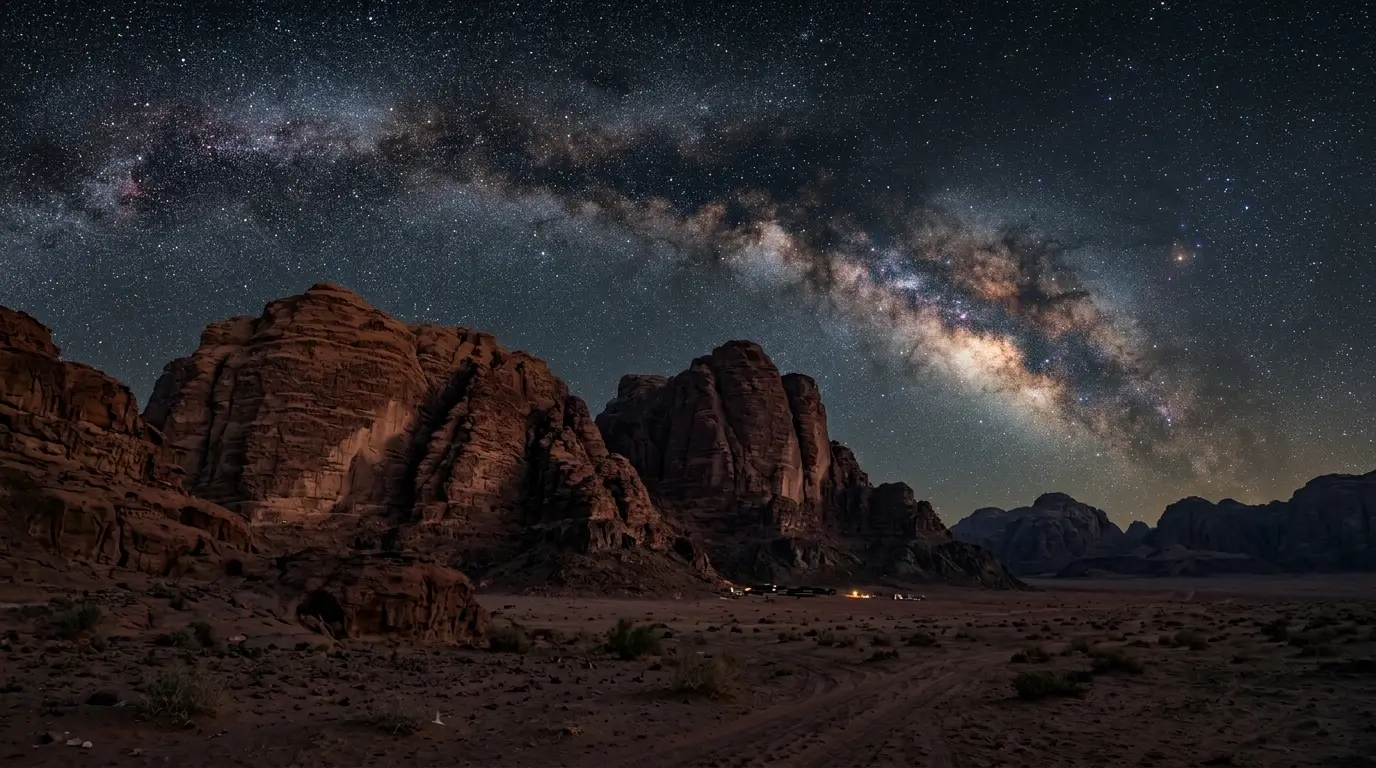
Featured · Destination
Wadi Rum
See the Wadi Rum night sky from a Zalabieh Bedouin camp in Jordan's UNESCO desert: bare tents to glass domes, Bortle 2-3 skies, and year-round stargazing.
Hollywood Mars vs Two-Thousand-Year-Old Tombs
Most travelers already know Wadi Rum's name before they book anything, and it's rarely because of astronomy. Lawrence of Arabia's 1962 desert scenes, filmed in this valley, are widely credited with kick-starting Jordan's entire tourism industry[5], and the association never really faded. More than fifty years later, Ridley Scott shot The Martian in the same red-rock valley, using Wadi Rum's landscape as a stand-in for the surface of Mars. See the same rock walls in Best Stargazing Spots in Wadi Rum and you'll recognize them instantly from either film.
AlUla's fame runs on a completely different clock. Its draw is Hegra, with 111 monumental tombs (94 of them carved with decorated facades) hollowed from sandstone cliffs by Nabataean engineers who also mastered desert water management[6]. There's no blockbuster attached to this one. What Hegra offers instead is depth: two thousand years of continuous archaeological record, a sister city to Petra that most travelers only discover once they start researching AlUla specifically.
That's a genuine difference in why someone ends up choosing one destination over the other. Wadi Rum sells itself through pop-culture recognition built over sixty years; AlUla sells itself through archaeological weight most visitors are only now discovering. Neither hook is shallow. They're just different reasons to book a flight, and knowing which one is pulling you matters when you're deciding what the trip's real highlight will be.
Which Sky Is Officially Dark? AlUla's New Certification vs Wadi Rum's Proven Fame
On paper, AlUla now holds the stronger dark-sky credential. On October 3, 2024, it became the first International Dark Sky Park in the Gulf Cooperation Council region, certified by DarkSky International[7]. That's a real, dated, third-party audit, the kind of paperwork astrophotographers and Bortle-scale purists can point to with confidence. The Manara visitor center sits inside that certified zone, with exhibition space, a planetarium, a restaurant, and a rooftop observation deck built specifically to take advantage of it[8].
Recommended tours
Tours are selected for quality, not commission. I earn a small fee if you book — at no extra cost to you.
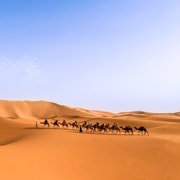

Wadi Rum holds no equivalent formal dark-sky designation, and it's worth being straightforward about that rather than glossing over it. What Wadi Rum has instead is a night sky already proven camera-ready at a scale AlUla hasn't matched yet: it stood in for the surface of Mars in The Martian, with filming beginning in March 2015[9], precisely because its darkness and rock formations read as otherworldly on screen without digital help. No certificate did that. The valley's genuine remoteness did.
Oct 3, 2024
Here's the honest read: AlUla can prove its darkness with paperwork. Wadi Rum has been proving it on camera for decades. Neither claim is fake, but they're answering slightly different questions, one about measured light pollution, the other about what the sky actually looks like once you're standing under it.
Access, Visas, and Which One Should You Book
Logistics separate these two destinations almost as much as their skies do, and it's worth weighing before you commit. Jordan is generally simple to enter for most Western travelers, and Wadi Rum sits a short hop from Aqaba or Petra, easy to fold into an existing Jordan itinerary. Saudi Arabia issues tourist entry through an online eVisa system, straightforward but requiring advance planning, and AlUla itself takes a longer domestic transfer once you've landed, since it isn't yet served by the same volume of direct international flights. Confirm current visa rules for both countries directly with official sources before you book; requirements shift, and neither destination is somewhere you want to discover a documentation problem at the airport.
Cost follows the same split as everything else here. Wadi Rum's Bedouin-run camps span a genuinely wide budget range, from simple shared tents to higher-end glamping. AlUla, backed by Royal Commission investment, skews toward resort-model, higher-cost stays tied to its broader development plan. Neither is universally cheaper, but the pricing pressure differs between the two markets.
Book Wadi Rum If...
You want budget flexibility, direct Bedouin-run hospitality, and a valley whose fame you've already seen on screen. It fits easily into a wider Jordan trip built around Petra and Aqaba, and it rewards travelers happy with a night under natural, unaudited darkness rather than a certified one. Check Best Time to Visit Wadi Rum for Stargazing before you pick a date, since moon phase and season both move the odds, and see Getting to Wadi Rum for the practical route in.
Book AlUla If...
You want a documented Dark Sky Park credential, purpose-built astrotourism infrastructure like the Manara observatory, and don't mind a resort-model budget to get it. It suits travelers drawn to Hegra's archaeological depth as much as the night sky above it, and to a destination still actively building out its stargazing programming rather than one that's been informally famous for decades.
Can You Visit Both?
Not easily on one trip. Jordan and Saudi Arabia aren't a short hop apart, and each destination already asks for its own dedicated travel days and separate entry paperwork. Treat them as two distinct desert-stargazing trips rather than one combined itinerary, and pick the one that matches the trip you're already planning. If Wadi Rum's camp options are the deciding factor, Best Desert Camps in Wadi Rum for Stargazing is worth checking before you book.
The Honest Verdict
Wadi Rum and AlUla really are answering different questions, and pretending one simply beats the other flattens both. Wadi Rum offers a mixed UNESCO valley, Bedouin-run hospitality that's stayed largely unchanged for two generations, and a night sky whose reputation was built on film rather than certification. AlUla offers Hegra's ancient tombs, a Royal Commission-funded astrotourism buildout, and a freshly dated Dark Sky Park credential most desert destinations still don't have.
Pick Wadi Rum for the budget range, the lived-in Bedouin hospitality, and a sky that's been proving itself on camera since before astrotourism was a marketing category. Pick AlUla for the archaeological depth, the purpose-built astrotourism infrastructure, and a credential you can point to on paper. Either way, book a specific named camp or stay rather than an unnamed reseller, and confirm the season and moon phase before you commit to a date. If you're still weighing whether Wadi Rum itself is worth the trip at all, Is Wadi Rum Worth It for Stargazing? is worth reading before you decide.
Featured · Article
Uluru Cultural Significance and Visitor Etiquette
Uluru is Anangu land under joint management. Here's why the 2019 climb closure is settled policy, what you can't photograph, and real visitor etiquette.