Revontulet: Finland's fire-fox legend
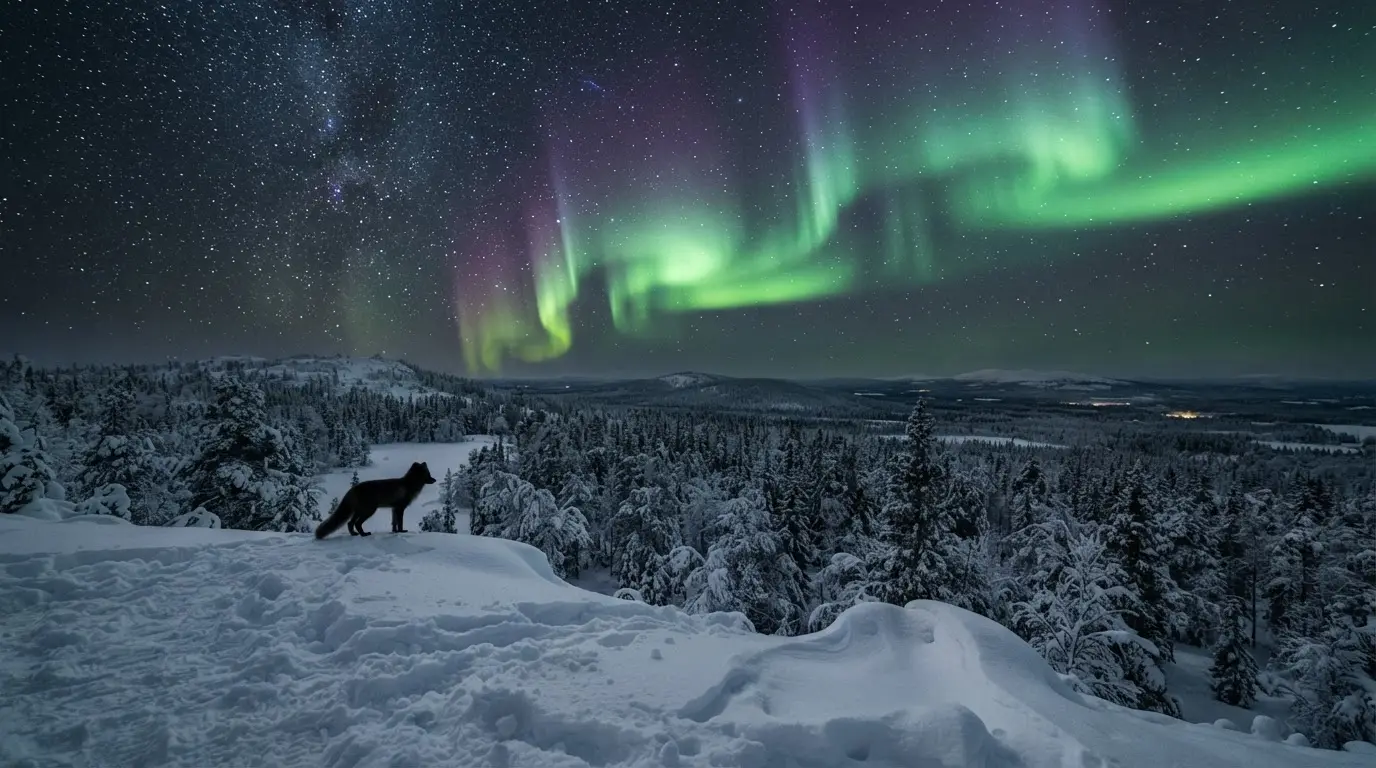
Revontulet is the Finnish word for the aurora borealis, and it translates literally to fire foxes. The old Lapland folk belief behind the name is specific: an arctic fox runs across the fells at night, and its tail throws off sparks as it brushes against branches, bushes, or even mountains[1]. Those sparks, in the story, are the lights themselves, rippling green and violet overhead.
It's a tidy explanation for something that otherwise resists one: a fox nobody has actually seen, moving fast enough across an entire sky to leave sparks behind it. The word has outlived the story it was built to explain. Finnish weather forecasts, tourism sites, and everyday conversation still call the aurora revontulet, long after most people stopped picturing an actual fox.
Revontulet is Finnish, not Sami. That distinction matters for the rest of this guide, because the two traditions get flattened into one generic 'Nordic legend' far more often than either deserves.
Two traditions, not one legend
Finnish fire-fox folklore and Sami tradition about the aurora come from two different peoples with two different relationships to the same sky, and treating one as a variant of the other loses what makes each specific.
Revontulet is a folk etymology: a word, a story, and an image, told broadly across Finland to explain a natural phenomenon in terms a child could picture. Sami tradition about the aurora sits inside something larger and older: a spiritual and oral tradition bound up with ancestors, reindeer herding, and a set of taboos about drawing the lights' attention that some Sami communities still observe.
The Sami are the only recognized Indigenous people within the EU area[2], with their own languages, their own governing bodies, and a homeland, Sápmi, spanning northern Norway, Sweden, Finland, and Russia's Kola Peninsula, overlapping with what's marketed to travelers as Finnish Lapland. Their relationship to the aurora doesn't derive from the Finnish word most travelers arrive already knowing; it predates it, and stands apart from it.
Sami oral tradition: ancestors, guardians, and guovssahas
Sami tradition holds a different account of the same sky. For some Sami communities, the lights are read as ancestral spirits moving through the night, watching over reindeer herders during the darkest stretch of the year[3]. It isn't a single fixed myth so much as a living oral tradition, carried differently across Sami communities in Norway, Sweden, Finland, and Russia, and it doesn't reduce to one sentence the way the fire-fox story does.
One Sami word for the aurora, guovssahas, is glossed in English as 'light you can hear'[4], a phrase that points at something the fire-fox legend never touches: a sensory quality some describe in the lights' movement, rather than a purely visual spectacle borrowed for a story.
“To some Sámi, the Northern Lights are ancestors dancing through the skies, companions and guardians for reindeer herders.”
That difference in framing matters. Revontulet treats the aurora as a puzzle explained with an animal. Guovssahas and the broader Sami tradition treat it as a presence to be addressed carefully, on its own terms, by people who lived under the polar night generations before anyone wrote 'fire fox' on a tourism website. A different medieval tradition skipped both the animal and the ancestor entirely: a 13th-century Norwegian court text weighed three physical explanations for the same lights and refused to declare a winner.
Why staying quiet mattered: whistling, joik, and the taboo on drawing attention
Sami tradition around the aurora carried practical taboos alongside spiritual ones. In parts of the tradition, making noise toward the lights, whistling, singing, or waving, was treated as risky, because it could draw the attention of ancestral spirits in ways that weren't welcome[5]. Whether the aurora makes any sound at all is a separate, scientific question, covered in do the northern lights make a sound. Some accounts describe Sami people choosing to stay indoors altogether when the aurora was active, rather than risk it.
This connects to joik, the traditional Sami vocal tradition, itself a form of sound closely tied to specific people, places, and animals. Joik isn't aurora-specific, and it isn't universally restricted; it's worth mentioning because it shows how seriously Sami tradition treats sound as something with real consequence, which makes the whistling taboo easier to place in context rather than read as an isolated superstition.
Recommended tours
Tours are selected for quality, not commission. I earn a small fee if you book — at no extra cost to you.
None of this is a museum-piece belief locked in the past. Oral traditions like this one are living, held with varying degrees of observance across different Sami communities and generations, which is exactly why this guide avoids saying what 'the Sami' universally believe or believed. Some do; some don't; the tradition itself doesn't ask for one flattened answer.
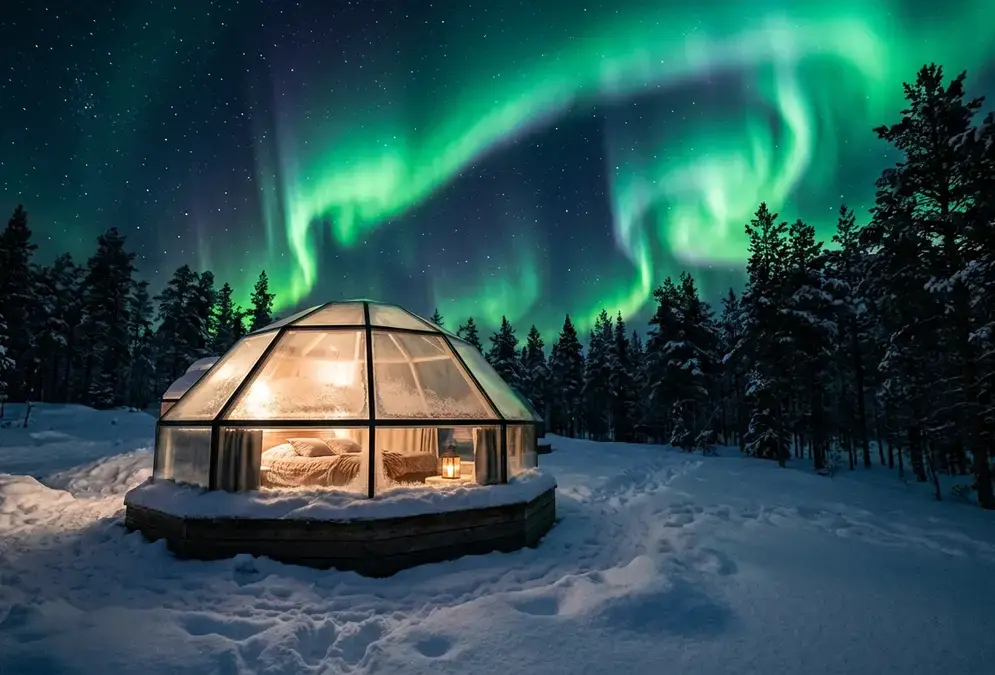
Featured · Destination
Northern Lights in Finnish Lapland
Finnish Lapland's whole-region aurora guide: glass igloos, Santa Claus Village, six bases from Rovaniemi to Inari, aurora season Sep–Mar, no road drama.
Siida and Sami-led ways to go deeper than folklore
For travelers who want more than a folklore summary, the Siida Sami Museum and Nature Centre, in Inari, Finland, is the clearest starting point. It reopened in 2022 after renovation, with a permanent exhibition, These Lands Are Our Children, built and presented as Sami culture told by the Sami themselves[6], rather than translated through an outside curator's framing.
That distinction, Sami-told versus told about Sami people, is worth carrying into every other Sami-related stop on a Lapland itinerary. A museum, a reindeer farm, or a guided cultural visit either involves Sami people in how the story gets told, or it doesn't, and the difference shows up in the details: who owns the operation, who's speaking, and whether the framing treats Sami culture as a living community rather than a costume.
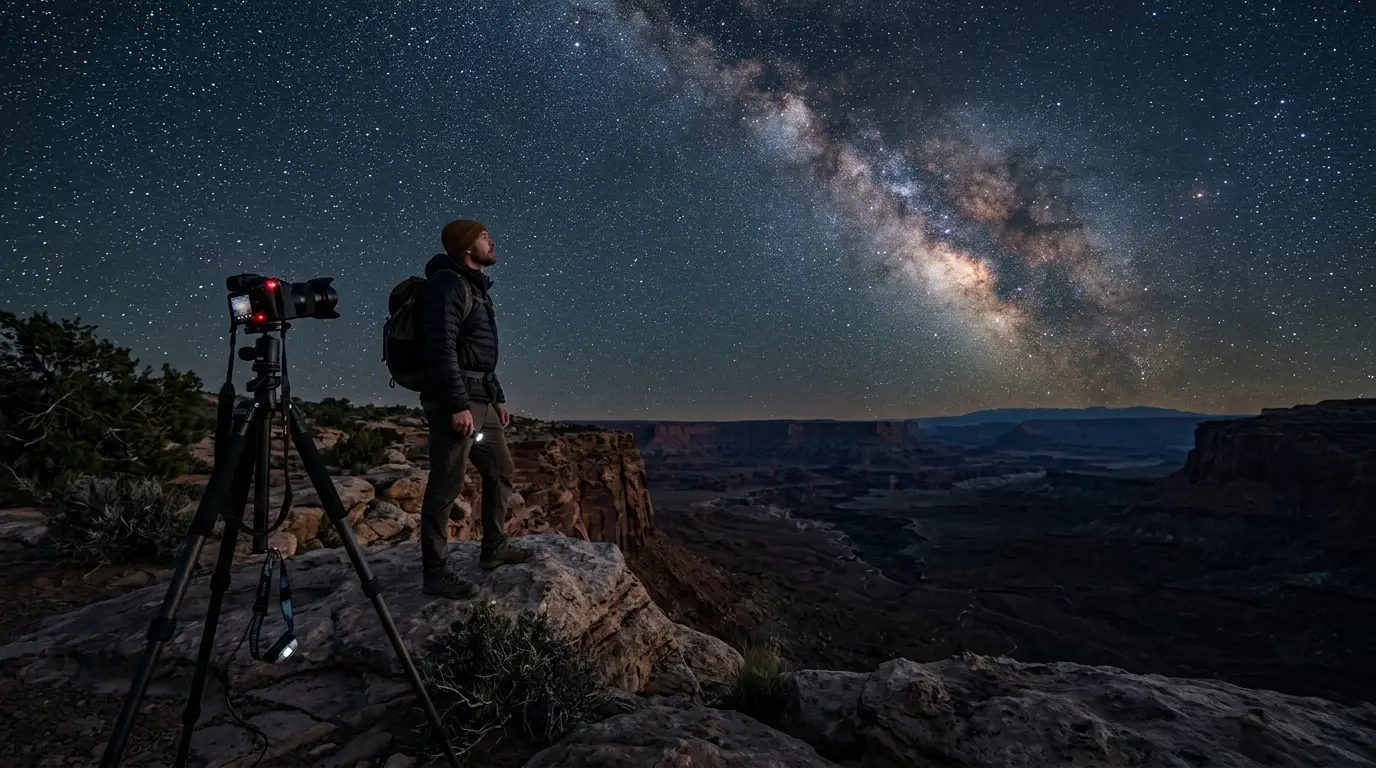
Featured · Article
What Is Astrotourism? The Complete Beginner's Guide
Astrotourism means travel built around dark skies: meteor showers, auroras, the Milky Way. What it means, where to go, and how to plan your first trip.
Inari sits well north of Rovaniemi, deep in the region most travel guides call Finnish Lapland, and it's worth budgeting a separate day for it rather than treating it as a drive-through stop between aurora hunts. For how the region's aurora season lines up against Inari's cultural depth, see the best time to see the northern lights in Finnish Lapland.
Visiting Sami culture respectfully while aurora-hunting
None of this folklore is an invitation to treat Sami culture as a photo backdrop for an aurora trip. Sami-led travel guidance is fairly consistent on a handful of specific points[7]:
- Don't call Sami people 'Lapp' or 'Laplander'; both are considered offensive
- Don't photograph Sami people without asking first
- Treat the gákti, traditional Sami dress, as clothing that encodes family and regional identity, not a costume
- Check who owns and runs a tour before booking; Sami-owned businesses are typically open about identifying as such
Before booking a Sami-led experience
- Confirm the operator is Sami-owned or Sami-run
- Ask before photographing anyone in traditional dress
- Skip anything marketed simply as 'Lapp culture'
- Treat the gákti as clothing with meaning, not a costume
A straightforward reindeer sleigh ride or aurora tour doesn't need to double as a cultural lesson to be worth booking. But if part of the reason for the trip is genuinely learning something about the people who have read this sky longer than 'revontulet' has existed as a word, look for the operators who are Sami-run, and ask directly when it isn't obvious. For a longer look at the region's daytime options and how Sami tourism ethics fit into the wider trip, see What to Do in Lapland Beyond the Northern Lights.