
The Arab Revolt: Wadi Rum's Place in the 1916-18 War

The Arab Revolt opened at Mecca on 10 June 1916, when the Hashemite Sharif Hussein bin Ali turned his forces against the Ottoman Empire that had ruled the Arab provinces for centuries[1]. The rebellion ran until October 1918, and its stated goal was an independent Arab state from Aleppo to Aden. For most of its first year the war stayed far from the desert valley now called Wadi Rum; the campaign's decisive phase came in 1917, when the revolt moved north into what is now southern Jordan.
The Sharifian Army, led by Hussein and his sons with backing from Britain's Egyptian Expeditionary Force, fought a guerrilla war against Ottoman garrisons across the Hejaz and Transjordan[4]. Lawrence arrived in the Hejaz in late 1916 as a liaison officer attached to the Arab Bureau in Cairo, and his name became inseparable from the revolt's northern wing under Emir Faisal, Hussein's third son[5]. That northern army, with Lawrence working alongside it, was the force that pushed the revolt toward the Red Sea port of Aqaba and, later, Damascus.
Timeline
  1. 10 June 1916

    Revolt declared at Mecca

    Sharif Hussein bin Ali launches the Hashemite uprising against Ottoman rule.

  2. Late 1916

    Lawrence joins the northern army

    The British liaison officer is attached to Faisal's forces in the Hejaz.

  3. 6 July 1917

    Aqaba falls

    Arab forces take the port after a landward march across the desert.

  4. October 1918

    Damascus captured

    The revolt ends with the fall of Damascus and the Ottoman withdrawal.

  5. 1980s

    Seven Pillars rock named

    The formation known as Jabal al-Mazmar is renamed after Lawrence's book.

Lawrence's Role: Liaison Officer, Not Desert Commander

T. E. Lawrence was a British Army officer who served as a military advisor to the Bedouin forces during the revolt, not as their commander[5]. His job, first at the Arab Bureau in Cairo and then in the field, was to keep the Arab army supplied, organised, and pointed at targets that served the wider war. He was based in Wadi Rum in 1917-18, helping to organise raids on Ottoman positions from Aqaba south to Damascus with Emir Faisal's support[6].
The valley mattered to Lawrence personally, not just strategically. He passed through it several times during the revolt and wrote about it at length[7]; his account preserves the moment of entering the valley: "The hills on the right grew taller and sharper, a fair counterpart of the other side which straightened itself to one massive rampart of redness"[8]. That first-hand description, written into Seven Pillars of Wisdom, is the real historical thread the valley's later Lawrence naming grew out of.
"The hills on the right grew taller and sharper, a fair counterpart of the other side which straightened itself to one massive rampart of redness."
T. E. Lawrence , Seven Pillars of Wisdom

The Capture of Aqaba, July 1917: The Campaign's Turning Point

The revolt's decisive moment came in the summer of 1917, and it happened not in Wadi Rum but at Aqaba, the only remaining Ottoman port on the Red Sea[9]. The port threatened the right flank of Britain's Egyptian Expeditionary Force in Egypt, and taking it would hand the Arab army a secure base and a supply line. Rather than attack from the sea, the Arab force marched inland and came at Aqaba from the landward side.
The 600-mile (970 km) journey[2] across the desert was led by Sherif Nasir, with Lawrence accompanied by Auda Abu Tayi, leader of the northern Howeitat tribe. On 6 July 1917, after an overland attack, Aqaba fell to the Arab forces with only a handful of casualties[10]. By the end of the engagement the force had swelled to 2,000 Howeitat, and they had taken 700 prisoners, including 42 officers[11]. The port became the revolt's supply base, and the campaign shifted decisively north.
For Wadi Rum, the significance is indirect but real: the valley sat on the route the revolt used once Aqaba was secure, and it became part of the story the later Lawrence naming would draw on. Today most visitors arrive through the same port city on their way in, so see getting to Wadi Rum for how the modern route connects to the campaign's.

Seven Pillars of Wisdom: The Book Behind the Name
The rock at Wadi Rum's entrance borrows its name from Lawrence's book, Seven Pillars of Wisdom, the autobiographical account of his time advising the Bedouin forces during the revolt[5]. Lawrence completed the manuscript in February 1922, but it was only first published in December 1926[12]. The title comes from the Book of Proverbs: "Wisdom hath builded her house, she hath hewn out her seven pillars" (Proverbs 9:1)[13].
The seven pillars of the title are biblical, not geological. They have no connection with Wadi Rum[3], a point the book's own history makes clear: before the war Lawrence had planned a scholarly work on seven great cities of the Middle East under the same title, and he recycled it when the war gave him a larger subject. The name on the rock is a literary reference to a memoir, not a description of the valley it overlooks.
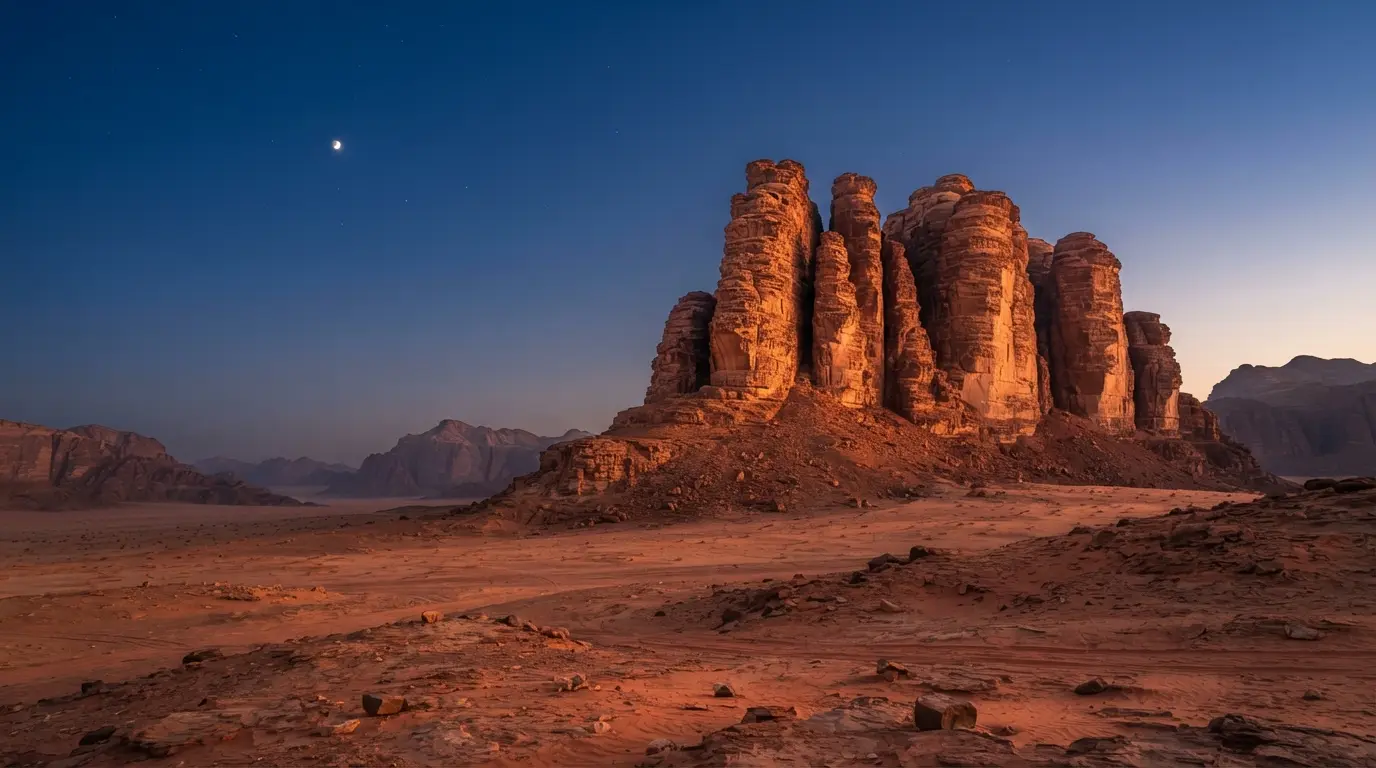
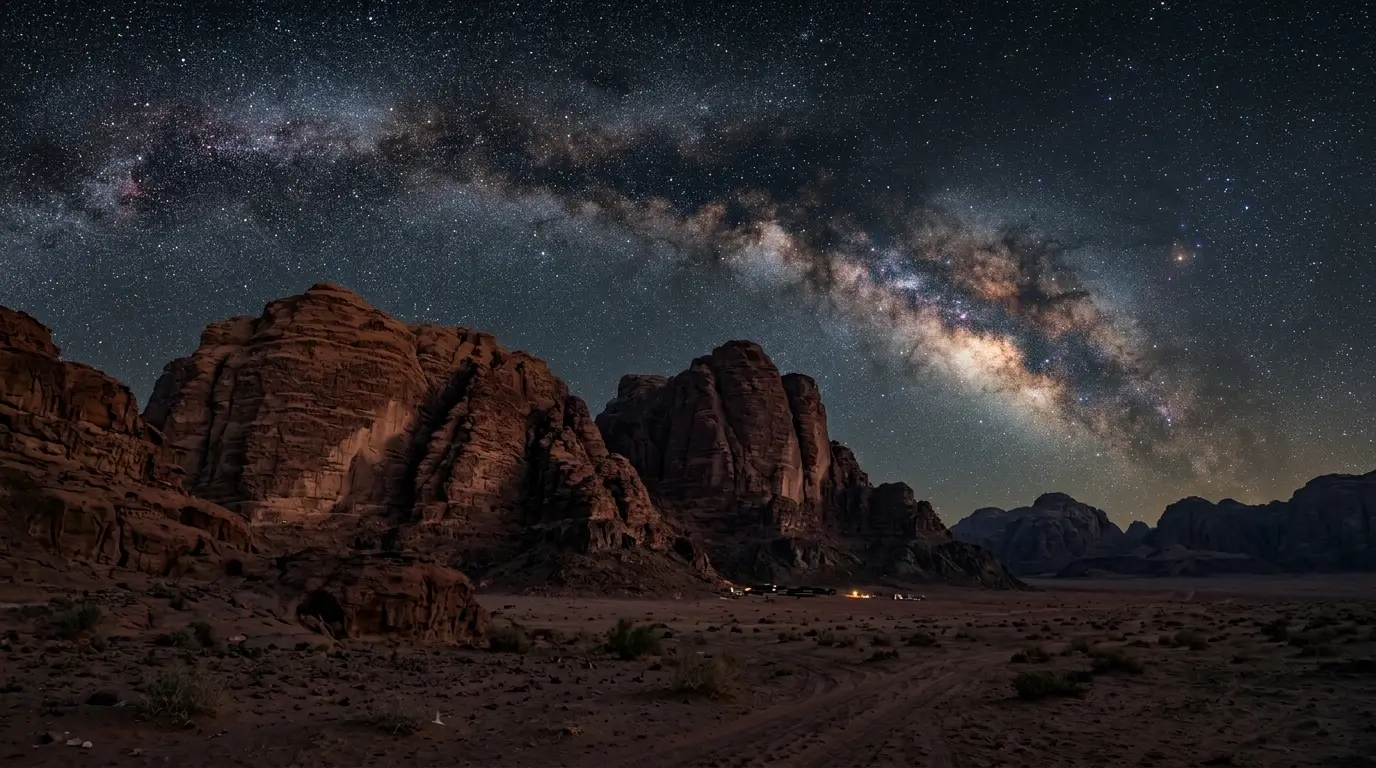
Milky Way over the red sandstone mountains of Wadi Rum, Jordan's UNESCO-listed desert stargazing destination

Featured · Destination

Wadi Rum

Wadi Rum is Jordan's UNESCO World Heritage desert, a Mars-like sandstone landscape where Bedouin-led camps put you under near-total darkness at night.

The Seven Pillars Rock: A 1980s Renaming in Lawrence's Memory

The formation that now carries the book's name was not always called that. It was originally known as Jabal al-Mazmar, the Mountain of the Plague, and it was renamed in the 1980s, after Lawrence's book, in a wave of naming meant to draw visitors[3]. Many sites inside the Wadi Rum area were named after Lawrence to attract tourists, with little or no evidence connecting him to any of them, the Seven Pillars rock near the entrance included[14].
The rock sits close to the road and the visitor centre, which is why every Wadi Rum jeep safari and camp transfer passes it on the way in. For the history, the honest summary is that the campaign was real, Lawrence was genuinely based in the valley, and the specific landmarks that now carry his name were mostly added decades later for the tourist trade. What you can verify today is the war itself, and that is what makes the naming worth understanding rather than repeating.
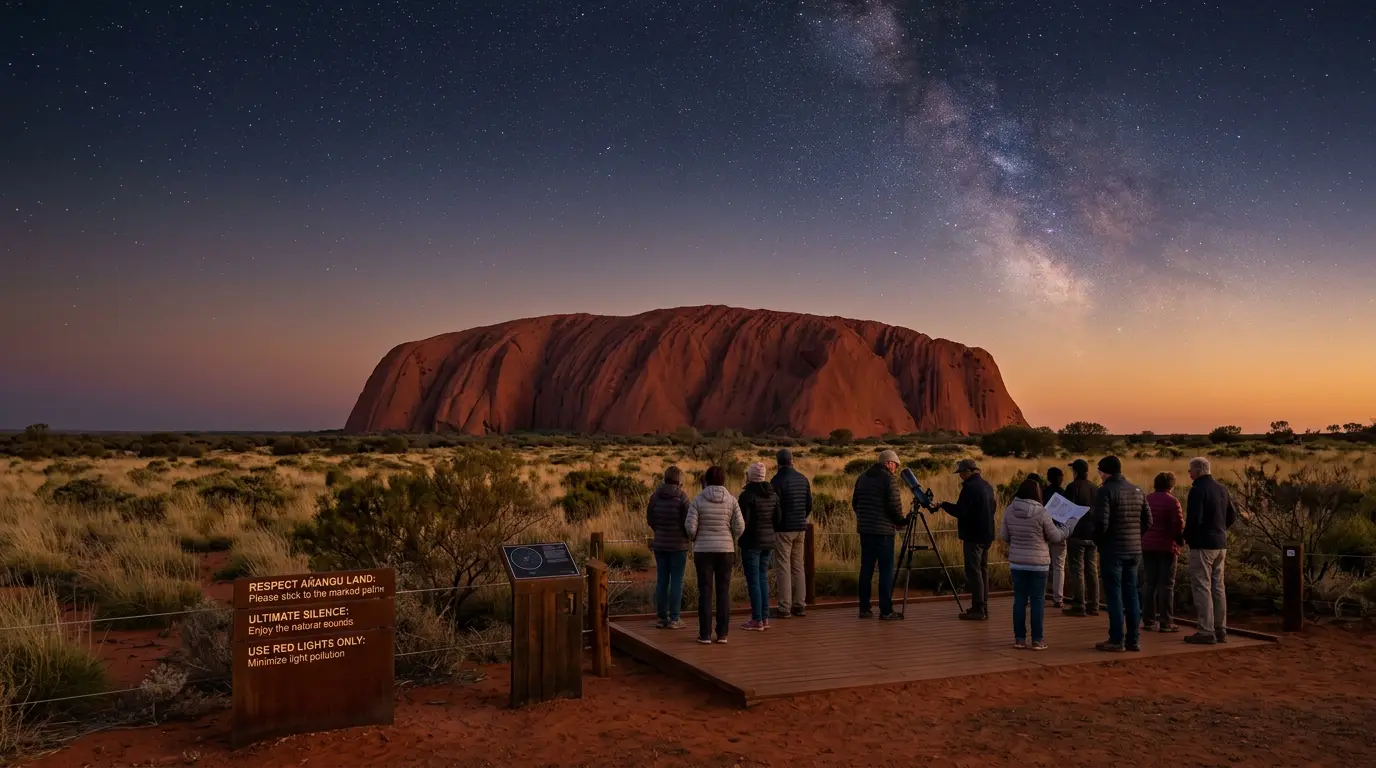
Wide, respectful photograph of Uluru glowing red at dusk under a star-filled sky on Anangu land, capturing Uluru's cultural significance and the visitor etiquette every stargazer should know

Featured · Article

Uluru Cultural Significance and Visitor Etiquette

Uluru is Anangu land under joint management. Here's why the 2019 climb closure is settled policy, what you can't photograph, and real visitor etiquette.

For the practical side of a trip, the best stargazing spots in Wadi Rum start where this history leaves off. The same remoteness that made the valley a working base a century ago is what keeps its night sky clear now.