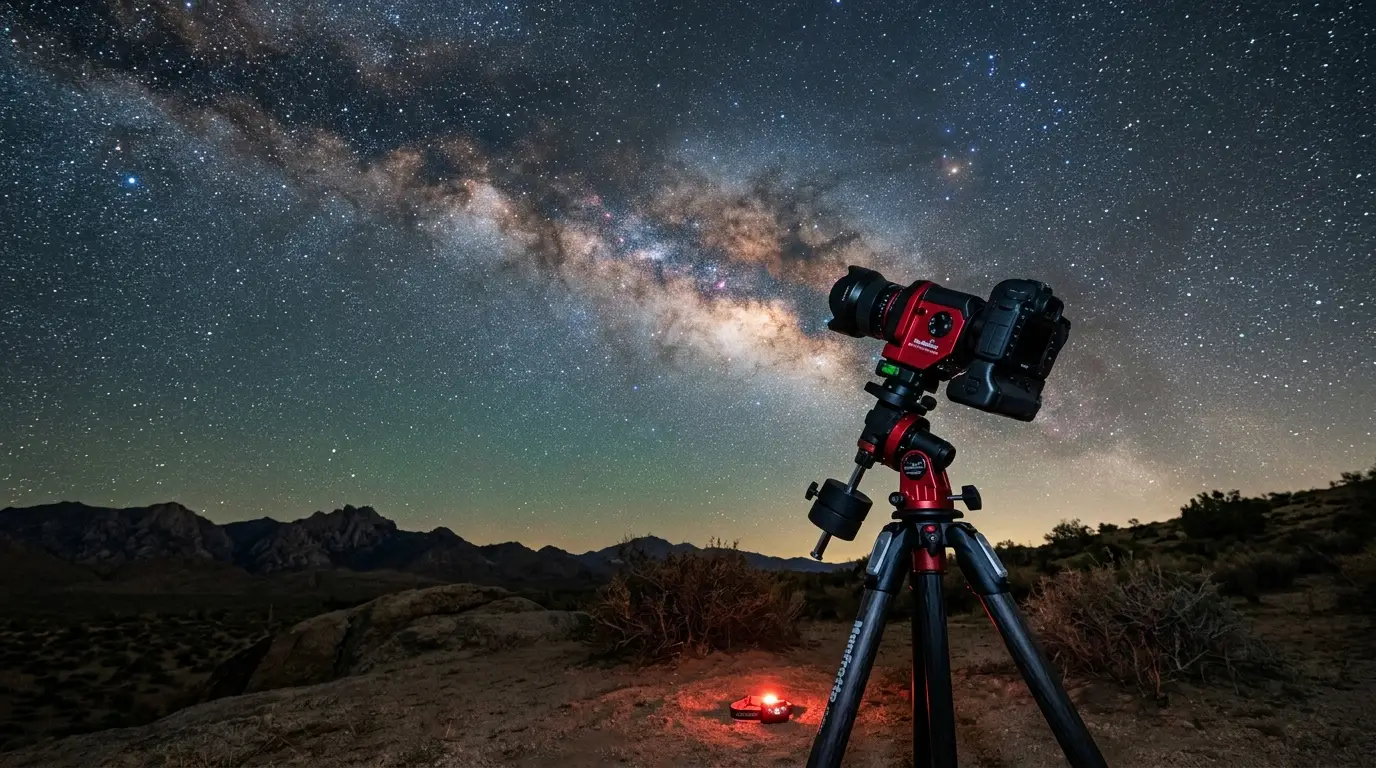
Sky-Watcher Star Adventurer 2i star tracker mounted on a tripod under the Milky Way, one of the best star trackers for astrophotography compared in this guide

Best Star Trackers for Astrophotography: Payload, Alignment, and Price Compared

The best star tracker for astrophotography depends on payload capacity, polar alignment, and price: six real picks from $239 to $1,149, ranked and compared.

Our top pick

Sky-Watcher Star Adventurer 2i (Pro Pack)

Best overall single-axis tracker

The Sky-Watcher Star Adventurer 2i wins because its 5kg payload matches mounts costing $100 to $350 more, its built-in polar scope needs no separate accessory, and its enormous installed base means troubleshooting help is one search away. The iOptron SkyGuider Pro earns runner-up for anyone who already knows they'll want a guide scope eventually, its ST-4 autoguider port and 20-hour battery are built for that upgrade path.

A 5kg/11lb payload rating covers the Star Adventurer 2i, SkyGuider Pro, and GTi alike, the price gap between them buys GoTo and autoguiding, not extra carrying capacity.

Runner-up: iOptron SkyGuider Pro, the two-axis upgrade path with the longest battery life and a built-in autoguider port.

The best star tracker for astrophotography is not the one with the biggest payload number, it's the one whose payload rating actually covers your camera and lens combination with room to spare. Every tracker in this guide lists a maximum payload in kilograms, but that figure describes a balanced, well-mounted load. A mirrorless body plus a moderate 100-300mm telephoto, a ball head, and an L-bracket typically lands in the 2 to 3.5kg range, comfortably inside a 5kg-rated mount's ceiling. Push toward a full-frame body with a 400mm-plus lens and a guide scope, and you can approach or exceed the rating even while staying under the printed number on the box, which shows up as periodic error and motor strain rather than an outright failure to track.

Polar alignment accuracy is the second variable that decides what a tracker can actually shoot, and it matters more than most buyers expect before they own one. Careful alignment at wide focal lengths, 14-35mm, typically buys 2 to 4 minutes of clean exposure before star trailing appears; at 50-85mm that window narrows to 1 to 3 minutes, and at 135-200mm telephoto it's down to roughly 60 to 120 seconds regardless of which tracker's motor is doing the tracking. Wide framing is forgiving of small alignment errors since sidereal drift is barely visible at low magnification; telephoto framing punishes the same error far faster. A built-in illuminated polar scope, standard on the 2i, SkyGuider Pro, and GTi below, gets you to that accuracy faster than a laser pointer or a phone compass, which is exactly why the trackers relying on those cheaper alignment methods sit at the budget and travel ends of this list rather than the top.

Single-axis versus two-axis tracking matters mostly for framing convenience, not tracking accuracy. A single-axis mount like the base Star Adventurer 2i tracks right ascension, the sky's east-west drift, and nothing else; centering a specific target still means physically repositioning the tripod head. Add a declination bracket, standard on the SkyGuider Pro's upgrade path and available as an accessory for the 2i, and you can fine-tune framing on the second axis without moving the whole tripod. GoTo, as on the Star Adventurer GTi, automates finding the target in the first place, a different problem from framing it once found. None of these upgrades change the underlying payload or alignment-accuracy math above; they change how much manual fiddling stands between you and the shutter button.

Ranked list

How we chose

The places on this list were selected against the following editorial criteria.

  • Payload capacity in kilograms, not the marketing number on the box: a rated ceiling only holds with a balanced load, and pushing near it introduces periodic error even within the nominal limit
  • Polar alignment method and accuracy: a built-in polar scope caps usable exposure time far less than a laser pointer or phone-compass alignment at the same focal length
  • Tracking mechanism: continuous sidereal drive versus step-based advance changes what focal lengths and subjects a tracker can realistically shoot
  • Battery life and power source, since a dead tracker mid-session on a multi-night trip is a wasted dark-sky window
  • Upgrade path: whether a DEC bracket, autoguider port, or GoTo motor exists for anyone planning to grow into more advanced astrophotography

All picks at a glance

  • Sky-Watcher Star Adventurer 2i (Pro Pack)

    Best overall single-axis tracker
    Price
    $395-$585 depending on package (Pro Pack)
    Why it makes the list
    5kg/11lb payload, built-in polar scope, Wi-Fi app control
  • iOptron SkyGuider Pro (Full Package)

    Best two-axis upgrade path
    Price
    $488 retail, frequently discounted under $400 (Full Package)
    Why it makes the list
    5kg/11lb payload, AccuAlign polar scope, ST-4 autoguider port, 20-hour battery
  • Move Shoot Move Star Tracker (Basic Kit B)

    Best budget entry point
    Price
    $239 (Basic Kit B with laser pointer); Basic Kit A with polar scope $279
    Why it makes the list
    3kg payload, 0.4kg device weight, step-based (non-continuous) tracking
  • Sky-Watcher Star Adventurer GTi Mount Kit

    Best full GoTo tracker
    Price
    ~$830 for this kit with tripod and pier extension; ~$720 for a separate mount-head-only kit
    Why it makes the list
    5kg/11lb payload, full GoTo via SynScan Pro app, up to 72-hour battery life
  • Vixen Polarie U Star Tracker

    Best ultra-portable travel tracker
    Price
    Roughly $450-$550, not firmly confirmed at time of writing, check the current retailer listing
    Why it makes the list
    570g device weight, tiered payload from 2.5kg to 10kg depending on accessory or mode
  • Benro Polaris Astro Edition (3-Axis)

    Best premium AI-assisted tracker
    Price
    $1,149 (Astro Edition, 3-Axis); WiFi Astro Pack bundle ~$999
    Why it makes the list
    7kg/15lb payload, robotic 3-axis gimbal, app-guided one-star alignment (no polar scope)

Reporter notebook

Insider tips

Money tip

Check the exact package variant before buying

The SkyGuider Pro alone ships in at least three near-identical listings (Full Package, iPolar edition, mount-head-only), and Move Shoot Move's laser-pointer kit and polar-scope kit look nearly the same in a thumbnail. Read the exact package name before adding to cart, since price differences of $100-plus often come down to which variant you picked, not a sale.

What to bring

Buy the DEC bracket only when you need it

A declination bracket turns a single-axis tracker into a genuine two-axis platform, but it's a real accessory purchase on top of the mount, not a free upgrade. Skip it until you've spent a season tracking wide-field shots and find yourself wanting to fine-tune framing on a specific deep-sky target without repositioning the whole tripod.

In this guide

6 places
  1. Sky-Watcher Star Adventurer 2i (Pro Pack)

    Best overall single-axis tracker

    $395-$585 depending on package (Pro Pack)

    The Sky-Watcher Star Adventurer 2i is the mount most people landing on this list will end up buying, and the math backs that instinct up. Its 5kg (11lb) payload rating matches the pricier SkyGuider Pro and Star Adventurer GTi below it, gear that costs $100 to $350 more for extra features rather than extra carrying capacity. Do the payload math before you shop: a mirrorless body, a 100-300mm zoom, a ball head, and an L-bracket usually lands in the 2 to 3.5kg range, well inside the 2i's rated ceiling with room to spare. Push toward a full-frame body and a 400mm-plus telephoto and you're close enough to the rating that periodic error creeps in even under the nominal limit.

    Where the 2i earns its market-leader status is the built-in illuminated polar scope, no separate accessory purchase required, unlike the base Move Shoot Move kit below it. Align it correctly and 2-4 minute exposures at wide focal lengths are routine; push into 135-200mm telephoto territory and that window narrows to 60-120 seconds regardless of which tracker you're using, since alignment error, not the motor, is what caps exposure time at longer focal lengths.

    What the 2i doesn't have is what separates it from the two mounts priced above it: no GoTo (the GTi adds that), and no true declination axis out of the box (the SkyGuider Pro's DEC bracket accessory gets you there; the 2i needs the same kind of add-on bracket). Think of it as the no-GoTo, lower-cost sibling in Sky-Watcher's own lineup, not a lesser product, just a simpler one. For anyone shooting wide-field Milky Way panoramas or moderate telephoto work who doesn't need the mount to find targets for them, that's a fair trade for the price gap.

    Pros

    • 5kg payload matches pricier two-axis mounts at a lower price
    • Built-in illuminated polar scope, no extra accessory needed for basic alignment
    • Huge installed user base means abundant tutorials and accessory support

    Cons

    • No GoTo and no declination axis out of the box, DEC bracket is a separate purchase
    • No autoguider port, capping practical exposure length for telephoto deep-sky work
  2. iOptron SkyGuider Pro (Full Package)

    Best two-axis upgrade path

    $488 retail, frequently discounted under $400 (Full Package)

    The iOptron SkyGuider Pro Full Package sits one rung above the 2i for a reason: pair its optional DEC bracket kit (bracket, counterweight shaft, counterweight, and dovetail saddle, sold separately) with the mount head and you get genuine two-axis framing, not just single-axis tracking with manual adjustments. Payload capacity is the same 5kg/11lb ceiling as the 2i and GTi, so the upgrade here isn't more carrying capacity, it's more control once you're framing a specific deep-sky target rather than sweeping a wide Milky Way arc.

    Two details set it apart on paper. First, a built-in rechargeable battery rated for 20 hours at 20°C, the longest of any tracker in this lineup that doesn't run on disposable AAs, so you're not burning through batteries on a multi-night trip. Second, an ST-4 autoguider port, meaning this is the one tracker here built with a future guide-scope upgrade in mind rather than treating guided long exposures as an afterthought.

    The catch is buying the right package. iOptron sells this mount in at least three near-identical listings: the Full Package with the AccuAlign dark-field illuminated polar scope (the one reviewed here), a pricier iPolar electronic-finder edition roughly $150 more, and a mount-head-only version with no polar scope at all. Read the listing title twice before adding it to your cart. At street prices frequently dipping under $400 against a $488 retail figure, this is the pick for anyone who already knows they'll want a guide scope eventually and would rather buy the autoguider port now than replace a mount later.

    Pros

    • 20-hour built-in battery life, longest of any tracker in this roundup without external power
    • ST-4 autoguider port supports a future upgrade to guided long exposures
    • DEC bracket accessory path gives a genuine two-axis upgrade route

    Cons

    • True two-axis framing requires buying the DEC bracket kit separately
    • Three near-identical package variants online make it easy to order the wrong one
  3. Move Shoot Move Star Tracker (Basic Kit B)

    Best budget entry point

    $239 (Basic Kit B with laser pointer); Basic Kit A with polar scope $279

    Move Shoot Move's tracker is the odd one out on this list mechanically, and that's exactly its appeal at the budget end. Instead of a continuous sidereal motor, it advances the camera in small fixed steps, 0.05°, 0.075°, 0.1°, or 0.125° per shot, triggered by the sound of your shutter closing. That makes it a genuinely different tool from every other tracker here, built for stacking wide-field Milky Way frames and time-lapses rather than long single exposures.

    At 0.4kg it's also the lightest real tracker in this roundup by a wide margin, and its 3kg payload ceiling is honest about what it's for: a mirrorless body and a wide or short lens, not a telephoto rig. Basic Kit B bundles a laser pointer for rough alignment instead of a polar scope, which keeps the price down to around $239, but that laser is restricted or illegal in some countries; Southern Hemisphere buyers or anyone in a laser-restricted country should look at Basic Kit A ($279) with a polar scope instead of this kit.

    Buy this one for what it actually is: the cheapest real entry into tracked astrophotography, and the tracker to throw in a carry-on when packed weight matters more than payload capacity or continuous exposures past a couple of minutes at moderate focal lengths.

    Pros

    • Lightest and most packable tracker in this roundup at 0.4kg
    • Cheapest real entry point into tracked astrophotography
    • No dedicated tripod needed, works on any standard 1/4-20 photo tripod

    Cons

    • Step-based tracking, not a continuous drive, limits it to wide and short-telephoto lenses
    • Base kit's laser pointer is restricted or illegal in some countries; Southern Hemisphere buyers need the polar-scope kit variant instead
    • 3kg payload rules out most telephoto lens and camera combinations
  4. Sky-Watcher Star Adventurer GTi Mount Kit

    Best full GoTo tracker

    ~$830 for this kit with tripod and pier extension; ~$720 for a separate mount-head-only kit

    The Star Adventurer GTi carries the same 5kg/11lb ceiling as the 2i and SkyGuider Pro, so don't buy it expecting to carry more gear. What you're paying the premium for is full GoTo: point at a target in the SynScan Pro app and the mount finds and tracks it, instead of you dialing in right-ascension offsets by hand. For anyone who has used the 2i and outgrown manually hunting for faint targets, that's the real reason to trade up, not extra payload.

    Two other numbers matter here. Battery life runs up to 72 hours on 8 AA batteries, the longest of any AA-powered tracker in this roundup, useful on a multi-night trip far from an outlet. And alt-az polar alignment through its illuminated polar scope reportedly takes about a minute once you know the routine, with reticle brightness adjustable from the same app that runs the GoTo functions.

    This kit, with a tripod and pier extension, runs about $830; a mount-head-only kit at a different ASIN runs about $720 for buyers who already own a compatible tripod and don't want to pay for a second one. Either way, it's the most expensive mechanical (non-AI-assisted) tracker in this lineup, and the honest case for it comes down to one question: do you already know what you want to point at, or do you want the mount to help you find it?

    Pros

    • Full GoTo, points the mount at a chosen target automatically via the app
    • Longest AA-battery runtime in this roundup, up to 72 hours
    • Dual-position counterweight supports low-latitude shooting

    Cons

    • Most expensive mechanical tracker in this roundup
    • Same 5kg payload ceiling as cheaper single-axis options, GoTo and battery life are the real upgrades, not carrying capacity
  5. Vixen Polarie U Star Tracker

    Best ultra-portable travel tracker

    Roughly $450-$550, not firmly confirmed at time of writing, check the current retailer listing

    The Vixen Polarie U is the tracker to consider once packed weight matters more than anything else on this list: 570 grams for the device alone, lighter than every mount here except the Move Shoot Move, but with a continuous sidereal drive the Move Shoot Move's step-based mechanism doesn't offer. Its payload spec is unusually tiered rather than a single number: a modest 2.5kg (5.5lb) base rating, extendable to 6.5kg (14lb) with an optional Multi Mounting Block, or 10kg (22lb) laid horizontal for time-lapse work, more flexible on paper than most single-spec competitors, if less capable than the 5kg-class mounts above at its base rating.

    There's no built-in polar scope on the base unit; alignment relies on a separate PF-L II polar scope accessory or the Polarie smartphone app's compass-assisted mode. That's a real cost to factor in before comparing sticker prices against the 2i, which includes its polar scope.

    Pricing here needs a caveat: retailer listings for the current U model vary enough that we can't point to one confirmed current MSRP, somewhere in the $450-$550 range based on available listings, though an older base Polarie model carried a lower MSRP around $475. Check the current listing directly before budgeting for this one rather than trusting a number here. Battery life is one spec Vixen does document clearly: about 7 hours on 4 AA batteries (alkaline, Ni-MH, or Ni-Cd) or via USB-C.

    Pros

    • 570g device weight, among the lightest continuous-drive trackers available
    • Tiered payload spec scales from 2.5kg up to 6.5kg with an accessory block, or 10kg in horizontal time-lapse mode
    • Wi-Fi app control with a genuine custom tracking-rate mode

    Cons

    • No built-in polar scope on the base unit, a separate accessory is needed for precision alignment
    • Current exact price and battery specifications aren't firmly confirmed, verify with the retailer before buying
  6. Benro Polaris Astro Edition (3-Axis)

    Best premium AI-assisted tracker

    $1,149 (Astro Edition, 3-Axis); WiFi Astro Pack bundle ~$999

    The Benro Polaris Astro Edition (3-Axis) is the only tracker in this lineup that replaces manual polar alignment entirely: point the Polaris app's camera at the sky, pick a star from its list, and a compass-assisted one-star alignment routine does the rest. At $1,149 it's also the most expensive pick here by a wide margin, roughly double the next most expensive mechanical mount, and that price buys a fundamentally different device rather than a nicer version of the same idea.

    Payload capacity is the highest in this roundup at 7kg (15lb), enough for a full-frame body with a heavier telephoto lens and still leaves headroom the 5kg-class mounts above don't have. The built-in camera and robotic 3-axis gimbal add live-preview framing and automated panorama and time-lapse modes that no purely mechanical tracker here offers, and the 2,500mAh battery is rated for over 24 hours, chargeable while in use.

    The tradeoff is dependence on electronics for a function every other tracker here handles with a fixed optical polar scope: alignment accuracy rides on the phone's compass and the app, not a mechanical reference point, a real consideration if you're shooting somewhere cold enough to worry about battery drain or phone reliability. A cheaper WiFi Astro Pack bundle (base head plus Astro expansion module) runs about $999 for buyers willing to shop the bundle instead of the full kit. This is the pick for someone who has already used a mechanical tracker, finds polar scopes fiddly in the dark, and has the budget to buy the workaround.

    Pros

    • Highest payload capacity in this roundup at 7kg/15lb
    • No manual polar scope needed, app-guided one-star alignment
    • Built-in camera and robotic gimbal add framing and panorama features no mechanical tracker here offers

    Cons

    • By far the most expensive tracker in this roundup
    • Polar alignment accuracy depends on the phone's compass and app, not a fixed optical reference

Every tracker above is a real, currently sold product, though package variants are the single biggest way to buy the wrong thing in this category. The SkyGuider Pro alone ships in at least three near-identical listings, and Move Shoot Move's laser-pointer kit and polar-scope kit look almost identical in a thumbnail. Read the exact package name in the listing before adding to cart, not just the model name.

Prices here move with sales, stock, and currency shifts more than most gear categories, and the Vixen Polarie U's current retail price wasn't firmly confirmed even after checking multiple retailer listings, a rare enough gap in this research pass that it's worth a caveat on its own. Treat every price in this guide as a snapshot, not a quote, and check the manufacturer's or retailer's current listing before buying.

If you're choosing between the top two picks: buy the Star Adventurer 2i if you're shooting wide-field Milky Way frames and moderate telephoto and don't yet know whether you want a guide scope. Buy the SkyGuider Pro if you already know you'll add a guide scope within a year or two and would rather pay for the autoguider port now. Skip straight to the GTi only if manually finding faint targets has already become the part of the hobby you don't enjoy, and skip the Benro Polaris unless you've used a mechanical tracker before and specifically want out of manual polar alignment.

None of this replaces a wide-field lens or a genuinely dark sky. A perfectly tracked exposure under a bright suburban sky still won't show what a short untracked shot reveals under a truly dark one; see the best places to see the Milky Way for where that difference is biggest. Pick the tracker that matches your gear and budget, then spend the money you saved on the drive to somewhere actually dark.

Frequently asked questions

Do I need a star tracker for Milky Way photography?

Not always. A wide-angle lens (14-24mm) on a sturdy tripod can capture the Milky Way untracked in a single 15-20 second exposure, and that's a fine starting point. A tracker becomes worth it once you want to stack multiple longer exposures for a cleaner, less noisy image, or you're shooting a longer focal length where star trailing shows up in seconds rather than tens of seconds. If you're already framing wide shots and happy with single-exposure results, skip the tracker and put the budget toward a darker sky instead.

How long can you expose with a star tracker?

It depends far more on your focal length and polar alignment accuracy than on which tracker you buy. With careful alignment, typical results run 2 to 4 minutes at 14-35mm, 1 to 3 minutes at 50-85mm, and roughly 60 to 120 seconds at 135-200mm before star trailing creeps in. Wider lenses forgive small alignment errors since sidereal drift is barely visible at low magnification; telephoto lenses punish the same error much faster.

What payload capacity do I need for a star tracker?

Add up your camera body, lens, and any accessories like a ball head or L-bracket, then leave real headroom below the tracker's rated ceiling rather than loading it right up to the limit. A mirrorless body with a 100-300mm lens typically lands around 2 to 3.5kg, comfortably inside a 5kg-rated mount like the Star Adventurer 2i, SkyGuider Pro, or GTi. Loading a full-frame body with a 400mm-plus telephoto and a guide scope can approach or exceed a 5kg rating even while staying under the printed number, showing up as periodic error rather than an outright failure.

How accurate does polar alignment need to be for astrophotography?

Accurate enough that drift stays invisible for your focal length and planned exposure time. At wide angles that's forgiving: a rough alignment with a laser pointer or phone compass usually holds up fine for a couple of minutes. At telephoto focal lengths, 135mm and up, the same alignment error becomes visible in under two minutes, which is exactly why trackers built for longer or narrower framing, like the SkyGuider Pro and GTi, ship with a proper illuminated polar scope rather than a laser or phone compass.

Can you use a star tracker without a polar scope?

Yes, several trackers in this category ship without one. Move Shoot Move's base kit uses a bundled laser pointer, and the Benro Polaris skips a polar scope entirely in favor of a phone-compass-and-one-star app alignment. Both work, but neither matches the accuracy of a dedicated illuminated polar scope like the one built into the Star Adventurer 2i or SkyGuider Pro, so expect a shorter usable exposure window at a given focal length if you're aligning by laser or compass alone.

What is the difference between a single-axis and two-axis star tracker?

A single-axis tracker, like the base Star Adventurer 2i, only compensates for the sky's east-west sidereal drift; framing a specific target still means physically repositioning the whole tripod. A two-axis setup adds a declination bracket, standard on the SkyGuider Pro's upgrade path, so you can fine-tune vertical framing without moving the tripod at all. Neither changes tracking accuracy, they change how much manual repositioning happens between setting up and taking the shot.

Do star trackers work with any camera and lens?

Mechanically, yes, almost any camera and lens combination mounts via a standard tripod thread or ball head. The real limit is payload capacity: check your camera-and-lens weight against the tracker's rated ceiling before buying, and remember that rating assumes a balanced, well-mounted load, not gear stacked right at the limit. A mirrorless body with a moderate zoom fits comfortably on any 5kg-class tracker in this guide; a full-frame body with a long telephoto and a guide scope needs the higher-capacity Benro Polaris (7kg) or a careful weight check against the others.

Further reading

Sources