Why book here
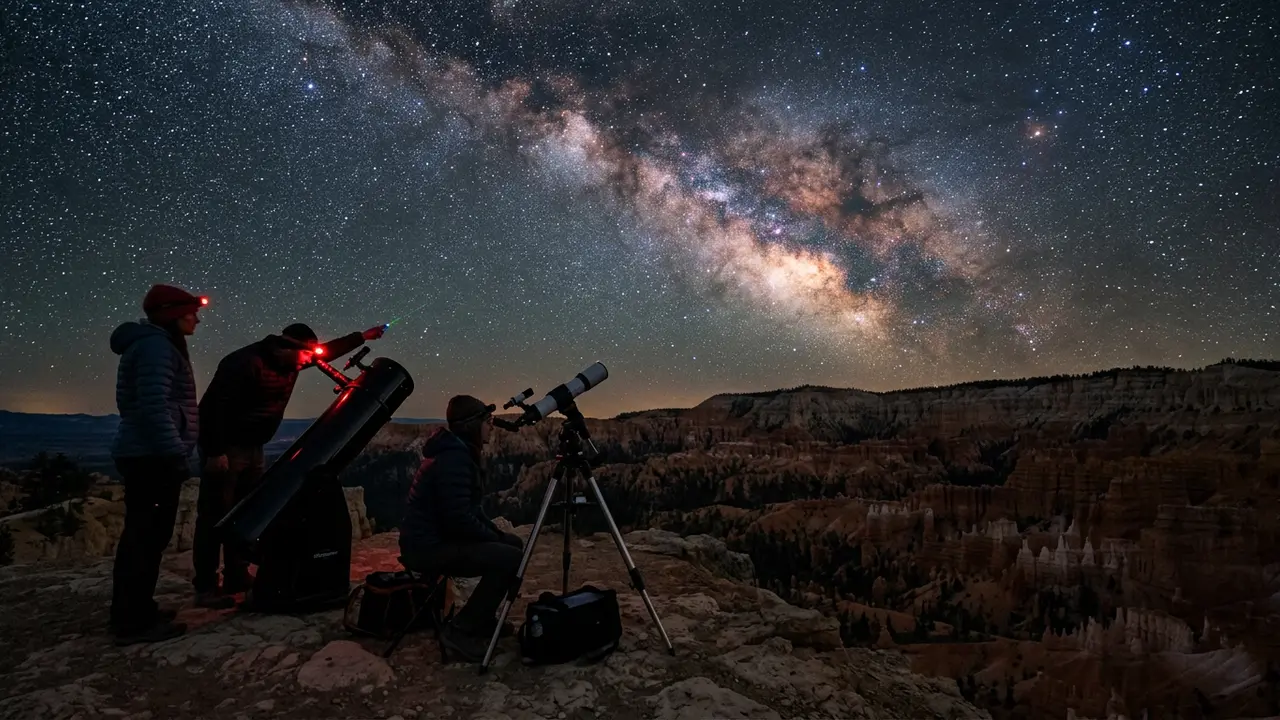
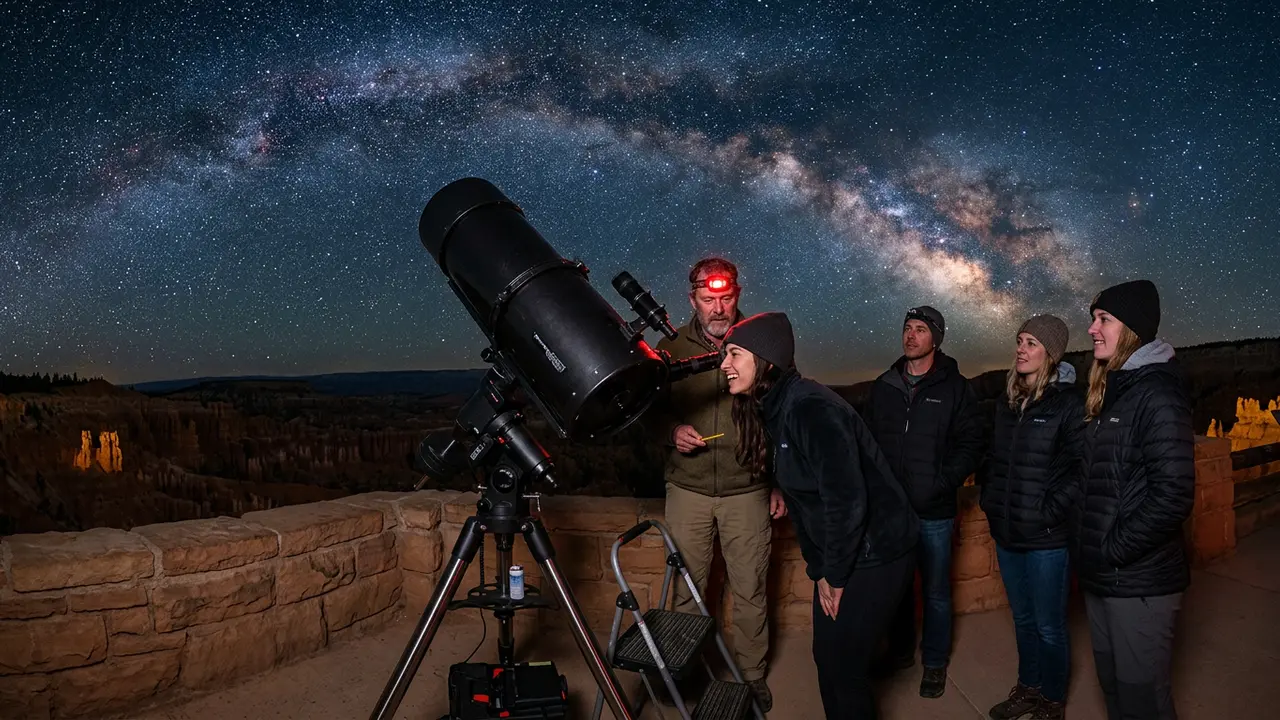
Dark Ranger Telescope Tours operates one of the largest collections of research-grade telescopes in the four-corners region, and it's the anchor public tour at Bryce Canyon. You won't wait in line for eyepiece time — the operator caps groups at 42 to maintain a 1-telescope-per-5-to-7-guests ratio, which is genuinely generous for a public tour. The nightly schedule (7 PM to 11 PM, year-round) fits around the sunset and gives you a solid 2.5-hour block for observing without the cold-endurance test that 4+ hour backcountry stargazing demands. If you're planning a first serious look at the Milky Way from a dark sky, this is the tour that actually delivers telescope access.
What the 2.5-hour tour includes
Each public tour follows a structure designed around beginner and intermediate stargazers. You arrive, get a hands-on instruction on focusing and operating the telescopes, and start with bright naked-eye targets — planets (depending on season: Jupiter, Saturn, Mars), star clusters, and the Moon when visible. After roughly 45 minutes, there's a live astronomy presentation — the staff walks you through what's actually up that night, constellation stories and navigation, and the science of what you're seeing. You get complimentary hot beverages during the break, which matters when you're at 9,100+ feet and it's well below freezing, even in summer. Then back to the eyepieces for deep-sky objects — nebulae and galaxies visible in the ultra-dark Bortle-scale 1 sky. A laser-guided constellation tour wraps it all together, showing you how to find what you've just seen without a scope.
Booking and group structure
Reservations are required — the operator needs to know group size so the right number of telescopes are set up. Public tours run nightly at the observatory in Tropic, Utah, about 30 minutes from the main Bryce Canyon park entrance. Group size tops at 42 to avoid the crowd-sourcing problem that plagues popular tours — everyone actually gets a turn at the eyepiece, not a 10-second peek while 100 people wait behind you.
Private group tours are available, and if you're booking with 8 or more people, direct contact (435-590-9498) often yields better pricing than the default public rate. Astrophotography lessons can be booked separately for visitors who want to learn to capture what they're seeing, though the basic public tour is purely visual.
Season and weather trade-offs
Tours operate year-round, but the best observing is May through September — new-moon weeks in those months offer the longest comfortable evenings before the cold sets in. Winter nights are long and dark, but temps drop to well below freezing, and cloud cover is more common. Meteor shower events (Perseids in mid-August, Geminids in mid-December) book faster and draw extra crowds, so reserve ahead if you're chasing a specific shower.
Note: unlike some stargazing tours, there's no built-in bad-weather fallback. Clear skies are the baseline requirement. That's honestly better than paying $50 for a cloudy night and a sorry-we-have-no-indoor-option refund.
Practical details
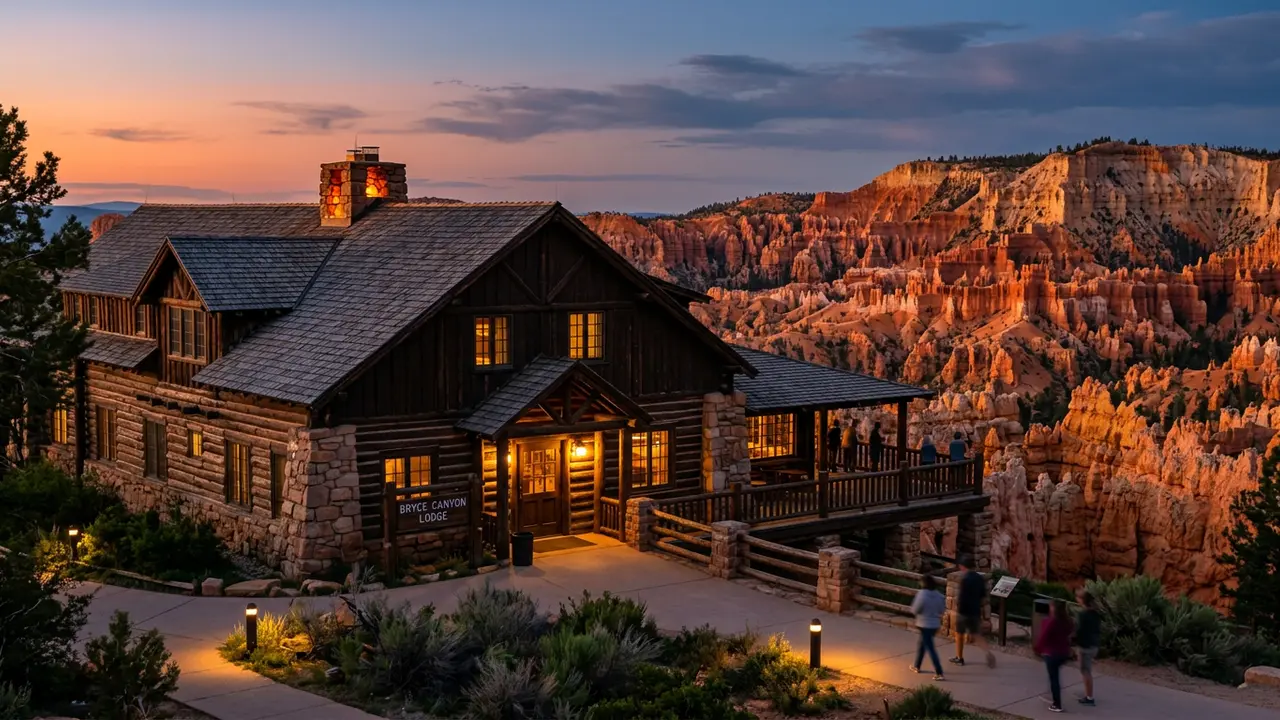
What to bring: Layer generously. The Observatory sits at high elevation, and even a July afternoon turns to freezing well after sunset. Jackets, hats, and a blanket for your lap make the difference. The lodge has some outdoor seating, but your comfort gear is non-negotiable for a full 2.5 hours.
Accessibility: The telescope stations operate at ground level; contact the operator directly to discuss specific mobility needs or setup questions.
Getting there: The Observatory is at 1 Mile South East Fork Road, Bryce Canyon City, UT 84764. It's on the boundary of the park, 30 minutes from the main gate. Self-drive and arrange your own transport; there's no shuttle from the park or town.
Languages: Tours are conducted in English.