The Grand Canyon Star Party is eight nights of free, ranger-led stargazing on the rim of one of the darkest big landscapes in the American Southwest, no telescope of your own required. In 2027 it runs May 29 through June 5 on the South Rim, timed close enough to the new moon that the canyon's layered rock disappears into black and the sky above it fills in with stars most visitors have never actually seen away from city light.
Dates, location, and what's free
The 2027 event runs May 29 – June 5 at Grand Canyon National Park's South Rim, organized by the National Park Service with the Tucson Amateur Astronomy Association bringing in volunteer astronomers and their own telescopes for the week. The event itself is free, though the standard park entrance fee still applies: $35 per vehicle, valid for seven days. There's no registration or ticket to arrange in advance. Show up after dark, find a telescope with a line, and wait your turn.
Grand Canyon has held International Dark Sky Park status for years, which is the reason a week like this works here at all: the park has already done the lighting-policy work that keeps its night sky usably dark, rather than washed out by nearby development the way most national parks now are.
Ranger programs and telescope viewing
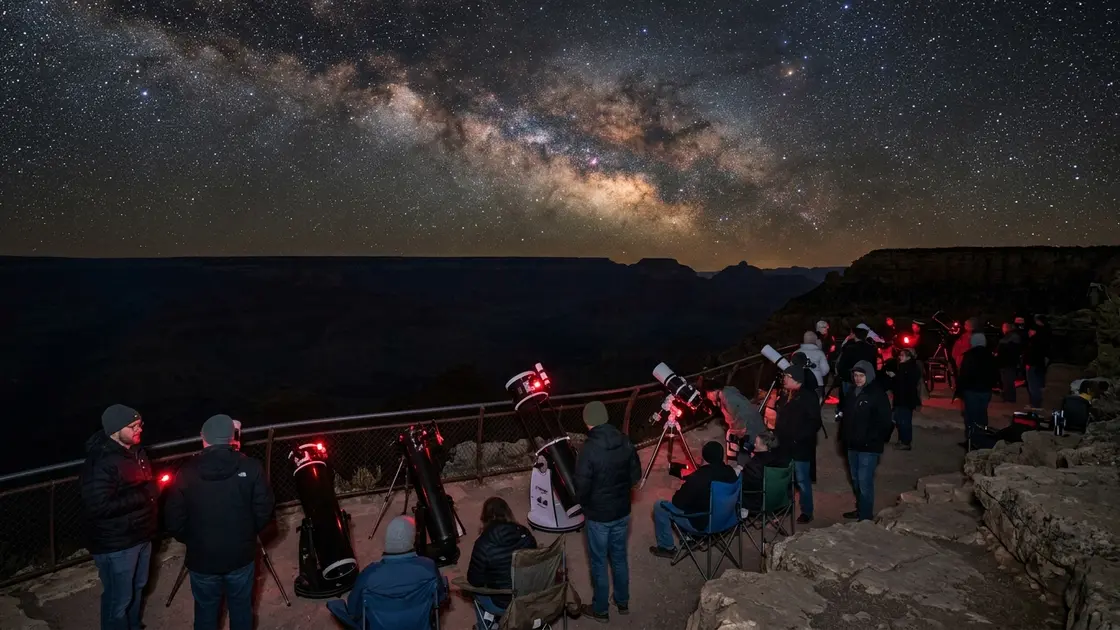
The event opens at sunset, but the real payoff starts once twilight has fully faded, typically after 9 pm. Park rangers run constellation tours at 9:00, 9:30, and 10:00 pm, walking small groups through what's overhead with a green laser pointer, no gear needed to follow along. Guest speakers give evening presentations at 8:00 pm, usually astronomers or NASA-affiliated researchers covering that year's sky highlights. Telescope viewing runs the rest of the evening, staffed mostly by TAAA volunteers who'll happily explain what you're looking at, whether it's Saturn's rings or a faint smudge that turns out to be a galaxy.
None of this requires owning a telescope, a star app, or any prior stargazing experience. It's built for a family with kids as much as for someone who's tracked meteor showers for a decade, and the ranger programs are explicitly pitched at first-timers.
Where to watch on the South Rim
Mather Point is the default gathering spot and the most convenient, right by the main visitor center, which also means it draws the thickest crowds once the telescopes come out. If you'd rather find a quieter stretch of rim with the same dark sky, drive out Desert View Drive to Moran Point or Lipan Point, both a short detour off the main road with far less foot traffic and, at Lipan Point especially, an open eastern view that's good for catching the Milky Way's core rising later in the night.
Either way, bring a headlamp with a red-light setting. White light ruins night vision for everyone standing near a telescope eyepiece, and rangers will ask you to switch it off if you forget.
What about the North Rim?
The North Rim has run its own, separate Star Party in past years, but the 2026 edition was cancelled after the Dragon Bravo Fire, and as of this writing its 2027 status has not been confirmed. Don't plan a North Rim stargazing trip around this event without checking the NPS Grand Canyon Star Party page directly first. The South Rim dates above are the only ones confirmed for 2027.
Planning your trip
The South Rim sits at over 7,000 feet, and late May nights there still drop into the 40s Fahrenheit even after warm days, so pack real layers, not just a jacket for photos. Parking near Mather Point fills up fast once the sun sets; arriving before dusk buys you a closer spot and time to find a good line at a telescope before the crowd thickens.
This event covers one specific week on one specific rim. For the rest of the year, or if late May doesn't fit your travel dates, the best dark sky parks in the world ranks Grand Canyon alongside 11 other certified parks and reserves worth building a trip around. And if awareness rather than a single event is what you're after, International Dark Sky Week is the separate, worldwide April campaign against light pollution, not tied to any one park.