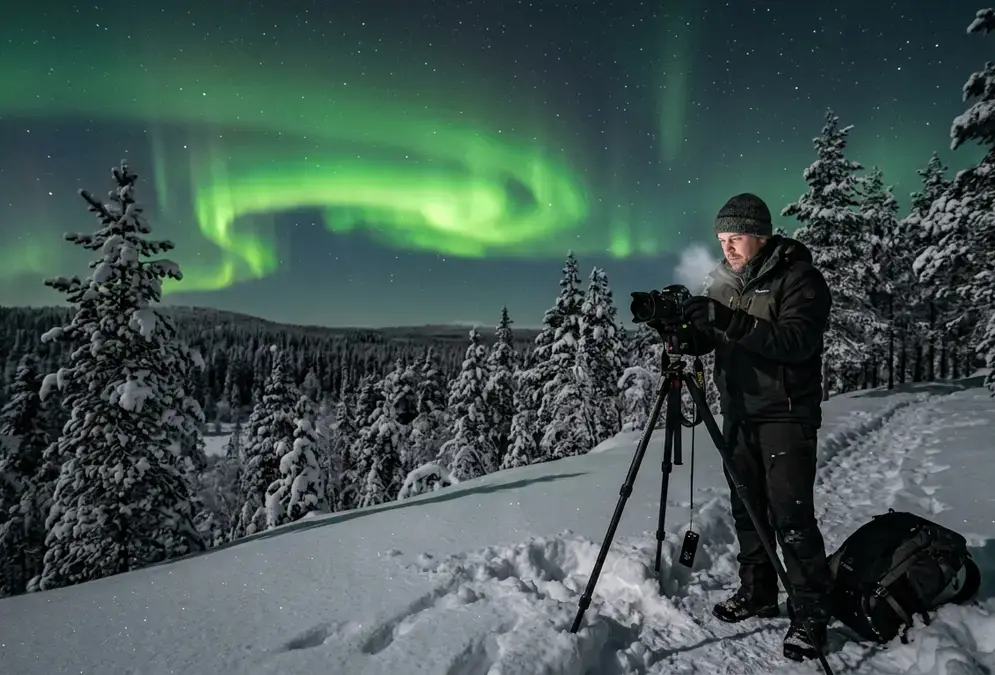
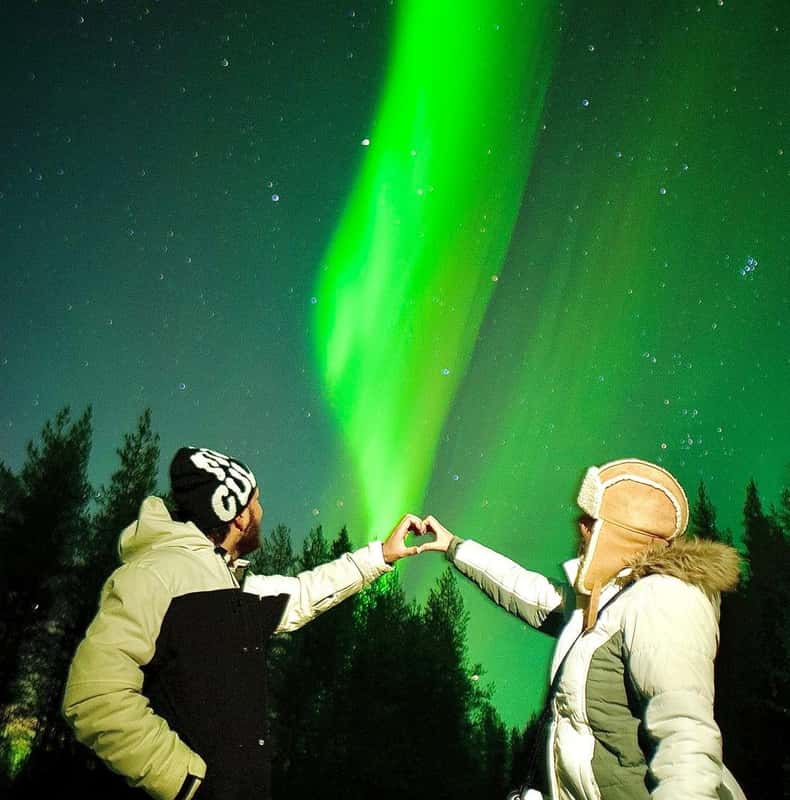
Photographer with tripod capturing green aurora borealis over a snow-covered pine forest near Rovaniemi, Finnish Lapland
Astrophotography

Guided Aurora Photography in Finnish Lapland

7–10 hours
Nightly departures September through March, weather permitting. Typical departure 6–9 PM from Rovaniemi depending on how early darkness falls; return between midnight and 4 AM. Guides adjust timing and routing against live Kp index readings and cloud-cover data.
Hotel pickup in central Rovaniemi, typically 6–9 PM depending on darkness, with an equipment brief covering camera settings before departure
All activities

Rovaniemi's aurora-tour market runs almost entirely on one script: a minibus, a thermal suit, and a guide who points at the sky. A photography tour breaks from that script before the aurora even shows up, setting up test shots against the dark treeline while the group waits for full darkness, so that when the display actually moves, cameras are already dialed in instead of being fumbled with in thick gloves. This is the guided, in-field version of aurora photography in Finnish Lapland; if you already own a cold-rated kit and just want the settings, that's a different problem than the one this tour solves.

What the guide actually teaches

Instruction starts in the van, before anyone steps outside. Guides run through manual mode: ISO 800 to 3200, aperture f/2.8 or wider, shutter speed 3 to 4 seconds for a moderate display, adjusting as the aurora brightens or speeds up. Manual focus locked to infinity gets checked before departure, since a soft-focus aurora photo is the single most common failure among people shooting alone for the first time. Composition gets real attention too. Lapland's frozen lakes, kelo pine forests, and open fell terrain around Rovaniemi offer different foreground options than a flat parking lot, and a guide who has shot the same handful of sites repeatedly knows which angle actually holds up once the aurora starts moving. Groups run small, typically 6 to 8 guests, tight enough that the guide checks every camera before the group moves to the next stop.

Battery cold and the fogging problem

Rovaniemi's winter runs from around −10°C in September and October to −20°C to −30°C during December and January's kaamos, the polar night, and lithium batteries lose roughly half their rated capacity somewhere in that range. Guides carry hand warmers, but the tour still depends on each guest bringing at least three spare batteries; one camera running on a single battery for seven to ten hours in true Arctic cold is a bet that rarely pays off. The other trap guides walk through: carrying a cold camera straight into a heated van fogs the lens and sensor from the inside within seconds, and that fog doesn't clear until the whole body warms back up. Sealing the camera in a bag before it goes anywhere warm is standard practice on these tours, and guides remind the group every time the van door opens. See our Lapland aurora photography gear guide for the full kit list.

Premium price, fewer operators

Photography-focused aurora tours around Rovaniemi run €240 to €380 for 7 to 10 hours, roughly double or triple the cost of a standard chase tour that skips the coaching. Fewer companies offer the photography version at all: a couple of premium listings on GetYourGuide build the entire tour around camera instruction and professional photo delivery, and Viator carries a comparable van-based option, but it's a smaller, higher-priced niche next to the basic aurora hunt. The extra cost buys a guide who is a working photographer rather than a driver with a flashlight, real-time routing against live cloud cover and the Kp index, and a set of high-resolution photos from the guide's own camera as backup if personal shots don't quite land.

No guarantee, and what backs it up

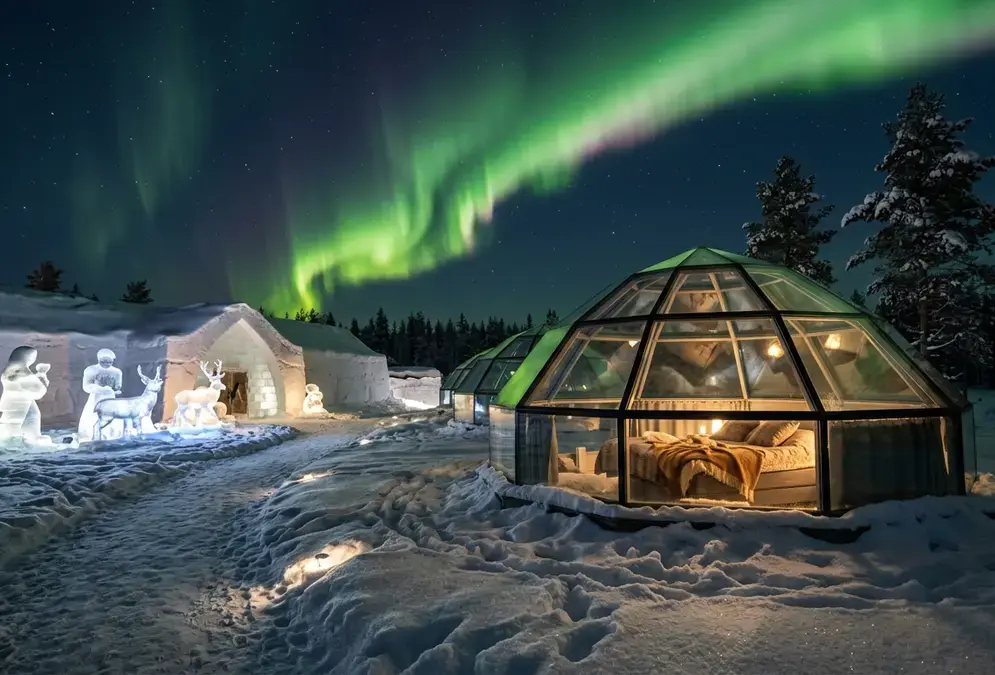
No operator can promise the lights will show. Solar activity and cloud cover sit outside anyone's control, in Lapland the same as everywhere else the aurora appears. What the premium price buys instead is a guide who reads the forecast rather than guessing, and delivered photos as insurance against a night where camera settings didn't come together fast enough. If seeing the lights matters more than photographing them, the region's standard aurora hunts start around €129 and skip the camera coaching entirely. For photographers who'd rather shoot from a fixed base with the sky built into the room, Kakslauttanen's glass igloos put the aurora over the bed instead of at the end of a drive. For flight and transfer details into Rovaniemi, see getting to Rovaniemi.
Highlights

  • Real-time camera coaching from a professional aurora photographer, not a driver reading a script
  • Live weather and Kp-index routing toward the clearest patch of sky that night
  • Composition guidance against Lapland's frozen lakes, kelo pine forests, and open fell terrain
  • Battery-management coaching for genuine Arctic cold: rotation timing, warm storage, fogging prevention
  • High-resolution photos from the guide's own camera, a backup if personal shots don't capture the display
  • Small groups of 6 to 8 guests for real one-on-one attention

Included

  • Professional aurora photographer as guide
  • Real-time weather and cloud tracking with flexible routing
  • Camera settings coaching (manual mode, ISO, aperture, shutter speed)
  • Tripod setup assistance and composition guidance
  • Battery-management advice for extreme cold
  • Hot drinks and snacks
  • High-resolution photos from the guide's camera
  • Hotel pickup and drop-off in central Rovaniemi

Not included

  • Personal camera equipment (bring your own DSLR or mirrorless body)
  • Extra batteries beyond what you bring yourself (guides carry hand warmers, not spare batteries for the group)
  • Post-processing or editing of your own photos
  • Tripod rental (some operators include it; confirm when booking)
  • Meals beyond hot drinks and snacks

Practical information

Availability

September through March; peak aurora frequency runs December through January, though extreme cold can slow down the coaching itself

Languages

English, Finnish

Group size

Max 6–8 guests (small group for personalized coaching)

Good to know before booking

  • DSLR or mirrorless camera required (not a smartphone or point-and-shoot)
  • Basic manual-mode familiarity is helpful but not required; guides teach from scratch
  • At least three spare camera batteries recommended; cold drains lithium cells fast
  • Tripod strongly recommended; confirm with your operator whether one is provided
  • Warm winter clothing essential underneath any provided thermal layer
  • Physical stamina for 7 to 10 hours outdoors in extreme cold

Prices & Booking

From €240 approx.

From €240 per person; premium or private coaching sessions run closer to €380

Nightly departures September through March, weather permitting. Typical departure 6–9 PM from Rovaniemi depending on how early darkness falls; return between midnight and 4 AM. Guides adjust timing and routing against live Kp index readings and cloud-cover data.

An editorial guide to this experience. Book directly with the operator when you plan your trip.

Tags

aurora photography guided tour lapland finland rovaniemi astrophotography small group winter arctic kaamos

Frequently asked questions

What's the difference between this and a standard aurora tour in Lapland?

A standard chase tour drives you to clear sky and lets you watch. This tour adds a working photographer-guide who sets your camera to manual mode, checks focus and exposure in real time, and coaches composition against Lapland's fells and frozen lakes. It costs roughly double to triple a standard hunt (€240–380 versus about €129) and caps groups at 6–8 guests instead of a full minibus.

Do I need my own camera for the tour?

Yes. The tour is built around a DSLR or mirrorless camera in manual mode; a phone camera can't hold the long exposures aurora photography needs. Guides teach settings from scratch, so prior experience isn't required, but bring your own body and lens or arrange a rental in Rovaniemi before the tour.

What camera settings work for aurora photography in Lapland?

Start in manual mode: ISO 800 to 3200, aperture f/2.8 or wider, shutter speed 3 to 4 seconds, focus locked manually to infinity. Guides adjust these live as the aurora brightens, fades, or starts moving faster, which changes the ideal shutter speed within seconds.

How cold does it get, and will it kill my camera battery?

Rovaniemi temperatures run from around −10°C in the shoulder season to −20°C to −30°C during December–January's kaamos. Below about −10°C, battery output can drop to 40–50% of its rated capacity. Bring at least three spare batteries, keep them in an inner coat pocket, and rotate every 30 to 40 minutes; guides carry hand warmers but not enough spare batteries for the whole group.

Is the aurora guaranteed on a photography tour?

No. Solar activity and cloud cover are outside any guide's control, and photography tours are no exception. What the premium price buys is a guide who tracks live weather and the Kp index to route toward the clearest sky, plus high-resolution photos from the guide's own camera as a backup if personal shots don't capture the display.

What's included in the price?

From about €240 for 7–10 hours: a professional photographer-guide, real-time weather routing, camera-settings coaching, tripod setup assistance, hot drinks and snacks, hotel pickup and drop-off, and high-resolution photos from the guide's camera. Personal camera gear, extra batteries beyond what you bring, and meals beyond snacks aren't included.

Further reading

Sources