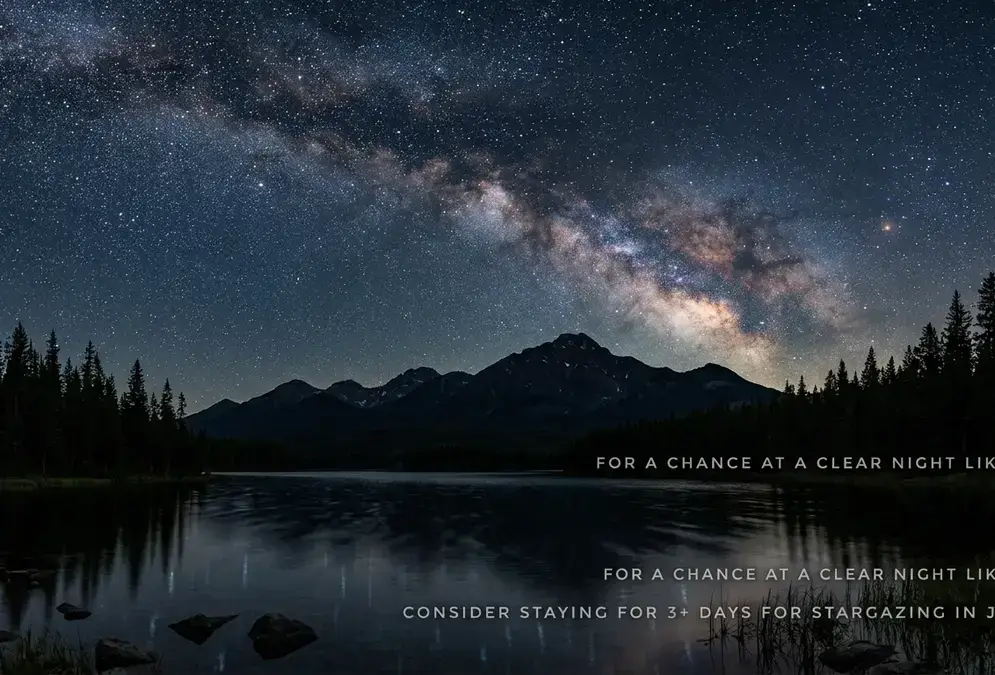

The short answer: two, three, or four nights
Two nights covers the minimum version of a Jasper stargazing trip: one evening close to town, one weather backup, and nothing else. Three nights adds a full day on the Icefields Parkway without giving up a stargazing evening, and buys you a second shot at clear skies if the first night clouds over. Four nights turns that same Parkway drive into a one-way relocation toward Banff instead of a there-and-back day trip, which matters if you're building a longer Canadian Rockies itinerary rather than a dedicated Jasper weekend.
None of this requires the trip-planning gymnastics of a long-haul dark-sky destination. Jasper Dark Sky Preserve is one of the world's largest Dark Sky Preserves, designated by the Royal Astronomical Society of Canada[1], and it sits inside a national park reachable from Edmonton or Calgary in half a day's drive. That accessibility is the whole point of choosing Jasper over somewhere that demands a 20-hour flight and a week of acclimatization: you can test whether stargazing for beginners is a hobby worth building future trips around over a long weekend, or commit to four nights and fold in the Parkway and a Banff comparison without the stakes of a once-in-a-decade trip.
Featured · Destination
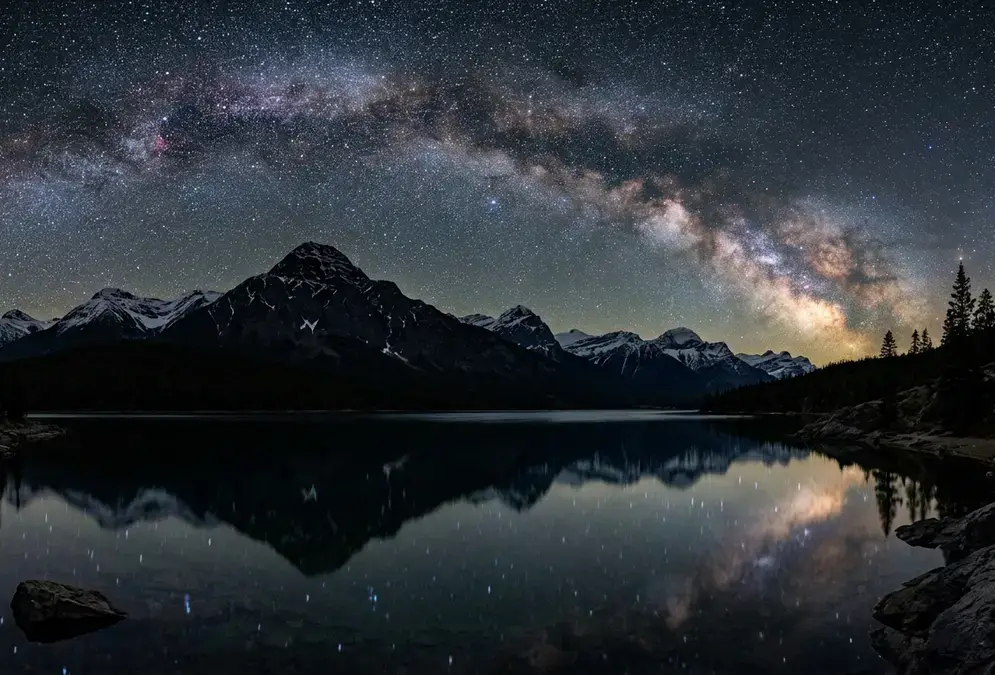
Stargazing in Jasper National Park
Jasper National Park is widely called the largest accessible Dark Sky Preserve in Canada: 11,228 km², an October Dark Sky Festival, and a 38-seat planetarium.
One caveat before the itineraries below: aurora is possible at this latitude, especially during periods of high solar activity, but Jasper isn't built around it the way Tromsø or Fairbanks are. Treat any aurora sighting as a bonus layered on top of the Milky Way and the Dark Sky Preserve's real draw, never the reason you book the trip in the first place.
Compare that to Aoraki Mackenzie or NamibRand, where the itinerary math starts with a long-haul flight and a multi-day acclimatization buffer before you even reach the dark site. Jasper's version of 'how many days' is a domestic road-trip question, not a bucket-list commitment, which is the real reason the answer here is two, three, or four nights instead of two weeks.
Two nights: the minimum viable stargazing trip
This is the floor, not the ideal, but it works well for a couple's weekend add-on to a longer Rockies trip, or for testing the Dark Sky Preserve before committing more time to it.
Day 1: Arrive and orient with the Jasper SkyTram up Whistlers Mountain in the afternoon, then head out for night one. Old Fort Point and Pyramid Island/Pyramid Lake both sit under ten minutes from the townsite, which matters on a short trip: if clouds roll in, you haven't burned an hour driving to a dark site only to turn around empty-handed.
Day 2: Spend the day on the Maligne Canyon hike or a wildlife-viewing drive along Maligne Lake Road, then stargaze at Maligne Lake itself that evening, about 50 minutes from town. If the sky doesn't cooperate, the Jasper Planetarium's dome-and-telescope session at the Fairmont Jasper Park Lodge is the weather-proof fallback, and it's worth booking ahead rather than treating it as a walk-up option.
This sequence mirrors the Jasper Dark Sky Festival's own self-guided single-evening route: SkyTram in the afternoon, the Maligne Lake Road drive in the evening, Pyramid Island or Lac Beauvert as the night finale[2]. Two nights just gives you that route twice, with a planetarium visit as insurance. Pack layers even in July, since night temperatures at these elevations drop fast once the sun is down, and cell coverage thins out well before Maligne Lake, so download offline maps before you leave town; the stargazing gear for beginners guide covers what's actually worth packing beyond a warm coat.
What two nights doesn't cover: the Icefields Parkway or a Banff extension. Both need a third or fourth night, covered next.
Three nights: building in a weather buffer and the Icefields Parkway
Three nights is where a Jasper stargazing trip stops being a coin flip. You get one full day devoted to the Icefields Parkway without giving up a stargazing evening, and a second dedicated night-sky session instead of one.
Day 1: Arrive, SkyTram or town orientation, night one at Pyramid Lake or Old Fort Point, same as the two-night plan.
Day 2: Drive the Icefields Parkway as a round trip, not a relocation. Athabasca Glacier, Sunwapta Falls, and Athabasca Falls are all reachable there-and-back in a single day, since the round trip from Jasper to the glacier and back is manageable without an overnight stay elsewhere. The glacier itself is visibly smaller than it was even a decade ago, worth knowing if you're planning the foreground for a photo you'll want to compare against one taken years from now. Book the evening for a dedicated Jasper Planetarium telescope session; it doubles as the trip's built-in cloudy-night backup, so a poor forecast doesn't cost you the whole evening.
Day 3: A Maligne Lake day, a canoe or boat tour if you want one, into a third night of stargazing at Maligne Lake or Pyramid Island.
Three nights turns your stargazing session from a single coin-flip into two chances at a clear sky, close to the framing SunDog Tour Company uses when it markets its 3-day Jasper visit around a telescope experience under what it calls the darkest night sky in the Rockies[3]. If your first night clouds out, you still have a second shot before you leave, and the planetarium fills in if both nights go bad.
Three nights turns your stargazing session from a single coin-flip into two chances at a clear sky
Four nights: turning the Parkway into a one-way drive to Banff
Four nights changes the shape of the trip, not just the length. Instead of driving the Icefields Parkway there and back, you drive it once, southbound, and end in Banff.
Days 1-2: Identical to the two-night plan. Town-based, Old Fort Point or Pyramid Lake on night one, Maligne Lake on night two.
Day 3: Check out of your Jasper lodging and drive the full Icefields Parkway southbound toward Banff or Lake Louise, stopping at the marquee pullouts, Bow Lake, Peyto Lake, Athabasca Glacier, Sunwapta Falls, rather than rushing a round trip back to Jasper. The drive itself takes roughly 3.5 hours without stops[4], but that number is almost beside the point on this version of the itinerary: the whole day is built around stopping, not arriving.
Day 4: Base near Banff or Lake Louise and stargaze there for comparison. Banff's park character and light-pollution profile are genuinely different from Jasper's, since it sits closer to Calgary's glow, before you depart via Calgary the next morning.
3.5 hrs
If you're renting a car, confirm you can drop it off in Banff or Calgary instead of driving back to Jasper. Most major agencies allow one-way rentals across Alberta for an additional fee, but it's worth confirming before you commit to this version of the itinerary.
This is the natural bridge if you're weighing Jasper against Banff as a Rockies dark-sky base rather than picking one outright: four nights lets you see both without doubling your total trip length.
Combining Jasper and Banff: how many nights that actually takes
If Jasper is one stop on a bigger Canadian Rockies trip rather than the whole point of the visit, the math changes again. A trip that does both parks properly is generally recommended as a five-day minimum, split roughly two to three days in each, plus the drive between them[5].
That's longer than any of the itineraries above, and worth knowing before you build a four-night Jasper-only trip and try to bolt Banff onto the end. The four-night version gets you one comparison night in Banff, not a real Banff stay. If Banff stargazing and Rockies sightseeing both matter to you as much as Jasper's Dark Sky Preserve, budget the extra nights rather than compressing. Astrophotographers weighing a longer trip should note that a serious Milky Way session benefits from at least two attempts at each location, since a single cloudy night at Maligne Lake or in Banff can otherwise cost you the shot entirely.
A few practical notes for the drive itself, whichever direction you take it: there's no cell signal along most of the Icefields Parkway, and the last gas station before Jasper, heading north from Banff or Lake Louise, is at Saskatchewan River Crossing[4]. Fill the tank in Banff or Lake Louise, download offline maps, and tell someone your rough schedule before you lose signal. None of this is dangerous with basic preparation, but it catches first-timers who assume a Rockies highway behaves like any other.
Whichever itinerary you choose, check the new-moon window before you lock in dates: see when to stargaze for how moon phase, season, and cloud cover interact. If you're still deciding which park to base yourself in for the stargazing itself, the differences come down to Jasper's Dark Sky Preserve status and Festival programming against Banff's proximity to Calgary and a different park character, worth weighing before you fix a night count.
Which itinerary actually fits you
Match the itinerary to what you're actually optimizing for, not just the number of nights you happen to have available.
- Two nights — testing the idea, a couple's weekend add-on, no real margin if weather turns against you.
- Three nights — the recommended baseline for most first-time dedicated visits: one round-trip day on the Icefields Parkway, two stargazing evenings, and a planetarium session kept as a backup.
- Four nights — the right call if you're continuing on to Banff or building a longer Rockies road trip rather than treating Jasper as a standalone weekend.
| Nights | Best for | What you get | What you skip |
|---|---|---|---|
| 2 | Weekend add-on, testing the idea | One stargazing evening plus a planetarium backup | Icefields Parkway, a Banff extension |
| 3 | Most first-time dedicated trips | Two stargazing evenings, an Icefields Parkway round trip | A true Banff stay |
| 4 | Longer Rockies road trips | A one-way Icefields Parkway drive plus a Banff comparison night | A full multi-night Banff stay of its own |
Whichever length you pick, book your Jasper Planetarium session and check the moon calendar before you fix your dates. An itinerary built around a full-moon week still gets you the Rockies scenery, but a washed-out Milky Way, no matter how carefully you've sequenced the rest of the days.
There's no version of this itinerary that requires the logistics of a long-haul trip: every one of these plans is buildable around a handful of days off work and a rental car, which is the entire case for choosing Jasper as your first dark-sky destination rather than saving the idea for a bigger trip someday.