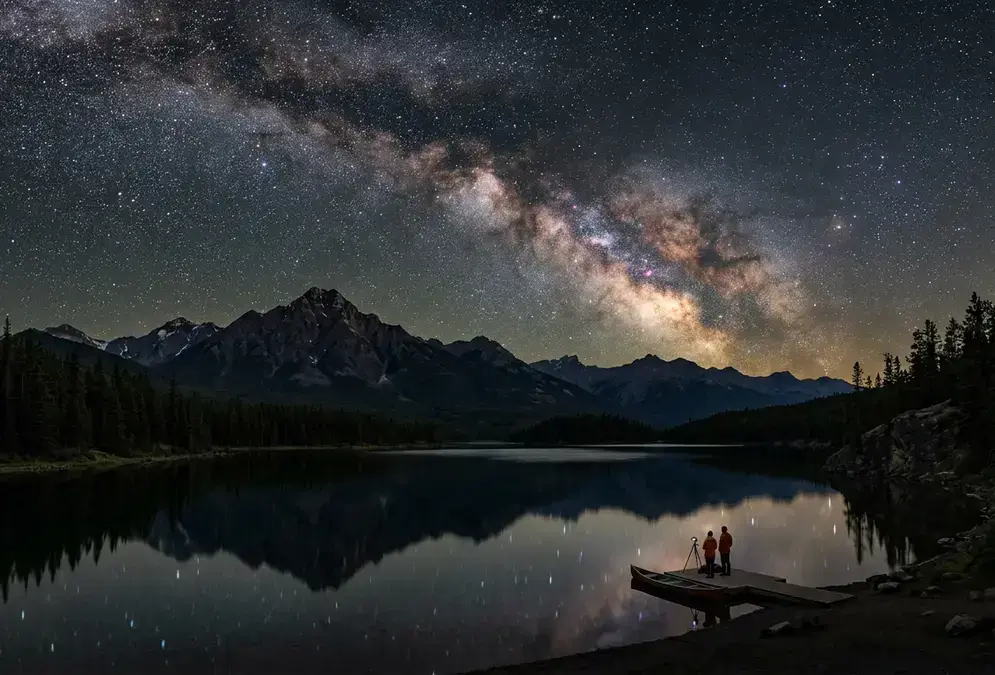

What you actually get: access over spectacle
Jasper National Park earned Royal Astronomical Society of Canada Dark Sky Preserve designation[1], and the town of Jasper sits inside the preserve boundary -- a rarity among large reserves, most of which keep visitor infrastructure well outside the darkest zone. That single fact does a lot of the explaining for why this cluster exists: you can stay at the Fairmont Jasper Park Lodge, which houses the Jasper Planetarium, and be under a genuinely dark sky twenty minutes later.
Getting there is the whole pitch. Most visitors choose one of two access routes:
- Fly into Edmonton (YEG), where international flights land daily[2], then drive roughly four hours west on Highway 16.
- Fly into Calgary (YYC) and drive about five hours north-west, much of it along the Icefields Parkway -- a scenic drive that's arguably worth the trip on its own, past the Athabasca Glacier and the Columbia Icefield.
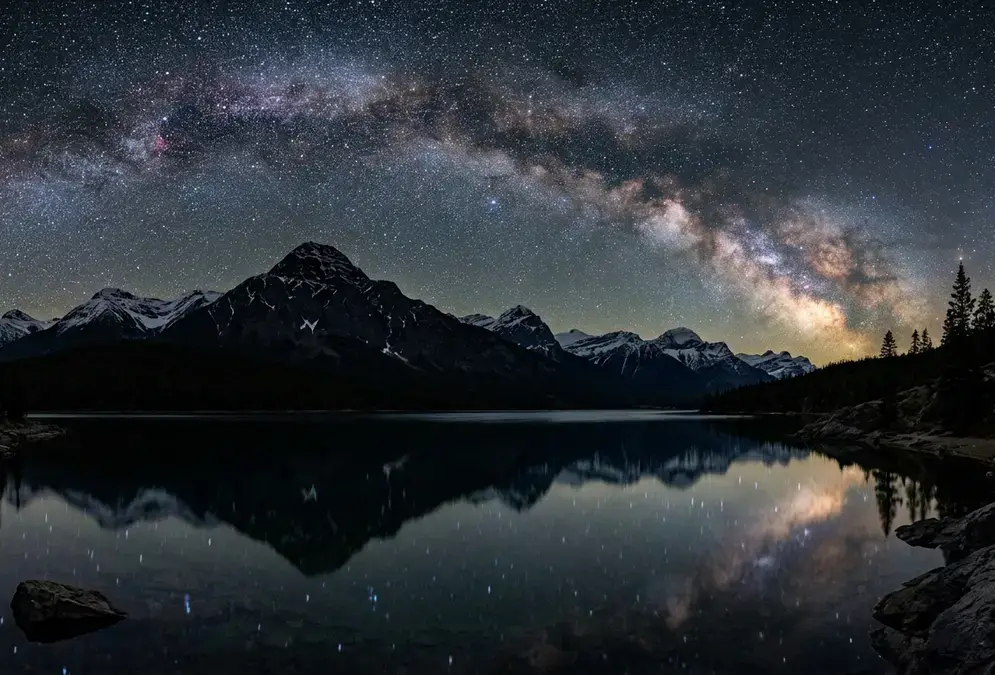
Featured · Destination
Stargazing in Jasper National Park
Jasper National Park is widely called the largest accessible Dark Sky Preserve in Canada: 11,228 km², an October Dark Sky Festival, and a 38-seat planetarium.
Either way, a Parks Canada pass is required for entry, and neither route involves a transatlantic connection or the kind of multi-flight routing that eats two full days each way to reach Chile or Namibia.
The honest aurora picture
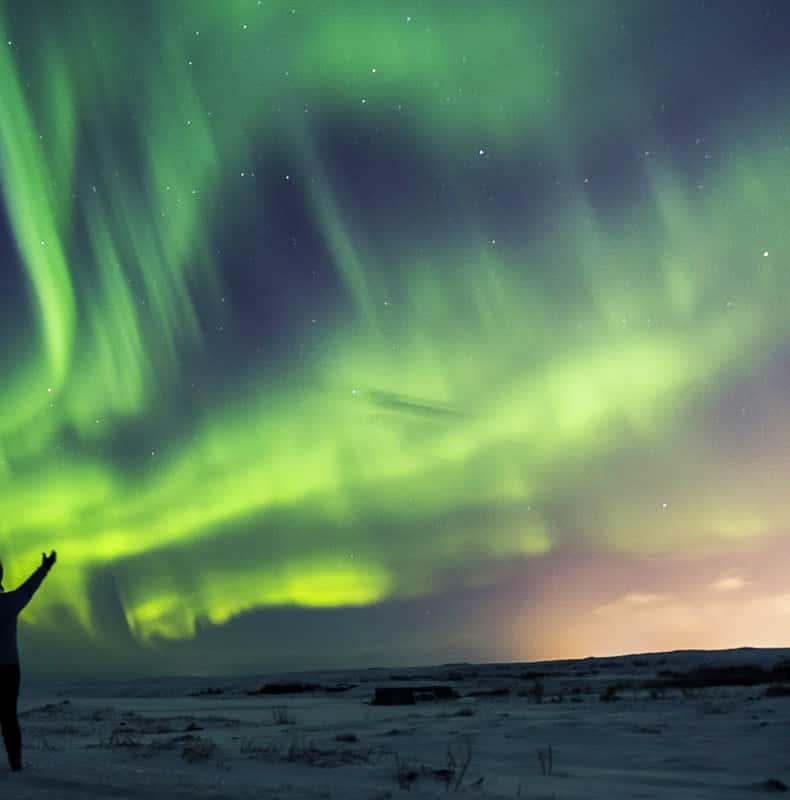
Jasper's own dark-sky tourism coverage is refreshingly blunt about what to expect overhead: 'the aurora borealis comes to Jasper around once a week,' and while that's a real, non-trivial cadence, it's a fraction of what a dedicated aurora-chasing trip promises. The same coverage frames Jasper as 'a lot easier to get to' than the far-north aurora destinations, with 'much more dark sky infrastructure in place' than most remoter alternatives[3] -- which is really the point. Jasper trades aurora frequency for accessibility and built-out visitor support.
~1x/week
If the northern lights are the actual goal, the honest move is comparing Jasper against the destinations built around them[4]:
- Tromsø, Norway -- tours from about $120 per person, six-day packages from roughly $1,774, not including flights.
- Iceland -- tours from around $60 per person, five-day packages from about $1,179, not including flights, often with a sighting guarantee and free rebooking.
- Finnish Lapland -- five-day aurora packages from about $1,150, not including flights[4].
All three also require a long-haul flight for most North American travelers. Jasper doesn't replace them for aurora odds -- it isn't trying to.
None of this means Jasper's skies stay green-free. The current solar cycle peak pushes more geomagnetic activity toward mid-latitudes than a quiet solar-minimum year would, so a trip timed around an active stretch has genuinely better odds than the once-a-week baseline suggests. A good aurora night in Jasper is a real bonus worth staying up for -- the Kp index explained helps you judge your odds on any given night. But if the northern lights are the entire reason for the trip, is Iceland worth it for northern lights is the more honest question to ask first.
The Rockies scenery: an independent reason to go
Jasper works as a trip even before the stars enter the picture, because the daytime scenery inside the same park boundary is exceptional:
- Pyramid Lake and Pyramid Island -- a short walk from town, and one of the most photographed stargazing viewpoints in the park.
- Maligne Lake -- turquoise, glacier-fed, ringed by peaks.
- Mount Edith Cavell -- a dramatic north face and the Angel Glacier, reachable by an accessible day hike.
- Athabasca Glacier and the Columbia Icefield -- directly off the Icefields Parkway, walkable onto the ice with a guided tour.
None of this demands the multi-day altitude acclimatisation that a trip to the Andean altiplano requires. Jasper townsite occupies a modest valley elevation, and nothing on the standard sightseeing circuit forces the kind of gradual adjustment that thinner-air destinations like the Atacama do.
The scenery compounds the value case. A Jasper trip isn't a single-purpose stargazing pilgrimage the way a moon-timed run to the Atacama or NamibRand tends to be -- you can spend the day on the Icefields Parkway or hiking toward Angel Glacier, and still make it back to a dark-sky viewpoint by nightfall.
For astrophotographers specifically, Pyramid Island and the Old Fort Point overlook both give a mountain silhouette to frame the Milky Way against, which matters more than it sounds: a flat horizon photographs as an empty band of stars, while a jagged Rockies skyline gives the shot a sense of place the moment someone sees it.
The real costs -- and how they compare
Jasper's stargazing spend sits closer to a domestic weekend trip than a bucket-list expedition: a park pass, a planetarium or guided astronomy tour ticket, and a moderate-range hotel or lodge -- no premium eco-lodge pricing, no captive-market desert-town markup. At the low end, the lodging line nearly disappears: camping in Whistlers or Wapiti puts a tent under the same preserve sky for pocket change by lodge-night standards.
Recommended tours
Tours are selected for quality, not commission. I earn a small fee if you book — at no extra cost to you.
Compare that to the other non-aurora-primary option in this portfolio. Aoraki Mackenzie International Dark Sky Reserve in New Zealand requires flying into Christchurch, then driving about three hours to Lake Tekapo[6] -- a long-haul Southern Hemisphere trip for almost every traveler outside Australasia. NamibRand Nature Reserve in Namibia is more remote still, a long dirt-road transfer from the nearest town[7], and its eco-lodges sit at genuine luxury pricing. Both are worth the trip on their own terms -- see is the Atacama Desert worth it for stargazing for how that calculus plays out for South America's flagship dark-sky region -- but neither is a weekend option the way Jasper is.
| Destination | Getting there | Trip style |
|---|---|---|
| Jasper (Alberta, Canada) | Domestic-scale flight to Edmonton or Calgary, then a scenic drive | Weekend to a few nights, moderate cost |
| Tromsø / Iceland / Lapland | Long-haul flight to Northern Europe | Aurora-chasing trip, week-long packages |
| Aoraki Mackenzie (New Zealand) | Long-haul flight to Christchurch, then a 3-hour drive | Southern Hemisphere expedition |
| NamibRand (Namibia) | Long-haul flight plus a remote transfer, nearest town ~140 km away | Remote, premium eco-lodge trip |
You don't need the once-a-decade trip mentality that Aoraki or NamibRand practically demand. Jasper works as a long weekend tacked onto a Calgary or Edmonton visit already on the calendar for other reasons, which is the whole case for calling it accessible astro-tourism rather than an expedition.
The flight math is the real lever here. Skip the long-haul leg to Santiago, Windhoek, or Reykjavik and the whole trip gets cheaper and shorter before a single Jasper-specific dollar is spent -- a two-flight domestic routing through Edmonton or Calgary simply costs less and eats less vacation time than any transatlantic or transpacific alternative in this comparison.
Who Jasper suits -- and who should look elsewhere
Jasper suits the traveler who wants real dark skies without treating the trip as a moon-timed expedition. If you're the kind of person comparing Iceland aurora packages against a mortgage payment and wondering whether there's a closer option that still delivers a genuinely dark sky, Jasper is built for exactly that question.
It also suits beginners and families. There's no altitude to manage, no remote transfer to plan around, and the Jasper Dark Sky Festival each October gives first-timers a built-in reason to visit when programming, telescopes, and planetarium shows are all running at once.
Who should think harder before booking:
- Dedicated aurora-chasers who want near-nightly odds -- Tromsø or Iceland deliver that; Jasper doesn't try to.
- Travelers drawn to the once-in-a-lifetime remoteness of NamibRand or the Southern Hemisphere novelty of Aoraki.
- Anyone expecting Bortle-1 desert-level darkness identical to the Atacama's high-altitude plateau -- Jasper's skies are genuinely dark, but a temperate mountain valley isn't the same optical environment as a high-altitude desert.
The verdict on Jasper
Jasper is worth it if the honest pitch is what you actually want: a Dark Sky Preserve you can reach without a long-haul flight, Rockies scenery that stands on its own, and a modest, welcome chance at the aurora rather than a guaranteed one.
What it isn't worth it for is a dedicated aurora hunt. If seeing the northern lights is the entire point of the trip, book Tromsø or Iceland and treat any green over Jasper as a bonus on a different kind of trip. But for the traveler weighing a moderate-cost stargazing trip against a week-long, long-haul commitment, Jasper is the rare destination that asks for a long weekend instead of a leave-of-absence -- and still delivers a sky worth the drive.