All articles
Written by Maya Okonkwo
  • 4 min
  • 22 sources

Were the Pyramids of Güímar Built to Track the Solstice?

Do the Pyramids of Güímar track the solstice? A 1991 survey says the walls align with the sun, but excavation dates them to the 19th century, not Egypt.
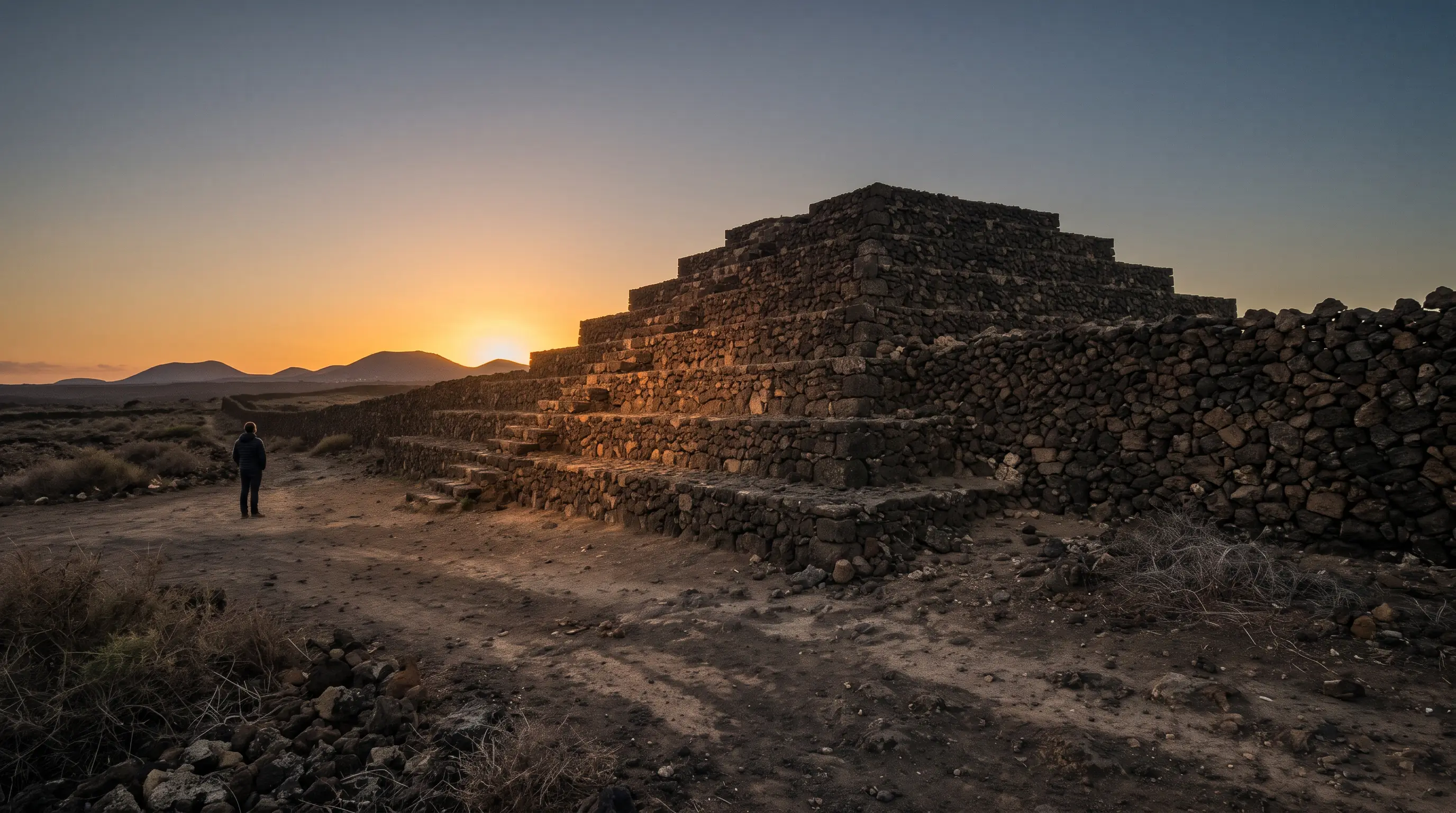
Pyramids of Güímar at solstice sunset, rectangular stepped lava-stone terraces with a western stairway, low orange light and a mountain peak on the horizon

Illustration of the stepped majanos at Chacona: up to 12 m high, oriented to the solstices, built in the 19th century.

The stepped lava-stone pyramids of Güímar, up to 12 m high[1], are measurably aligned with the solstices: astronomers from the Instituto de Astrofísica de Canarias (IAC) found in 1991 that the main complex marks the summer-solstice sunset on one side and the winter-solstice sunrise on the other[2]. The Egypt-to-the-Maya story attached to them does not hold: the owner's 1854 purchase deeds do not mention the terraces and his 1872 will does, an 18-year window[3], and Aparicio and Esteban date the structures to 1854–1881[4]. The alignment is measured, but whether anyone intended it is still contested.
Tallest pyramid
12 m
Maximum height of the stepped lava-stone terraces[1]
IAC solstice survey
1991
Main complex found oriented to solstice sunset and sunrise[2]
Deeds-to-will window
18 years
1854 deeds omit the terraces; the 1872 will lists them[3]

The claim and what the 1991 survey measured

The claim travels in its tidiest form as one line: the pyramids "were built following an exact alignment with the summer and winter solstices"[5]. The 1991 survey by IAC researchers Belmonte, Esteban and Aparicio reported something plainer, an astronomical orientation of the main complex[2]. "Oriented" is a weaker word than "exact", and the gap between the two is where the argument starts.
Read narrowly, the finding is two sight lines and nothing more. It does not say who set them, in which century, or for what purpose, and every later argument about the pyramids is an argument about one of those three gaps. The survey's authors wrote it up for Archaeoastronomy in 1993[6] and added a short follow-up there the next year[7]. The published figures are in that paper; this page does not restate them.
Two features carry the alignment: the main limiting wall, which sights the summer-solstice sunset, and the stairs on the pyramids' western sides, which look toward the winter-solstice sunrise[8]. Both can be checked on the ground at the right time of year. That is more than most "ancient alignment" stories can say for themselves.
Around the summer solstice the park stages a double sunset: seen from the main complex, the sun slips behind a mountain peak, returns for a few minutes, then sets for good[9]. For anyone building a Tenerife stargazing trip around the June solstice, it is the one event in this story you can actually attend.

Heyerdahl's solar temples versus the 19th-century record
Heyerdahl and the excavators answer a different question from the astronomers. The alignment is a measurement of where the walls point; the temple theory is a claim about who built them, and that is the half the record contradicts.
Milky Way arching over Mount Teide volcano at new moon, galactic core visible above the caldera with the sea of clouds below at 2,000 metres, Teide National Park dark sky

Featured · Destination

Tenerife Stargazing

Tenerife stargazing guide: Teide National Park's UNESCO Bortle-2 skies, 83 constellations visible. Observatory visits from €21, Parador hotel, and best tours.

The two claims also fail in different ways. A surveyed orientation can mislead about intent but not about the compass, while a construction date collapses the moment one deed or one pottery find contradicts it.

What Heyerdahl proposed

Thor Heyerdahl's case rests on three claims:
  • The pyramids are solar temples raised by ancient civilizations before Columbus[10]
  • The Canarian pyramids were a stopping point on voyages between ancient Egypt and the Maya[11]
  • Neither the age nor the builders were ever pinned down by Heyerdahl himself[10]
The Guanches, Tenerife's pre-conquest inhabitants, left their own Guanche star myths, but a 19th-century construction date takes them out of the story of who built these terraces.

What the ground and the archive show

The paperwork dates the structures to the 19th century: the 1854 deeds for the land do not mention the stepped structures, and the owner's 1872 will does[3]. The pottery from the first excavation campaign, in the complex's plaza, agrees with that dating[12], and Aparicio and Esteban put construction very probably between 1854 and 1881[4].
Local residents recognise them as majanos, farm constructions for clearing land or drying fruit[13]. A farm origin is humbler than a temple, but it is also the better documented one. Two independent kinds of evidence, one physical and one documentary, land in the same century, which is why I treat the date as settled.

Why a farm wall would face the sun

The date is settled; the orientation is not. Aparicio and Esteban, working from the IAC and La Laguna, concluded in 2005 that the majanos are 19th-century, agricultural and oriented to the summer and winter solstices[14]. Those findings sit awkwardly together, because a purely agricultural origin gives no obvious reason for a solstitial orientation.
The astronomers' own Springer entry describes the Pyramids of Güímar as the construction of "a modern myth where archaeoastronomy has played an essential role"[15]. Two explanations for the orientation now compete.
One reads the stepped form as Masonic symbolism, partly because Antonio Díaz Flores, who owned the estate from 1854, was a Freemason[16]. It speaks to the shape rather than the date or the function, which keeps it a hypothesis.
Molinero Polo's paper in Tabona rejects it. The majanos, the argument runs, were built on the edge of a lava flow "and, consequently, any orientation is accidental"[17].
Wide, respectful photograph of Uluru glowing red at dusk under a star-filled sky on Anangu land, capturing Uluru's cultural significance and the visitor etiquette every stargazer should know

Featured · Article

Uluru Cultural Significance and Visitor Etiquette

Uluru is Anangu land under joint management. Here's why the 2019 climb closure is settled policy, what you can't photograph, and real visitor etiquette.

Spanish Freemasonry's interest in ancient Egypt developed only from the 1870s, when the Chacona structures were already built[18], and Egyptian pyramids were oriented to the cardinal points, not the solstices[19]. That last point cuts two ways: it weakens the Masonic reading, and it leaves the solstice alignment without an Egyptian precedent.
My own lean is toward accident, because it asks the least of the evidence. The Masonic idea has a human logic, a landowner with symbolic tastes, but it needs a field-clearance project to have carried a lodge's symbolism. I'd still call my lean a lean, not a verdict.

What to check before a solstice visit

The park runs a special event around the summer solstice every year, but it publishes the details in June: updated dates, times and capacity go up on its social media channels throughout that month[21]. I would not book flights around a specific date before that announcement.
Regular opening hours are 10:00 to 18:00 every day except 1 January and 25 December[22]. The solstice evening is a separate event, so those hours are the wrong thing to plan around.

Recommended tours

Tours are selected for quality, not commission. I earn a small fee if you book — at no extra cost to you.
I haven't seen the double sunset yet, so I can't tell you how the viewing area copes with a crowd. If I were planning it, I would treat the pyramids as the sunset stop and keep the night for the sky: June falls in the window the best time for stargazing in Tenerife guide rates as peak. Check the park's June announcement before booking anything.
On site, the useful test for any claim you hear is the one used here: ask whether it describes a measurement, a date or a motive. The first two can be checked against the survey and the documents. The third is still open, and a good guide will say so rather than reach for Egypt.

Frequently asked questions

Do the Pyramids of Güímar line up with the solstice?

Partly, and the measured part is narrow. In 1991 IAC researchers found the main complex oriented toward the summer-solstice sunset on one side and the winter-solstice sunrise on the other. The park's own line is "exact alignment"; the survey reported an astronomical orientation, and alignment alone cannot say why the walls point where they do.

Who built the Pyramids of Güímar and when?

They date to the 19th century, as farm structures on the estate, not to an ancient civilization. The 1854 land deeds omit them, the owner's 1872 will includes them, pottery from the first excavation campaign agrees, and Aparicio and Esteban place construction very probably between 1854 and 1881.

Did Thor Heyerdahl prove the Pyramids of Güímar are ancient?

No. He read them as solar temples built before Columbus and linked them to voyages between ancient Egypt and the Maya, but he never determined their age or their builders. Excavation and the land records place them in the 19th century instead.

What is the double sunset at the Pyramids of Güímar?

Around the summer solstice, seen from the main complex, the sun sets behind a mountain peak, reappears for a few minutes, then sets for good. The park holds a yearly event around it and announces the details in June.

Can you visit the Pyramids of Güímar at the summer solstice?

Yes, through the park's solstice event, whose dates, times and capacity are announced on its social media channels throughout June. The regular 10:00 to 18:00 hours do not govern that evening.

Are the Pyramids of Güímar just piles of stones?

In origin, close to it: they are majanos, terraces of volcanic stone built for farming in the 19th century. Local people recognise them as constructions for clearing land or drying fruit, which makes them evidence of Canarian rural work rather than temples.

Sources

22 references Show
  1. Wikipedia (opens in a new tab)

    “These pyramids stand as high as 12m.”

  2. diariodeavisos.elespanol.com (opens in a new tab)

    “comprobaron que el complejo principal está orientado astronómicamente: señala la puesta de Sol del solsticio de verano por un lado y la salida del Sol del solsticio de invierno por otro.”

  3. diariodeavisos.elespanol.com (opens in a new tab)

    “En las escrituras de compra de los terrenos, fechadas en 1854, las estructuras escalonadas no aparecen mencionadas. En el testamento que redactó el propietario en 1872, sí.”

  4. riull.ull.es — 2308 (opens in a new tab)

    “Las morras de Chacona, en Güímar, son construcciones agrícolas levantadas, muy probablemente, entre 1854 y 1881 que, según nuestras investigaciones, presentan marcadas orientaciones solsticiales.”

  5. piramidesdeguimar.es — Pyramids and routes (opens in a new tab)

    “These mysterious pyramids were built following an exact alignment with the summer and winter solstices.”

  6. link.springer.com (opens in a new tab)

    “Belmonte JA, Aparicio A, Esteban C (1993) A solstitial marker in Tenerife: the ‘Majanos de Chacona’. Archaeoastronomy 18 (Supplement to the Journal for the History for Astronomy 24):S65–S68”

  7. link.springer.com (opens in a new tab)

    “Esteban C, Belmonte JA, Aparicio A (1994) A solstitial marker in Tenerife: addendum. Archaeoastronomy 18 (Supplement to the Journal for the History for Astronomy 24):S84–S86”

  8. Wikipedia (opens in a new tab)

    “The main limiting wall points to the sunset in the Summer solstice and the pyramids have stairs on their western side which face the direction of the rising sun on the Winter solstice.”

  9. piramidesdeguimar.es — The double sunset (opens in a new tab)

    “From the main complex, the sun first disappears behind the peak of a mountain and, minutes later, briefly reappears before setting definitively on the horizon.”

  10. diariodeavisos.elespanol.com (opens in a new tab)

    “Sostuvo que eran templos de adoración solar levantados por civilizaciones antiguas antes del descubrimiento de América. Nunca llegó a determinar ni su edad ni quiénes las construyeron.”

  11. Wikipedia (opens in a new tab)

    “Heyerdahl hypothesised that the Canarian pyramids formed a temporal and geographic stopping point on voyages between ancient Egypt and the Maya civilization”

  12. diariodeavisos.elespanol.com (opens in a new tab)

    “Y coincide con la datación de las piezas de cerámica halladas en la primera campaña de excavación realizada en la plaza del complejo.”

  13. riull.ull.es — 46377 (opens in a new tab)

    “la población local las reconoce como majanos, construcciones agrícolas utilizadas para limpiar terrenos o secar frutas.”

  14. diariodeavisos.elespanol.com (opens in a new tab)

    “Su conclusión fue que los majanos datan del siglo XIX, están vinculados a tareas agrícolas y presentan una orientación hacia los solsticios de verano e invierno.”

  15. link.springer.com (opens in a new tab)

    “We discuss about the construction of a modern myth where archaeoastronomy has played an essential role: the Pyramids of Güímar”

  16. diariodeavisos.elespanol.com (opens in a new tab)

    “Antonio Díaz Flores, propietario de la finca desde 1854, era masón.”

  17. riull.ull.es — 18172 (opens in a new tab)

    “the majanos of Güímar were built on the edge of a volcanic lava flow stretching along the land and, consequently, any orientation is accidental”

  18. riull.ull.es — 18172 (opens in a new tab)

    “the interest of the Spanish Freemasonry on ancient Egypt was developed since the 1870’s, at a time when the Chacona structures were already built”

  19. riull.ull.es — 18172 (opens in a new tab)

    “Egyptian pyramids were oriented towards the cardinal points”

  20. Wikipedia (opens in a new tab)

    “it is impossible based solely on these observations to conclude what was the intention of the builders or the building date.”

  21. piramidesdeguimar.es — The double sunset (opens in a new tab)

    “Throughout June, we publish all updated information about dates, times, and capacity on our social media channels”

  22. piramidesdeguimar.es — Es (opens in a new tab)

    “El Parque abre todos los días, de 10:00 a 18:00 horas, excepto el 01 de enero y el 25 de diciembre.”