All articles
Written by Maya Okonkwo
  • 6 min
  • 44 sources

Tenerife's Southern Sky Has Canopus. Most of Europe's Doesn't

Canopus clears Tenerife's southern horizon, while Crux and Alpha Centauri barely do. Latitude, declination and refraction explain why, and when to look.
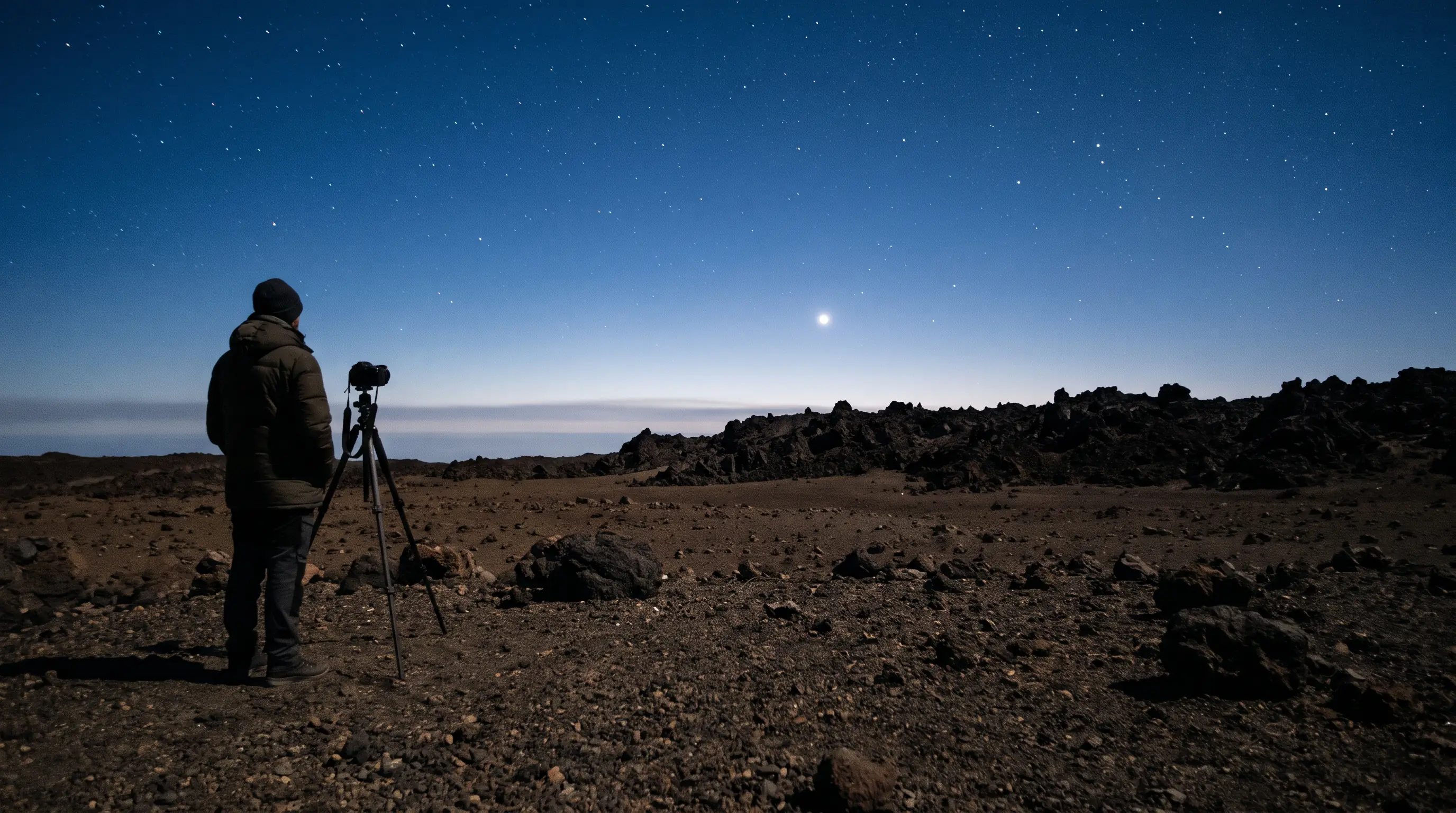
Tenerife southern sky Canopus low over the volcanic caldera of Teide National Park at night, a bright star above a dark ridge with the Southern Cross rising faintly beside it

Canopus never rises for anyone north of about 37°N; Tenerife sits near 28°N, which puts the star well within reach of the Canaries.

Canopus, the second-brightest star in the night sky, never rises above the horizon for anyone north of about 37°N[1], yet it can be seen from the Canary Islands[2], Spanish territory off the northwest coast of Africa[26]. The Southern Cross is a tighter squeeze: its brightest star, Acrux, clears the horizon for a few minutes in mid-May[4], and the rest of the Cross clears it by only a few degrees. Everything south of Canopus is that low, so a ridge or a haze layer decides what you actually see.
Canopus latitude limit
37°N
Never above the horizon for locations farther north[1]
Cross observing window
5 months
From January before dawn to late May after sunset[3]
Casado's Cross photo site
2,300 m
Teide National Park altitude of his whole-Cross frame[6]

How latitude decides which stars you get

The highest a star can climb above your southern horizon is its declination plus 90° minus your latitude[7]. Declination is a star's celestial latitude, positive north of the celestial equator and negative south of it, so the formula ranks every southern star by how far north you can stand and still catch it. Tenerife sits near 28°N[8], and Izaña, the island's observatory plateau, is at 28°18′N[27], so the arithmetic sets the geometric cutoff near −62° of declination: anything farther south never touches a flat horizon, however dark the night.
Canopus sits at −52° 41′ 45″[9], which leaves it about 9° above that flat line at culmination, the moment it crosses the meridian due south. Treat that as approximate geometry rather than a measured sighting, because haze, terrain and refraction all move the real number. Still, 9° is the difference between a star you can plan a night around and one you can only hope for.
The same sum explains why this is a latitude story rather than a darkness story. A Bortle 1 sky does nothing for a star that never rises, and a modest site at 28°N beats a perfect one at 45°N for any target in the deep south. When I rank spots for these stars, I put the southern horizon ahead of the Bortle number.

Canopus is the easy southern star, and mainland Europe barely gets it
Canopus is comfortably visible from Tenerife and only just reachable from the south of mainland Spain. It is the second-brightest star in the night sky, about 310 light-years away[10], and it never rises above the horizon north of about 37°N[1]. The Canary Islands, Spanish territory about 100 km off the northwest coast of Africa[26], sit far enough south to see it[2].
That 37°N is the geometric line. Add refraction and a perfectly flat southern horizon and the northernmost limit for even a brief view stretches to 37.9°N[28], but the practical limit sits nearer 35°N[11], because a star skimming the southern horizon usually sits in thick haze[29] and real horizons are rarely flat.
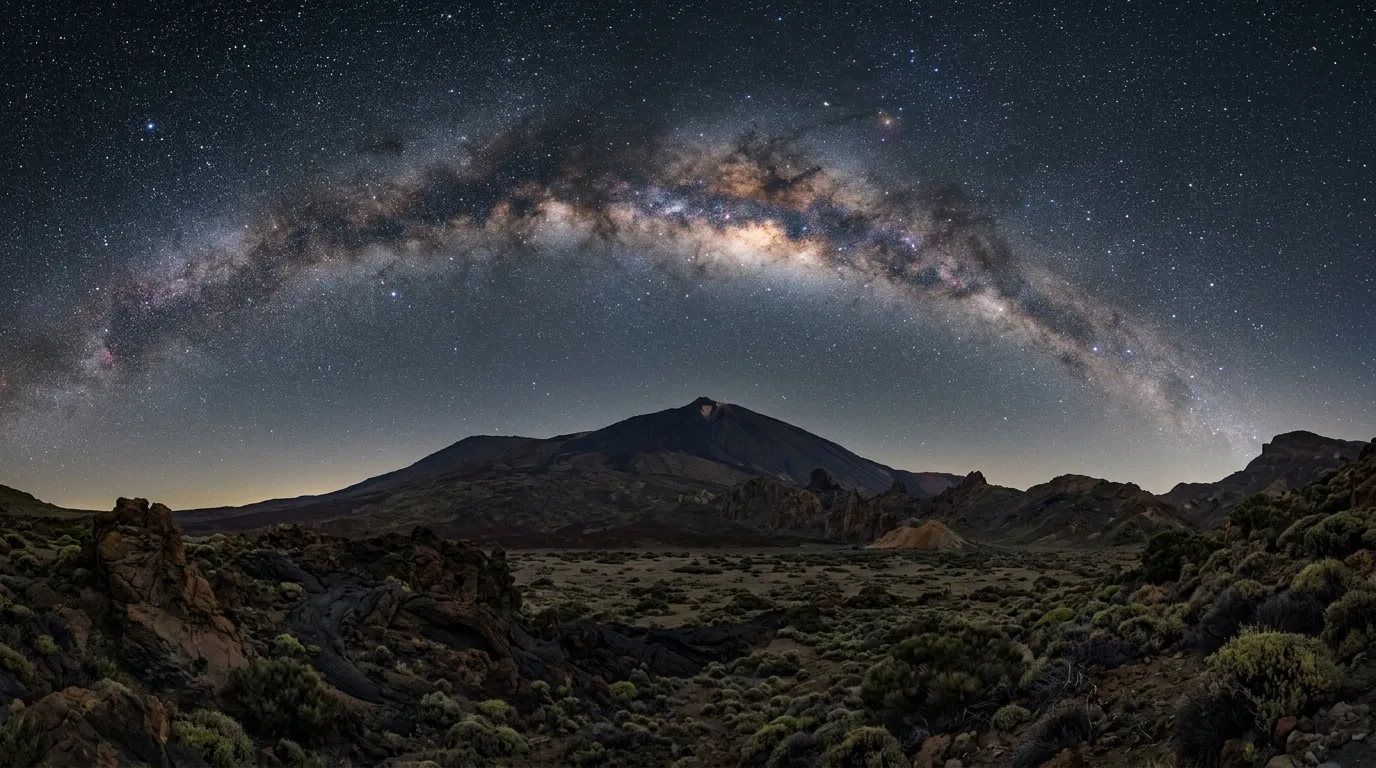
Milky Way arching over Mount Teide volcano at new moon, galactic core visible above the caldera with the sea of clouds below at 2,000 metres, Teide National Park dark sky

Featured · Destination

Tenerife Stargazing

Tenerife stargazing guide: Teide National Park's UNESCO Bortle-2 skies, 83 constellations visible. Observatory visits from €21, Parador hotel, and best tours.

The Spanish mainland's best case is thin. Astronomers at Calar Alto, in the south of the peninsula, have caught Canopus on very clear winter nights[12], an edge case rather than a plan, while the Southern Cross never rises above the horizon anywhere on the continent[13]. A star that needs a perfect night on the mainland's southern edge is an easy target near 28°N, which is the practical argument for flying to the islands instead of waiting for a lucky winter evening.
The island's first inhabitants had their own reading of the star, set out in the Guanche star myths of Tenerife. The astronomy and the myth agree on one thing: you have to be looking south, and low.

The Southern Cross and the Centauri pair sit on the edge

The Southern Cross and Alpha Centauri sit within a few degrees of Tenerife's southern horizon, so each is a marginal catch rather than a safe bet. Acrux, the Cross's brightest star at declination −63° 10′, never clears the horizon on paper[14], and Alpha Centauri, at a declination of almost −61°, is out of reach for anyone north of 29°N[15]. Izaña, at 28°18′N[27], sits less than a degree inside that limit.
For the Cross the margin is thinner still: EarthSky puts the latitude for seeing Acrux and the Southern Cross at about 27°N or farther south[35], so Tenerife is an edge case that depends on refraction, altitude and a flat southern horizon. Anything this low also shines through about 40 air masses of atmosphere at the horizon[30], which dims it.
Two stars in the Cross matter most. Acrux, magnitude 0.77 and the southernmost first-magnitude star[32], is the one that stays at or below a flat horizon. Gacrux marks the top of the Cross[43] and Mimosa, magnitude 1.25, is its second-brightest star[33][44]; on flat-horizon geometry alone they climb to roughly 5° and 2° at best, approximate figures that haze and terrain will trim. Alpha Centauri, magnitude −0.27 for the pair combined[34], gets under 1°.
TargetDeclinationBrightnessFrom Tenerife
Canopus−52° 41′ 45″[9]Second-brightest star in the sky[10]Comfortable: about 9° up at culmination by simple geometry
Alpha CentauriAlmost −61°[15]−0.27, pair combined[34]Marginal: just inside the 29°N limit[15]
Acrux−63° 10′[14]0.77[32]Minutes only, mid-May, from high ground[4][6]
Crux is not visible from many northern latitudes today[16], but its absence from ancient European skies was a matter of drift, not latitude: it was plainly visible from ancient Greece and Babylonia[36], low but clear at Athens's latitude[38], until precession gradually lowered its stars below the European horizon[37].
High ground can stretch the margin. A photographer working from La Palma's high ground gained about one degree of extra visibility below the theoretical horizon, enough to frame Alpha and Beta Centauri alongside most of the Cross[17]. That is the ceiling for the technique, not the average night.

How altitude and refraction buy the last degrees
Atmospheric refraction lifts every object near the horizon, stars included[18]: at the horizon it raises the Sun's lower limb by roughly 34′ and its upper limb by 29′[31], about half a degree. That is why a target with a negative altitude on paper can show up in a long exposure.
A pair of 10x50 binoculars and a tabletop Dobsonian telescope arranged on a dark table under a star-filled night sky, illustrating essential stargazing gear for beginners

Featured · Article

Stargazing Gear for Beginners: Binoculars to Telescopes

New to stargazing gear? This guide breaks down binoculars, telescopes, and smart telescopes, so you know what to buy first and what to skip for right now.

Altitude adds a second correction, and three different Teide-area heights get quoted as if they were one place:

  • 2,300 m is Juan Carlos Casado's photo site in Teide National Park, in what he calls probably the darkest and most transparent sky on the island[6]
  • 2,390 m is the IAC's Teide Observatory at Izaña[20]
  • 2,373 m is AEMET's Izaña Atmospheric Observatory, a separate station on the same plateau at 28°18′N, 16°29′W[27]
The horizon dip grows with the square root of the observer's height[19]. By the standard formula that is worth more than a degree toward a sea horizon from these heights, but toward the island's own ridges the terrain is the horizon, so treat the dip as a ceiling rather than a promise.
High ground is where both corrections show up in practice: the Southern Cross can be glimpsed whole only from the islands' higher zones, where altitude and refraction add the few degrees that decide it[21]. The Teide plateau is that terrain, the same ground as any Tenerife stargazing night, so the southern targets cost no extra travel.
The documented Tenerife case is Casado's frame of the whole Cross, in which Acrux, which never rises on paper, showed for only a few minutes in mid-May in the early evening[4].

When to look: February for Canopus, January to May for the Cross

February evenings are the best time for Canopus, which arcs across the south alongside Sirius[22]. EarthSky's rule of thumb puts its peak around 9 p.m. by the clock[5], but that figure is centred on the middle of a time zone. Canary winter time is UTC+0[39] and Izaña lies at 16°29′W[27], so by approximate geometry culmination lands roughly an hour later on a Tenerife watch, around 10 p.m. or a little after.
The Southern Cross runs to a different clock: its observing window stretches from January before dawn to late May after sunset[3]. Its midnight culmination falls in late March and early April[40]; in March it peaks around 1 a.m., and in December and January only before dawn[42], while May suits the evening[41]. These are zone-centred times too, so add about an hour on Tenerife's clock.

Check the southern horizon first

Targets this low sit very close to the horizon, so confirm that no mountain or building blocks the south before you drive up. Choose a moonless night and give your eyes 15 to 20 minutes to adapt[23].

Four windows are worth marking in the calendar:

  • February evenings, with Sirius for company, for Canopus
  • Late March and early April, around midnight, for the Cross at its highest
  • May evenings, for the Cross after dark, from high ground
  • Mid-May in the early evening, for the few minutes Acrux shows[4]

Recommended tours

Tours are selected for quality, not commission. I earn a small fee if you book — at no extra cost to you.

These are winter and spring targets, a different trip from the summer Milky Way season that Tenerife stargazing advice usually centres on, the Tenerife stargazing FAQ included. If you book a guided night, a tour such as the Teide stargazing astronomy tour or the Las Cañadas night hike can put you on open ground, but I would ask the operator before paying whether the stop has a clear southern horizon.
My verdict: go in February for Canopus and treat everything else as a bonus unless you can reach high ground between January and May with a clear south. Canopus is the reliable target. The Cross is a gamble that altitude and a clean horizon turn into a decent one.

Frequently asked questions

Can you see Canopus in Tenerife's southern sky?

Canopus is visible from Tenerife, which sits at about 28°N[8], well south of the roughly 35°N practical limit for the star[11]. The Canary Islands, Spanish territory off the northwest coast of Africa[26], see it best on February evenings[22].

Can you see the Southern Cross from Tenerife?

The Southern Cross shows whole from Tenerife only from high ground[21], in a window that runs from January to late May[3]. Acrux is the marginal star, visible for just a few minutes in mid-May[4], and Tenerife lies beyond the roughly 27°N latitude EarthSky gives for the Cross[35], so altitude and refraction decide it.

Can you see Canopus from Spain or mainland Europe?

Canopus never rises for anyone north of about 37°N[1], so mainland Europe sees it only at the extreme south: astronomers at Calar Alto have caught it on very clear winter nights[12].

Is Alpha Centauri visible from Tenerife?

Alpha Centauri is at the edge of Tenerife's reach. At a declination of almost −61°, it can be seen only from south of 29°N[15], and Izaña sits at 28°18′N[27]. A photographer on La Palma's high ground gained about one degree below the theoretical horizon[17].

What is the best month to see Canopus from the Canary Islands?

February evenings are the best time to see Canopus from the Canary Islands, when it arcs across the south with Sirius[22]. EarthSky's zone-centred guidance puts its peak around 9 p.m.[5], and because Canary winter time is UTC+0[39] while Izaña lies at 16°29′W[27], culmination falls about an hour later on a Tenerife clock.

Why can you see southern stars from Tenerife but not from northern Europe?

Latitude sets how high a star can climb above the southern horizon: its declination plus 90° minus your latitude[7]. From Aberdeen at 57°N, at least 39 of the 88 constellations cannot be seen at all[24], while Canopus needs an observer south of about 37°N[1].

Does altitude help you see stars below the horizon?

Altitude helps by lowering the horizon line[19], and refraction lifts stars near it into view[18]. On the Canary Islands' high ground the two together add the few degrees that decide whether the Southern Cross shows[21].

How many constellations can you see from Tenerife?

A press estimate puts Tenerife's reach at about 80% of the southern celestial hemisphere over a year[25]. A tally of whole constellations depends on how you treat partly visible ones such as Crux and Centaurus, which clear the horizon by only a few degrees.

Sources

44 references Show
  1. earthsky.org — Few know the second brightest star canopus (opens in a new tab)

    “Canopus never rises above the horizon for locations north of about 37 degrees north latitude.”

  2. earthsky.org — Canopus over spains canary islands (opens in a new tab)

    “This includes the American South and, in Europe, the Canary Islands.”

  3. diariodeavisos.elespanol.com (opens in a new tab)

    “La ventana de observación es además concreta: desde enero, antes del amanecer, hasta finales de mayo, tras la puesta de sol.”

  4. twanight.org — Cross above tenerife (opens in a new tab)

    “However, due to atmospheric refraction and the high altitude, the star is visible only for a few minutes in mid-May in early evening.”

  5. earthsky.org — Few know the second brightest star canopus (opens in a new tab)

    “Then, this star is at its highest in the sky around 9 p.m. your local time (the time on your clock no matter where you are on the globe).”

  6. twanight.org — Cross above tenerife (opens in a new tab)

    “I made the image from Teide National Park at altitude of 2300 meters, probably the place with darkest and most transparent sky on the island.”

  7. homepages.abdn.ac.uk (opens in a new tab)

    “Hopefully it’s now obvious that the highest a constellation will rise is above the southern horizon to an angle of”

  8. twanight.org — Cross above tenerife (opens in a new tab)

    “Have you ever seen the Southern Cross from 28 degrees north?”

  9. earthsky.org — Few know the second brightest star canopus (opens in a new tab)

    “The position of Canopus is RA: 6h 23m 57s, Dec: -52° 41′ 45″”

  10. laorotava.es (opens in a new tab)

    “Canopus is the second brightest one in the night sky, no less than 310 light years away.”

  11. earthsky.org — Canopus over spains canary islands (opens in a new tab)

    “Due to its far southern declination, however, it can only be observed from latitudes up to about 35 degrees north.”

  12. diariodeavisos.elespanol.com (opens in a new tab)

    “Astrónomos del observatorio de Calar Alto, en el sur peninsular, la han observado en noches muy claras de invierno.”

  13. diariodeavisos.elespanol.com (opens in a new tab)

    “Desde la Europa continental no se ve, sencillamente porque nunca se levanta por encima del horizonte.”

  14. twanight.org — Cross above tenerife (opens in a new tab)

    “Theoretically the star Acrux (alpha Crux at declination -63º 10′) never appears over the horizon of this place.”

  15. astronomy.com (opens in a new tab)

    “Since it is positioned at a declination of almost –61°, only stargazers located south of latitude 29° have any hope of seeing it.”

  16. noirlab.edu (opens in a new tab)

    “Crux was not visible from many northern latitudes, so it was not well known to ancient civilizations in Europe and the Mediterranean region.”

  17. twanight.org — Northern record for southern cross (opens in a new tab)

    “What helped photographer to achieve this was fine planning and gaining about one degree of extra visibility below the theoretical horizon because of high altitude.”

  18. britastro.org (opens in a new tab)

    “Obviously this uplift applies to any astronomical object such as stars, planets and the Moon, not just the Sun.”

  19. aty.sdsu.edu (opens in a new tab)

    “Typical values used in practice are dip = 1.75′ × sqrt (h, meters) [taken from the Explanatory Supplement], and horizon range = 3.83 km × sqrt (h, meters).”

  20. iac.edu.es (opens in a new tab)

    “Located in Izaña (Tenerife) at 2390 metres above sea level, the site marks the point at which the municipal boundaries of La Orotava, Fasnia, and Güímar meet.”

  21. diariodeavisos.elespanol.com (opens in a new tab)

    “solo puede vislumbrarse al completo desde las zonas altas de las islas, donde la altitud y la refracción atmosférica añaden esos grados de margen que marcan la diferencia.”

  22. earthsky.org — Few know the second brightest star canopus (opens in a new tab)

    “For those southerly observers, Canopus and Sirius arc across the south together on February evenings.”

  23. diariodeavisos.elespanol.com (opens in a new tab)

    “mirar hacia el horizonte sur y comprobar que no haya montaña ni edificio tapándolo, porque estos objetos aparecen muy bajos”

  24. homepages.abdn.ac.uk (opens in a new tab)

    “This rules out being able to see at least 39 of the 88 constellations from our location.”

  25. diariodeavisos.elespanol.com (opens in a new tab)

    “Desde el archipiélago pueden observarse a lo largo del año todas las estrellas del hemisferio norte de Canarias y en torno al 80% de las del hemisferio sur celeste.”

  26. Wikipedia — Canary Islands (opens in a new tab)

    “the southernmost autonomous community of Spain, located about 100 kilometres (60 mi) off the northwest coast of Africa.”

  27. izana.aemet.es (opens in a new tab)

    “The Izaña Atmospheric Observatory (IZO) is at the island of Tenerife at 28º18’N, 16º29’W, 2373 m a.s.l.”

  28. space.com (opens in a new tab)

    “So it is that latitude 37.9 degrees north marks the northernmost limit for getting just a brief view of Canopus, presupposing that you have access to a perfectly flat southern horizon”

  29. space.com (opens in a new tab)

    “Appearing to skim just above the southern horizon from most of the southern United States, it usually is immersed in thick horizon haze”

  30. asterism.org (opens in a new tab)

    “Note that the number of air masses at the horizon is 40.”

  31. britastro.org (opens in a new tab)

    “the lower limb of the Sun is lifted by roughly 34’ and the upper by ‘only’ 29’.”

  32. earthsky.org — Acrux shines in the southern cross (opens in a new tab)

    “At a magnitude 0.77, Acrux is the southernmost 1st-magnitude star, that is, the southernmost of the brightest stars in our sky.”

  33. earthsky.org — Acrux shines in the southern cross (opens in a new tab)

    “Mimosa, or Beta Crucis, is fainter than Acrux with a magnitude of 1.25.”

  34. Wikipedia — Alpha Centauri (opens in a new tab)

    “appear to be a single star with an apparent magnitude of −0.27”

  35. earthsky.org — Acrux shines in the southern cross (opens in a new tab)

    “You need to be south of about 27 degrees north latitude – that is, no more north than 27 degrees north of the equator – to see Acrux and the Southern Cross.”

  36. nbcnews.com (opens in a new tab)

    “Crux was plainly visible everywhere in the United States some 5,000 years ago, as well as in ancient Greece and Babylonia.”

  37. universetoday.com (opens in a new tab)

    “the precession of the equinoxes gradually lowered its stars below the European horizon”

  38. universetoday.com (opens in a new tab)

    “At the latitude of Athens, Crux was clearly visible, though low in the night sky.”

  39. gml.noaa.gov (opens in a new tab)

    “Time Zone: Local Standard Time + 0.0 hour(s) = UTC”

  40. earthsky.org — Acrux shines in the southern cross (opens in a new tab)

    “you might know they exhibit their midnight culmination (highest elevation above the southern horizon at midnight) in late March and early April.”

  41. earthsky.org — The southern cross signpost of southern skies (opens in a new tab)

    “For the Northern Hemisphere’s tropical and subtropical regions, May is a good time to find Crux in the evening sky.”

  42. earthsky.org — The southern cross signpost of southern skies (opens in a new tab)

    “In March, you have to wait until about 1 a.m. to catch the Southern Cross at its highest elevation.”

  43. noirlab.edu (opens in a new tab)

    “It is the third-brightest star in the Crux constellation and is the star at the top of the cross.”

  44. noirlab.edu (opens in a new tab)

    “Beta Crucis, also known as Mimosa, is the second-brightest star in Crux.”