All articles
Written by Maya Okonkwo
  • 9 min
  • 45 sources

Fairbanks vs. Tromsø — Which Northern Lights Destination Wins?

Fairbanks offers drier, clearer winter skies; Tromsø is milder and sits right under the oval. Compare season, hours, logistics and who each suits best.
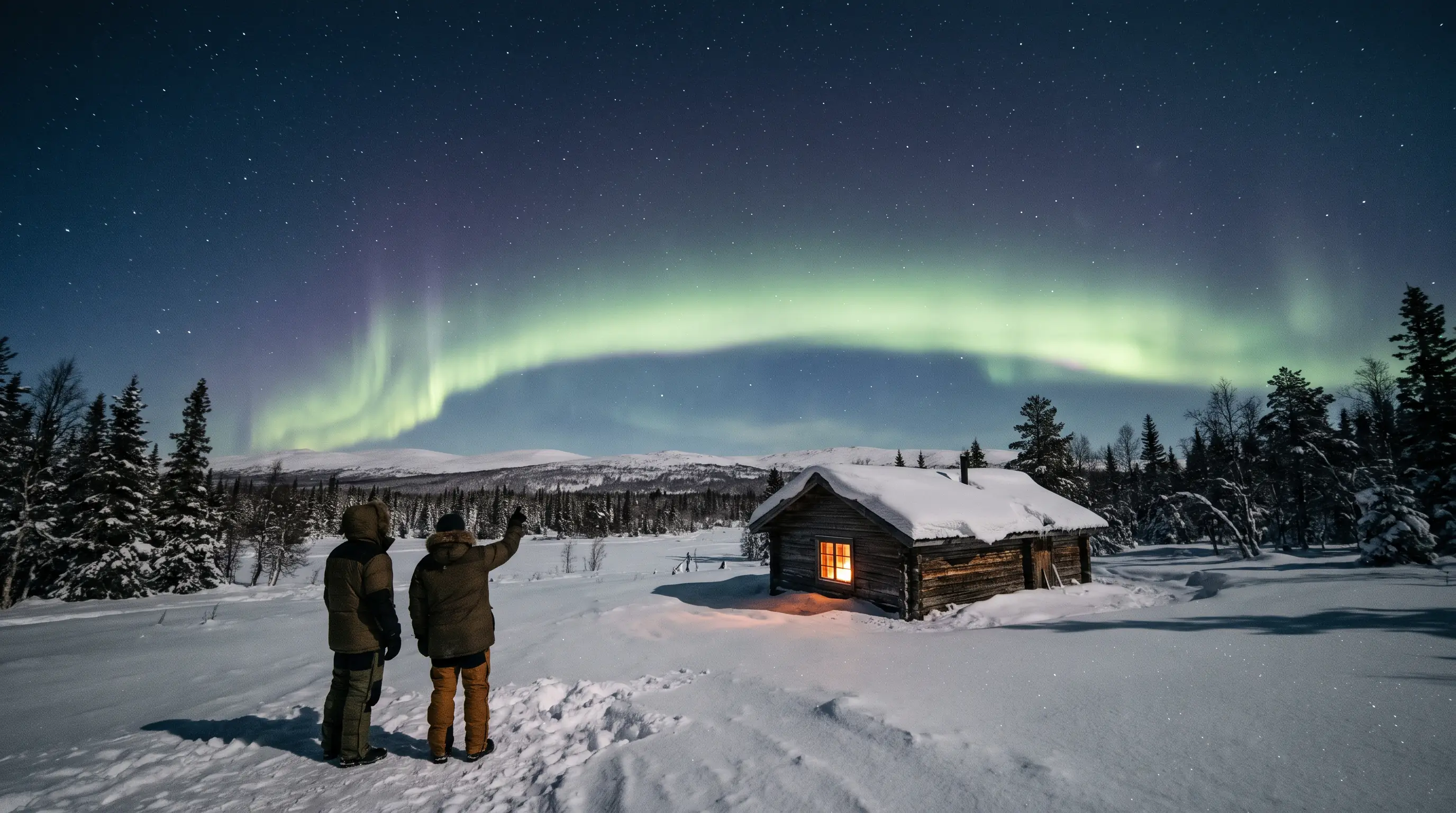
Green aurora over a snowy inland Alaskan valley on the left and over a Norwegian fjord near Tromsø on the right, split night-sky composition, photorealistic, a Fairbanks vs Tromsø northern lights comparison

Fairbanks defines its aurora season as August 21 to April 21; Tromsø's runs from late August to early April.

Fairbanks is the better bet for a clear sky and Tromsø for a comfortable night, and which of those you value more decides this comparison. Fairbanks counts an aurora season of August 21 to April 21[1] and sits at roughly 65°N geomagnetic[2]; Tromsø averages around −4 °C through the winter[3]. Whichever you choose, one or two nights is a gamble on a single forecast.
Fairbanks aurora season
Aug 21–Apr 21
Fairbanks tourism office's nine-month definition[1]
Fairbanks magnetic latitude
65.46°N
Geomagnetic latitude at the USGS College Observatory[2]
Tromsø winter average
−4 °C
Average winter temperature in the city itself[3]

Clear skies or a milder night: the trade-off that decides it

Fairbanks offers the better odds of a clear sky, and Tromsø offers the milder night to wait in. Climatology puts Fairbanks among the inland northern sites with the clearest skies under the auroral zone, and gives Scandinavia its best odds in spring, which is worth remembering if your Tromsø dates fall late in the season[4]. That describes climate rather than any single week, but it is the best-sourced reason to lean inland if a cloud-out is what you fear.
Fairbanks earns its reputation from geography. The city sits in the Tanana Valley, with the Brooks Range holding off Arctic wind to the north and the Alaska Range holding back wet coastal weather to the south[5], and its tourism industry puts the consistently clear nights down to low precipitation and distance from the coast[6]. The price is cold you feel in your teeth: a winter day can run from 25°F (about −4 °C) at midday to −35°F (about −37 °C) at night[7], and the night figure is the one you will be standing in.
Tromsø trades reliability for mildness. The Gulf Stream gives it a milder coastal climate than many places at the same latitude[8], but weather there is local, which is why guided tours travel beyond the city to find clearer skies when conditions in town are poor[9]. A cloudy forecast in Tromsø is a reason to move, not a reason to go to bed.
Think of it as two different ways to lose a night. In Fairbanks the likelier loss is to cold and fatigue; in Tromsø it is to cloud, and the remedy there is mobility. Cold is something you can buy your way out of with the right clothing, whereas cloud is not, which is why I give the climatology more weight than the thermometer when the two disagree.
My rule of thumb: if the thing you dread is a cloud-out, lean toward Fairbanks and pack for the cold. If what you dread is the cold, lean toward Tromsø and accept that you may be driving for your sky.

Season length, the polar night and the hour that counts
Season length will not decide this, because both destinations cover almost the same stretch of the year. Fairbanks defines its aurora season as August 21 to April 21[1], and Tromsø's runs from late August to early April, whenever the sky is dark enough[10]. The edges differ by a couple of weeks at most, and both open once nights are long enough to be properly dark.
The bigger calendar effect is the equinox. Over Interior Alaska the statistical likelihood of aurora is roughly twice as high at the equinoxes as at the solstices, a pattern known as the Russell-McPherron effect[11]. That is the logic behind choosing September or March for Fairbanks over the deep midwinter that postcards favour.
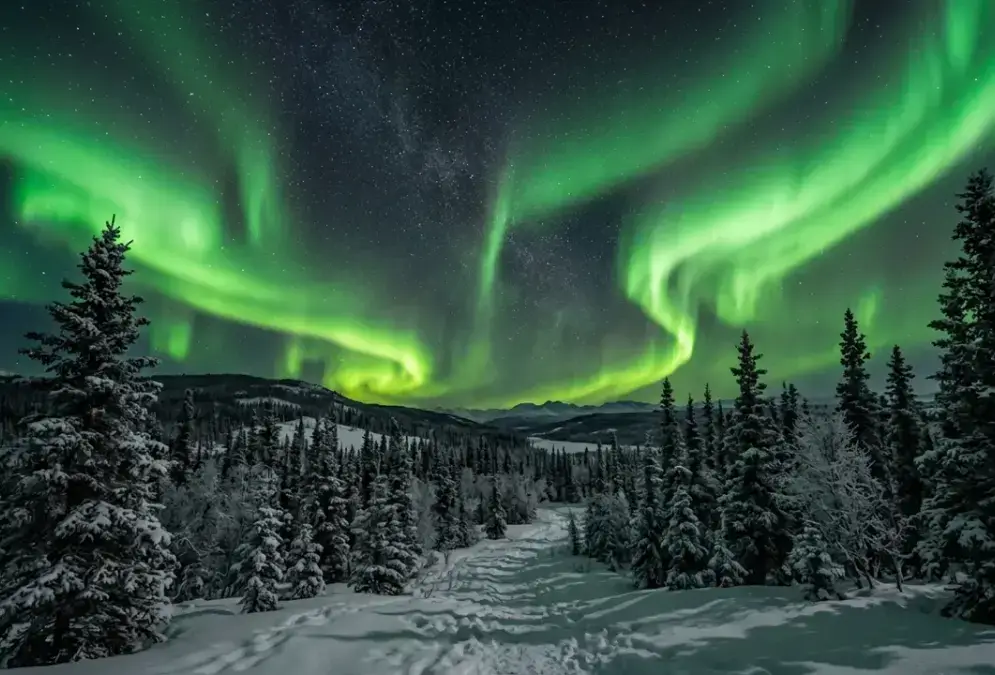
Green aurora borealis ribbons over a snow-covered black spruce forest near Fairbanks, Alaska, with a faint band of stars visible through the curtain of light

Featured · Destination

Fairbanks Northern Lights

Fairbanks sits directly under the auroral oval at 64.8°N. Aurora season runs Aug 21–Apr 21, peaking Feb–Mar, with roughly 90% odds if you stay 3+ nights.

Tromsø adds the polar night, when the sun stays below the horizon from roughly mid-November to mid-January, give or take a couple of weeks depending on the count[12]. Fairbanks keeps a short day instead: on the shortest day of the year it gets less than four hours of direct sunlight[13]. For aurora that barely matters, since you are out after dark either way, but it changes how the daylight hours feel and how you fill them.
On the clock, the two separate more clearly. Fairbanks's best window is usually about 11 p.m. to 1 a.m.[14], while Tromsø's displays are often most active between roughly 20:00 and 02:00[15]. That earlier start is the quiet reason Tromsø suits anyone with a normal bedtime, and it is the first thing I would weigh for a family.
Moon phase and Kp both matter on top of all this, but neither city has an edge on them. A full moon washes out faint displays in Fairbanks and Tromsø alike, so spend your planning effort on the number of nights instead.

Under the oval or south of it: what the latitude gap changes

Tromsø sits directly below the auroral oval[16], while Fairbanks sits a little south of its quiet-time ring. The oval is on average a thin band around 67–68° geomagnetic latitude[17]; the USGS College Observatory in Fairbanks reads about 65.5°N[2], and a history-of-geophysics paper puts the Tromsø observatory near 67°N[18]. The figures come from different models and different decades, so read them as roughly two degrees apart, not as a measured gap.
What the gap changes is the margin for a quiet night. On the Troms and Finnmark coast, observers see the northern lights every other clear night or more often[19], and Tromsø holds a good chance of aurora even when solar activity is relatively low[20]. Fairbanks asks a little more of the sun, though its own tourism figure is generous: the aurora is visible on average four nights in five when the sky is clear and dark enough[21].
Those two statistics are not like-for-like, since one comes from an observatory and the other from tourism marketing, and both are conditional on a clear sky. Neither says how often the sky is clear, which is the variable the climate difference decides. Read them as Tromsø needs less from the sun, Fairbanks needs less from the clouds.
In practice the two cities fail differently. A weak night under the oval at Tromsø can still give you something overhead, while a clear but quiet night at Fairbanks may leave a display low in the north, since the Alaskan peak sits north of town. I would rather hold the second hand, because a clear sky can be matched to a good forecast, and cloud cannot be forecast away.
For either city, a Kp index reading tells you how far south a display will reach, not whether you will see it. Check the cloud forecast first and the Kp number second.

20°

Height above the northern horizon, seen from Fairbanks, of a display directly overhead at Fort Yukon. The Alaskan peak sits north of town.[22]

Getting there, and where you actually stand to watch

Tromsø is the easier place to reach and the easier place to wait in. Oslo flights take about 1 hour 50 minutes[23], with several departures a day[24], and direct flights also arrive from several other European cities[25]. The airport sits about 5 km from the centre[26], a 10 to 20 minute drive[27], so a late-afternoon landing still leaves the evening free.
Fairbanks asks for a connection. Alaska Airlines and Delta fly nonstop to Seattle all year, while United's Minneapolis and Chicago flights run only in summer[28]. Condor's Frankfurt route is a once-weekly summer service[29], so a winter trip from Europe means connecting through the US. Airlines revise winter timetables from year to year, so price your own dates before committing to either city. Once you land, the options are a menu rather than a default: aurora from a dog sled, while ice fishing, from a snow cat, part way up the Dalton Highway or on a flight above the Arctic Circle[30].

Recommended tours

Tours are selected for quality, not commission. I earn a small fee if you book — at no extra cost to you.

In Tromsø you can start without leaving town. On clear nights the aurora may be visible from the city, including darker spots such as Prestvannet[31], which makes it a forgiving first outing. Whether to sleep in the centre or outside Tromsø is a real decision, and lodging runs from city-centre hotels and apartments to cabins surrounded by nature[32].
That difference shapes the planning. A Tromsø trip can start the evening you land and flex around the forecast night by night, while a Fairbanks trip rewards committing to extra nights up front, because each viewing is an outing you organise rather than a walk from your hotel. Neither approach is better; they are different ways of buying the same odds.
The honest summary is that Tromsø lets you fit the aurora into an ordinary trip, and Fairbanks makes it the reason for the trip. Neither is wrong, but you should know which trip you are buying.

Tours, prices and what to wear once you are there
Tromsø's guided outings are the easier ones to price, because the operators list their fares. Express Aurora Hunt is listed at 1,850 NOK per adult[33] and leaves at 20:00 from in front of Scandic Ishavshotel for a four-hour outing[34]. The small-group minibus chase is listed at 1,890 NOK per adult[35], leaves at 18:00[36] and runs 5 to 8 hours depending on the weather[37]. Because it may cross the border into Finland, carry your passport[38]. The operator lends warm suits, boots and ice spikes when needed[39], which spares you buying arctic gear for a single night.
Fairbanks outings fold the transfer into the booking, so a rental car is not needed for a tour. Alaska Aurora Adventures says all its tours include hotel transfers[40], and Aurora Borealis Lodge, which sits 21 miles north of Fairbanks and is set up for 360-degree viewing[41], runs nightly tours with round-trip transfers from Fairbanks between late August and early April[42]. That lodge is an outside-town base worth a look if you would rather sleep near the viewing than ride out to it.
Beyond the Tromsø fares above, the rest of the bill depends on your dates. Fairbanks tour prices, and flights and lodging in both cities, vary by season and operator, so confirm each figure with the operator before you add up a total.
Traveler photographing the Milky Way arc above a dark desert horizon on an astrotourism trip, tripod-mounted camera capturing star trails against a certified dark-sky park backdrop

Featured · Article

What Is Astrotourism? The Complete Beginner's Guide

Astrotourism means travel built around dark skies: meteor showers, auroras, the Milky Way. What it means, where to go, and how to plan your first trip.

Layers are the number one way to stay warm in a Fairbanks winter[43], and you do not have to own the outer shell: one local outfitter rents boots rated to −100°F, parkas trusted by mushers and bibs that keep out wind and wet[44]. In Tromsø, the suit lent on the chase tour covers the same need.

Who should pick which: beginners, families and couples

Tromsø is the safer pick for beginners, and Fairbanks is the sharper pick for anyone who can commit to the cold. A first trip is mostly about not wasting nights, and Tromsø gives you more ways to rescue one: a short airport transfer[27], aurora visible from the city on clear nights[31], and tours that drive out to find gaps in the cloud[9]. Whichever city you choose, plan on at least three nights: Fairbanks's tourism office claims better than a 90% chance with three nights and your evenings spent outdoors[45]. That is a tourism estimate, not a measured statistic, and the same floor is a sensible minimum in Tromsø, where a spare night is cheap insurance against cloud.
Families should lean Tromsø. Its displays are often most active from about 20:00[15], which is late enough to be dark and early enough for a child to be awake, whereas Fairbanks's best window of about 11 p.m. to 1 a.m.[14] asks a lot of small children, and a night that can reach −35°F[7] asks more. Tromsø's winter average of around −4 °C[3] is still cold, but it is a cold you can plan a family evening around.
Couples have the closest call, and Fairbanks suits couples who want the lights to be the reason for the trip. A dog sled, a snow cat or a drive up the Dalton Highway[30] turns each night into its own small expedition, and a clear-sky climate gives you the best chance of finishing it under a green sky. If you would rather split your evenings between the lights and a town with options, Tromsø's mix of city-centre hotels and cabins[32] is the more flexible base.
FactorFairbanksTromsø
SkyInland and statistically clearerCoastal, with local weather; tours drive out to find gaps
Winter feelDry, with deep cold at nightMilder, on a Gulf Stream coast
Position vs the ovalA little south of the quiet-time ringDirectly below it
Best hoursLate, around midnightEvening into the small hours
Where you watchOrganised outings and drivesCity edge or a tour
Best forClear-sky odds, a trip built around the lightsEasy logistics, a trip with other things in it
If you can weigh only one thing, weigh the cold. A tour, a forecast app or an extra night can work around almost everything else on this page, but nothing works around how long you are willing to stand outside in the weather your dates will bring. Be honest about that number before you book, because it is the one that ends evenings early.
I haven't seen an aurora in person yet, so this is a planner's verdict rather than a traveller's. The Tromsø trip I keep costing in a spreadsheet is built on margin against cloud rather than a single-night gamble, and I have not booked it because I want the seasonal forecast to firm up first. Decide how many days to give Tromsø before you compare fares, and the choice between the two cities starts to matter less than the number of evenings you give yourself.

Frequently asked questions

Fairbanks vs Tromsø northern lights: which is better for a first trip?

Tromsø is the easier first trip, and Fairbanks is the better bet if a clear sky matters most. Tromsø is a short transfer from its airport[27], can show the aurora from the city on clear nights[31] and has tours that drive out to find gaps in the cloud[9]. Fairbanks sits in a continental climate that statistically clears more often[4], but its nights are far colder[7].

Which has clearer skies, Fairbanks or Tromsø?

Fairbanks has the statistical edge for clear skies, because inland continental locations under the auroral zone are the clearest[4]. Tromsø's coastal weather is more local, and guided tours travel beyond the city to find clearer skies when conditions in town are poor[9]. Treat any precise cloud-cover percentage you see quoted for either city with caution.

Is Tromsø warmer than Fairbanks in winter?

Tromsø is milder: its Gulf Stream coast averages around −4 °C in winter[3][8], while a Fairbanks winter day can run from 25°F (about −4 °C) at midday to −35°F (about −37 °C) at night[7]. The two figures are not like-for-like, but the night-time swing is the real difference.

How long is the aurora season in Fairbanks vs Tromsø?

Fairbanks defines its aurora season as August 21 to April 21[1], and Tromsø's runs from late August to early April[10]. The two seasons overlap almost completely, so the calendar rarely decides between them.

Do I need a high Kp index to see the aurora in Tromsø or Fairbanks?

Tromsø needs less help from the sun, because it sits directly below the oval and holds a good chance of aurora even when solar activity is relatively low[16][20]. Fairbanks sits south of the quiet-time oval at about 65.5° geomagnetic[2], so a livelier night helps, though cloud cover matters more than the Kp number in either place.

What time of night should I look for aurora in Fairbanks and Tromsø?

Fairbanks's best window is usually about 11 p.m. to 1 a.m.[14], while Tromsø's aurora is often most active between roughly 20:00 and 02:00[15]. If you are travelling with children, Tromsø's earlier start is easier to plan around.

How many nights should I stay in Fairbanks vs Tromsø?

Fairbanks and Tromsø both need at least three nights to give the weather a fair chance. Fairbanks's tourism office puts the chance of seeing the aurora above 90% for three nights with evenings spent outdoors[45], which is a tourism estimate rather than a measured statistic, and the same logic of building in spare nights applies in Tromsø.

Sources

45 references Show
  1. explorefairbanks.com — Nine months of northern lights in fairbanks (opens in a new tab)

    “Spanning all four seasons and nine months of the year, Aurora Season runs August 21st through April 21st.”

  2. usgs.gov (opens in a new tab)

    “Geomagnetic Latitude: 65.46°N”

  3. visittromso.no — 10 reasons to visit tromso in winter (opens in a new tab)

    “The average winter temperature in Tromsø is around −4°C.”

  4. gi.alaska.edu — Aurora forecast (opens in a new tab)

    “Statistically, the continental locations in Russia, Alaska and western Canada under the auroral zone have the clearest skies, and in the spring, the skies of Iceland and Scandinavia are usually clear.”

  5. explorefairbanks.com — What is winter weather like in fairbanks (opens in a new tab)

    “Situated in the Tanana Valley, the Brooks Range north of Fairbanks keeps the harsh Arctic winds at bay, and the Alaska Range keeps the wet, coastal weather to the south.”

  6. explorefairbanks.com — Aurora season (opens in a new tab)

    “low precipitation and distance from coastal areas contribute to consistently clear nights.”

  7. explorefairbanks.com — Fairbanks weather (opens in a new tab)

    “It is common for the temperature to go from a toasty 25F above during the middle of a winter day to a chilly 35F below at night.”

  8. visittromso.no — 10 reasons to visit tromso in winter (opens in a new tab)

    “Owing to the Gulf Stream, Tromsø has a milder coastal climate than many other destinations at the same latitude.”

  9. visittromso.no — Faq (opens in a new tab)

    “Guided tours travel beyond the city and can search for areas with clearer skies when local conditions are challenging.”

  10. visittromso.no — Faq (opens in a new tab)

    “The northern lights can normally be seen in the Tromsø region from late August to early April, when the sky is dark enough.”

  11. gi.alaska.edu — Aurora forecast (opens in a new tab)

    “the statistical likelihood of seeing aurora over Interior Alaska is roughly twice as high on the equinox as it is at solstice.”

  12. visittromso.no — Look out for northern lights (opens in a new tab)

    “North of the Arctic Circle, the sun does not rise above the horizon from mid-November to mid-January.”

  13. explorefairbanks.com — What is winter weather like in fairbanks (opens in a new tab)

    “On the shortest day of the year, Fairbanks gets less than four hours of direct sunlight.”

  14. gi.alaska.edu — Aurora season (opens in a new tab)

    “Usually, though, the hours from about 11 p.m. to 1 a.m. offer the best chance of seeing the bright arcs that challenge photographers and captivate observers.”

  15. visittromso.no — When and where (opens in a new tab)

    “although they are often most active between approximately 20:00 and 02:00.”

  16. visittromso.no — Look out for northern lights (opens in a new tab)

    “Tromsø is located directly below the Northern Lights oval”

  17. gi.alaska.edu — Aurora forecast (opens in a new tab)

    “is on average a thin oval band situated around 67-68 degrees in geomagnetic latitude.”

  18. hgss.copernicus.org (opens in a new tab)

    “geomagnetic latitude 67.1 ◦N”

  19. tgo.uit.no (opens in a new tab)

    “In Troms and Finnmark, we can see the Northern Lights every other clear night, if not even more frequently.”

  20. visittromso.no — 10 reasons to visit tromso in winter (opens in a new tab)

    “This means that there is a good chance of seeing the northern lights, even when solar activity is relatively low.”

  21. explorefairbanks.com — Aurora season (opens in a new tab)

    “the aurora will be visible in Fairbanks an average of four out of five nights when the sky is clear and dark enough.”

  22. gi.alaska.edu — Aurora season (opens in a new tab)

    “A display directly overhead at Ft. Yukon would appear to be 20 degrees above the northern horizon to someone watching in Fairbanks.”

  23. visittromso.no — Travel to tromso (opens in a new tab)

    “The flight time is approximately 1 hour 50 minutes.”

  24. visittromso.no — 10 reasons to visit tromso in winter (opens in a new tab)

    “Tromsø has several daily flights to and from Oslo, as well as direct connections with a number of international destinations.”

  25. visittromso.no — Travel to tromso (opens in a new tab)

    “There are direct flights to Tromsø from several destinations accross Europe. You will also find many connections via Oslo.”

  26. visittromso.no — Travel to tromso (opens in a new tab)

    “Tromsø Airport Langnes is located approximately 5 km from the city centre.”

  27. visittromso.no — 10 reasons to visit tromso in winter (opens in a new tab)

    “Tromsø Airport is approximately a 10–20-minute drive from the city centre, depending on traffic.”

  28. explorefairbanks.com — Transportation (opens in a new tab)

    “Fairbanks is served year-round with direct flights to and from Seattle by Alaska Airlines and Delta Airlines, and seasonally during the summer by United Airlines with direct flights to and from Minneapolis and Chicago.”

  29. explorefairbanks.com — Transportation (opens in a new tab)

    “German airline Condor offers once-weekly passenger service during the summer season between Fairbanks and Frankfurt.”

  30. explorefairbanks.com — Aurora season (opens in a new tab)

    “You can also see them on a dog sled adventure or while you are ice fishing, on a snow cat tour, via a trip part way up the Dalton Highway or even on a flight above the Arctic Circle.”

  31. visittromso.no — Faq (opens in a new tab)

    “On clear nights, the aurora may be visible from Tromsø city, including darker locations such as Prestvannet.”

  32. visittromso.no — 10 reasons to visit tromso in winter (opens in a new tab)

    “Choose from city-centre hotels, apartments, seaside resorts, cabins and distinctive accommodation surrounded by nature.”

  33. visittromso.no — Express aurora hunt (opens in a new tab)

    “Departure time and place: 8 PM (20:00) in front of Scandic Ishavshotel”

  34. visittromso.no — Northern lights chase minibus (opens in a new tab)

    “Departure time and place: 6:00 PM (18:00) from Ami Hotel, Skolegata 24, 9008 Tromsø.”

  35. visittromso.no — Northern lights chase minibus (opens in a new tab)

    “Approximately 5–8 hours, depending on the weather and conditions.”

  36. visittromso.no — Northern lights chase minibus (opens in a new tab)

    “Depending on the weather conditions, the journey may cover long distances and can cross the border into Finland.”

  37. visittromso.no — Northern lights chase minibus (opens in a new tab)

    “Warm suits, boots and ice spikes suitable for Northern Norwegian winter conditions can be borrowed when needed.”

  38. explorefairbanks.com — 10477 (opens in a new tab)

    “All tours include hotel transfers.”

  39. explorefairbanks.com — 10308 (opens in a new tab)

    “Located 21 miles north of Fairbanks, the Aurora Borealis Lodge is ideally situated for 360 degree viewing & photography.”

  40. explorefairbanks.com — 10308 (opens in a new tab)

    “From late August through early April, we offer nightly aurora tours w/ roundtrip transfers from Fairbanks.”

  41. explorefairbanks.com — What to pack for a winter trip to fairbanks (opens in a new tab)

    “The number one way to stay warm in winter is to wear layers.”

  42. explorefairbanks.com — 11323 (opens in a new tab)

    “Boots rated to -100 degrees Fahrenheit; parkas trusted by mushers; bibs to keep out both wind and wet.”

  43. explorefairbanks.com — Nine months of northern lights in fairbanks (opens in a new tab)

    “If you stay a minimum of three nights in the Fairbanks area and are actively out during the evening hours, your chances of seeing the aurora are more than 90%!”