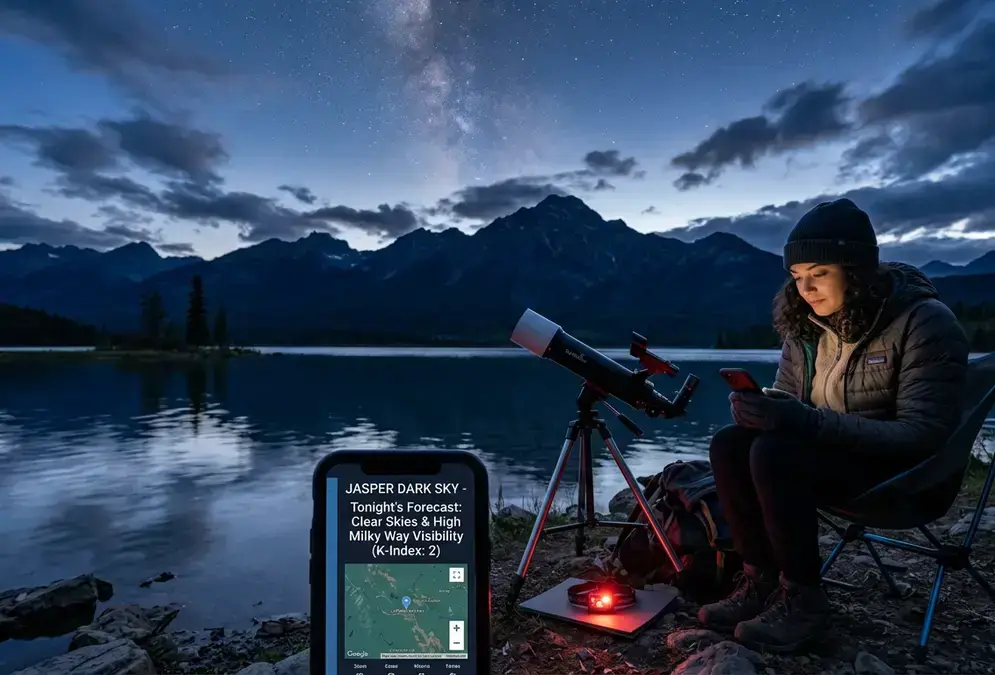

Why a Jasper stargazing forecast means more than one weather app
Type «Jasper weather» into a search bar and the result is a seven-day icon strip for the townsite: sun, cloud, a chance of rain. That tells you almost nothing about whether tonight is a night to drive out to Pyramid Lake with a tripod. Jasper National Park's Dark Sky Preserve spans roughly 11,000 km², the second-largest Dark Sky Preserve in the world[1], and conditions inside that boundary vary by valley, by ridge, and by hour in ways a single townsite forecast can't capture.
A genuine Jasper stargazing forecast answers three separate questions: how much cloud, at what altitude, and for how long the sky stays properly dark before moonrise or dawn washes it out. It is not an aurora forecast, despite what a first-time visitor might assume. Jasper sits far enough north that the northern lights do turn up on strong nights, but they're a bonus here, not the plan; if you're specifically chasing the Kp index and geomagnetic storms, the Kp index guide covers that separate question properly. This guide sticks to the one question that applies on every clear night of the year: will the sky actually be clear.
Environment Canada's astronomical clouds tool
Most Environment Canada traffic goes to the standard weather.gc.ca hourly and seven-day pages for Jasper, AB, which are genuinely useful as a first pass: cloud-cover percentage, precipitation probability, and an hourly breakdown[2]. Fewer visitors know the agency also runs a separate tool built specifically for astronomers: the Clouds Forecast for Astronomical Purposes, at weather.gc.ca/astro.
The astronomical tool covers Eastern and Western Canada plus Eastern and Western United States, with four model runs a day (00, 06, 12 and 18 UTC) extending forecasts up to 84 hours ahead[3]. Each panel is labelled in
T+hh notation: T marks the model's initial run time, and hh counts the hours forward from it, so T+36 on the 12 UTC run means roughly 36 hours past noon UTC. It reads like a spreadsheet built by meteorologists for meteorologists, not a polished app, but it's the only free tool giving Jasper a purpose-built astronomical cloud forecast rather than a general-public one.84 hrs
Use it the way working astronomers do: check it two to three days out to rule a night in or out, then refine the plan as each new model run comes in every six hours.
Reading the Jasper Clear Sky Chart
cleardarksky.com publishes a Jasper-specific Clear Sky Chart, plus a regional Alberta Star Party chart and separate charts for the two gateway cities, Edmonton and Calgary[4]. It's a purpose-built astronomer's tool, not a general forecast: it plots cloud cover, transparency, seeing, and darkness hour by hour on a single grid, with each column representing one hour.
The cloud-cover row is the one to read first. It runs on a colour scale from dark blue (clear) through lighter blues (increasing cloud) to white (overcast). A solid dark-blue block across your planned evening window is a green light. A patchwork of blue and white means a genuinely uncertain night, worth rechecking closer to sunset rather than deciding a week out.
- Cloud cover: the row to read first; dark blue means clear, white means overcast
- Transparency and seeing: secondary rows describing haze and atmospheric steadiness, worth checking once cloud cover already looks promising
- Darkness: how much of the night window is fully dark versus twilight, which matters more in Jasper's short summer nights than almost anywhere else in this guide
| Chart row | What it shows | Read it as |
|---|---|---|
| Cloud cover | Dark blue to white shading, hour by hour | Solid dark blue means go; white means overcast |
| Transparency | How much haze or moisture is dulling the sky | Check once cloud cover already looks clear |
| Seeing | Atmospheric steadiness, how much stars blur or twinkle | Matters most for telescope and planetary detail |
| Darkness | How much of the night window is fully dark | Short in Jasper's summer, long in winter |
Bookmark the Jasper-specific chart rather than relying on the regional Alberta Star Party version. Conditions inside an 11,000 km² preserve[10] aren't uniform, and the chart tied to the exact site gives the more honest read.
Moon phase and Jasper's seasonal darkness windows
Cloud cover is only half the forecast; the other half is what the moon is doing. New-moon nights, especially in fall and winter, are consistently rated the best stargazing conditions in Jasper: a full moon can wash out the fainter structure of the Milky Way even under a perfectly clear sky, so cross-reference any promising Clear Sky Chart window against a moon-phase calendar before committing to a night out.
Season changes the practical viewing window as much as the moon does. In summer, Jasper's high latitude delays sunset past 10pm, and true darkness doesn't arrive until close to midnight, a short window even on a flawless clear night. Winter flips this entirely, with up to roughly 16 hours of night sky[5], which is the real reason fall and winter are generally rated the better stargazing season here despite the cold. A mediocre cloud forecast in December still leaves more dark hours to work with than a perfect one in July — see how many days to plan for Jasper stargazing for how that trades off against trip length.
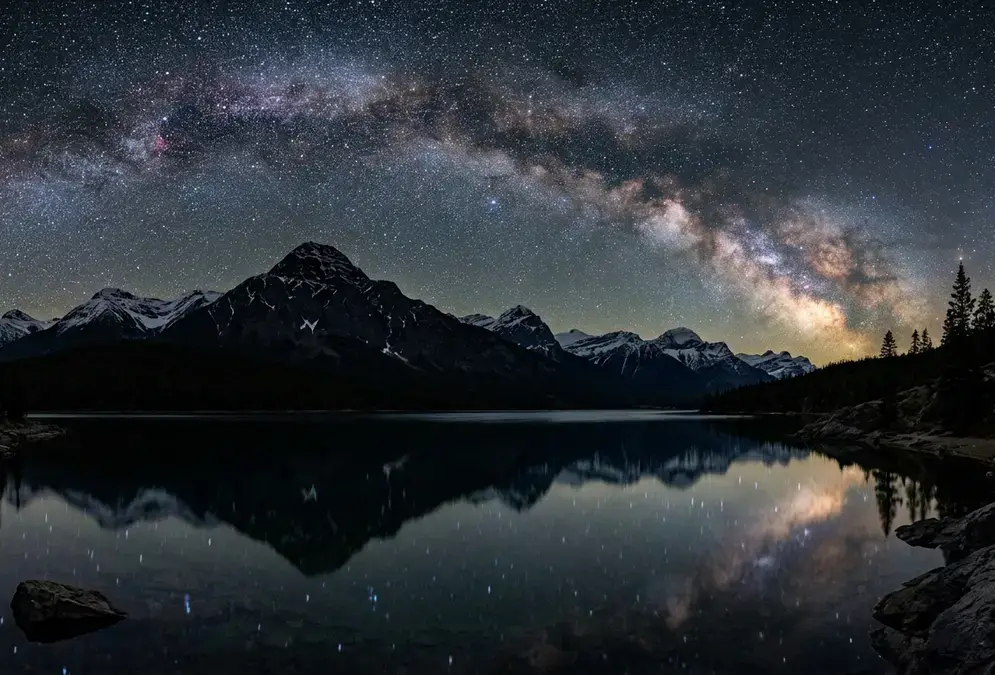
Featured · Destination
Stargazing in Jasper National Park
Jasper National Park is widely called the largest accessible Dark Sky Preserve in Canada: 11,228 km², an October Dark Sky Festival, and a 38-seat planetarium.
For the full seasonal calendar, including how the Milky Way's position changes month to month, the general guide to when to stargaze covers the framework this forecast method plugs into. And for anyone timing a trip around a new-moon window specifically for photography, the Milky Way photography guide covers the exposure settings that assume you've already found the dark sky this section is about.
Mountain-weather quirks: why one Jasper forecast doesn't cover the whole park
The Rockies complicate every forecast in a way flat terrain doesn't. Orographic lift forces low-level winds up and over the mountain chain; as that air rises and cools, it condenses into cloud on the windward slopes[6]. Cloud cover can build against a ridge to the east while a lakeshore or valley floor a few kilometres away stays completely clear, and it's the single biggest reason a general Jasper-area forecast can read as marginal while a specific viewpoint delivers a genuinely clear night. Valley-floor spots like the townsite and Pyramid Lake tend to outperform a forecast that looks so-so for «the Jasper area» as a whole.
Underneath that local variability sits a structural advantage. The Canadian Rockies sit in a rain shadow[11] relative to the Pacific coast, giving the region markedly lower humidity and better atmospheric transparency than coastal British Columbia. That baseline edge comes with a real caveat: mountain weather is genuinely capable of changing within minutes[7], so treat any single evening forecast as a starting estimate rather than a guarantee, and keep watching the sky once you're actually out there.
Elevation itself changes the picture too. Higher viewpoints such as Mount Edith Cavell run roughly 10°C cooler than the valley floor[8], which matters for comfort and for gear: camera batteries drain noticeably faster in the cold, so pack spares if you're heading up rather than staying lakeside. In summer, it's also worth a glance at Alberta's wildfire smoke outlook. The same Clear Sky Chart carries a smoke overlay sourced from Environment Canada's Wildfire Smoke Prediction System[9], and smoke haze can degrade transparency in a way that never shows up on a plain cloud-cover forecast.
Putting the forecast together: a Jasper stargazing decision workflow
Turn all of this into one practical decision the night before a planned outing:
- Check the Clear Sky Chart for Jasper specifically, two to three days out. A run of dark-blue cloud-cover blocks across your evening window is the green light.
- Cross-check Environment Canada's astronomical clouds tool for the same window, using the
T+hhforecast closest to your planned time. If both tools agree, trust the forecast. - Confirm the moon phase. A clear forecast during a full moon still gets you stars, but not the faint Milky Way structure that makes a Jasper night memorable; new-moon windows are worth planning a trip around.
- Pick a viewpoint with the orographic effect in mind. If the general forecast looks marginal, a valley-floor or lakeshore spot is a better bet than a ridge or high viewpoint the wind is hitting directly.
- Watch the sky yourself once you're out there. Rockies weather changes fast enough that the forecast you checked at breakfast is a starting point, not the final word.
One last practical note: once a clear night and a spot are picked, dark-sky etiquette matters more inside a working Dark Sky Preserve than almost anywhere else on this list: keep headlamps on red mode, and don't point vehicle high beams toward other stargazers. Good forecasting gets you to a clear sky. Basic courtesy is what keeps everyone else's night clear too.