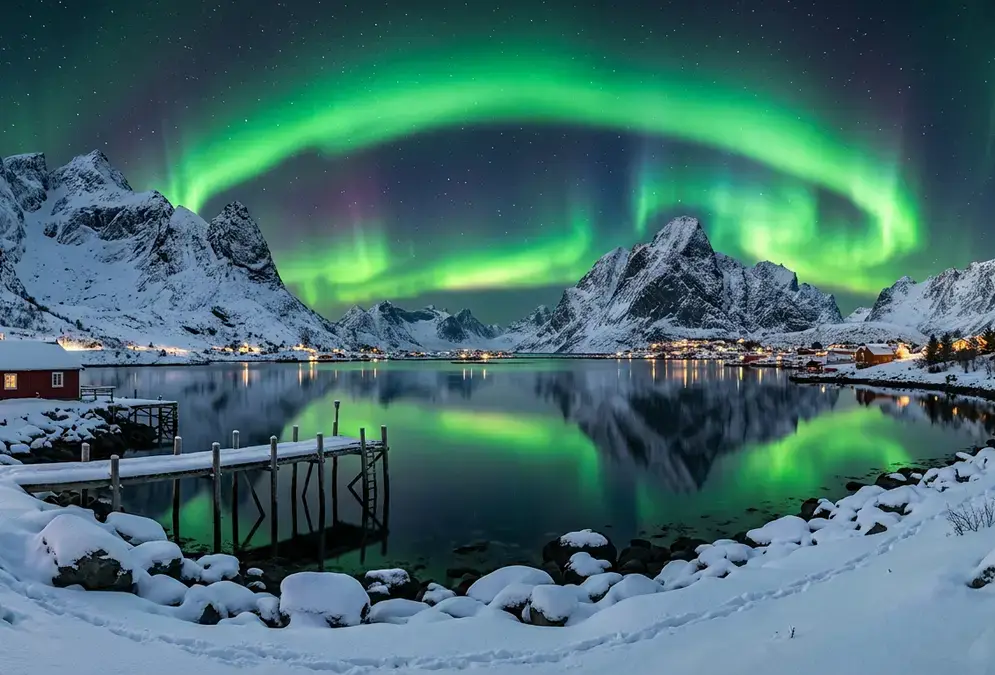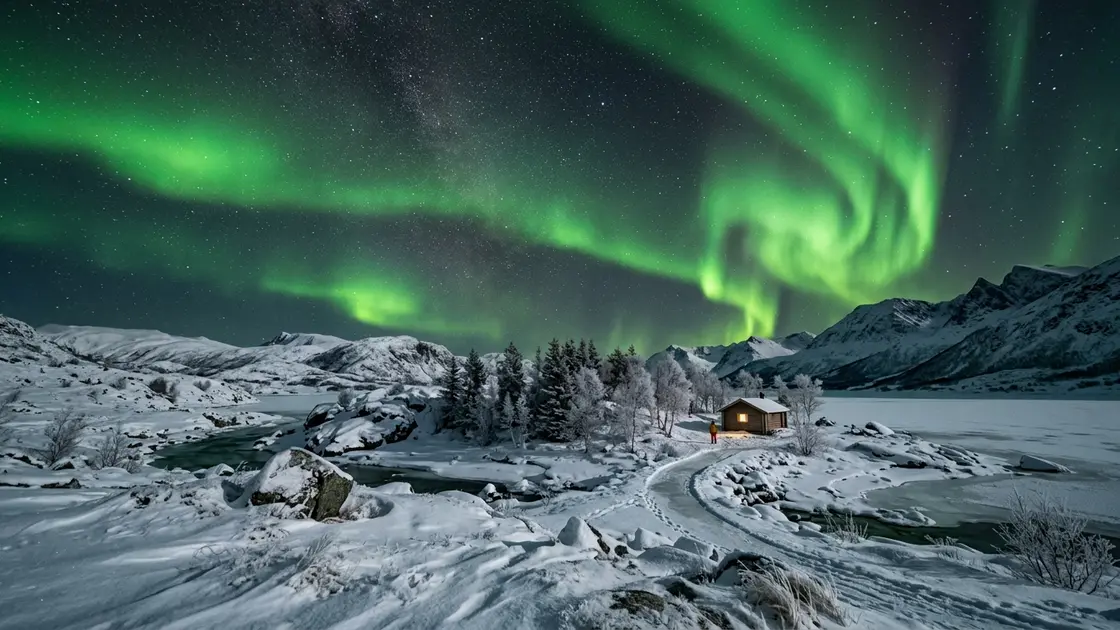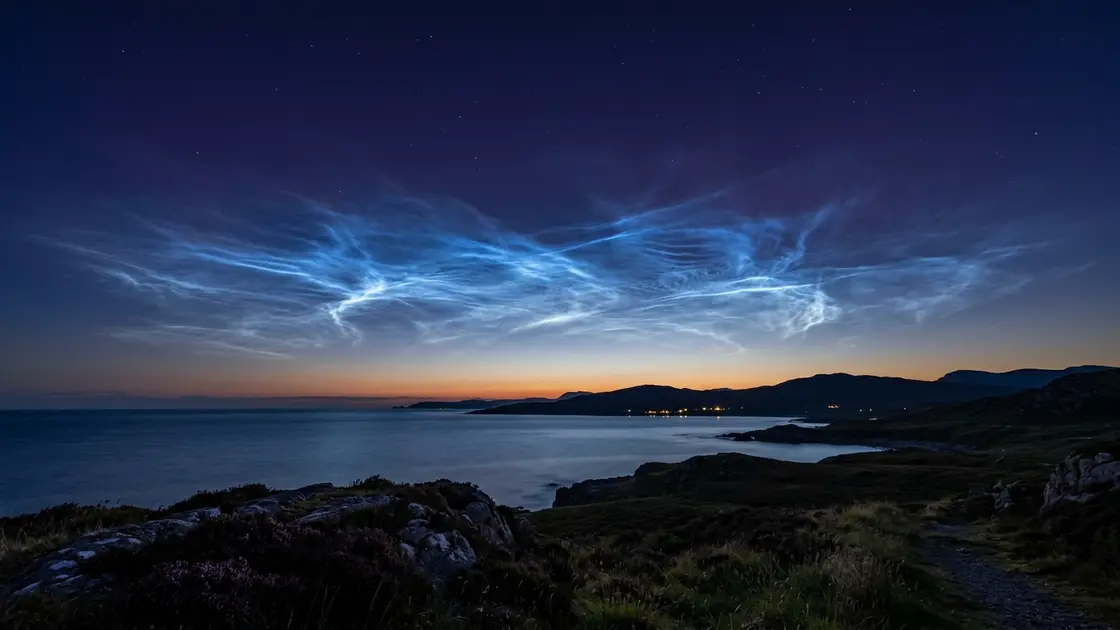
Aurora season goes quiet across the far north from May to August, when the sky barely gets dark enough for the northern lights to register. Noctilucent clouds fill that exact gap. These electric-blue clouds form roughly 80 km up in the mesosphere and only become visible in the long twilight of a Northern Hemisphere summer, making them the natural counterpart to the winter aurora season at many of the same high-latitude destinations. The window runs from mid-May to mid-August, peaking in July, and you don't need a Kp forecast or a moonless night to see them, just a clear view west about 30 minutes after sunset.
When noctilucent cloud season runs
Noctilucent clouds (NLC), also called night-shining clouds, first appear in the Northern Hemisphere around late May and taper off by late August. Activity builds through June, peaks in July, and fades as the mesosphere warms back up heading into autumn. Unlike a meteor shower or an eclipse, there's no single peak date to circle on a calendar. The whole three-month window is worth watching, and the payoff on any given clear night depends more on luck and location than on the exact date.
Why summer makes the coldest sky of the year
That timing sounds backward until you look at where NLC actually form. They sit at roughly 80 km altitude, the edge of the mesosphere, where ice crystals condense onto specks of meteoric dust. That only happens below about −120°C (−184°F), and counterintuitively, the mesosphere hits its coldest point of the year during Northern Hemisphere summer, driven by seasonal vertical wind patterns that push air upward and let it expand and cool, even as the ground below bakes in daylight. It's a layer of atmosphere running opposite to the surface season, which is part of why NLC still catch people off guard.
Where to look: the 50–65°N sweet spot
NASA describes NLC as forming generally above 50°N, with the most reliable displays typically observed between 50° and 65°N; Wikipedia's figure runs a touch wider, roughly 50° to 70°N. Either way, Yellowknife (62°N) and Fairbanks (65°N) sit inside that prime band, while Finnish Lapland (66–68°N), Abisko (68°N), and Tromsø (69.6°N) sit just north of it.
Worth being honest about: this isn't necessarily a downgrade. NLC displays have been reported from all five, and space-weather trackers still list Tromsø, Finnish Lapland, Fairbanks, and Yellowknife among the world's known viewing spots for the phenomenon. The real complication at these latitudes is daylight, not distance. In late May and June, several of these destinations sit close enough to the Arctic Circle that the sky barely dims past twilight, and a sky that never gets dim enough won't show a faint silvery-blue glow no matter how many ice crystals are forming overhead. Viewing generally improves through July and into August as nights lengthen again, which is also when NLC activity itself peaks, so the two curves work with each other rather than against each other.
How to actually see them
Look west, about 30 minutes after sunset, once the sun has dropped between 6° and 16° below the horizon. NLC show up as thin, wispy, electric-blue or silvery-white streaks well above the normal orange band of a sunset, distinct from any low cloud or contrail catching the same light. The farther north you're standing, the longer a display tends to last into the night, since the sun stays closer to the horizon for longer. A wide-angle lens, a tripod, and a high ISO handle the photography side; NLC are faint enough that a phone camera alone usually loses the detail.
NLC and aurora: two phenomena, one late-night habit
Noctilucent clouds and the aurora share almost nothing physically. NLC are ice clouds sitting around 80 km up; the aurora is ionized gas colliding with the atmosphere 100 km and higher, driven by solar wind rather than water vapor and dust. What they do share is a viewing habit, and often, a destination. If winter aurora season already has you looking up at a high-latitude sky, NLC season is the same instinct applied to the other half of the year.