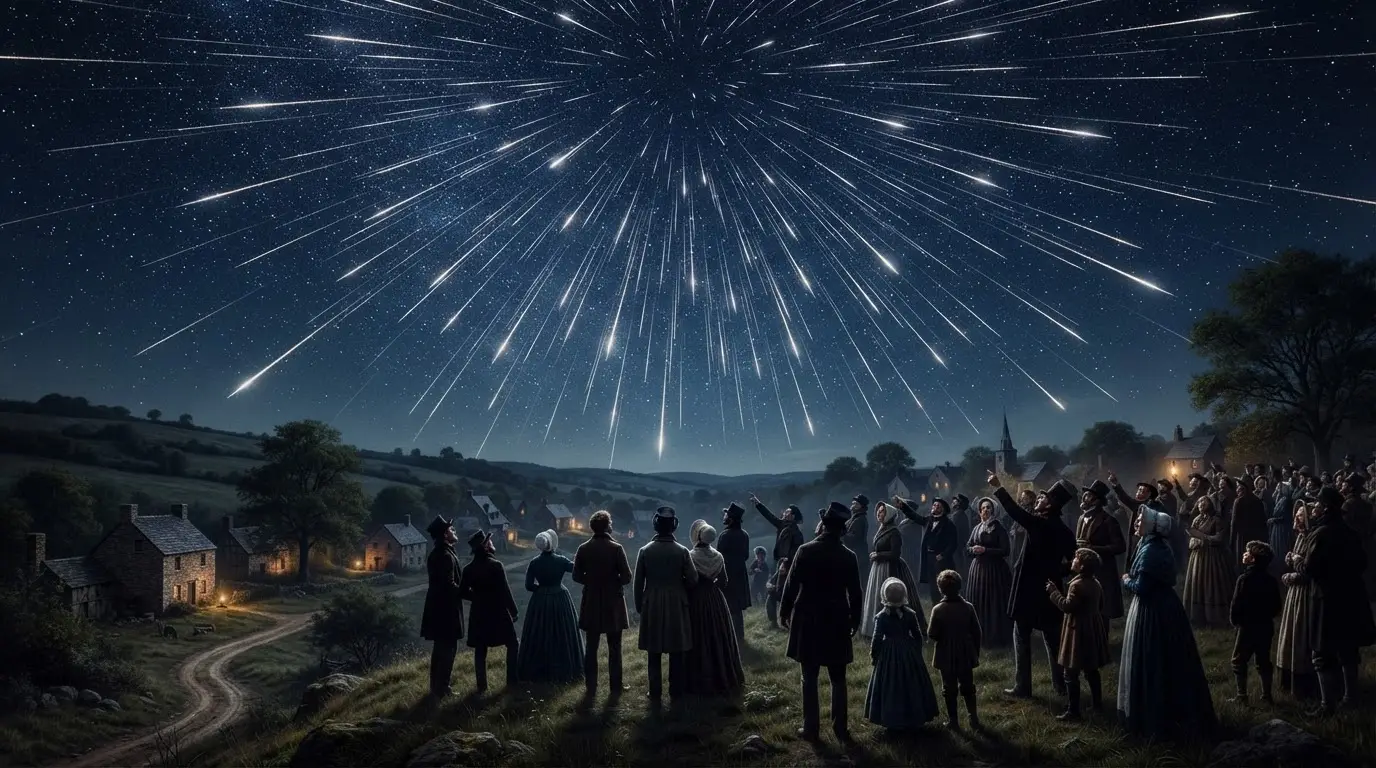

The night of November 12-13, 1833
Meteors fell across the eastern half of North America for roughly nine hours that night, from around 9 p.m. until dawn washed them out. "There was a war of shooting stars in the northwest," the Boston Evening Transcript reported. "For an hour, meteor succeeded meteor in such rapid succession that it was impossible to count them; at times the sky seemed full of them, and the earth was illuminated as with morning light"[4].
First-hand memory of the night carried a heavier tone than any newspaper report. One woman later recalled her parents describing the firmament on high as "one solid glare of fire and light," with every star in the sky seeming to fall to the ground, and said they were certain that the Day of Judgment was at hand[5].
How many meteors actually fell is still argued over. The commonly repeated figure puts the peak at over 100,000 an hour[1]; a more careful tally, made as the storm wound down, counted in excess of 240,000 meteors across the full nine hours, over the region of North America east of the Rocky Mountains[6]. Either way, it dwarfed anything the annual Leonid meteor shower has produced since.
Why so many people thought the world was ending
For most people that night, there was no scientific frame to put around what they were seeing. Joseph Smith, the founder of Mormonism, wrote in his journal that November that the storm was "a litteral fulfillment of the word of God" and a sign the Second Coming was near[8].
Featured · Destination
Northern Lights in Tromsø
At 69.6°N inside the auroral oval, Tromsø sees aurora at Kp 2. Peak season November–February. Best viewing spots, tour advice, and aurora forecast strategy.
Native American nations recorded it in their own terms. Several nations marked the night specifically: the Cheyenne signed a peace treaty around it, and the Lakota reset their winter count, the pictorial calendar some bands used to anchor their history to memorable years[9].
The night stuck in memory for decades. According to the poet Walt Whitman, a young Abraham Lincoln watched it from rural Illinois and retold the story during the Civil War to argue that, just as the world hadn't ended in 1833, the Union would survive its present chaos too[10].
Denison Olmsted's crowdsourced investigation
Denison Olmsted was a Yale professor of mathematics and natural philosophy who had held his chair since 1825, and nothing in his career up to that point had anything to do with meteors. The 1833 storm changed that: by the time he was finished, he had studied the phenomenon closely enough to demonstrate what one account calls its "cosmical origin"[11]. Over the following weeks he did something no scientist had really attempted before: he asked the public for help.
The letter that broke with 'electricity'
Olmsted's method was blunt. In a letter reprinted by newspapers across the country, he dismissed the standard electricity explanation outright: "With respect to the cause of these meteors, I do not consider it as hitherto explained," he wrote. "Everything of this kind is loosely attributed to electricity; but in my view without any just grounds"[12].
He asked readers to send in what they had seen, and by the new year enough letters had arrived for him to state a position. "At present, all I can say is that I think it evident that the point from which the fire-balls emanated was beyond the limits of our atmosphere," he wrote[13]. It was a genuinely strange claim for 1833: that a fireball anyone could watch overhead was not, in fact, a weather event at all.
A radiant fixed in Leo, and moving with the stars
Tracing where the meteors seemed to stream from, Olmsted concluded the point sat in a single constellation. "Those who marked its position among the fixed stars observed it to be in the constellation Leo," he wrote[14]. More importantly, he noticed that this radiant moved with the stars overnight rather than staying fixed relative to the ground, which told him the meteors had a cosmic origin rather than an atmospheric one[15].
Not every observer agreed, and Olmsted had to sift through plenty of noise to get there. Some reported the temperature dropping sharply after the storm, high winds picking up, and unrelated auroral activity; many others insisted the radiant moved with the earth, not the stars, the opposite of what Olmsted needed to make his case[16]. He kept the observations that held up and built his argument on those.
From Olmsted's paper to Comet Tempel-Tuttle
Olmsted published his conclusions in the American Journal of Science and Arts in 1834, presenting his findings that January after spending the last weeks of 1833 collecting reports[17]. He is credited with founding meteor science as a field[18] — not by explaining the debris streams and radiants behind an ordinary annual shower, which the meteor showers guide covers in full, but by proving meteors belonged to astronomy rather than meteorology in the first place.
Olmsted died six years before anyone identified what had actually caused his storm. Comet Tempel-Tuttle was discovered independently by Ernst Tempel and Horace Tuttle, in 1865 and 1866 respectively[19].
It took until 1866-67 for astronomers to gather enough observations of the new comet to connect it to the Leonids[20]. An orbit was calculated, and the link to the annual shower was confirmed[21] — the piece of the parent body puzzle Olmsted had correctly guessed existed but never lived to see named.
Why Leonid storms return roughly every 33 years
A meteor storm is a specific technical term, not just a big shower: the modern definition sets the bar at 1,000 meteors an hour, ten times the ceiling of even the best annual showers measured by their zenithal hourly rate[22].
The 1833 storm wasn't caused by Tempel-Tuttle passing nearby that year. Modeling of the comet's dust trail later showed Earth had instead run straight into the debris the comet shed on an earlier pass, in 1800[23] — the parent comet itself was somewhere else entirely at the time.
Featured · Article
What Is Astrotourism? The Complete Beginner's Guide
Astrotourism means travel built around dark skies: meteor showers, auroras, the Milky Way. What it means, where to go, and how to plan your first trip.
The same mechanism explains the next major storm, in 1866: that one was traced to meteoroids shed on the comet's 1733 pass[24]. Tempel-Tuttle takes 33 years to complete one orbit[2], so its debris trails are laid down roughly every 33 years, and Earth only crosses a dense one on the same rough schedule, which is why Leonid storms cluster around that interval rather than arriving every November.
None of that mechanism was available to Olmsted or to anyone else in 1833. What he actually proved was narrower and, in hindsight, more important: that the fireballs came from space at all. If you'd rather see next November's shower at its ordinary, un-stormy best, start with a properly dark site: best dark sky parks in the world is the place to look.